 dr.vision
30–42
months of age: one visit to the eye doctor, even without anything unusual.
Start here
What suits you?
Find out in 2 minutes which procedure suits your eyes.
Start the Suitability CheckOr by age:
< 45yearsGet rid of glasses & contact lenses 45–64yearsGet rid of reading glasses 65+yearsCataract & glasses-free★★★★★ 5.0 · 376 Google reviews · 20,000+ procedures
Decide well
What you should know beforehand.
Who operates?Prof. Dr. Mehdi ShajariFOCUS Top Doctor · operates on every patient personally What does it cost?Laser from €3,498 · Lenses from €6,886Prices for both eyes Is it safe?Safety & risks When will I be fit again?Work, sports, driving Would you rather read in peace first?Decision Guide Freedom from GlassesProcedures
Laser or lens?
Laser eye surgery
SMILE ProSmartSightFemto-LASIKTrans-PRKPRKPresbyond (laser away your reading glasses)All laser procedures at a glanceLaser procedures compared ›Lens surgery
ICLLens exchange (reading glasses)Cataract surgery with premium lensLens types: trifocal, EDOF, toricLens types compared ›Start here
Something wrong with your eyes?
A thorough eye check-up with us clarifies what is behind it.
Book an eye check-up★★★★★ 5.0 · 376 Google reviews
Pediatric eye doctor · Pediatric ophthalmology
So that your child sees well with both eyes.
Children rarely say that they cannot see well. Amblyopia can only be treated well until early school age, so an early check is worthwhile. You can usually get appointments within 24 to 48 hours, also on Saturdays.
 12× FOCUSTop Doctor
Children do not say that they see poorly.
30–42
months of age: one visit to the eye doctor, even without anything unusual.
~3 %
of children have amblyopia in one eye, often unnoticed.
2 hrs
outdoors during the day slows nearsightedness, say the professional societies.
0,01 %
Atropine drops, special lenses or contact lenses if it increases quickly.
GOÄ
Billed privately, amount given beforehand by Patient Care.
376 reviews. Average 5.0.
376 Google reviews give dr.vision an average of 5.0 out of 5 stars. dr.vision does not check whether Google reviews come from treated patients.
“We got an appointment right away, the very next day. Dr. Shajari and his team took care of our son very warmly and professionally, so that he felt comfortable immediately.”
“Excellent examination and advice from a doctor who specializes in children, no waiting time – everything was outstanding!”
“The team is very good with children. They have state-of-the-art technology and offer comprehensive support.”
“Very well equipped, modern practice from a technical point of view. Admission and treatment digitally supported and a very short waiting time!”
Children's eyes in five answers.
For parents who have two minutes. Each answer leads to the detailed chapter.
Without anything unusual, between the 30th and 42nd month of life. With strabismus or strong glasses in the family, or as a premature baby, already at 6–12 months.
Age scheduleThe brain learns to see in the first years of life. If one eye sees worse, the brain switches off its image. This amblyopia can only be treated well in childhood.
Vision developmentStrabismus, tilted head posture, eye rubbing, holding things very close to a book, headaches. A white pupil in photos should go to the eye doctor immediately.
Warning signsTwo hours of daylight a day and breaks during close work. If it increases quickly: atropine 0.01%, special lenses or contact lenses.
Slow nearsightednessSenior physician Ivana Pavlovic and Dr. Claudia Grunwald, child-friendly and with time. Billing under the German fee schedule for physicians (GOÄ); private health insurance (PKV) reimburses depending on your plan, Beihilfe according to your Beihilfe rate.
CostsThe age schedule. From the first week to school.
Every child once between the 30th and 42nd month of life, even if they seem to see well. Children at risk already at 6 to 12 months, and with certain hereditary diseases in the first week of life. In addition come the eye tests in the U check-ups with the pediatrician.
| Age | Who and what | What it is about | Source |
|---|---|---|---|
| First week of life | Eye doctor, if congenital cataract, childhood glaucoma or eye tumors run in the family | Diseases that must be treated immediately | BVA [1] |
| U1 to U6 (up to 12 months) | Pediatrician: pupils, fixation, following movements, strabismus | Spot gross abnormalities early | G-BA Children's Directive [2] |
| 6 to 12 months with risk | Eye doctor, if parents or siblings have strabismus, farsightedness over 3 D or very unequal glasses prescriptions, and for premature babies | Refractive error and strabismus, before amblyopia develops | BVA [1] |
| U7a (34th to 36th month) | Pediatrician: examination focusing on vision development | Early detection of amblyopia | G-BA resolution U7a 2008 [2] |
| 30th to 42nd month, all children | Eye doctor, even without anything unusual | Small strabismus and one-sided refractive error that cannot be seen from the outside | BVA [1] |
| U8 and U9 (4 and 5 years) | Pediatrician: vision test, stereo vision, strabismus | Visual acuity of both eyes before starting school | G-BA Children's Directive [2] |
| Before starting school | Eye doctor, recommended | Reading and writing need both eyes | dr.vision practice recommendation |
| School age without findings | Eye doctor every 2–3 years | Beginning nearsightedness | dr.vision practice recommendation |
| With glasses or increasing nearsightedness | Eye doctor every 6–12 months | Adjust glasses, measure progression, slow it if needed | DOG/BVA myopia statement [3]: follow-up monitoring (no fixed interval specified) |
Pediatric check-ups (U examinations) and eye doctor appointments complement each other. With warning signs, the schedule does not apply; instead: book an appointment now.
In the U check-ups, pediatricians test whether the child fixates, whether the pupils light up red, whether the child has strabismus and, later, how well the child sees on picture charts. This finds many problems, but not all. A very small angle of strabismus or one-sided farsightedness are invisible from the outside, and a small child makes up for everything with the better eye.
The eye doctor uses drops to measure the actual glasses prescription of each eye and looks into the eye. That is why the professional association of eye doctors recommends the examination between the 30th and 42nd month of life in addition, and earlier for children at risk.
Vision is learned. Only once.
In the first years of life, the brain learns to process the images of both eyes. If one eye delivers a blurred or misaligned image, the brain suppresses it, and the eye stays amblyopic (amblyopia). About 3 in 100 children are affected. Detected early, it can usually be treated well; after primary school age, hardly any more.
A child with an amblyopic eye notices nothing. The child sees completely normally with the other eye, plays, draws, learns. Only an eye doctor who tests each eye separately finds the difference.
60–70 %
Without treatment. That is why every case of strabismus after the sixth month of life must be examined.
1
Different glasses prescriptions in the two eyes are invisible from the outside and a common cause.
up to ~8
The younger the child, the faster and more completely. After that, the effect drops noticeably.
Glasses: First, the refractive error is corrected completely, and the glasses must be worn all day. In some children, the weak eye already improves just from this.
Occlusion: If glasses are not enough, the better eye is covered with a patch for a few hours a day. This forces the brain to use the weak eye. How many hours and for how long depends on age and the difference between the eyes; we set a plan and review it every few weeks to months.
Atropine penalization: Instead of a patch, a drop can blur the better eye for near vision. An alternative if the patch is not accepted.
Important: After successful treatment, follow-up checks continue, because visual acuity can drop again up to school age.
Children do not complain. They show it.
Small children think their vision is normal and say nothing. Watch for strabismus, tilted head posture, eye rubbing, a very short distance when reading and headaches. A white instead of red pupil reflex in photos is a reason to call the same day. Choose how urgent it is:
White or yellowish pupil reflex in flash photos instead of red
Sudden strabismus, especially with double vision or headaches
Red, painful eye, injury, chemical burn, foreign body
A white reflex can be a sign of a congenital cataract or, very rarely, a retinal tumor (retinoblastoma). Sudden strabismus can have a neurological cause.
Call us and describe the symptoms. For a chemical burn, first rinse for a long time with water. Outside practice hours (Mon–Fri 8:00–19:00, Sat 9:00–15:00), go to the nearest eye hospital.
Strabismus after the sixth month of life, even if occasional
Large, light-sensitive, watering eyes in a baby
Drooping upper eyelid, eye tremor, tilted head posture
Strabismus with amblyopia, very rarely childhood glaucoma (large eyes, light sensitivity), a ptosis that blocks vision.
Appointment in the next few days. Photos or a short video showing the strabismus help us a great deal.
Goes very close to a book, tablet or TV, squints
Often rubs the eyes, blinks a lot, headaches after school
Often stumbles, reading and concentration problems, mixes up lines
Nearsightedness, farsightedness, astigmatism, a disorder in how the two eyes work together. Dyslexia is not an eye disease, but a vision disorder should be ruled out beforehand.
Book a regular appointment. Note when it stands out: morning, evening, when reading, in the sun.
One eye waters constantly or is sticky in the morning, without redness
Usually a tear duct that has not opened yet. Most open on their own in the first months of life.
See the pediatrician or us; tear sac massage as instructed. If it persists longer, a small flushing may be needed. Redness, swelling or fever: have it examined soon.
Guidance for parents, does not replace an examination. If in doubt, call us: 069 509 586 770 (available 24 hours)
Strabismus does not go away on its own.
About 5 in 100 children have strabismus. The problem is less the appearance than the vision: the misaligned eye often becomes amblyopic. Treatment almost always starts with glasses and, if needed, a patch; surgery is done if the misalignment remains, mostly for binocular vision and appearance.
| Form | Typical | Treatment |
|---|---|---|
| Early-onset esotropia | Begins in the first 6 months of life, large angle, often alternating | Glasses if needed, occlusion against amblyopia, surgery often in toddler age |
| Accommodative esotropia | At 2–4 years, with farsightedness; stronger when focusing up close | Glasses correct the farsightedness, and the strabismus often largely disappears as a result |
| Microstrabismus | Tiny, not visible from the outside, often with amblyopia | Glasses and occlusion; found only during the eye doctor's examination |
| Intermittent exotropia | One eye drifts outward at times, when tired or in the sun | Observation, glasses, exercises; surgery if it increases |
| Paralytic strabismus | Sudden, often with double vision and head posture | Prompt clarification of the cause, also neurological |
| Pseudostrabismus | A broad nasal bridge and eyelid fold only make it look like esotropia | No treatment needed; the examination provides certainty |
The type determines the treatment. If possible, bring photos from different months.
Surgery corrects the position of the eyes by moving or shortening eye muscles. It does not replace the treatment of amblyopia; glasses and patches continue. The timing depends on the type of strabismus: for early-onset esotropia often in toddler age, for other types later. In children, surgery is performed under general anesthesia, usually as an outpatient or with a short hospital stay.
Orthoptic exercises can help with certain types, for example problems with how the two eyes work together up close. They do not treat true strabismus with amblyopia. Be careful with offers that want to replace glasses or patches with training: this costs time that is missing from the window for vision development.
In children, glasses are often a treatment.
Mild farsightedness is normal in toddlers and is usually outgrown. A child needs glasses if the values are too high for their age, the two eyes differ markedly, or the child has strabismus or sees poorly. In children, measurement is done with eye drops, because otherwise they hide farsightedness.
Normal to a certain degree. Too much is tiring, causes headaches and can trigger esotropia. Then the glasses are treatment, not comfort.
Usually begins at school age and increases into the late teenage years. Can be slowed if it progresses quickly. More
Above a certain strength, blurred at every distance; must be corrected early, otherwise amblyopia is a risk.
If the two eyes differ greatly (anisometropia), the child sees normally with the better eye. A common cause of amblyopia.
When glasses are prescribed as treatment, they must be worn from getting up until going to sleep. Sturdy, flexible children's frames help.
Also possible for children if hygiene and cooperation are right, for example with large differences between the two eyes or for myopia control.
To measure the true glasses prescription, drops relax the muscle the eye uses to focus up close; the pupil also becomes wide. The drops take about 30–45 minutes to work. Afterward, your child sees blurred up close and is sensitive to glare, for a few hours up to the next day depending on the drops. Sunglasses or a cap help. It is better to postpone reading and homework on this day.
Light, breaks and, if needed, treatment.
For all children: at least two hours of daylight a day and breaks during close work. If nearsightedness increases by 0.5 diopters or more per year, the German professional societies additionally recommend low-dose atropine 0.01% or special contact lenses; myopia spectacle lenses are promising, but less studied independently.
| Measure | How it works | Effect in studies | For whom | Source |
|---|---|---|---|---|
| Two hours of daylight a day | Bright light slows the lengthwise growth of the eye | Less new nearsightedness, slower progression (about 0.13 D less per year) | All children, also as prevention, especially in winter | DOG/BVA 2022 [3] |
| Breaks during close work | Less constant strain up close | After 30 minutes of reading at a distance under 30 cm, look into the distance for 10 minutes | All children | DOG/BVA 2022 [3] |
| Atropine 0.01% eye drops | Acts on lengthwise growth, mechanism not fully understood | In Asian studies, markedly slower progression; studies in European children are ongoing | approx. 6–14 years, increase ≥ 0.5 D per year; approved product for ages 3–14 since 2025 | DOG/BVA 2022 [3], EU approval [4] |
| Myopia spectacle lenses (multi-segment) | Many small plus lenses create a stop signal at the edge of the retina | Progression halved in studies over 2–3 years, with involvement of the manufacturers | Children with increasing nearsightedness | DOG/BVA 2022 [3] |
| Multifocal contact lenses | Second image plane in front of the retina | 43% and 59% less progression in randomized studies over 3 years | Like atropine; hygiene and cooperation needed | DOG/BVA 2022 [3] |
| Orthokeratology (overnight lenses) | Shape the cornea overnight, no glasses during the day | About 40% less lengthwise growth | Like atropine; very good hygiene needed, risk of infection | DOG/BVA 2022 [3] |
| Progressive or bifocal lenses | Near addition | Only a small effect | Not recommended | DOG/BVA 2022 [3] |
Effect figures from the statement of the DOG, BVA and Bielschowsky Society (as of June 2022). No measure stops nearsightedness completely. Which one suits your child is decided by age, value, pace and daily life.
Whether nearsightedness is progressing quickly can only be reliably seen over at least twelve months. In addition to the glasses prescription, we measure the length of the eye with optical biometry, contact-free within seconds. The axial length shows whether a treatment works, also with night lenses that change the glasses values.
The longer the eye grows, the thinner and more stretched the retina becomes. According to the statement of the professional societies, the risk of lasting visual impairment rises markedly from about −6 diopters: retinal detachment, myopic macular degeneration, glaucoma. Every diopter that is not added in childhood lowers this risk. A later correction by laser eye surgery or a lens does not change the length of the eye.
Atropine 0.01% is dropped once in the evening before sleep into both eyes. Treatment usually runs several years; after two years at most, or at age 15, a check is made whether it is still needed. A check of tolerability is useful in the first weeks.
Possible side effects are a somewhat larger pupil and sensitivity to glare; a relevant limitation of reading is rare at this dose. Until 2025 there were only pharmacy-compounded preparations; since June 2025, a ready-made medicine has been approved in the EU for children aged 3 to 14 with −0.5 to −6 diopters and progression of at least 0.5 diopters per year.
There are no reliable limits for screen time. What is proven: a lot of time up close and a short distance raise the risk, time outdoors lowers it. In practice this means: do not hold the tablet in front of the nose, take a break after about 30 minutes with a look into the distance, and do not trade screen time for time outdoors.

Worried about your child's eyes?
Call. We will tell you how urgent it is.
Jana from our Patient Care team will briefly ask what you have noticed and find a suitable appointment, also on Saturdays. With warning signs, it goes faster. Phone available 24 hours, WhatsApp Mon–Fri 8:00–19:00, Sat 9:00–15:00.
Playfully. In four steps.
For the first appointment, including waiting time after the drops, plan about 1.5 to 2 hours. Nothing hurts: your child looks at pictures, follows lights and gets drops. At the end you know how well each eye sees and whether anything needs to be done.
Step 1 of 4
Well prepared, arrive relaxed.
Tell them beforehand: recognizing pictures, looking at lights, drops in the eyes. None of it hurts.
Choose appointmentStep 2 of 4
Pictures instead of letters.
Children under three show their vision by fixating and grasping; this can also be tested.
Why each eye counts separatelyStep 3 of 4
The true glasses prescription.
Afterward, your child is sensitive to glare for a few hours and sees blurred up close. Bring sunglasses or a cap.
More about the dropsStep 4 of 4
Clear answers for parents.
Ask anything you want to know. Patient Care reminds you of the follow-up checks.
Who examines your child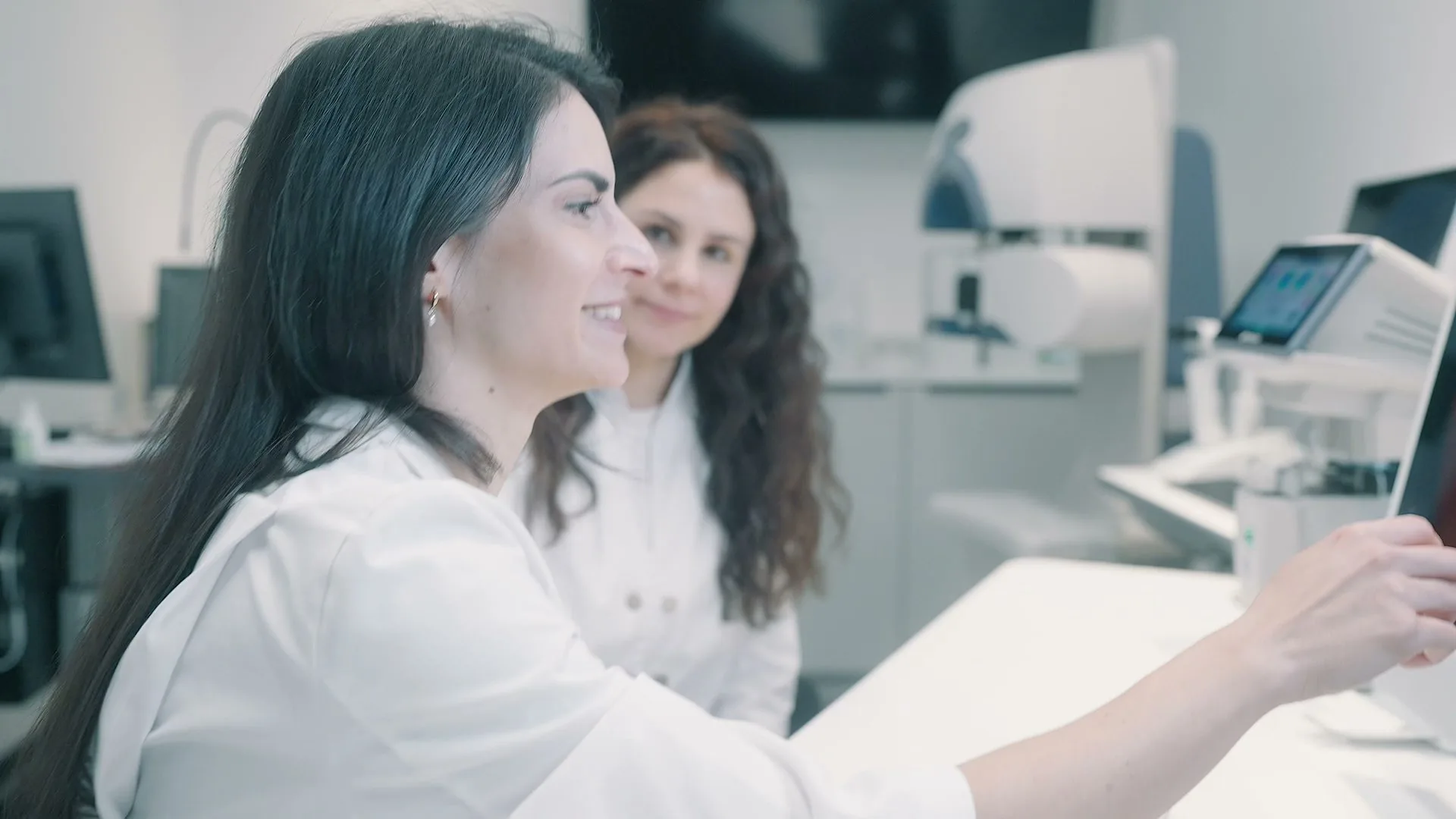
Two specialist physicians with a focus on children's eyes.
Ivana Pavlovic was a senior physician (Oberärztin) at the Frankfurt University Hospital for several years, with a leading role in pediatric ophthalmology; her surgical focus there was eyelids and children's eyes. Dr. Claudia Grunwald, a specialist physician with the European specialist title (FEBO), has pediatric ophthalmology as her focus. dr.vision recommends the first examination between the 30th and 42nd month of life, earlier for children at risk.
Children need breaks. We plan them in instead of rushing.
Sat 9:00–15:00, without missing school or daycare. Mon–Fri until 19:00.
On request, the findings go to your pediatrician, so that everyone has the same information.

Because children's eyes need patience.
At dr.vision, specialist physicians from university medicine examine your child with child-friendly tests. Appointments are also available on Saturdays, and you park free of charge below the practice, 3 minutes from Goetheplatz. 5.0 stars from 376 reviews.
Under the GOÄ. Stated beforehand.
The examination is billed privately under the GOÄ (German fee schedule for physicians); Patient Care tells you the amount before the appointment. Guide price for the initial examination: from €120. Children with private health insurance are reimbursed depending on the plan, children with Beihilfe (allowance for German civil servants) according to the Beihilfe rate; children with statutory health insurance are self-paying with us.
The medically necessary examination, glasses prescription and treatment of amblyopia and strabismus are generally reimbursed by private health insurance (PKV) plans under the GOÄ. Myopia control with special lenses, contact lenses or atropine is not included in every plan; ask beforehand.
For children who are eligible, a separate Beihilfe rate applies, and the rest goes to the private supplemental insurance. Aids such as glasses have their own rules in each federal state. We prepare the documents ready for submission.
dr.vision is a private practice; you pay yourself, with an invoice under the GOÄ.
You are not alone
Questions about costs and reimbursement? Patient Care helps: 069 509 586 770 (available 24 hours)
| First appointment | all children between the 30th and 42nd month of life; children at risk at 6–12 months (BVA) |
|---|---|
| Topics | Amblyopia, strabismus, refractive error and glasses, slowing nearsightedness, drooping eyelid, tear ducts, conjunctivitis |
| Nearsightedness | 2 h of daylight daily; if it increases ≥ 0.5 D/year, atropine 0.01%, special contact lenses, myopia spectacle lenses (DOG/BVA 2022) |
| Process | Playful vision test, stereo and cover test, drops, measurement, conversation; about 1.5–2 hours |
| Doctors | Senior physician Ivana Pavlovic and Dr. Claudia Grunwald, both with a focus on pediatric ophthalmology |
| Costs | under the GOÄ, amount beforehand; private health insurance by plan, Beihilfe by Beihilfe rate, patients with statutory health insurance as self-paying |
| Location and hours | Junghofstraße 16, 60311 Frankfurt am Main · Mon–Fri 8:00–19:00, Sat 9:00–15:00 · free parking |
Go deeper.
The preventive care schedule for all ages, also for parents.
To the roadmap MyopiaCauses, values and correction, also as an adult.
Learn more AcuteRed, sticky eyes in children: when to see the doctor, when back to daycare.
Learn more EyelidStye, chalazion, allergy: what helps and when it is urgent.
Learn more ParentsWhile you are here: preventive care from 40 for parents and grandparents.
To the check-up UrgentInjury, foreign body, sudden strabismus: an appointment quickly.
Urgent appointmentStill have questions?
 These are the questions we hear most often in consultation hours.
Once between the 30th and 42nd month of life, even without anything unusual, that is, at about two and a half to three and a half years. Earlier, already at 6 to 12 months, if parents or siblings have strabismus, wear strong glasses or the child was born prematurely. With congenital cataract, glaucoma or eye tumors in the family, in the first week of life.
The U check-ups are important and also check the eyes, for example fixation, strabismus and, from the U7a, vision development. A small angle of strabismus or a one-sided refractive error is not always noticed, however. That is why the professional association of eye doctors additionally recommends an eye examination between the 30th and 42nd month of life.
Without findings, one examination before starting school and then every two to three years is usually enough. If your child wears glasses or nearsightedness is increasing, check-ups every six to twelve months are usual. With reading or concentration problems, headaches or blinking at the board, an appointment in between is worthwhile.
No. True strabismus does not go away by itself, and the misaligned eye can become amblyopic. In babies in the first months of life, brief misalignment is still normal; if a child has strabismus after the sixth month or permanently, they should be examined by an eye doctor. Sometimes a broad nasal bridge only makes it look like strabismus; we clarify that too.
That depends on age and on how large the difference between the eyes is. Usually it is a few hours a day over months, with regular follow-up checks. The younger the child, the faster the treatment works. We set a plan and adjust it at every check.
Children's eyes can focus so strongly that they hide farsightedness. The drops briefly relax the muscle for near focusing, and only then can the true glasses prescription be measured; at the same time they widen the pupil for a look at the retina. Afterward, your child sees blurred for a few hours and is sensitive to glare, with some drops until the next day.
Tell them beforehand that they will recognize pictures and look at lights and that nothing hurts. Plan an appointment when your child is well rested, and bring a stuffed toy, drink and snack for the waiting time after the drops, as well as the yellow check-up booklet and existing glasses.
At the low dose of 0.01 percent, they are considered well tolerated according to the statement of the German professional societies. A slightly larger pupil and some glare sensitivity are possible, and rarely problems with reading. They are dropped once in the evening. An approved product for children aged 3 to 14 has been available in the EU since June 2025.
A lot of time up close and a short reading distance raise the risk that a child becomes nearsighted or that nearsightedness increases, whether book or screen. More important than a ban are breaks: after about 30 minutes of close work, look into the distance for 10 minutes, and be outdoors at least two hours every day.
Laser eye surgery is possible from age 18 if the values have been stable for at least a year. With high nearsightedness, an implantable lens (ICL) also comes into question. Slowing nearsightedness in childhood is still worthwhile, because strong nearsightedness raises the risk of retinal and macular diseases, even after a correction.
The costs depend on the scope of the examination and are billed under the GOÄ. Patient Care tells you the amount before the appointment. Children with private health insurance are reimbursed depending on the plan, children with Beihilfe according to the Beihilfe rate; children with statutory health insurance are self-paying with us as a private practice.
For children and teenagers, statutory insurers generally pay a subsidy toward the lenses, usually not the frame. Special myopia spectacle lenses, myopia contact lenses and atropine drops are often not covered or only partly. Private insurers reimburse depending on the plan. Ask your insurer beforehand.
Medically reviewed by Prof. Dr. Mehdi Shajari · As of October 2026
Your preventive care roadmap to read at home.
Arrives by e-mail in about 60 seconds. No newsletter, just the guide and, if you wish, a follow-up from Patient Care. Privacy policy
How would you like to continue?
You book the appointment by phone or online. For the first appointment, including waiting time after the drops, plan about 1.5 to 2 hours. You go home with clear findings for each eye and a plan, and on request a report for the pediatrician.
In Frankfurt, Junghofstraße 16 · also evenings and Saturdays
Our locations.
 Opening hours
Junghofstraße 16, 60311 Frankfurt am Main
 Opening 2027
Breite Straße 69, 40213 Düsseldorf (in the Neuer Stahlhof, corner of Graf-Adolf-Platz)
Until opening: preliminary talk in Frankfurt, Patient Care plans your travel.
Plan route Opening 2027
Lautenschlagerstraße 23, 70173 Stuttgart (2nd floor, step-free access)
Until opening: preliminary talk in Frankfurt, Patient Care plans your travel.
Plan route