069 509 586 770Available 24/7 Book an appointment

Laser eye surgery private health insurance reimbursement

Private health insurance.

Does private health insurance (PKV) pay for laser eye surgery? Often yes.

Private health insurance? In many cases, the PKV reimburses laser eye surgery, since the Federal Court of Justice recognized nearsightedness of around −3 D as a disease in 2017. Your plan is decisive: with our cost estimate, you can obtain written information in advance.

5,0 · 376 Google reviews 12× FOCUS Top Doctor
Short answer

Does private health insurance cover the costs of laser eye surgery?

In many cases, yes. On March 29, 2017, the Federal Court of Justice (Bundesgerichtshof) ruled that nearsightedness of −3 or −2.75 D can be an illness within the meaning of the model terms of private health insurance, and that the necessity of laser surgery is not lacking merely because one could wear glasses (IV ZR 533/15). Whether your private health insurance pays depends on the plan: exclusions, maximum amounts per eye or vision-aid budgets limit the reimbursement. Obtain written information before the procedure (§ 192 para. 8 of the German Insurance Contract Act, VVG for short); there is no guarantee.

Sources: Federal Court of Justice (BGH), judgment of March 29, 2017, IV ZR 533/15; § 192 VVG (gesetze-im-internet.de, accessed November 15, 2026). Medically reviewed by Prof. Dr. Mehdi Shajari, specialist in ophthalmology. General information, not tax or legal advice. As of November 2026. Laws, forms and the practice of the authorities can change. Clarify your case with your tax advisor or your insurer.

How do patients experience their treatment at dr.vision?

376 reviews. Average 5.0.

376 Google reviews give dr.vision an average of 5.0 out of 5 stars. dr.vision does not check whether Google reviews come from treated patients.

“Really very well-founded and detailed personal consultation. Perfect and well-structured handling at the practice, which is very nicely furnished.”
patrick merkt · Google
“A very modern practice, clear and competent advice; you feel in the very best hands here.”
Torben Hinrichs · Google
“The overall package (practice, staff, examination, consultation, treatment) is top.”
Margit Krah · Google
“Quick appointment, good advice. Modern, friendly and professional.”
Marc-Andre Dymala · Google

What do I need to know about reimbursement for laser eye surgery as a privately insured patient?

In five answers.

For everyone who has two minutes. Each answer leads to the detailed chapter.

1

Does the private health insurer have to pay?

Not automatically. Since the Federal Court of Justice ruling in 2017, nearsightedness of around −3 D can be an illness; the procedure is then reimbursable if it is medically necessary and the plan does not exclude it.

The ruling explained
2

What does my plan decide?

Exclusion of refractive surgery, maximum amount per eye, vision-aid budget, deductible and the maximum rate of the German fee schedule for physicians (GOÄ). This is in your plan's terms.

The six clauses
3

How do I inquire correctly?

With our cost estimate and a medical justification, in writing before the procedure. For costs above €2,000, the insurer must reply within four weeks.

Step by step
4

And if it declines?

Rejections are often blanket ones. Object with a medical statement, then go free of charge to the PKV ombudsman.

What helps then
5

Is it worth submitting?

Usually yes, for amounts from €3,498. If you expect a premium refund, do a quick calculation.

Calculate it yourself

What did the Federal Court of Justice decide in 2017 about private health insurers reimbursing laser eye surgery?

Nearsightedness can be an illness.

On March 29, 2017 (IV ZR 533/15), the Federal Court of Justice ruled that nearsightedness of −3 and −2.75 D can be an illness within the meaning of the model terms of private health insurance, even if many people of the same age are affected. The expert witness in the lower court had pointed out that specialists speak of pathological nearsightedness only from −6 D. According to the Federal Court of Justice, this does not matter. Glasses or contact lenses do not rule out the medical necessity of the surgery from the outset.

Federal Court of Justice, judgment of March 29, 2017, IV ZR 533/15, overview
ItemWhat the Federal Court of Justice saidWhat this means for you
The caseAn insured woman had her nearsightedness (−3 / −2.75 D) treated with LASIK, costs around €3,500; the insurer declined.Even moderate values, as many people have, can be reimbursable.
Definition of illnessWhat matters is the understanding of an average policyholder, not statistics on how many people are affected.The insurer cannot decline merely with “that is normal, many people have it”.
Glasses as an alternativeThe necessity of the surgery cannot be denied merely by pointing out that glasses or contact lenses are common.Referring to glasses is not a reason for rejection in itself.
Necessity in the individual caseThe surgery must be medically justifiable; the case went back to the regional court for further examination.A medical justification is needed that the procedure is suitable for your eyes.
Plan termsThe ruling interprets the definition of illness in the model terms; deviating plan rules remain possible.Exclusions or maximum amounts in your plan can still limit the reimbursement.

Summary based on the text of the ruling and reports (LTO, beck-aktuell, March 30, 2017). Not legal advice; in a dispute, a specialist lawyer for insurance law will advise you.

When is laser eye surgery medically necessary for private health insurance?

Illness, suitability, justification.

Under § 192 para. 1 VVG, private health insurance reimburses expenses for medically necessary treatment of an illness to the agreed extent. For laser eye surgery, this generally means: a refractive error with the value of an illness, a procedure that is suitable and safe for your eyes, and a medical justification for it. For lens procedures and presbyopia, the reimbursement situation differs.

1

Refractive error with the value of an illness

Nearsightedness, farsightedness or astigmatism that limits everyday life without a vision aid. According to the Federal Court of Justice, −3 D was enough; there is no fixed lower limit.

2

Suitable procedure

The pre-operative examination shows whether the procedure safely fits: e.g. SMILE Pro/SmartSight up to −8 D, ICL (additional lens in front of your own lens) from −6 D, for farsightedness Femto-LASIK.

3

Medical justification

Diagnosis, values, findings and why the chosen procedure is medically indicated. We provide this with the cost estimate.

Reimbursement situation in private health insurance by procedure, for orientation
Proceduresguide price, both eyesReimbursement by private health insuranceWhat matters
SMILE Pro · Femto-LASIK · Trans-PRK€3,498 – €5,198often, depends on the planValue of an illness, suitability, no exclusion in the plan
ICLfrom €6,886often, depends on the planHigh values, thin cornea: necessity usually easy to justify
Presbyond · Lens exchange without cataract€6,398 · from €6,998inconsistentSome insurers see presbyopia as natural aging; the justification is decisive
Cataract surgery with monofocal lens€6,998generally yesA clear illness; lens and surgery according to the GOÄ
Premium lens (EDOF, trifocal)€7,242 · €7,876depends on the planNot all plans pay the additional cost of the lens; ask in advance. Cataract surgery costs

Prices: dr.vision guide prices for both eyes according to the GOÄ; the cost estimate after the pre-operative examination is binding. The classification of the reimbursement situation is orientation from practice, not a commitment.

Which clauses in my private health insurance plan decide the reimbursement for laser eye surgery?

Six places in your policy.

Whether and how much your private health insurer pays is usually decided by six rules in the plan terms: an explicit exclusion of refractive surgery, a maximum amount per eye, a classification as a vision aid with a budget, the deductible, the maximum GOÄ rate reimbursed and the premium refund. You find them in the insurance certificate and in the General Insurance Terms (Part II, plan).

Plan clauses that determine the reimbursement for laser eye surgery
ClauseHow it reads (typical)What it doesWhat you can do
Exclusion of refractive surgery“Not reimbursable are … operations to correct refractive errors”No reimbursement if validly agreedCheck whether it is your plan or an old exclusion; if in doubt, ask
Maximum amount“… up to €X per eye” or “once per lifetime”Reimbursement up to the limit, the rest is your own shareCompare the limit with the cost estimate
Vision-aid budgetLaser eye surgery “in place of a vision aid” with a budgetOften only a small part of the costsAsk whether laser counts as medical treatment or as a vision aid
DeductibleAnnual own share, e.g. for outpatient careReduces the reimbursement in the year of treatmentBundle the procedure and other invoices in the same year
Maximum GOÄ rateReimbursement “up to 2.3 times” or “3.5 times the rate”Amounts above the rate are not borne by the planLook at the factors in the cost estimate
Premium refundRepayment if no invoice is submitted in the yearSubmitting can cost you the refundCompare in the calculator below
Read deeper

My plan is old. Does the Federal Court of Justice ruling still apply?

Definition of illness and explicit exclusions

The ruling concerns the interpretation of the definition of illness, which in many plans follows the model terms. It therefore also applies to older contracts, as long as they do not provide otherwise. If your plan has an explicit exclusion of benefits for operations to correct refractive errors, the situation is more difficult; whether such an exclusion is valid is a legal question in each individual case.

I have supplementary eye insurance.

Supplementary plans usually pay a fixed subsidy

Supplementary eye plans often pay a fixed subsidy for laser eye surgery, sometimes only after waiting periods or graded by contract year. You will find the amount in your plan; we prepare the documents so that you can ask your supplementary and primary insurers in parallel. Patients with statutory health insurance, please read the page Statutory health insurance.

Does my private health insurance plan pay for laser eye surgery? The plan check

Four questions for your policy.

Answer four questions with a look at your plan terms. The check classifies your chances and tells you what to do next: in most cases a written inquiry with our cost estimate, which your private health insurer must answer within four weeks for costs above €2,000. It does not replace information from your insurer.

Does your plan contain an exclusion for operations to correct refractive errors?
Is there a maximum amount or a vision-aid budget for laser eye surgery?
How strong is your refractive error?
Do you expect a premium refund for this year?
Your classification

Unclear: read up first, then inquire

–

    Orientation, not a promise of benefits and not legal advice. Only the written information from your insurer is binding.

    How do I get laser eye surgery reimbursed by private health insurance, step by step?

    Ask first, then have the laser treatment.

    The safest way is a written inquiry before the procedure: pre-operative examination, cost estimate with a medical justification, inquiry under § 192 para. 8 VVG. For costs above €2,000, the insurer must reply with reasons within four weeks (two weeks in urgent cases); if it stays silent, the necessity is presumed until proven otherwise. After that, you plan the appointment in peace.

    1

    Initial consultation and pre-operative examination

    We measure your eyes, clarify the suitable procedure and document values and findings. The initial consultation is free of charge. The pre-operative examination is included in the surgery price; without a procedure, it is billed separately.

    2

    Cost estimate under GOÄ

    You receive the amount in writing, itemized by GOÄ codes, plus a medical certificate on the medical necessity.

    3

    Written inquiry to the private health insurer

    With the cost estimate and certificate. Our drafting aid provides the text. Expressly ask for information under § 192 para. 8 VVG.

    4

    Wait for the reply: 4 weeks

    The insurer must reply within four weeks, within two if urgent. The period runs from receipt of the inquiry.

    !

    If declined or partly approved

    Read the reasons for rejection carefully, add a medical statement together with us, file an objection. What helps then

    →

    Procedure, invoice, reimbursement

    After the procedure, you receive the invoice according to the GOÄ and submit it, usually through an app. The follow-up checks are included in the guide price.

    Patient Care at dr.vision

    You are not alone

    Cost estimate, certificate, follow-up questions: we prepare your inquiry together with you.

    • Cost estimate in advance, worded so that your private health insurer can reply clearly.
    • Medical certificate with diagnosis, values and justification of the procedure.
    • Queries from the insurer we answer in writing together with you.
    • Invoice under the GOÄ after the procedure, ready to submit.

    Questions about reimbursement? Patient Care: 069 509 586 770 · available 24 hours

    How do I word the inquiry to my private health insurer about laser eye surgery?

    With these sentences, ready to adopt.

    You can adopt this drafting aid for your inquiry. You receive the cost estimate and the medical certificate after the pre-operative examination.

    Drafting aid

    Subject: Request for information about insurance coverage under § 192 para. 8 VVG, policy number [your number]

    Dear Sir or Madam,

    I have a refractive error of [values right / left according to the findings]. After the pre-operative examination at dr.vision, Frankfurt, a correction by means of [procedure] is medically indicated. According to the enclosed cost estimate under the GOÄ, the expected costs are €[amount], which is above €2,000.

    Please inform me in text form to what extent you will cover the costs. Under § 192 para. 8 VVG, I request your reasoned reply within four weeks. Please address the enclosed cost estimate in it. I refer to the judgment of the Federal Court of Justice of March 29, 2017 (IV ZR 533/15).

    Enclosures: Cost estimate under the GOÄ · Medical certificate on medical necessity

    The inquiry is made by the person who took out the contract, also for co-insured family members. Drafting aid for orientation, not legal advice.

    What should I do if my private health insurer declines to cover the costs of laser eye surgery?

    A rejection is often not the last word.

    Rejections are often given with blanket reasons, such as “not an illness” or “glasses sufficient”. The Federal Court of Justice ruling of 2017 does not accept a reference to glasses alone, and even moderate values can be an illness. First check whether a plan exclusion or maximum amount is the reason; if it is the medical necessity, an objection with a medical statement helps. After that, you can turn to the PKV ombudsman free of charge. The route to court remains open to you regardless.

    Typical reasons for rejection and possible replies
    Insurer's reasonWhat is behind itPossible reply
    “Nearsightedness is not an illness”Statistical argument (“many people have it”)Refer to BGH IV ZR 533/15: −3 / −2.75 D can be an illness
    “Glasses or contact lenses are sufficient”Reference to a vision aidAccording to the Federal Court of Justice, no reason to deny the necessity merely for that; have intolerance of contact lenses documented by a doctor
    “Not medically necessary”Doubt about the indicationMedical statement with values, findings and suitability of the procedure
    “Excluded by the plan”Exclusion in the plan termsRequest the clause and have it checked; validity is a legal question
    “Only up to the maximum amount”Limitation in the planUsually correct; bear the rest yourself, finance it or check it for tax purposes
    1

    Objection, in writing

    Referring to the reasons given and the Federal Court of Justice ruling, plus a medical statement.

    2

    PKV ombudsman

    Free, independent arbitration body of private health and long-term care insurance. Submission online (pkv-ombudsmann.de).

    3

    Legal advice

    For higher amounts or matters of principle: a specialist lawyer for insurance law, if applicable through your legal expenses insurance.

    Is it worth submitting, or do I lose my premium refund?

    Calculate with your own values.

    Many private health plans pay back part of the premiums if you submit no invoice for a year. If you submit the invoice for laser eye surgery, you usually lose this refund for that year. For a procedure from €3,498, the reimbursement generally outweighs it if the plan pays; with your own values, you see it immediately.

    Procedures

    Pre-filled with €1,000 as an example value; please replace it with your amount. Deductible and other invoices in the year are not taken into account. If multiplier factors in the cost estimate are above the maximum rate of your plan, you bear the part above it yourself.

    Result with your values

    Submitting is worthwhile

    Reimbursement by the insurer
    –
    Lost premium refund
    –
    Benefit from submitting
    –

    Tip: Then also submit other invoices from the same year; the refund is then usually lost anyway.

    What does laser eye surgery cost at dr.vision, and what if the insurer pays only part?

    One guide price. Everything included.

    At dr.vision, laser eye surgery costs €3,498 (PRK/Trans-PRK), €4,298 (Femto-LASIK) or €5,198 (SMILE Pro, SmartSight) for both eyes, the ICL from €6,886, in each case including pre-operative examination, procedure by Prof. Dr. Mehdi Shajari and aftercare. If your PKV pays only part, you can finance the rest at 0% over 12 months and, if applicable, claim it for tax purposes.

    dr.vision guide prices for both eyes, basis for the cost estimate
    Proceduresguide price, both eyesAbove €2,000 (information under § 192 para. 8 VVG)
    Trans-PRK€3,498✓
    Femto-LASIK€4,298✓
    SMILE Pro€5,198✓
    Presbyond€6,398✓
    ICLfrom €6,886✓
    Lens exchange / Cataract surgeryfrom €6,998✓

    Partial reimbursement? Finance it.

    0% over 12 months directly at dr.vision (SMILE Pro: from €433 per month) or 24 to 72 months through medipay (fixed nominal interest rate 9.49% p.a., effective annual interest rate 9.90%)*. Financing

    Out-of-pocket share and taxes

    What nobody reimburses you for, you can declare as extraordinary expenses in your tax return. Whether and how much the tax office recognizes depends, among other things, on your reasonable burden. Tax

    Eligible for Beihilfe?

    Civil servants have their own rules: under the Beihilfe regulations, laser eye surgery is generally not eligible for Beihilfe (allowance for German civil servants); the residual-cost insurance may pay, depending on the plan. Beihilfe

    * Representative example: €5,198 net loan amount · 72 months · fixed borrowing rate 9.49% p.a. · 9.90% effective annual interest rate · monthly installment €94.97 · total amount €6,837.84 · via medipay. Example 0% over 12 months directly with dr.vision: €5,198 cash price · no down payment · fixed borrowing rate 0% p.a. · 0% effective annual interest rate · monthly installment €433.17, last installment €433.13 · total amount €5,198.

    All prices and what is included

    dr.vision doctor talking with a patient at a tablet

    What does my private health insurer pay for at dr.vision?

    For one surgeon. For both eyes.

    More than 20,000 procedures by Prof. Dr. Mehdi Shajari with a 99.9% safety rate, 5.0 stars from 376 Google reviews. And a Patient Care team that knows you from the first call to the last follow-up check.

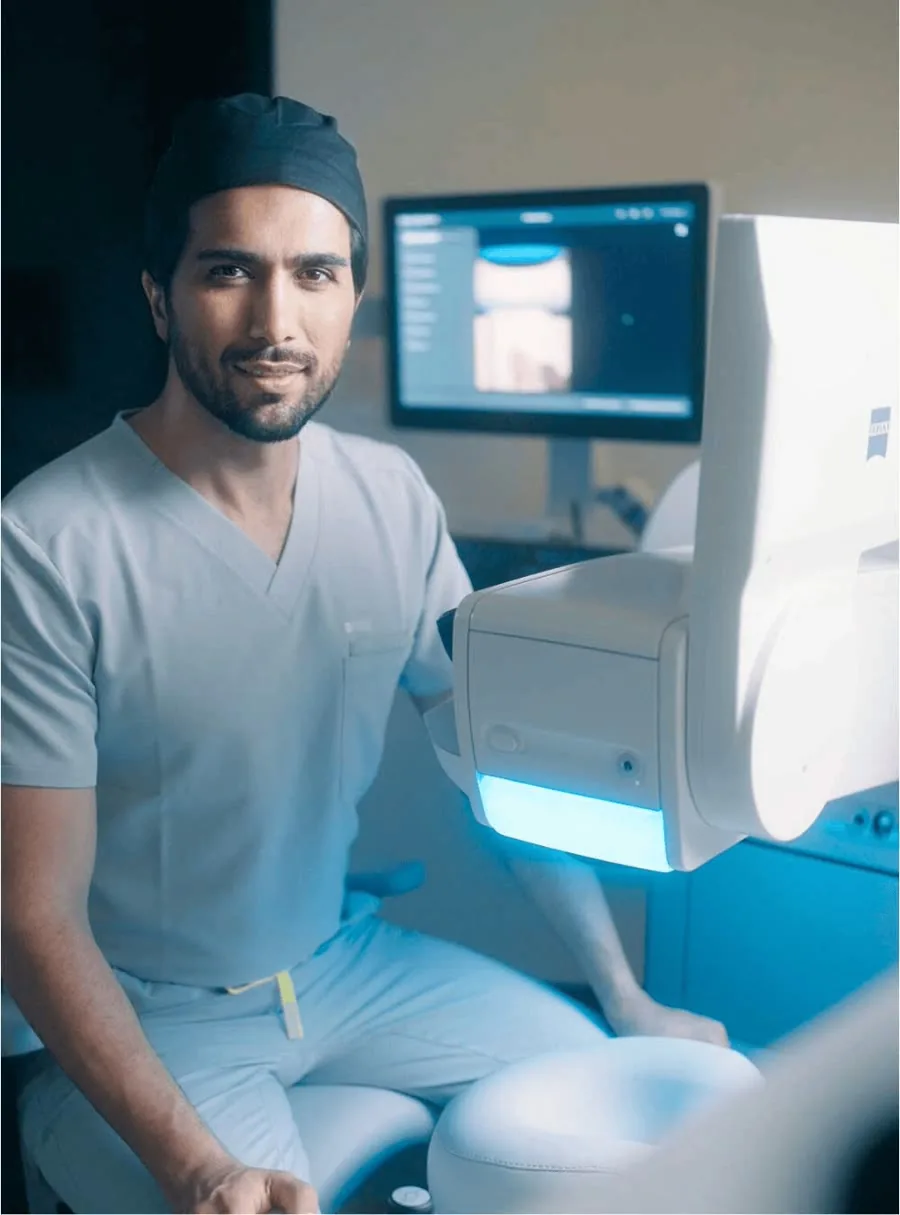
    Prof. Dr. Mehdi Shajari in the examination room at dr.vision

    Who operates if my private health insurer covers laser eye surgery?

    Every procedure: Prof. Dr. Mehdi Shajari. Personally.

    Prof. Dr. Mehdi Shajari operates on every patient himself. He is a specialist in ophthalmology with a professorship and habilitation at the University of Frankfurt, has 80+ publications on lens and corneal surgery and is a 12× FOCUS Top Doctor.

    20.000+Procedures by Prof. Dr. Mehdi Shajari
    99.9%Safety rate for procedures by Prof. Dr. Mehdi Shajari
    80+Publications
    12×FOCUS Top Doctor 2026, refractive surgery and cataract
    FOCUS Top Doctor

    “I advise every privately insured patient to ask the insurer in writing before the procedure. You get the cost estimate with a medical justification from us for that.”

    Prof. Dr. Mehdi Shajari

    Publications by Prof. Dr. Mehdi Shajari

    He does research, teaches and trains.

    Prof. Dr. Mehdi Shajari has published numerous papers on freedom from glasses, teaches, and has trained several colleagues in this field.

    About Prof. Dr. Mehdi ShajariScience & publications

    Frequently asked questions about private health insurance reimbursement for laser eye surgery

    Still have questions about reimbursement?

    “These are the questions from privately insured patients that I hear most often on the phone. Here are the answers.” Jana, Patient Care

    Does private health insurance pay for laser eye surgery?

    Often yes, but not automatically. Since the Federal Court of Justice ruling of March 29, 2017 (IV ZR 533/15), nearsightedness of around −3 D can be an illness within the meaning of the private health insurance terms. Whether your insurer pays depends on the medical necessity in the individual case and on your plan, for example on exclusions or maximum amounts.

    From how many diopters does private health insurance pay for laser eye surgery?

    There is no fixed limit. In the Federal Court of Justice case, −3 and −2.75 D were enough. That specialists speak of pathological nearsightedness only from about −6 D is not decisive according to the Federal Court of Justice. With very low values, the medical necessity is harder to justify.

    Can the insurer refer me to glasses?

    Not for that reason alone. The Federal Court of Justice decided that the medical necessity of laser surgery cannot be denied merely because wearing glasses or contact lenses is common. Plan exclusions or maximum amounts can still limit the reimbursement.

    Do I have to obtain a cost commitment beforehand?

    It is not required by law. Whether your plan requires a commitment in advance is stated in the plan terms. It is always advisable. For treatments above €2,000, you can request information in text form in advance under § 192 para. 8 VVG; the insurer must reply within four weeks, in urgent cases within two weeks. All procedures at dr.vision are above €2,000.

    What happens if the insurer does not reply within four weeks?

    Then, under § 192 para. 8 VVG, it is presumed until proven otherwise that the planned treatment is medically necessary. This does not replace a commitment on the scope of your plan; keep the proof of receipt of your inquiry.

    Which documents do I need for the inquiry to my private health insurer?

    The cost estimate under the GOÄ, a medical certificate with diagnosis, values and justification of the procedure, and a short cover letter. You receive the cost estimate and certificate after the pre-operative examination. For the cover letter, you will find a drafting aid on this page.

    What do I do if the insurer declines?

    Read the reasons carefully. If it is about the medical necessity, a written objection with a medical statement and a reference to the Federal Court of Justice ruling often helps. After that, you can turn to the PKV ombudsman free of charge; for higher amounts, a specialist lawyer for insurance law is worthwhile.

    Does private health insurance also pay for ICL, lens exchange or Presbyond?

    The ICL is often reimbursed for high values, similar to laser eye surgery. For Presbyond and lens exchange because of presbyopia, the situation is inconsistent, because some insurers see presbyopia as natural aging. Private insurers generally reimburse cataract surgery with a monofocal lens, and premium lenses depending on the plan.

    Do I lose my premium refund if I submit the invoice?

    In many plans yes, for that year. For procedure costs from €3,498, the reimbursement generally outweighs it if your plan pays. Compare with your own values in the calculator on this page.

    My plan has a maximum amount per eye. What do I pay myself?

    The part above the maximum amount, plus any deductible. You can finance your own share at 0% over 12 months at dr.vision or through medipay and, where applicable, claim it for tax purposes as extraordinary expenses.

    Are follow-up checks and a possible enhancement reimbursed?

    At dr.vision, the follow-up checks are included in the guide price of the procedure. An enhancement is rare, about 2 in 100 after SMILE Pro. If an enhancement is medically sensible, under our concept it is generally possible within 6 months without a co-payment.

    I am eligible for Beihilfe. Does this apply to me too?

    For the privately insured portion, your private health insurance terms apply. Beihilfe has its own regulations; laser eye surgery is generally not eligible there. Details are on the Beihilfe page.

    Medically reviewed by Prof. Dr. Mehdi Shajari · As of November 2026 · General information, not tax or legal advice

    How do I get the cost estimate for my private health insurer?

    How would you like to continue?

    You receive the cost estimate according to the GOÄ and a medical certificate from dr.vision after the initial consultation and the pre-operative examination. With these, you ask your private health insurer in advance under § 192 para. 8 VVG. You arrange the initial consultation by phone or online.

    I would like an appointment

    Initial Consultation for Freedom from Glasses

    I am coming from near

    In Frankfurt, Junghofstraße 16 · Cost estimate for your private health insurer after the pre-operative examination

    Next available appointment Tue, Oct 27 · 10:15
    Book a free initial consultation ★ 5.0 · 376 Google reviews · 12× FOCUS Top Doctor
    I still have questions

    Talk first

    Jana online
    Reply usually within 10–15 min · Mon–Fri 8:00–19:00, Sat 9:00–15:00
    Ask via WhatsApp Call 069 509 586 770Available 24 hours
    Request a callback

    Where do I find dr.vision?

    Our locations.

    dr.vision practice, FrankfurtOpening hours

    Frankfurt

    Junghofstraße 16, 60311 Frankfurt am Main

    Mon–Fri
    8:00–19:00
    Sat
    9:00–15:00
    • Phone069 509 586 770 · available 24 hours
    • ParkingFree in the building (Junghofstraße parking garage)
    • Public transitHauptwache (S/U), 5 min on foot
    Plan route
    Rooms at the Düsseldorf locationOpening 2027

    Düsseldorf2027

    Breite Straße 69, 40213 Düsseldorf (in the Neuer Stahlhof, corner of Graf-Adolf-Platz)

    Mon–Fri
    8:00–19:00
    Sat
    9:00–15:00
    • Phone069 509 586 770 · available 24 hours
    • ParkingQ-Park GAP 15 at Graf-Adolf-Platz, 3 min on foot
    • Public transitGraf-Adolf-Platz (subway, streetcar), 4 min on foot

    Until opening: preliminary talk in Frankfurt, Patient Care plans your travel.

    Plan route
    Reception at the Stuttgart locationOpening 2027

    Stuttgart2027

    Lautenschlagerstraße 23, 70173 Stuttgart (2nd floor, step-free access)

    Mon–Fri
    8:00–19:00
    Sat
    9:00–15:00
    • Phone069 509 586 770 · available 24 hours
    • Public transitBörsenplatz (subway), 2 min on foot; main station 5 min

    Until opening: preliminary talk in Frankfurt, Patient Care plans your travel.

    Plan route
    Sources and further reading
    1. Federal Court of Justice (Bundesgerichtshof), judgment of 03/29/2017, IV ZR 533/15 (refractive error as an illness in private health insurance; LASIK), reports by LTO and beck-aktuell of 03/30/2017
    2. Versicherungsvertragsgesetz (VVG) § 192 Abs. 1 und Abs. 8, gesetze-im-internet.de, abgerufen 15.11.2026
    3. Gebührenordnung für Ärzte (GOÄ) §§ 5, 12
    4. Einkommensteuergesetz § 33 (extraordinary expenses)
    5. Ombudsmann Private Kranken- und Pflegeversicherung (Schlichtungsstelle)
    6. dr.vision price list, as of October 2026 (guide prices for both eyes); medipay financing terms
    Arrange an appointment