069 509 586 770Available 24/7 Book an appointment

Comparison · Laser eye surgery or lens

Laser or lens?

Three dividing lines. One honest answer.

Whether laser or lens, your diopters, your cornea and your age decide. Up to about −8 D and under 45, laser is usually suitable, otherwise often the lens; between −6 and −8 D both are possible. Prof. Dr. Mehdi Shajari offers both options and operates on you personally.

5,0 · 376 Google reviews 12× FOCUS Top Doctor 20.000+ Procedures on cornea and lens
5,0376 Google reviews
FOCUS Top Doctor 202612× FOCUSTop Doctor
Free initial consultationUsually in 48h Laser or lens? Check in 1 minute

Laser eye surgery or lens: what is the short answer?

Laser shapes the cornea. The lens works inside the eye.

Both paths usually make you glasses-free. Three things decide which is better: your diopters (limit for laser about −8), the thickness and shape of your cornea and your age (presbyopia begins from about 45). At dr.vision, laser eye surgery costs from €3,498, a lens from €6,886 for both eyes.

In brief

Laser eye surgery is better if you are under 45, nearsighted up to −8 diopters (or farsighted up to about +4 diopters) and your cornea is thick enough. Between −6 and −8 diopters both are possible; the pre-operative examination decides. A lens is better if your values are above that, your cornea is too thin or irregular, or you also want to get rid of reading glasses from about 45.

Orientation based on the limits we work with at dr.vision. Whether they apply to your eyes is shown only by the pre-operative examination with thickness measurement and tomography.

Path 1 · Cornea

Laser eye surgery

SMILE Pro/SmartSight, Femto-LASIK or Trans-PRK reshape the cornea. No procedure inside the eye, quickly back to everyday life.

  • 18 to about 45 years
  • up to −8 D, cylinder up to 5 D, farsighted up to about +4 D
  • €3,498 to €5,198 both eyes
Compare laser procedures
Path 2 · Add a lens

ICL

An ultra-thin lens is placed in front of your own lens. The cornea stays untouched, and the lens can be removed again.

  • about 21–45 years
  • from −6 D, thin cornea, dry eyes
  • from €6,886 both eyes
To ICL
Path 3 · Replace the lens

Lens exchange

Your own lens is replaced with an artificial lens that can cover distance and near. No cataract afterwards.

  • from about 45, usually from the mid-50s
  • reading glasses and distance glasses at once
  • from €6,998 both eyes
To lens exchange

Laser eye surgery or lens: how do the paths differ in detail?

All criteria. One table.

20 criteria, three paths: laser on the cornea, ICL as an additional lens, lens exchange as a replacement of your own lens. The laser wins on price and recovery, the lens with high diopters, thin cornea, dry eyes and from about 45. The stronger path is marked in green.

Swipe the table sideways · first column stays in place

Laser eye surgery, ICL and lens exchange compared
CriterionLaser eye surgerySMILE Pro · Femto-LASIK · Trans-PRKICLLens addedLens exchangeLens replaced
Suitability
PrincipleLaser shapes the cornea (on the outside of the eye)Additional lens in front of your own lensYour own lens is replaced by an artificial lens
Typical age18 to about 45 yearsabout 21–45 yearsfrom about 45, usually from the mid-50s
Nearsightednessup to −8 Dfrom −6 D, up to −18 Dany strength
Farsightednessup to about +4 D (Femto-LASIK)up to +10 Dany strength, especially from 45
Astigmatismup to 5 D (SMILE Pro), Femto-LASIK up to about 6 Dup to 6 D (toric ICL)with a toric artificial lens
Reading glasses (presbyopia)only with Presbyond from 45no, reading glasses come from 45yes, with a multifocal or EDOF lens (extended depth of focus)
Thin corneaonly to a limited extent (Trans-PRK)well suited, the cornea stays untouchedwell suited
Procedure and recovery
Where is the work done?only in the corneain the eye, in front of your own lensin the eye, lens capsule
Durationapprox. 20 min, both eyesapprox. 20 min per eyeapprox. 20 min per eye
Both eyeson the same dayusually at separate appointmentsusually about a week apart
Painnone during; a foreign-body sensation for a few hours (Trans-PRK: 4–5 days of burning)none during; slight pressure afterwardsnone during; slight feeling of pressure afterwards
Back at the office1–2 days (Trans-PRK about 5–7 days)1–2 days2–3 days
Side effects and risks
Dry eyesfrequent in the first weeks (SMILE Pro: 3 in 10)hardly, the corneal nerves are preservedhardly
Night vision (halos)frequent in the first weeks, about 5 in 100 after 3 monthsfrequent at first, usually decreasingdepends on the lens; trifocal: 3 in 10 at first, below 1 in 10 after 3 months
Serious risksInfection below 1 in 1,000, ectasia well below 1 in 1,000Lens clouding 1–2 in 100, infection below 1 in 5,000Retinal detachment about 2 in 1,000 in the first year, up to about 1 in 100 over the years, infection under 1 in 1,000
Enhancement2 in 100Lens exchange or repositioning, if neededLaser fine correction about 5 in 100, secondary cataract about 1 in 10 in 5 years
Long term
Reversible?no, tissue is permanently changedyes, the ICL can be removedlens can be exchanged, your own lens does not come back
Cataract latercan be operated on normally, keep your datathe ICL is removed during the cataract surgeryruled out, no more cataract
Sportsafter 1 week, contact sports depending on the procedureafter 1 week, contact sports after consultationafter 1 week, contact sports after consultation
Price both eyes€3,498 to €5,198from €6,886from €6,998

stronger path in this criterion · Prices: guide prices for both eyes at dr.vision · Frequencies from informed-consent materials and the literature

Read deeper

Why is Presbyond not a path of its own in the table?

A laser for reading glasses, from about 45

Presbyond is a laser procedure based on Femto-LASIK for people from about 45 whose own lens is still clear. One eye is set slightly for near vision, and together both cover distance to near. So it belongs to the “laser” path, but unlike SMILE Pro it also takes care of reading glasses. Guide price at dr.vision: €6,398 for both eyes. Whether Presbyond or a lens exchange suits you better is a question of its own, which we answer on the page Lens exchange or Presbyond.

What do diopters, cylinder and “D” mean?

How to read your glasses prescription

Diopters (D) indicate the strength of glasses. A minus stands for nearsightedness (you see blurred in the distance), a plus for farsightedness. The cylinder (column “Cyl” or “cyl”) describes astigmatism, and the axis its direction. For the decision between laser and lens, the stronger eye counts, using the value without contact lens conversion. With high nearsightedness, contact lens values are often lower than glasses values.

What is the difference between laser eye surgery and a lens?

On the outside of the eye or inside the eye.

Your eye has two lenses: the cornea in front and your own lens behind it. The laser changes the curvature of the cornea by fractions of a millimeter without opening the eye. With the lens procedures, Prof. Dr. Mehdi Shajari works inside the eye through an access of about 2–3 mm. That is the reason for most of the differences in the table.

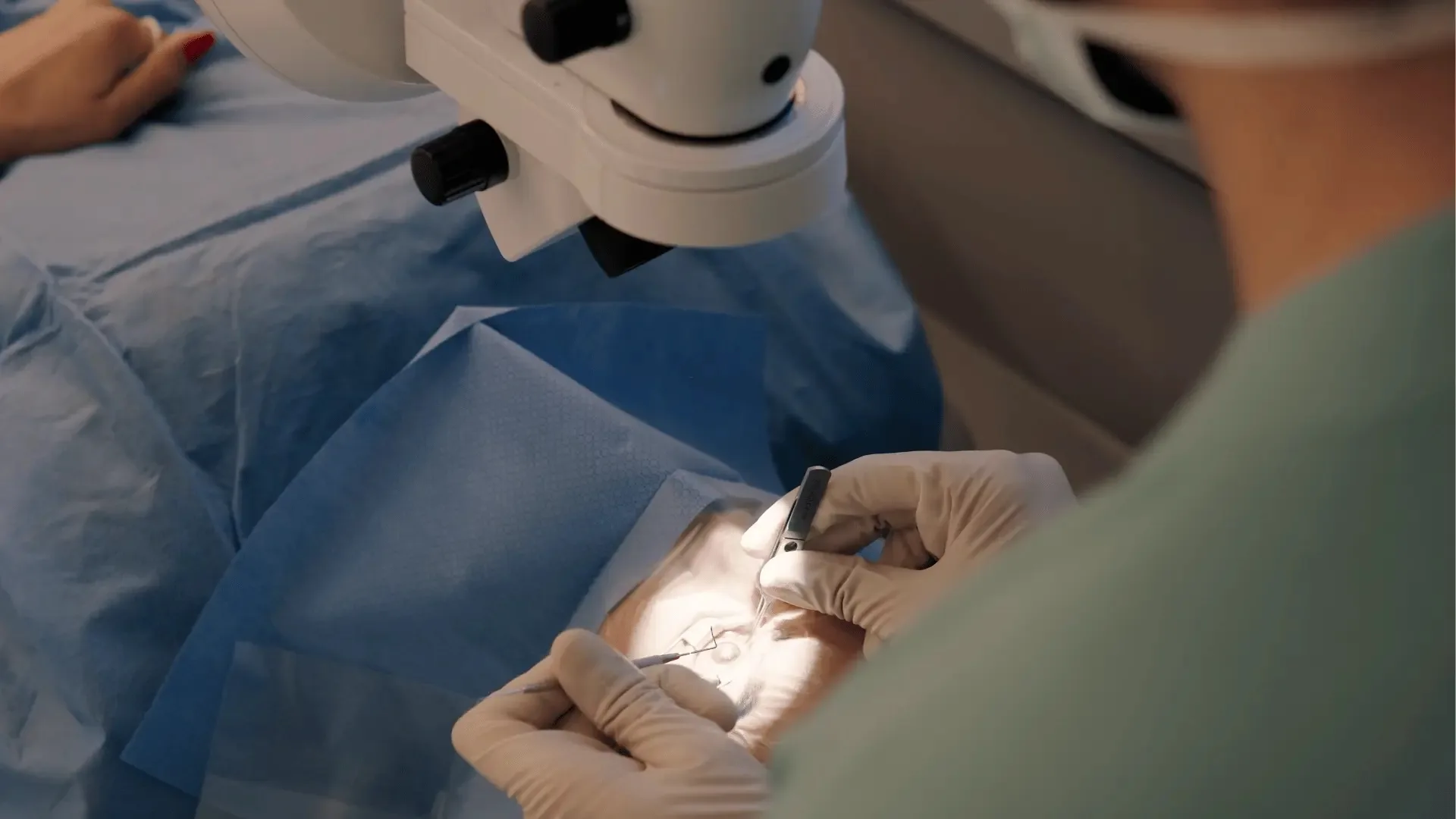
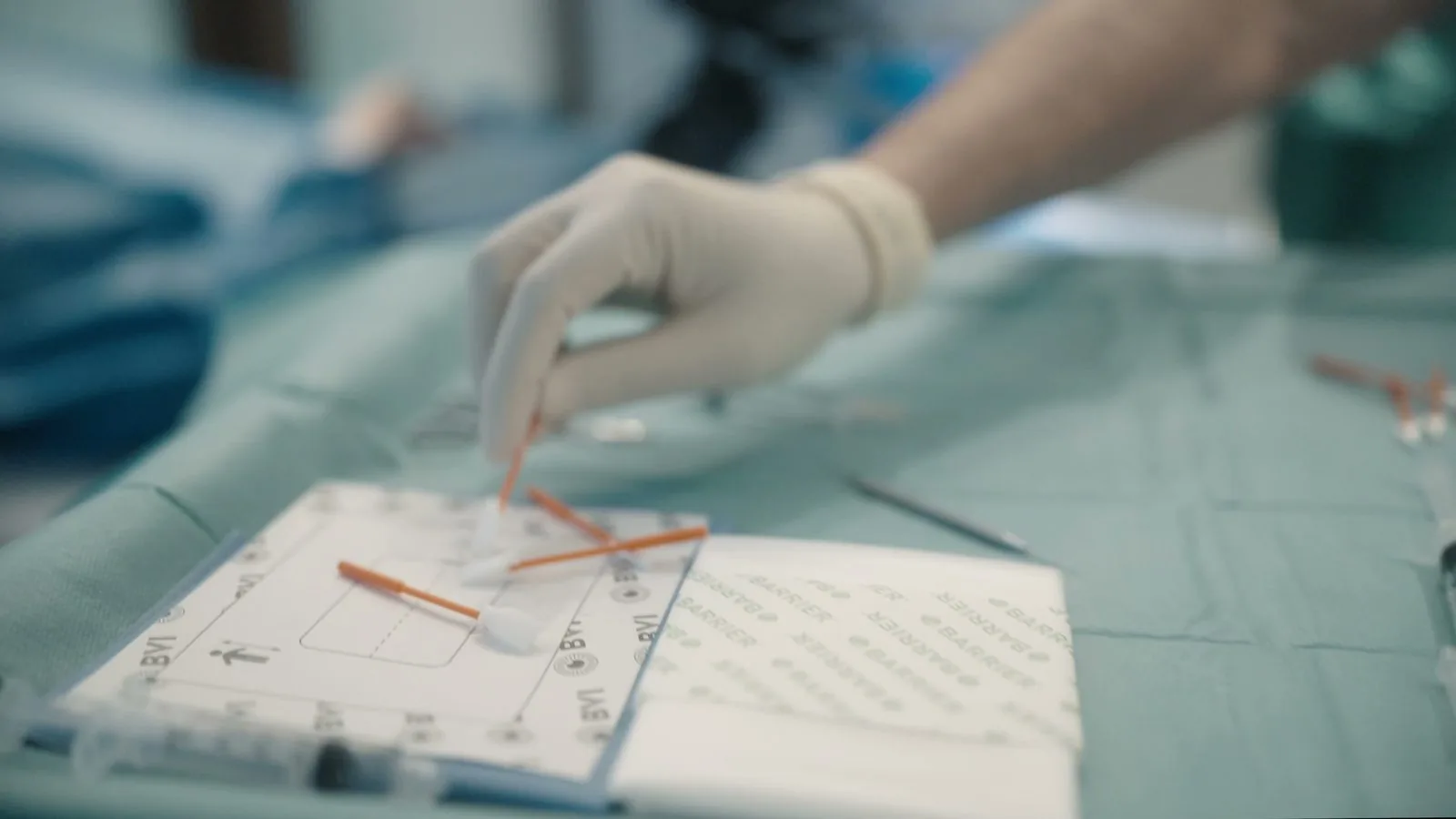
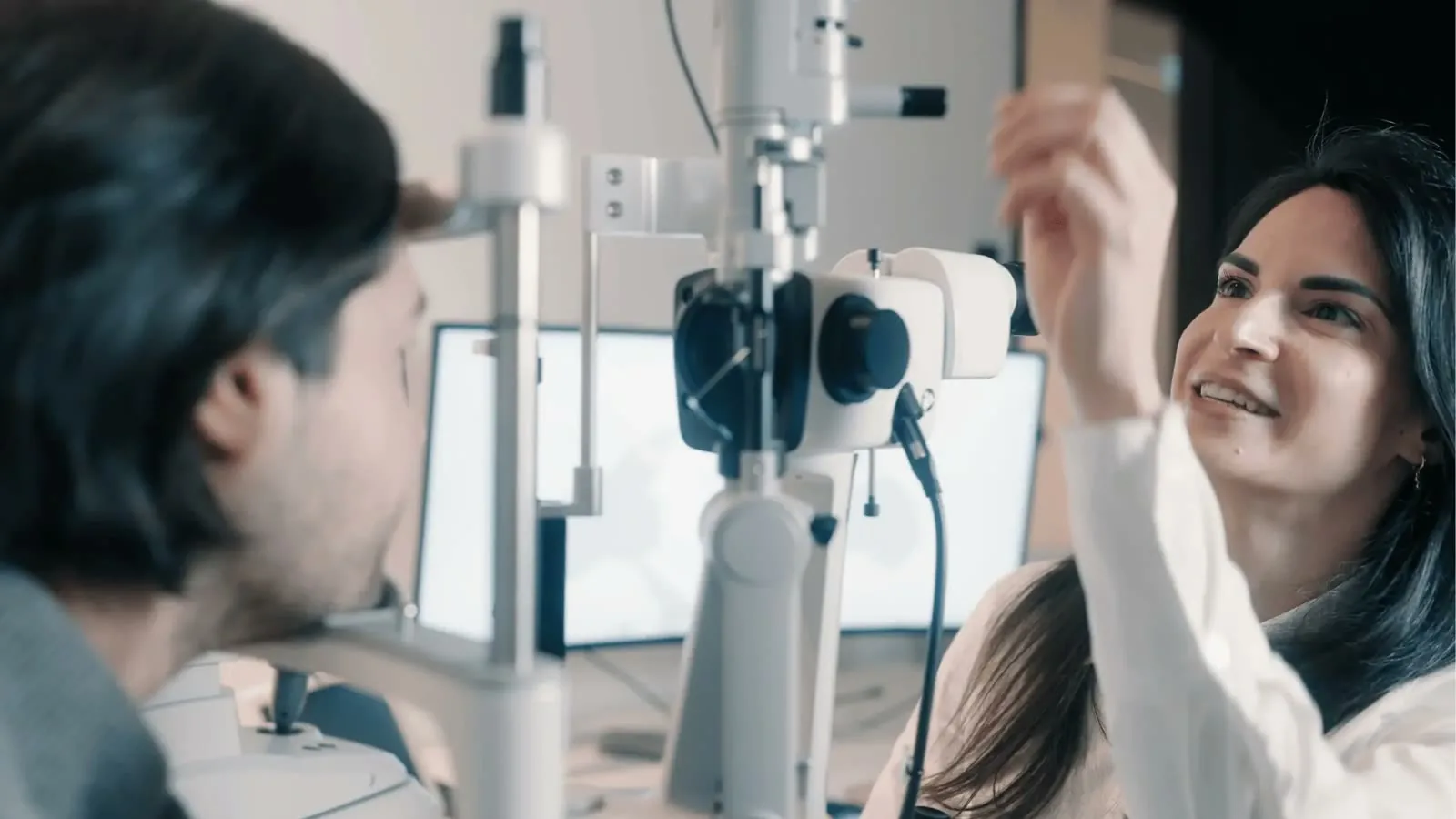
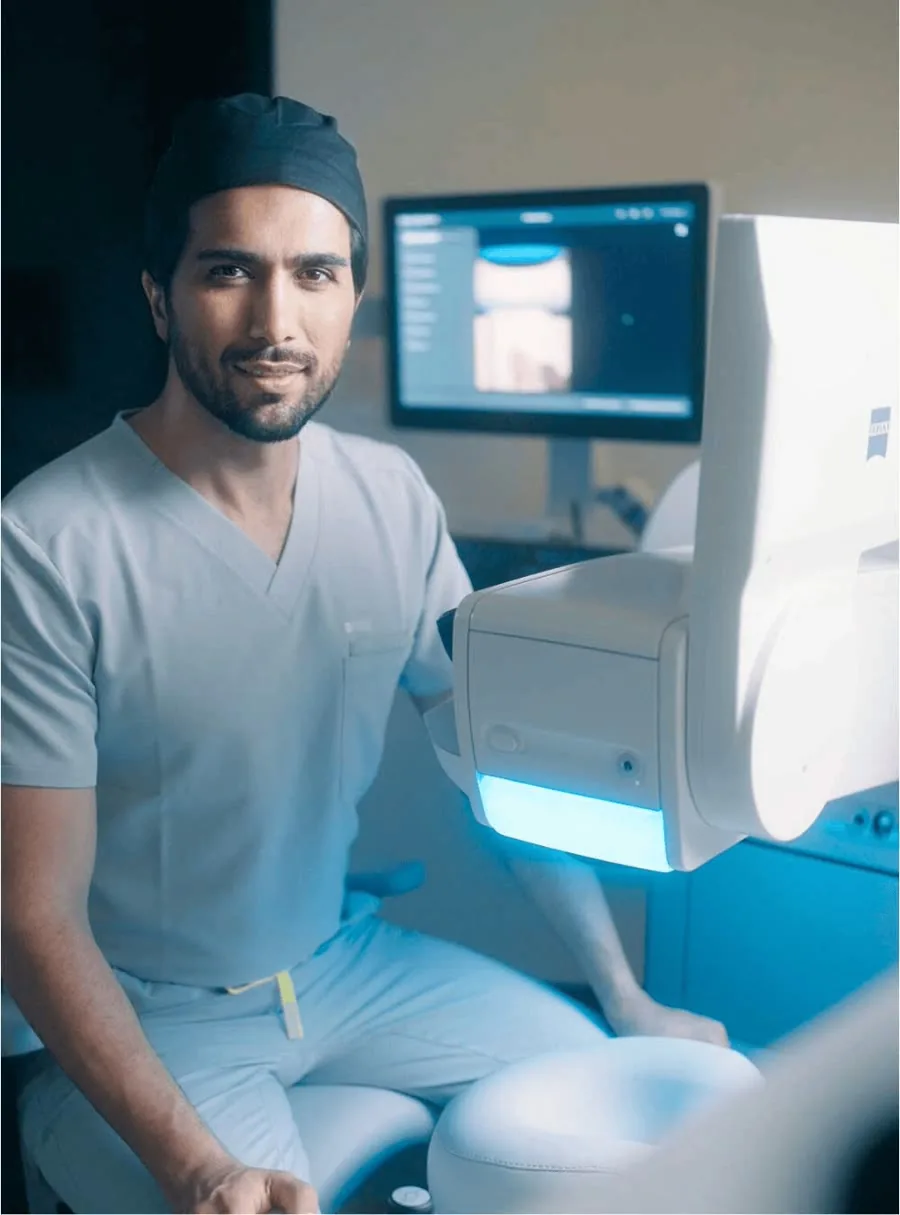
Way 1 Prof. Dr. Mehdi Shajari operating the ZEISS VisuMax 800 during laser eye surgery Insertion of an implantable contact lens under the surgical microscope Sterile instruments on the operating table before a lens operation Pre-operative examination at the measuring device at dr.vision
  1. Path 1 · Laser on the cornea

    The cornea is reshaped.

    With SMILE Pro, the laser forms a thin disc inside the cornea, which is removed through a small access. With Femto-LASIK, a cover is folded back; with Trans-PRK, the surface is removed. None of these lasers goes into the eye. The higher the diopters, the more tissue is removed; that is why the limit is at about −8.

  2. Path 2 · ICL added

    A lens is added.

    The implantable contact lens (ICL) is inserted folded through a small access and unfolds behind the iris, in front of your own lens. Nothing is removed. That is why it suits high prescriptions and thin corneas, and why it can be taken out again if needed.

  3. Path 3 · Lens exchange

    Your own lens is replaced.

    As in cataract surgery, your own lens is removed with ultrasound and replaced with an artificial lens. A multifocal or EDOF lens can cover distance and near at the same time. Sensible when your own lens is losing its near focusing anyway, that is, from about 45.

  4. Who decides?

    The measurement, not the wish.

    Corneal thickness at many points, corneal shape (tomography), distance between cornea and lens, pupil in the dark, tear film, condition of your own lens. Only with these values can we say which of the three paths is safe for you. At dr.vision, we measure everything in one appointment.

From when is a lens better than laser eye surgery?

Three dividing lines decide.

The Refractive Surgery Commission (Kommission Refraktive Chirurgie, KRC) recommends laser procedures for nearsightedness up to about −8 diopters and astigmatism up to 5 diopters. Above that, with a cornea that is too thin or irregular, and from about 45 years, the lens becomes the better choice. Between −6 and −8 diopters both are possible; the pre-operative examination decides. Every limit has a medical reason.

Dividing line 1 · Diopters

Above −8 diopters: more likely ICL.

Per diopter, the laser removes about 12–15 µm of corneal tissue. At −10 or −12, too little load-bearing cornea would remain, and optical quality at night would decrease. The ICL corrects high prescriptions without removing tissue and often delivers a particularly clear image.

Laser up to −8 D · ICL from −6 D
Dividing line 2 · Cornea

Too thin or irregular: lens or PRK.

After laser treatment, a minimum thickness of the cornea must remain (residual thickness), otherwise a bulging (ectasia) is a risk. A tomography also shows whether an early keratoconus is present. Then laser is ruled out; the ICL or, with keratoconus, cross-linking first is the way. With a cornea that is only just thin, Trans-PRK may suit.

Thin cornea: ICL or Trans-PRK
Dividing line 3 · Age

From about 45: think about reading glasses too.

From about 45, your own lens loses its ability to focus on near objects. A laser for distance brings on reading glasses. If you want to get rid of both, you choose Presbyond (laser) or a lens exchange. From the mid-50s and with early clouding, almost everything speaks for the lens.

Under 45: laser · from 45: Presbyond or lens
Special case · Plus prescriptions

Farsighted: laser up to about +4, then lens.

Femto-LASIK corrects farsightedness in its range of application up to +3 D, in the borderline range up to +4 D. Farsighted people often feel presbyopia from 40. That is why lens exchange becomes a sensible option earlier for them than for nearsighted people.

Up to about +4 D: Femto-LASIK · above or from 45: lens
Special case · Dry eyes

Sensitive tear film: better without a corneal incision.

Every corneal laser severs some of the nerves that control the tear film; after SMILE Pro, 3 in 10 of our patients had dry eyes in the first weeks. If you already cannot cope with contact lenses, you are often better served with an ICL. More under Dry eyes after laser eye surgery.

Very dry eyes: more likely ICL
Special case · High nearsightedness

With high minus prescriptions, check the retina.

Highly nearsighted eyes are built longer, and their retina is more often thin or has weak spots. This does not change the choice between laser and ICL, but it matters before a lens exchange at a young age: the risk of a retinal detachment after lens operations is higher with high nearsightedness than with normal vision. That is why we examine the retina with a dilated pupil.

Young and highly nearsighted: ICL instead of lens exchange
Read deeper

How thick must the cornea be for laser?

Residual thickness, tomography and why there is no single limit value

A healthy cornea is about 0.5 to 0.6 mm thick in the center. What matters is not only this number, but what is left after the correction, and whether the cornea is regularly shaped. For each eye we calculate the remaining thickness and the ratio of removed to existing tissue. If the values are tight, Trans-PRK is often still possible because it needs no cover. If they are below that, we advise the ICL. More on the page Laser eye surgery with a thin cornea.

Can high prescriptions not simply be treated with laser twice?

Why that is not a good idea

No. For stability, the total amount of removed tissue counts, not the number of procedures. Two treatments of −5 each weaken the cornea similarly to one of −10. An enhancement of small remaining values after laser treatment, on the other hand, is common and needed in about 2 in 100 eyes.

Laser or lens: which path suits which age?

Your age shifts the answer.

At 25, laser eye surgery is almost always the first choice with usual prescriptions. Between 40 and 50, reading glasses play a part in the decision. From about 55, lens exchange usually makes more sense because it gets ahead of a later cataract. The four phases of life at a glance:

Swipe cards sideways

18 to 39 years

Laser first

With stable values up to −8 D, SMILE Pro/SmartSight is usually our first choice, with plus values Femto-LASIK. Between −6 and −8 D both are possible; the pre-operative examination decides. Above −8 D or with a thin cornea: ICL.

Typical
SMILE Pro/SmartSight, Femto-LASIK, Trans-PRK, ICL
Not sensible
Lens exchange with a clear, still flexible lens
Glasses-free under 45
40 to 44 years

Laser with foresight

Laser is still quite possible. If you read without glasses today because you are nearsighted, you will need reading glasses after laser treatment sooner or later. You should know that beforehand.

Typical
SMILE Pro/SmartSight or Femto-LASIK, with high prescriptions ICL
To discuss
Reading glasses from about 45
Laser eye surgery and age
45 to 54 years

The transition zone

Your own lens is usually still clear but can no longer focus on near objects. Presbyond (laser) or lens exchange: the condition of the lens, diopters and your daily life decide.

Typical
Presbyond, lens exchange
Important
Check the lens for early clouding
Get rid of reading glasses
from about 55 years

Lens first

Your own lens begins to cloud. A lens exchange solves distance, near and the later cataract in one step. If the cataract is already there, we operate on it with a premium lens.

Typical
Lens exchange, cataract surgery with a premium lens
Not sensible
Lasering an aging lens is “beside the point”
Glasses-free from 65
Read deeper

Is laser eye surgery still worthwhile at 45 or 50?

Yes, if the expectation is right

The correction in the cornea lasts permanently, even at 50. What it does not stop is the aging of your own lens: reading glasses come, and from about 60 a cataract can develop. If at 48 you mainly want to be glasses-free in the distance and accept reading glasses, you can be treated well with laser. If you want both, you are better advised with Presbyond or a lens exchange. We do not exchange a lens “in advance” in a 45-year-old with a clear lens and low prescriptions; that would be a bigger procedure than necessary.

Isn't a lens exchange excessive with a healthy lens?

A question we often hear

In young people with a clear, still flexible lens: yes, then it is not our path. From about 50 it looks different. Your own lens can then no longer focus on near objects, it gets cloudier every year, and within 15 to 20 years at the latest, most people need cataract surgery. A lens exchange brings this procedure forward and uses it for freedom from glasses at all distances. The risks correspond to those of cataract surgery, one of the most common procedures in medicine.

ICL or lens exchange: which lens is meant?

Keep your own lens or replace it.

“Lens” means two things to an eye doctor. The ICL is added to the eye, your own lens stays and keeps working; it is intended for people up to about 45. In lens exchange, your own lens is replaced; it is for people from about 45 who also want to get rid of reading glasses. Price: from €6,886 compared with from €6,998 for both eyes.

ICL · Lens added

To ICL

Lens exchange · Lens replaced

To lens exchange

Our rule of thumb: Under 45 with high prescriptions: ICL. From about 50 with a wish for freedom from glasses for distance and near: lens exchange. In between, the pre-operative examination decides, above all the condition of your own lens. Which artificial lens suits a lens exchange, we compare on the page Lens types compared.

Read deeper

What happens to the ICL if a cataract comes later?

No problem, but one more step

During cataract surgery, the ICL is removed through the same small access, and then an artificial lens replaces the clouded own lens. For experienced surgeons this is routine. Because the ICL sits behind the iris, we check once a year that it has enough distance from your own lens; lens clouding caused by the ICL is rare at 1–2 in 100.

Laser or lens: what suits my eyes?

Five questions. A first direction.

Choose your values, and the result appears at once. The check follows the limits Prof. Dr. Mehdi Shajari works with: −8 diopters, +4 diopters, cornea and age around 45. It does not replace an examination, but it shows you in a minute which of the three paths is likely to be an option.

1 · Your age

2 · Your glasses prescription (stronger eye)

3 · Has an eye doctor told you that your cornea is thin or irregular?

4 · Do you already need reading glasses, or do you take your glasses off to read?

5 · Do you often have dry, burning eyes?

Your direction

Laser

Laser eye surgery probably suits you.

Schedule the pre-operative examination Compare all paths

Orientation, not a diagnosis. Prof. Dr. Mehdi Shajari makes the decision after measuring corneal thickness, corneal shape, lens, pupil and tear film. In more detail: the full Suitability Check.

Jana, Patient Care at dr.vision

Still unsure whether laser or lens?

We clarify that together. Call us.

Jana from our Patient Care team answers your questions and arranges the pre-operative examination with Prof. Dr. Mehdi Shajari. Phone available 24 hours, WhatsApp Mon–Fri 8:00–19:00, Sat 9:00–15:00.

What is safer: laser eye surgery or a lens?

Different risks. Not more or less.

Both paths are safe when they suit your eyes. The laser stays on the outside of the eye; its most frequent side effect is dry eyes in 3 in 10 in the first weeks. Lens procedures spare the cornea but are a procedure inside the eye: infections are very rare there (below 1 in 1,000) but weigh more heavily. Tap a path.

Risks of laser eye surgery

Common, usually temporary

Dry eyes: 3 in 10 in the first weeks (SMILE Pro), more frequent in the first months after Femto-LASIK. Halos and glare at night: frequent in the first weeks, about 5 in 100 after 3 months.

Occasional

Remaining diopters with enhancement: 2 in 100. With Femto-LASIK, problems with the corneal flap: requiring treatment in below 1 in 100.

Very rare

Infection below 1 in 1,000. Bulging of the cornea (keratectasia) well below 1 in 1,000, most likely with an undetected keratoconus; that is why we do the tomography before every procedure.

Frequencies from the informed-consent materials of dr.vision, our own evaluation (SMILE Pro n = 412, lenses n = 1,100) and the literature. In detail: Laser eye surgery: risks and side effects.

How quickly am I fit again after laser or lens?

A day or two of difference.

After SMILE Pro, Femto-LASIK and ICL, most people are back at the office after 1–2 days, after lens exchange after 2–3 days. Trans-PRK takes about 5–7 days. With none of the options does anyone feel pain during the procedure; afterward, the days differ.

Recovery after laser and lens
WhatLaser eye surgeryICLLens exchange
In the eveninga few hours of scratchiness and tearingslight pressure, blurredslight pressure, blurred
Sharp visionusually good on the following day, fine sharpness in 4–12 weeksoften very clear already on the following daydistance usually on the following day, near vision matures over weeks
Office, screen1–2 days1–2 days2–3 days
Drivingafter the follow-up check on the following day, if visual acuity is sufficientafter the follow-up check, if visual acuity is sufficientwhen both eyes have been treated and visual acuity is sufficient
Sports, swimminglight sports after 1 week, swimming after 2 weekssports after 1 week, swimming after 2 weekssports after 1 week, swimming after 2 weeks

Guide values “usually” and “as a rule”; in an individual case we will tell you at the follow-up check. Everything about work, sports and driving: When am I fit again?

What is better in the long run: laser or lens?

Reversible, permanent, forward-looking.

In the long run, none of the three paths is better in principle. The correction in the cornea is permanent and cannot be reversed. The ICL can be removed. The lens exchange is final but rules out a later cataract. Which of these three points counts for you depends on how old you are and how your eyes will still change.

Laser

lasting

The tissue does not grow back.

The correction stays if your prescription was stable for 12 months beforehand. What changes is your own lens: reading glasses from about 45, cataract from about 60. Both can be treated normally after laser treatment; we keep your measurement data for that.

ICL

reversible

The only correction that can be taken out.

If your prescription changes or a cataract develops, the ICL is removed or exchanged. In return, it needs annual checks of eye pressure, endothelium and distance to your own lens for life.

Lens exchange

final

No more cataract.

The artificial lens generally stays clear and lasts a lifetime. Secondary cataract, a clouding of the capsule behind the lens, affects about 1 in 10 in 5 years and is resolved in minutes.

Examination at the slit lamp in the dr.vision practice in Frankfurt

Why ask the question laser or lens at dr.vision?

Because you get the procedure that is best for your eyes.

Those who only do laser recommend laser. At dr.vision, Prof. Dr. Mehdi Shajari operates on both cornea and lens: over 20,000 procedures, SMILE Pro/SmartSight, Femto-LASIK, Trans-PRK, ICL and lens exchange under one roof. The recommendation follows your measurements, not the device that happens to be available.

Prof. Dr. Mehdi Shajari in the examination room at dr.vision

Who decides at dr.vision whether laser or lens?

A doctor who operates both paths.

Prof. Dr. Mehdi Shajari makes the decision after measuring your eyes. He is a specialist in ophthalmology with a professorship and habilitation at the University of Frankfurt, has published numerous papers on freedom from glasses, teaches, and has trained several colleagues in this field. He performs your pre-operative examination himself, discusses the measurements with you and operates himself, whether at the laser or at the microscope.

20.000+Procedures by Prof. Dr. Mehdi Shajari
5Procedures for freedom from glasses under one roof
80+Publications
12×FOCUS Top Doctor 2026, refractive surgery and cataract
FOCUS Top Doctor

“Under 45, up to −8 diopters and with a sufficiently thick cornea, I usually advise laser. If the prescription is above that, the cornea is too thin, or reading glasses come into play, I advise a lens.”

Prof. Dr. Mehdi Shajari

What does laser eye surgery cost compared with a lens?

Laser from €3,498. Lens from €6,886.

Guide prices for both eyes at dr.vision, each including the pre-operative examination, the procedure by Prof. Dr. Mehdi Shajari and aftercare. Lens procedures cost more because the lens and surgical material are individual and both eyes are usually operated on at separate appointments. You receive your written cost estimate after the pre-operative examination.

Costs compared
ProceduresWayguide price, both eyesFinanced
Trans-PRKLaser€3,4980% over 12 months possible
Femto-LASIKLaser€4,2980% over 12 months possible
SMILE ProLaser€5,198from €3.90 a day* · €95 a month over 72 months or from €433 a month interest-free over 12 months
PresbyondLaser, from 45€6,3980% over 12 months possible
ICLLens addedfrom €6,8860% over 12 months possible
Lens exchangeLens replacedfrom €6,9980% over 12 months possible

* Representative example SMILE Pro: €5,198 net loan amount · 72 months · fixed borrowing rate 9.49% p.a. · 9.90% effective annual interest rate · monthly installment €94.97 · total amount €6,837.84 · via medipay. Example 0% over 12 months directly with dr.vision: €5,198 cash price · no down payment · fixed borrowing rate 0% p.a. · 0% effective annual interest rate · monthly installment €433.17, last installment €433.13 · total amount €5,198. Your monthly installment for the laser procedures: financing calculator.

Private health insurance

Many private health insurance (PKV) plans reimburse laser eye surgery and lens procedures in full or in part, since the Federal Court of Justice in 2017 classified nearsightedness of around −3 D as an illness (IV ZR 533/15); whether and how much is reimbursed depends on your plan. With premium lenses the plans differ especially. Our cost estimate according to the German fee schedule for physicians (GOÄ) helps with the request. More: Private health insurance.

Beihilfe

Beihilfe (allowance for German civil servants) does not usually reimburse laser eye surgery; for lens procedures it depends on the individual case. Your private supplementary insurance may cover a share, depending on the plan. More: Beihilfe.

Statutory health insurance

dr.vision is a private practice without statutory insurance accreditation; statutory health insurance generally does not pay for laser eye surgery and refractive lenses. You pay yourself. You can declare the costs as extraordinary expenses in your tax return. Whether and how much the tax office accepts depends, among other things, on your reasonable burden. More: Statutory health insurance and Taxes.

Read deeper

Is the extra cost for the lens worth it?

When the more expensive path is the right one

If laser is medically suitable, it is the less expensive and quicker path, and we recommend it. The extra cost of about €1,700 to €3,500 for the lens makes sense when the laser reaches a limit: above −8 diopters, with a thin cornea, with very dry eyes, or from about 45 with a wish for freedom from glasses at near as well. In these cases the less expensive laser would not be the better solution but a compromise. What glasses and contact lenses cost over ten years, we calculate on Laser eye surgery vs. contact lenses.

Frequently asked questions: laser eye surgery or lens?

Still have questions?

“Laser or lens is the question I hear most often. Here are the answers I give.” Prof. Dr. Mehdi Shajari

What is better, laser eye surgery or a lens?

Neither is better in principle. Laser eye surgery is usually the better choice between 18 and about 45 years, up to −8 diopters of nearsightedness or about +4 diopters of farsightedness, and with a sufficiently thick cornea. Between −6 and −8 diopters both are possible. A lens is better with higher values, a thin or irregular cornea, very dry eyes, or from about 45 if you also want to be rid of reading glasses. The pre-operative examination decides.

What is the difference between laser eye surgery and lens surgery?

The laser changes the shape of the cornea on the outside of the eye; the eye is not opened. In lens surgery, work is done inside the eye through a small access: the ICL is added in front of your own lens, and with a lens exchange your own lens is replaced with an artificial lens.

From how many diopters is a lens better than laser?

For nearsightedness from about −8 diopters, farsightedness from about +4 diopters and astigmatism over 6 diopters, we tend to advise a lens. Between −6 and −8 diopters both are possible; the pre-operative examination decides. With a thin cornea, the limit can also be much lower. For high values, ICL is usually the way, from about 45 lens exchange.

Up to what age can you have your eyes treated with laser?

There is no fixed upper limit. From about 45, however, presbyopia comes into play, which a normal laser for distance does not solve. Then Presbyond or a lens exchange often make more sense. From about 55 and with early lens clouding, we usually advise a lens.

I am 48. Laser or lens?

That depends on your own lens and your wishes. If the lens is clear and you want distance and near without glasses, we consider Presbyond and the lens exchange. If distance is enough for you and reading glasses are fine, laser is also possible. With early clouding, everything speaks for the lens.

Does a lens exchange make sense at 40?

With a clear, still flexible lens, usually not. At 40, a lens exchange makes you lose your natural near focusing earlier than necessary. For high prescriptions at this age, the ICL is the better lens path; with usual prescriptions, laser.

What is safer: laser or lens?

Both paths are safe when they suit the eyes; the risks are different. With laser, dry eyes are frequent in the first weeks (3 in 10 after SMILE Pro), serious complications very rare (below 1 in 1,000). Lens procedures spare the cornea but are a procedure inside the eye with very rare but more serious risks such as infection or retinal detachment.

Can a lens be taken out again?

The ICL, yes: it can be removed or exchanged, for example if your prescription changes or a cataract develops. An artificial lens after a lens exchange can be exchanged in exceptional cases, but your own lens does not come back. The laser correction of the cornea cannot be reversed.

Can I have cataract surgery later after laser eye surgery?

Yes. A cataract affects the lens, not the cornea, and is operated on in the same way after a laser. For calculating the artificial lens, the measurements from before the laser treatment are helpful; we keep them and give them to you.

I have dry eyes. Is a lens better then?

Often yes. Every corneal laser severs some of the nerves that control the tear film; after SMILE Pro, 3 in 10 have dry eyes in the first weeks. The ICL leaves these nerves untouched. We treat mild dryness before laser treatment; with pronounced dryness, we tend to advise a lens.

What do laser eye surgery and lens surgery cost at dr.vision?

At dr.vision, laser procedures for both eyes cost €3,498 (Trans-PRK), €4,298 (Femto-LASIK) or €5,198 (SMILE Pro, SmartSight), Presbyond €6,398. ICL costs from €6,886, lens exchange from €6,998. All prices are guide prices including pre-operative examination, procedure and aftercare; you will receive the written cost estimate after the pre-operative examination.

Does health insurance pay for laser or lens?

Statutory health insurance generally pays for neither; dr.vision is a private practice, and patients with statutory health insurance are self-paying patients. You can declare the costs as extraordinary expenses in your tax return. Whether and how much the tax office accepts depends, among other things, on your reasonable burden. Many private plans reimburse in full or in part; Beihilfe (allowance for German civil servants) usually does not for laser eye surgery.

Medically reviewed by Prof. Dr. Mehdi Shajari · As of October 2026

Can I take the laser or lens comparison with me?

Not ready yet? Everything important to read again and to pass on.

  • All paths comparedLaser, ICL and lens exchange with limits, recovery and risks
  • Costs and reimbursementGuide prices, financing, private health insurance, Beihilfe and taxes
  • Pre-operative examination checklistContact lens break, glasses prescription, questions for the conversation
Prefer to have it sent by WhatsApp

Arrives by e-mail in about 60 seconds. No newsletter, just the guide and, if you wish, a follow-up from Patient Care. Privacy policy

How do I find out whether laser or lens suits me?

How would you like to continue?

You arrange the appointment by phone or online. The answer is only settled after the measurements: diopters with and without a dilated pupil, corneal thickness and tomography, distance between cornea and lens, condition of your own lens, pupil and tear film. Afterwards, Prof. Dr. Mehdi Shajari discusses with you whether laser, ICL or lens exchange suits you. You go home with a written recommendation and a cost estimate.

I would like an appointment

Free initial consultation

I am coming from near

In Frankfurt, Junghofstraße 16 · all measurements included

Next available appointment Tue, Oct 27 · 10:15
Book a free initial consultation ★ 5.0 · 376 Google reviews · 12× FOCUS Top Doctor
I still have questions

Talk first

Jana online
Reply usually within 10–15 min · Mon–Fri 8:00–19:00, Sat 9:00–15:00
Ask via WhatsApp Call 069 509 586 770Available 24 hours
Request a callback

Where can I get advice on laser or lens at dr.vision?

Our locations.

dr.vision practice, FrankfurtOpening hours

Frankfurt

Junghofstraße 16, 60311 Frankfurt am Main

Mon–Fri
8:00–19:00
Sat
9:00–15:00
  • Phone069 509 586 770 · available 24 hours
  • ParkingFree in the building (Junghofstraße parking garage)
  • Public transitHauptwache (S/U), 5 min on foot
Plan route
Rooms at the Düsseldorf locationOpening 2027

Düsseldorf2027

Breite Straße 69, 40213 Düsseldorf (in the Neuer Stahlhof, corner of Graf-Adolf-Platz)

Mon–Fri
8:00–19:00
Sat
9:00–15:00
  • Phone069 509 586 770 · available 24 hours
  • ParkingQ-Park GAP 15 at Graf-Adolf-Platz, 3 min on foot
  • Public transitGraf-Adolf-Platz (subway, streetcar), 4 min on foot

Until opening: preliminary talk in Frankfurt, Patient Care plans your travel.

Plan route
Reception at the Stuttgart locationOpening 2027

Stuttgart2027

Lautenschlagerstraße 23, 70173 Stuttgart (2nd floor, step-free access)

Mon–Fri
8:00–19:00
Sat
9:00–15:00
  • Phone069 509 586 770 · available 24 hours
  • Public transitBörsenplatz (subway), 2 min on foot; main station 5 min

Until opening: preliminary talk in Frankfurt, Patient Care plans your travel.

Plan route
Sources and further reading
  1. KRC recommendations “Bewertung und Qualitätssicherung refraktiv-chirurgischer Eingriffe” (DOG/BVA), as of 05/2024, sections 1.2, 2 and 6, bva.dog/krc/qualit.pdf
  2. Kohnen T.: KRC-Indikationsgrenzen für SMILE und LASIK (Myopie bis −8 dpt, Astigmatismus bis 5 dpt, Hyperopie bis +3 dpt nur LASIK). EyeWorld Asia-Pacific, December 2024.
  3. Posterior-Chamber Phakic Intraocular Lens Implantation in Patients over 40 Years of Age. J Ophthalmol 2020 (PMC7341401).
  4. KRC recommendations “Bewertung und Qualitätssicherung refraktiv-chirurgischer Eingriffe” (DOG/BVA), as of 05/2024, section 7 (Refraktiver Linsenaustausch), bva.dog/krc/qualit.pdf
Arrange an appointment