 dr.vision
3 of 10
have dry eyes in the first weeks after SMILE Pro.
Start here
What suits you?
Find out in 2 minutes which procedure suits your eyes.
Start the Suitability CheckOr by age:
< 45yearsGet rid of glasses & contact lenses 45–64yearsGet rid of reading glasses 65+yearsCataract & glasses-free★★★★★ 5.0 · 376 Google reviews · 20,000+ procedures
Decide well
What you should know beforehand.
Who operates?Prof. Dr. Mehdi ShajariFOCUS Top Doctor · operates on every patient personally What does it cost?Laser from €3,498 · Lenses from €6,886Prices for both eyes Is it safe?Safety & risks When will I be fit again?Work, sports, driving Would you rather read in peace first?Decision Guide Freedom from GlassesProcedures
Laser or lens?
Laser eye surgery
SMILE ProSmartSightFemto-LASIKTrans-PRKPRKPresbyond (laser away your reading glasses)All laser procedures at a glanceLaser procedures compared ›Lens surgery
ICLLens exchange (reading glasses)Cataract surgery with premium lensLens types: trifocal, EDOF, toricLens types compared ›Start here
Something wrong with your eyes?
A thorough eye check-up with us clarifies what is behind it.
Book an eye check-up★★★★★ 5.0 · 376 Google reviews
Guides · Freedom from glasses
Usually weeks. Rarely longer.
Dry eyes after laser eye surgery are strongest in the first 1–4 weeks and usually subside within 3–6 months. How strong they are depends on the procedure. We check your tear film beforehand and advise you on the right path.
 12× FOCUSTop Doctor
The short answer.
In brief
Dryness is strongest in the first 1–4 weeks after laser eye surgery and usually fades after a few weeks to a few months. After SMILE Pro, about 3 in 10 have dry eyes in the first weeks. After Femto-LASIK, dryness is more common and lasts longer, because the corneal flap cuts through more nerves.
If you already have dry eyes beforehand, you should have them treated before the procedure. With pronounced dryness, an ICL is often the better choice because it does not touch the corneal nerves.
Common. Usually temporary. Well treatable.
3 of 10
have dry eyes in the first weeks after SMILE Pro.
Weeks to Months
until the dryness has usually subsided. The nerves regrow slowly.
80 vs. 57%
no longer needed artificial tears in one study 6 months after SMILE and LASIK, respectively.
2–3 mm
is the size of the access with SMILE Pro. With LASIK, a flap is cut with an edge incision about 20 mm long.
ICL
does not touch the corneal nerves. Often the better choice for markedly dry eyes.
Because the cornea loses its feelers.
The cornea is the most densely nerve-supplied tissue of the body. These nerves tell the brain when the eye is getting dry and trigger blinking and tears. During laser treatment, some of them are cut. Until they have regrown, the eye less often notices that it needs fluid.

Feedback loop
Cut nerves slow down the feedback loop of cornea, brain and tear gland. The eye produces fewer tears and blinks less often, even though it is dry.
Healing
The top cell layer and the mucus layer are stressed by the procedure and the drops. Until they have renewed, the tear film adheres less well.
Starting point
If you already had an unstable tear film before the procedure, for example from contact lenses or problems of the Meibomian glands (oil glands at the eyelid margin), you have symptoms more often and for longer afterward.
One in three at first. Some longer.
After SMILE Pro, about 3 in 10 have dry eyes in the first weeks. After Femto-LASIK, dry eyes are more common according to the studies and last longer. How much you are affected depends mainly on your tear film before the procedure. These factors raise the risk:
The most important factor. If you have burning, sticky eyelids or problems with contact lenses before the procedure, you should have that treated first.
Lenses thin the tear film and irritate the eyelid margins. Often a reason why people want laser treatment in the first place.
Hormonal changes reduce tear production. Women overall have dry eyes more often.
The more tissue is treated, the more nerves are affected. Above −8 D we usually recommend the ICL anyway.
If you sit at a screen for many hours, you blink less often and notice dryness more clearly after the procedure.
Rosacea, rheumatism, Sjögren's syndrome, thyroid conditions, medications such as isotretinoin (for acne) or antihistamines (for allergies). With some autoimmune diseases, we advise against laser treatment.
Stronger at first. Then better every month.
The symptoms are strongest in the first 1–4 weeks and then ease month by month. In a randomized study, symptoms after LASIK and PRK were back at the level before the procedure after one year. The values below are typical courses, not a promise.
| Period | What is typical | What you do | When to report |
|---|---|---|---|
| Days 1–3 | Foreign body sensation, tears, light sensitivity; after Trans-PRK, pain from the healing surface | Drops as planned, rest your eyes, sleep a lot | if pain increases or vision gets worse |
| Week 1–4 | Dryness strongest, vision fluctuates, burning in the evening, especially at a screen | Artificial tears several times a day even without a feeling of dryness, gel at night | if drops are needed more often than hourly |
| Month 1–3 | clearly better, symptoms mainly in dry air and after long reading | use drops as needed, eyelid care for Meibomian problems | mention at the follow-up check |
| Month 3–6 | subsided in most people; nerves largely regrown | drops only occasionally now | if symptoms still occur daily |
| After 6–12 months | persistent dryness in a small share, more often after LASIK and with prior burden | targeted treatment: plugs, cyclosporine, IPL | appointment for tear film diagnostics |
Time frames according to studies on LASIK, SMILE and PRK (among others Denoyer 2015, Murakami 2012) and our aftercare; individual courses differ.
The smaller the incision, the less dry.
According to the studies, the eyes dry out most after Femto-LASIK, less after SMILE Pro and Trans-PRK. In a meta-analysis of 14 studies, tear production fell significantly only after LASIK. Six months after the procedure, in a comparison study 80% of SMILE patients and 57% of LASIK patients no longer needed artificial tears. The ICL does not touch the corneal nerves at all.
| Criterion | SMILE Pro | Femto-LASIK | Trans-PRK | ICL |
|---|---|---|---|---|
| How it is done | Lenticule inside the cornea, removed through a small access | Corneal flap is cut and folded back | Removal at the surface, without an incision | Lens is placed in front of your own lens, cornea stays |
| Access | 2–3 mm | Flap, edge incision about 20 mm long | no incision | small incision at the edge of the cornea |
| Dryness in the first weeks | in about 3 in 10 | common, usually stronger (studies) | common, surface heals | rare |
| After 6 months | 80% without artificial tears (study) | 57% without artificial tears (study) | usually as before (studies) | usually as before |
| Pain | minor, a few hours | minor, a few hours | clearly noticeable for 4–5 days | low |
| Back to work | usually after 1–2 days | usually after 1–2 days | usually after 5–7 days | usually after 1–2 days |
| With dry eyes beforehand | good if pretreated | rather cautious | good if pretreated | first choice for pronounced dryness |
| guide price, both eyes | €5,198 | €4,298 | €3,498 | from €6,886 |
Study figures: Denoyer A et al., Ophthalmology 2015 (SMILE vs. LASIK, not randomized, 60 patients); Sambhi RS et al., meta-analysis, Can J Ophthalmol 2020. Prices as a guide price for both eyes, written cost estimate after the pre-operative examination. More in the comparison SMILE Pro vs. Femto-LASIK and Laser procedures compared.
Measure beforehand. Treat beforehand. Use drops afterward.
Preparation is the most effective: examine the tear film before the procedure, treat existing dryness over 4–8 weeks and choose the procedure accordingly. After the procedure: use preservative-free drops, even if your eyes do not feel dry.
Before the procedure
After the procedure
An unstable tear film distorts the measurement of the cornea on which the laser planning is based. An uneven tear film can mimic or hide astigmatism. That is why we treat dryness before the final measurement. At the same time, the finding shows how well your eyes tolerate a procedure on the cornea and whether an ICL makes more sense.
Step by step, until it fits.
Preservative-free artificial tears during the day and a gel at night are almost always enough. If symptoms stay noticeable for several weeks, dissolvable punctum plugs, anti-inflammatory drops such as cyclosporine and, for Meibomian gland problems, IPL help. All treatments are described in detail on the page Dry eye.
Hyaluronic or lipid drops without preservatives during the day, a gel at night. As planned, not only when you have symptoms.
Dissolvable plugs keep your own tears on the eye a few weeks longer, exactly while the nerves regrow.
If the surface is inflamed. Cortisone works quickly, cyclosporine after weeks to months.
If the Meibomian glands are involved, warmth and eyelid care help, and if needed OptiLight. After laser treatment, according to the manufacturer, after 6 months at the earliest.
When it gets worse instead of better.
Dry eyes burn, scratch and make the image fluctuate, but they get better from week to week. If pain increases, vision becomes clearly worse or the eye becomes very red, an inflammation or infection may be behind it. An infection is very rare after SMILE Pro at under 1 in 1,000, but must be treated the same day.
Mainly in the evening and at a screen, better after drops. Decreases over weeks.
The image blurs briefly and becomes clear again after blinking. Typical of an unstable tear film.
Increasing pain, markedly worse vision, severe redness, light sensitivity or discharge. Call the emergency number from your documents, and during practice hours also 069 509 586 770 (reachable 24 hours).
When the cornea should be spared.
An ICL is the better choice for dry eyes if the dryness remains pronounced despite treatment, if your nearsightedness is above −8 D, or if the cornea is too thin for tissue removal. The lens is placed in front of your own lens, the corneal nerves remain untouched, and it can be removed again if needed. Guide price for both eyes: from €6,886.
ICL is more likely if …
Laser treatment works well if …

Which procedure suits your eyes?
A first orientation in 60 seconds.
The Suitability Check asks about age, diopters, cornea and dry eyes and shows whether SMILE Pro/SmartSight, Trans-PRK, Femto-LASIK or an ICL is more likely to be an option. It is not a substitute for an examination.
Take the tear film seriously. Before and after.
dr.vision measures the tear film at every pre-operative examination and offers pretreatment by our team of doctors with a focus on dry eye, gentle procedures and the ICL as an alternative. Prof. Dr. Mehdi Shajari operates on every patient himself.
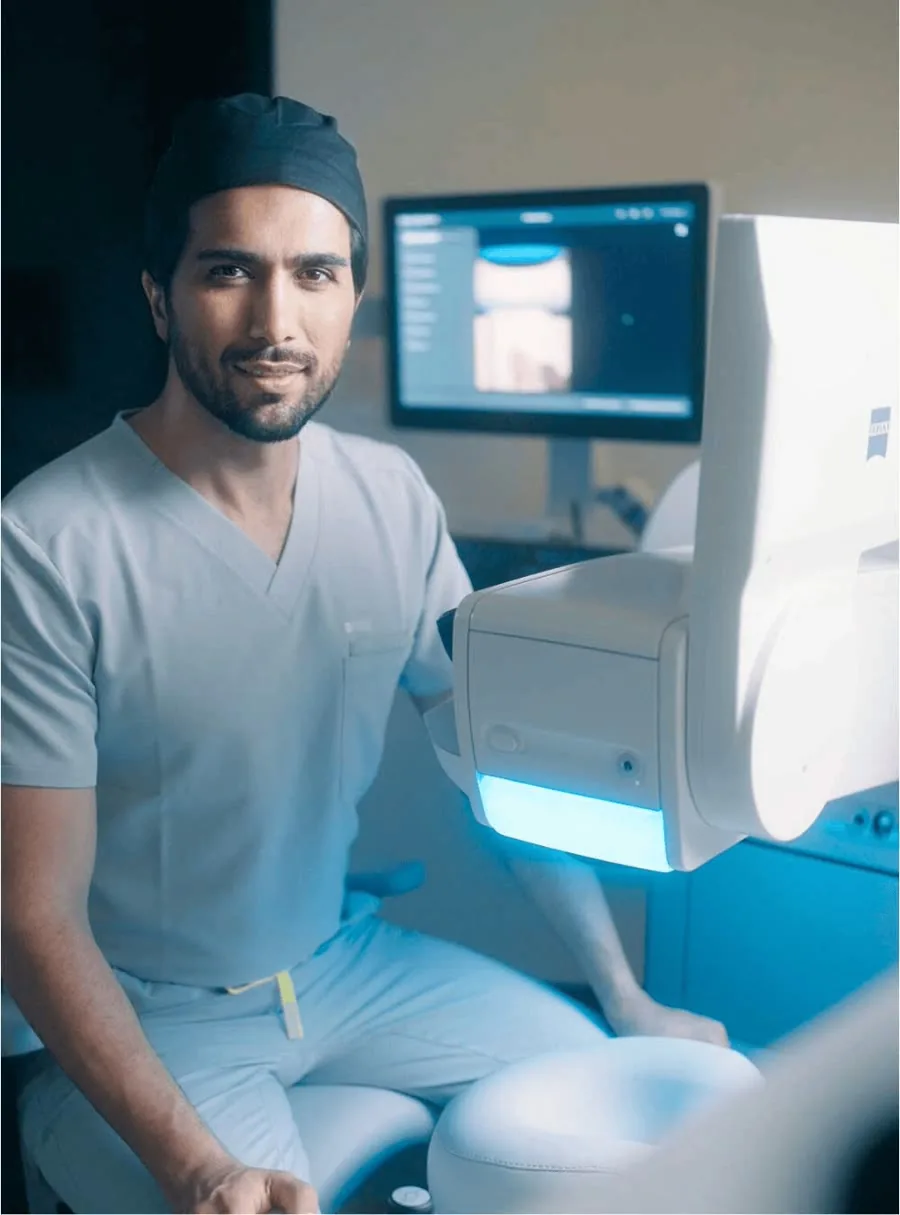
Prof. Dr. Mehdi Shajari. For both.
Prof. Dr. Mehdi Shajari is a specialist in ophthalmology with a professorship and habilitation at the University of Frankfurt and operates on every patient at dr.vision himself. He also reviewed this guide medically.
At dr.vision
Three steps so that dry eyes do not become a lasting problem.
Tear film, Meibomian glands and cornea at the pre-operative examination, not only when it burns.
If the tear film is unstable, we treat first and measure again. Only then do we plan.
A written drop schedule, follow-up checks after the procedure and an emergency number around the clock.
Guide prices for both eyes.
At dr.vision, laser eye surgery costs, as a guide price for both eyes, €3,498 (PRK/Trans-PRK), €4,298 (Femto-LASIK) or €5,198 (SMILE Pro, SmartSight), and the ICL from €6,886. You receive the written cost estimate after the pre-operative examination. The price includes the follow-up checks, a written eye drop schedule and a 24/7 emergency number.
What does laser eye surgery cost?Financing from €3.90 a day*All prices
* Representative example: €5,198 net loan amount · 72 months · fixed borrowing rate 9.49% p.a. · 9.90% effective annual interest rate · monthly installment €94.97 · total amount €6,837.84 · via medipay. Example 0% over 12 months directly with dr.vision: €5,198 cash price · no down payment · fixed borrowing rate 0% p.a. · 0% effective annual interest rate · monthly installment €433.17, last installment €433.13 · total amount €5,198.
Go deeper.
Causes, self-test and all treatments, independent of laser treatment.
To the page ProceduresThe gentle laser procedure with a small access, up to −8 D.
To SMILE Pro ProceduresThe lens for high prescriptions, thin cornea and dry eyes.
To ICL GuidesAll side effects with frequency, across procedures.
Read the guide GuidesWork, sports, driving, screen use after the procedure.
Read the guide TreatmentLight therapy for blocked Meibomian glands, also as preparation.
To OptiLight376 reviews. Average 5.0.
376 Google reviews give dr.vision an average of 5.0 out of 5 stars. dr.vision does not check whether Google reviews come from treated patients.
“While looking for a competent doctor, I became aware of this practice.”
“Worth highlighting is the very good diagnostics, all necessary equipment is available, above all a retina examination without pupil-dilating drops!”
“Today I was at the practice of Prof. Dr. Mehdi Shajari for a retina examination and was very pleased that I did not need any eye drops to dilate the pupils at all!”
“Extremely nice and competent doctor who takes a lot of time. Brilliant modern high-tech practice with all the latest equipment, no drops needed anymore.”
Four patients. In their own words.
It really was not that bad.
It was a very good decision to come here.
Less than 24h after surgery, better than ever.
It is an absolute liberation.
Still have questions?
“These are the questions I hear most often in consultation hours. Here are my answers.” Prof. Dr. Mehdi Shajari
Yes. Dry eyes are the most common side effect after laser eye surgery. After SMILE Pro, it affects about 3 in 10 in the first weeks. The cause is fine corneal nerves that are cut during laser treatment and have to regrow. In most people, the dryness is over after a few weeks to months.
In the first weeks as planned, even if your eyes do not feel dry, usually several times a day with preservative-free artificial tears. After that as needed. Many hardly need drops anymore after about three months; after Femto-LASIK it often takes longer than after SMILE Pro or Trans-PRK.
In a small share of patients, the eyes stay dry for longer than a year, most likely after LASIK and in people who already had dry eyes beforehand. That is why we examine the tear film before every procedure, treat dryness beforehand and choose the procedure accordingly. Even longer-lasting dryness can usually be treated well.
Often yes. Mild, well-treated dry eyes are not an exclusion if a gentle procedure such as SMILE Pro/SmartSight or Trans-PRK is chosen and the tear film has been stabilized beforehand. With pronounced dry eyes, an ICL is often the better choice because it does not touch the corneal nerves.
Studies point that way. SMILE Pro works through a small access instead of a large corneal flap and cuts fewer nerves. In a comparison study, six months after SMILE 80% managed without artificial tears, after LASIK 57%. Whether SMILE Pro suits you also depends on diopters and cornea.
Often it is the tear film: when it breaks up, the surface of the cornea briefly becomes irregular, and the image blurs until you blink. This is normal in the first weeks and improves with artificial tears. If your vision stays permanently blurry or gets worse, please get in touch.
Yes, usually after just one to two days. At a screen, however, we blink less often. In the first weeks, breaks following the 20-20-20 rule (every 20 minutes look into the distance for 20 seconds), a monitor slightly below eye level, sufficient humidity and artificial tears before longer sessions help.
If drops are not enough, yes. Small, dissolvable plugs in the tear points keep your own tears on the eye a few weeks longer, exactly during the time the nerves regrow. They are inserted in a few minutes without an incision.
Have the tear film treated beforehand: eyelid margin care with warmth, suitable artificial tears, with blocked Meibomian glands possibly IPL. After a few weeks, we measure again. If the tear film is then stable, laser treatment can be done; if it stays unstable, we discuss the ICL.
With increasing pain instead of improvement, clearly worse vision, severe redness, light sensitivity or discharge. These are not typical signs of dry eyes but can point to an inflammation. After the procedure you receive an emergency number that can be reached around the clock.
Medically reviewed by Prof. Dr. Mehdi Shajari · As of October 2026
The Decision Guide for laser eye surgery.
Arrives by e-mail in about 60 seconds. No newsletter, just the guide and, if you wish, a follow-up from Patient Care. Privacy policy
How would you like to continue?
You arrange the initial consultation by phone or online. At the pre-operative examination, we measure your eyes and check the tear film. You learn which procedure suits you and whether pretreatment makes sense, and you receive a written cost estimate.
In Frankfurt, Junghofstraße 16 · with tear film analysis
Our locations.
 Opening hours
Junghofstraße 16, 60311 Frankfurt am Main
 Opening 2027
Breite Straße 69, 40213 Düsseldorf (in the Neuer Stahlhof, corner of Graf-Adolf-Platz)
Until opening: preliminary talk in Frankfurt, Patient Care plans your travel.
Plan route Opening 2027
Lautenschlagerstraße 23, 70173 Stuttgart (2nd floor, step-free access)
Until opening: preliminary talk in Frankfurt, Patient Care plans your travel.
Plan routeHi, I'm Sebastian, 37, I live near Frankfurt, and I have somehow always been annoyed that I have to change glasses so often. I have kids now, who knock them off my head or smear them. And for me that was mainly a hassle problem. Apart from the fact that I naturally have weak eyesight, but I actually always got along quite well with glasses. And then I tried contact lenses and noticed that my eyes are dry and it all didn't fit together so well. And then I saw that this offer exists here and first informed myself. So, what does one actually do? There are so many treatments you could have. I went a bit too deep down the rabbit hole and watched videos and saw what these surgeries look like, and at first I kept my distance. It took half a year until I had gathered my courage and thought, well, it can't be that bad. So many thousands of people do it. And then I simply looked more closely at which treatment suits me. Before the doctor had even advised me, I don't know if I am the perfect patient if I already come with an idea, but I came here with the goal of having a PRK treatment. So basically the treatment that many patients are a bit afraid of. Rightly so, you always read in experience reports that it probably hurts quite a bit and that it is the most unpleasant of all the variants, with long healing times and long aftercare times.
So I have a refractive error, diagnosed since fifth grade or so, but not particularly bad. Somewhere between one and two diopters, it got a little worse over time, then I was at one and a half or 1.75, and from about eighth grade, ninth grade or so, it stayed stable. So it simply didn't change at all anymore. And it really only bothered me in that the glasses themselves are of course an obstacle. But that is bearable, it's not really that bad. It became more unpleasant when I started, for example, sports where glasses get in the way.
Climbing, bouldering and things like that, you don't necessarily want to start with glasses on, and that was annoying. Then I started with contact lenses, always had dry eyes, always had to rub my eye, push them around, and I didn't like that at all. Then of course I looked at what solutions there are, how I can get away from this somehow. I can say that my fear beforehand turned out not to be entirely justified, because the whole thing was basically not that bad for me. You have your eyes lasered, and of course that is an uneasy feeling.
And you also go home with swollen-shut eyes, maybe. Everything is not so great, it burns a little. But compared with the stories I had heard, what really happened to me, I have to say, it was really not that bad. You can take painkillers, and I should say, the first day it burns a little, but by far not as badly as is often said, in my case. And on the second day I hardly noticed it anymore, and on the third it was okay.
In terms of pain, that is. Of course you can't see anything right away. You may have to wait a little until your eyes can open again, the swelling has gone down and so on. But from then on it is actually a simple, straightforward healing process. It gets better every day, the vision gets better.
And I think after one week, that was it, I could already make out everything again reasonably well. And now, after a month, I am glad that I did it. I have no complaints at all. When I walk through Frankfurt, I can see the tops of the skyscrapers and see everything sharply again, without glasses, without contact lenses, without discomfort. It is wonderful.
The thing is, I have two children, and my two boys are not necessarily careful when it comes to touching my eyes. Now and then a hand lands in my eye, and perhaps not all that gently. And when I think about it after gathering my information, that something in the eye might actually not be firmly healed yet. Because with LASIK or other treatments, a disc or a piece of a disc is cut, so to speak, folded back and then put back.
This flap, exactly. It only heals at the outer edge. And when I imagine someone hitting it with force, I don't feel comfortable. Of course, I also know, you hear from doctors too, that it is not necessarily the force you need to lift this flap again.
But nevertheless I simply don't feel comfortable with it and couldn't warm to it at all. And PRK is actually a method that, according to my research, really many people have had done, and which is routinely used in the armed forces or other organizations, where force on the eye is perhaps more likely to occur. But if they do it, how bad can it really be for me? And this putting things into perspective is what in the end made me say, okay, this is my variant, this is how I want to do it.
And it worked well. I think that is true for everyone who starts out with this bad gut feeling. You try to optimize, you know, what can I do so that the whole thing goes well. And when you look around, of course you look for someone who treats the eyes and has a certain reputation.
A doctor, professor, doctor, someone who works at the university hospital, is of course exactly right. For me it was also close to work, so there were simply geographical reasons to come here as well. But it all fit together well. The information material was good, I could look closely at what the prices are, what the conditions are, and I could make an appointment where I could also speak directly with the doctor.
That is also very important to me, not to speak with just anyone but with the doctor, and also to know that the person I speak with at the start is the one who will treat me. Basically I would say it was a good decision, I would do it again, and it is certainly not as bad as is often said. Very many people have the surgery, few people have problems with it, and we all know the internet, often only those who have problems speak up. Don't trust it too much, get in contact, find out how I can do this, which doctor can support me.
In this case it was very easy, the first conversation was directly with the treating doctor, and then you see whether you feel up to it or not. Definitely, I had very positive experiences, I am satisfied with the result. No complaints to this day, of course.
I’m Teresa Schwenger, I’m 31 years old, I’m a project manager. I was nearsighted, so I didn’t see well at a distance, and at some point it was just super annoying with contact lenses, putting them in every morning, taking them out again in the evening. I think I wore contact lenses for about ten years, and then I also had the problem that my eye was no longer supplied with oxygen so well, which is why the little vessels grew further into the eye, and so I looked around for an alternative. Glasses were not an alternative for me, because I simply don’t like myself in glasses. It was always an issue with the swimming pool or the lake or the sea. Do you put your contact lenses in, can you dive, do you maybe lose a contact lens, and that was always really annoying. Or also when you stayed somewhere overnight, you always had your little contact lens case, your solutions and care products, which you had to take along, always a whole pack just for the contact lenses. I always found that very annoying, and also on long days, when I had put my contact lenses in very early, in the evening while watching TV I noticed, oh, this really annoys me now, I would like to take them out, and then watching TV with glasses on a couch, really very uncomfortable, and so that was a situation where I am now grateful that I will hopefully or probably never have them again.
And then I looked at which doctors in this area offer laser eye surgery, and I read through lots of reviews and looked at who is very good here. And the doctor here is really rated very, very highly, and I had a totally likeable first conversation with him and felt comfortable right away. I also saw all his awards, the FOCUS awards and so on, which reinforced my impression, and also lots of positive reviews, which I can confirm. So you feel very comfortable, and the work here is very professional. So it was a very good decision to come here, definitely.
Not quite so good. I was very nervous, had many worries and fears too. I would have liked to leave again right away on the day when I was sitting here. But I was received super kindly and warmly. Everything was explained to me well. Everyone was very warm, and they took the nervousness away. So I felt I was in good hands, and when it then started, the nervousness was already a bit less, because I knew that I was simply in good hands.
So I simply arranged the appointment, the first appointment, online, and then I got a call asking me to please stop wearing contact lenses from that point on, so that the eyes are already free of contact lenses, because things can still change there. Then the parking garage is right next door, you walk in here, and it is a very beautiful building and a very beautiful practice, definitely. I was welcomed warmly right away by the receptionists. Everything was explained to me well right away. I was given water and everything. Then I had the first tests. I was totally amazed at how many tests were done and with which devices. It's really incredible what names are on the devices and how expensive these devices are. But really everything was measured that I think can be measured in an eye. Then I had the conversation with the doctor. That was also really great, warm. He answered all the questions I had and took the time for me. I then said I would rather sleep on it for another night, because I am simply the type of person who plays it safe. But at home I actually already knew that I would like to have it done. The next day I called again and made a second appointment. The eyes were checked once more, again with a colleague of the doctor and with him. And then I had another informed-consent talk about what risks there are. I was able to ask my questions again and then got my treatment appointment very quickly. And on the day of the treatment, as I said, I was already here super nervous, but I was also welcomed very warmly. Many of my worries and fears were taken away.
Yes, exactly. So I got up this morning and I could see right away. That was my biggest worry, that I would no longer be able to see as I did before, but I could see perfectly right away. I also saw at a distance again. That was the exciting part in my case. I looked out of the window and also noticed the trees farther away. The outlines, which I otherwise always saw only like this, were clear and distinct. So it really is a change right away. I notice it totally, and it’s super nice.
Definitely, yes, absolutely. I felt super comfortable from the first second to the last. So definitely, if I ever have laser treatment again, then definitely here. I can only recommend it to everyone.
Yes, I definitely should have done it earlier, that's true, because I believe it really gives you a lot of quality of life back, and it is also good for the eyes. Of course, there is the treatment itself, but in the long run, as it was with me, because of the contact lenses, I had these tiny blood vessels, or I have them in my eye, because the eyes were not supplied well. Had I done this earlier with the lasers, it might not be as pronounced. So my appeal would be to do it earlier rather than too late.
I'm Duilio, I'm 22 years old. I was nearsighted before, with a prescription of minus 4.75. I actually looked into laser eye surgery a few years ago. But this practice didn't exist yet back then, and I informed myself a bit about it, and now I've finally come to the conclusion to have my eyes lasered.
So there was a free initial consultation here. I came here, first took a look at the practice, and I found the technology to be state of the art, and I also found Professor Shajari to be a very empathetic and very likable doctor, also very young, and so I then decided to have my eyes lasered here.
So the process was actually quite simple. You first came into a small room, where the eyes were cleaned a little, it burned briefly and then they were numbed and that was it. They were numbed with eye drops and then it went straight to the operating room and right there I was laid on the bed of the laser, the Carl ZEISS VisuMax 800, which is the newest laser, and then he actually started operating right away. I think I was only in the operating room for 15 to 20 minutes in total, while the laser itself took about ten seconds per eye.
Right, so after the surgery I got up first and couldn't see very sharply yet. I saw it as if it were milky cloudy. So my vision was milky cloudy, as if you were looking through a plastic cup when you hold it in front of your eyes. But I could already see better, or at least I had the feeling that I could already see almost better than I did before without glasses.
When I came for the follow-up check the day after, the optician took off the protective glasses and then I could really see, I saw him clearly, I saw the devices clearly, we did the tests, he said yes, you are at 100 percent in one eye, 125 percent in the other, exactly, so it was a great feeling, I then took out my sunglasses right away, because the sun was shining that day, and I went for a little walk through downtown Frankfurt. It was very nice, as I said, to see everything clearly without glasses not even 24 hours after the surgery, I think it was about half a day, 13, 14 hours after the surgery, yes, so it was really great.
My name is Raquel Schulze Wischeler. I have basically worn glasses since I was 13. I was really nearsighted, you could say. Really, really. I could only see outlines without glasses. I had minus 6 in one eye, a diopter of minus 6, and almost minus five in the right one. I think everyone who wears contact lenses or glasses knows how stressful all of that is. The eye dries out completely. In the evening, when you are lying on the couch, you notice, okay, my eye is super tired, I really do not feel like doing anything anymore. Whether it is contact lenses or glasses. With that diopter, you have rather thick lenses, and you notice that over the day too. And just getting the feeling, or knowing, hey, I do not have to wear anything anymore, neither glasses that I always have to clean, nor contact lenses where I have to watch hygiene, that is an absolute liberation. And that felt more like a dream to me, and then I said, okay, now you dare to do it, and so I will do it.
Interestingly, I had already thought about having my eyes lasered about five years ago, but I was very afraid and then dropped the idea again. And lately I had big problems with my eyes because of chalazia, because my glands in the eyelids do not quite work, and so I had surgery twice. And then I said, okay, since I have already had surgery on my eye, you might as well dare it once more. And then I first just googled, came across dr. vision, saw, oh, there are really great reviews, and by coincidence my eye doctor had worked with him at the university hospital in Munich, and I had an eye doctor appointment beforehand and told her about it, I am getting my eyes lasered, and then she said, well, where? Then I told her the doctor's name. And then she said, yes, I know him, I worked with him. You can go there, he specializes in this, he is really great. And that took away the last bit of doubt for me.
And yes, then I came, had an appointment the next day. And right away I had the feeling that I was in the right hands. He sat down with me, explained all the risks to me, explained how it works, showed me the treatment room. And then the fear was somehow gone, and then I said, okay, I am doing it here. I was thrilled by the professionalism, first of the practice itself, which is superbly organized, and by the speed. You do not have long waiting times, you are examined, you have the feeling, okay, here they really examine thoroughly and extensively, and then of course it is explained to you on the screen, you can see it. So that was just totally professional for me. And so I felt safe right away.
Yes, my biggest fear was the eye itself. It is on the eye. And you have a reflex, a physical one. And the question of course was, okay, do I react, and does something go wrong because of that. But the fear was taken from me relatively quickly. I also talked about the fear. And then during the treatment I saw that the eye was held still. I did not feel that either. And then I calmed down relatively quickly. And I knew the eye was numbed. And so everything worked quite well.
I have no pain. I feel that something has happened to the eye, like a slight pressure, but it is one day after. I was already at work today, I have no pain.
Absolutely, so I can answer that question with yes, and go for it. It's not bad at all, it doesn't hurt at all, it's quick, and the healing process is pretty much there a day later. And it's an absolute quality of life. That's totally great.