 dr.vision
−8 D
Up to this point, we use laser with SMILE Pro or SmartSight. Above it, we recommend ICL. From −6 D, it is possible alongside laser.
Start here
What suits you?
Find out in 2 minutes which procedure suits your eyes.
Start the Suitability CheckOr by age:
< 45yearsGet rid of glasses & contact lenses 45–64yearsGet rid of reading glasses 65+yearsCataract & glasses-free★★★★★ 5.0 · 376 Google reviews · 20,000+ procedures
Decide well
What you should know beforehand.
Who operates?Prof. Dr. Mehdi ShajariFOCUS Top Doctor · operates on every patient personally What does it cost?Laser from €3,498 · Lenses from €6,886Prices for both eyes Is it safe?Safety & risks When will I be fit again?Work, sports, driving Would you rather read in peace first?Decision Guide Freedom from GlassesProcedures
Laser or lens?
Laser eye surgery
SMILE ProSmartSightFemto-LASIKTrans-PRKPRKPresbyond (laser away your reading glasses)All laser procedures at a glanceLaser procedures compared ›Lens surgery
ICLLens exchange (reading glasses)Cataract surgery with premium lensLens types: trifocal, EDOF, toricLens types compared ›Start here
Something wrong with your eyes?
A thorough eye check-up with us clarifies what is behind it.
Book an eye check-up★★★★★ 5.0 · 376 Google reviews
Comparison · freedom from glasses with high values
Adding instead of removing.
High diopters, thin cornea or dry eyes? Up to −6 D, laser is usually the smaller procedure; above −8 D, ICL is usually the better choice. We clarify what suits your eyes in the free initial consultation.
 12× FOCUSTop Doctor
In short.
Up to −6 D, laser eye surgery is usually the smaller, faster and less expensive procedure. Above −8 D, with a thin cornea or dry eyes, the ICL is almost always the better choice, because it removes no tissue and can be removed again. In between, corneal thickness, pupil and eye surface decide, and from about 45 more likely a lens exchange.
ICL is more likely if …
Rather laser, if …
Five numbers that decide.
−8 D
Up to this point, we use laser with SMILE Pro or SmartSight. Above it, we recommend ICL. From −6 D, it is possible alongside laser.
0 µm
of cornea removed by the ICL. With laser treatment it is roughly 12–15 µm per diopter.
3 of 10
have dry eyes at first after SMILE Pro. Rarely after the ICL.
ICL
can be removed or exchanged. Tissue treated with a laser does not grow back.
from 6,886 €
ICL, both eyes. SMILE Pro €5,198, SmartSight €5,198, Femto-LASIK €4,298, Trans-PRK €3,498.
25 criteria. Four procedures.
Suitability, procedure, recovery, risks with frequency, long term and price side by side. Mint marks which procedure leads on each point. No procedure wins everywhere: the ICL leads with high values, thin cornea and dry eyes, laser treatment with recovery, follow-up effort and price.
← Swipe sideways to compare →
Compare ICL with:
| Criterion | ICLLens in front of your own lens | SMILE ProLaser, keyhole | Femto-LASIKLaser with a flap | Trans-PRKLaser at the surface |
|---|---|---|---|---|
| For whom | ||||
| Nearsightedness | up to about −18 D | up to −8 D | up to about −8 D | up to about −6 D |
| Farsightedness | up to about +10 D | no | up to about +4 D | small, rare |
| Astigmatism | up to about 6 D (toric ICL) | up to 5 D | up to about 6 D | up to about 3 D |
| Thin cornea | usually no obstacle, cornea stays untouched | limit set by remaining thickness | least favorable choice (flap costs thickness) | often still possible, no flap |
| Dry eyes beforehand | best choice, corneal nerves are preserved | possible with pretreatment | less favorable | possible with pretreatment |
| Age | about 21–45 years | usually from 18, values stable for 12 months | usually from 18, values stable | usually from 18, values stable |
| Anterior chamber | must be deep enough (from about 2.8 mm) | irrelevant | irrelevant | irrelevant |
| Procedure | ||||
| What happens | Foldable lens is placed in front of your own lens through a 3 mm opening | Laser shapes a lens disc in the cornea, removal through a 2–3 mm incision | Flap is lifted, laser shapes underneath | Laser removes surface and tissue, without an incision |
| Tissue removed? | no | yes | yes | yes |
| Duration | approx. 20 min per eye | approx. 20 min, both eyes | approx. 20 min, both eyes | approx. 20 min |
| Both eyes on the same day? | usually on two days | yes | yes | yes |
| Pain afterward | feeling of pressure, a few hours | foreign-body sensation, a few hours | foreign-body sensation, a few hours | 4–5 days of noticeable pain possible |
| Recovery | ||||
| Sharp vision | usually the next day | usually the next day | usually the next day | after 2 weeks |
| Work (office) | after 1–2 days | after 1–2 days | after 1–2 days | after 5–7 days |
| Contact sports | after 2 weeks at the earliest, after consultation | after 2 weeks | at the earliest after 2 weeks, the doctor will tell you exactly when (flap protection) | after 2 weeks |
| Side effects and risks | ||||
| Dry eyes afterward | rare | 3 in 10 in the first weeks | more often than SMILE Pro | temporary, weeks |
| Halos at night | common at first, permanently bothersome in a few in 100 | common in the first weeks, about 5 in 100 after 3 months | similar, more with high values | similar, more with high values |
| Typical risk | temporary pressure rise up to 2 in 10 | dry eyes | flap problems under 1 in 100 | scar haze rare |
| Most serious risk | infection in the eye under 1 in 5,000 | keratectasia well under 1 in 1,000 | keratectasia under 1 in 1,000 | Infection up to about 2 in 1,000 |
| Earlier cataract | 1–2 in 100 within eight years | no | no | no |
| Enhancement | 1–2 in 100 size exchange/rotation | 2 in 100 | similar | similar |
| Long term | ||||
| Reversible | yes, lens removable or exchangeable | no | no | no |
| Vision quality at high prescriptions | very good, no removal needed | good up to −8 D | decreases at high prescriptions | decreases at high prescriptions |
| Follow-up checks | annually (pressure, distance, endothelium) | not needed after healing is complete | not needed after healing is complete | not needed after healing is complete |
| Price both eyes | from €6,886 | €5,198 | €4,298 | €3,498 |
Advantage in this criterionPrices: guide prices for both eyes according to GOÄ
Limit values are guide values; in an individual case the pre-operative examination decides. In detail on each procedure: ICL · SMILE Pro · Femto-LASIK · Trans-PRK
The higher the prescription, the more the lens is the better choice.
The laser corrects nearsightedness by removing cornea, roughly 12–15 micrometers per diopter in the center. At −4 D this is little, at −10 D a quarter of the corneal thickness is missing. From −8 D we therefore recommend the ICL.
Small tissue removal, very good night vision, quick recovery. SMILE Pro, SmartSight, Femto-LASIK or Trans-PRK, depending on the cornea. An ICL would be a bigger procedure than necessary here.
With a thick cornea and a normal pupil, SMILE Pro and SmartSight are very good. With borderline corneal thickness, large pupils or dryness, the ICL is the better choice. Here we discuss both options with you.
The tissue removal becomes so deep that a smaller optical zone has to be chosen: more halos, less contrast at night and more frequent slight regression of the correction. The ICL does not have this limit.
ICL corrects up to about −18 D. Many patients see more sharply afterward than they did before with glasses, because glasses make the image smaller at high values.
Laser reaches its limits sooner with farsightedness than with nearsightedness. Up to about +4 D, Femto-LASIK; above that, ICL up to about +10 D if the anterior chamber is deep enough (at least about 2.8 mm); from age 45, lens exchange is more likely.
SMILE Pro corrects up to 5 D. Above that, or in combination with high prescriptions: toric ICL up to about 6 D.
The laser makes the cornea flatter. How deeply it removes tissue depends on the strength of the correction and on the diameter of the treatment zone. As a rule of thumb, with a 6.5 mm zone, roughly 12–15 µm per diopter. An average cornea is about 530–550 µm thick in the center.
| Nearsightedness | Tissue removal (approx.) | Classification |
|---|---|---|
| −3 D | 40–45 µm | not a concern |
| −6 D | 80–90 µm | not a concern with a normal cornea |
| −8 D | 105–120 µm | borderline range, corneal thickness decides |
| −10 D | 130–150 µm | we advise against it, ICL |
After the tissue removal, enough stable tissue must remain so that the cornea does not bulge forward. That is why, at the pre-operative examination, we calculate the residual thickness for each eye before we recommend a laser procedure.
Glasses of −10 D sit about 12 mm in front of the eye and noticeably shrink the image; many people know the “small eyes” behind thick lenses from the outside as well. The ICL sits inside the eye, and the image has its natural size again. That is why some patients read one line more on the eye chart after the ICL than before with glasses.
When laser is used for high prescriptions, the optical zone often has to be chosen smaller to save tissue. If the pupil opens wider at night than this zone, light passes through the transition area: halos and loss of contrast. The ICL has a fixed optic and does not remove any tissue.
After laser treatment, the top cell layer of the cornea thickens slightly and offsets part of the correction. At low prescriptions this hardly matters; at high prescriptions, a remainder of 0.5 to 1 D can return. The ICL does not show this effect, because nothing on the cornea is changed. This must be distinguished from progressive nearsightedness of the eye itself; that is why, for all procedures, the prescription must be stable for at least one year.
Little cornea, little room to work with.
Below about 500 µm central thickness we speak of a thin cornea; about 1 in 10 patients have this. Then it depends on the prescription: with low diopters, Trans-PRK is often still possible; with higher ones, the ICL. Femto-LASIK is usually ruled out.
The ICL is placed behind the iris. The cornea is opened only at the edge for a 3 mm access, and its thickness and stability remain. That is why the ICL is the standard solution for a thin cornea with medium to high prescriptions.
The surface treatment needs no cover (flap) and no pocket. For the same prescription, it leaves the most load-bearing tissue. With a thin cornea and prescriptions up to about −4 to −5 D, often the best laser option. Price: €3,498 for both eyes.
No flap, and the upper corneal layers stay largely intact. With borderline thickness and low prescriptions, sometimes possible if the residual thickness is sufficient. We calculate this for each eye individually.
The flap costs an additional 90–110 µm of load-bearing capacity. With a thin cornea, we advise against it. With keratoconus or suspected keratoconus, we do not use laser at all; then cross-linking is considered and, once the cornea is stable, the ICL.
We measure not only the thickness at the center but the entire cornea in 3D (tomography): front and back surface, the thinnest point, the thickness distribution. An early keratoconus often shows up first on the back surface, long before it changes your vision. These are exactly the eyes that must not be treated with laser. In addition, there is epithelial thickness and, if needed, biomechanics.
After laser treatment, enough firm tissue must remain beneath the treated zone. Common safety limits are a residual stroma of at least 250–300 µm and a share of altered tissue of no more than about 40% of the total thickness. We apply the limits rather conservatively. If you are just below them, we will not offer you laser treatment but a different recommendation.
“Too thin” usually means: too thin for Femto-LASIK. For Trans-PRK or ICL it can still be suitable. Bring existing findings; we measure again ourselves and explain which options remain. More on Laser eye surgery with a thin cornea and second opinion.
The nerves decide.
Tear flow is controlled by nerves in the cornea. Every laser procedure cuts some of them, the ICL does not. After SMILE Pro, 3 in 10 have dry eyes in the first weeks, after LASIK more. Anyone who already has dry eyes beforehand or does not tolerate contact lenses is usually better served with the ICL.
| Procedures | What happens to the corneal nerves | Dry eyes afterward | With dry eyes beforehand |
|---|---|---|---|
| ICL | remain untouched, access at the edge | rare, brief because of drops | best choice |
| SMILE Pro | small incision of 2–3 mm, upper nerve layer largely intact | 3 in 10 in the first weeks, usually gone after 3–6 months | possible after treatment of the dry eye |
| Femto-LASIK | flap incision all the way around, nerves severed except for one bridge | more frequent and longer than after SMILE Pro | less favorable |
| Trans-PRK | surface nerves are removed, regrow | a few weeks | possible after treatment |
Tear film break-up time, tear volume, eyelid margins, meibomian glands and the surface under the microscope. Many cases of “dry eyes” are an inflammation of the eyelid margin, which can be treated well.
Eyelid margin care, preservative-free artificial tears and, if needed, light therapy. Only when the surface has calmed down do we measure a second time and decide.
If the surface stays sensitive or you have not tolerated contact lenses for years, we recommend the ICL, even at prescriptions that could be treated with laser.
How long dryness lasts after laser treatment and what helps: Dry eyes after laser eye surgery · Treatment: Dry eye
Different risks. Serious ones are rare with both.
The safety rate for procedures by Prof. Dr. Mehdi Shajari is 99.9%. The difference lies in the type of risks: with laser treatment they concern the cornea, above all dry eyes. With the ICL the eye is opened; rare consequences are a rise in pressure, earlier clouding of your own lens and, very rarely, an infection in the eye, under 1 in 5,000.
| Risk | ICL | Laser eye surgery (SMILE Pro, SmartSight, LASIK, PRK) | What we do |
|---|---|---|---|
| Dry eyes | rare, the corneal nerves are not severed | 3 in 10 in the first weeks after SMILE Pro, more frequent after LASIK; usually gone after 3–6 months | Measure and treat the tear film beforehand; with pronounced dryness, we advise the ICL |
| Halos, glare | often at first; persistently bothersome in a few of 100 | frequent in the first weeks, about 5 in 100 after 3 months; more frequent with increasing diopters | Measure the pupil in darkness, match the optical zone to it |
| Eye pressure | temporary up to 2 in 10 in the first days; permanent about 1 in 100 in ten years | not a typical risk; cortisone drops can raise the pressure briefly | Pressure measurement after hours and on the following day, drops if needed |
| Earlier cataract | 1–2 in 100 in eight years with modern ICLs, more frequent over 40 | no increased risk | Calculate the size exactly, measure the distance annually; from 45, lens exchange is more likely |
| Endothelial cells | Long-term studies show no significant loss with modern ICLs beyond what comes with age | not affected | Count the cells before surgery and annually |
| Corneal bulging (ectasia) | no risk, no tissue removal | well below 1 in 1,000 after SMILE Pro with careful selection; higher with a thin or abnormal cornea | Corneal tomography, calculating residual thickness, not treating borderline cases with laser |
| Infection | inside the eye, below 1 in 5,000 | on the cornea, below 1 in 1,000 (after PRK up to about 2 in 1,000) | Sterile procedure, drops, follow-up check the day after the procedure, emergency number around the clock |
| Enhancement | Size exchange or rotation 1–2 in 100 | 2 in 100 after SMILE Pro | Only after stable prescriptions, at the earliest after 3 months |
Frequencies from the literature and our own evaluation (SMILE Pro: n = 412, 01/2024–01/2026).

Simplified depiction. Photo: Patrick Tomasso, Unsplash (CC0).
Night vision: tap an effect. The photo shows what it looks like.
With the ICL, the eye is opened through a 3 mm access, similar to cataract surgery, the most common procedure in medicine. That is more than a treatment on the corneal surface, and it carries risks that do not exist with laser, above all an infection inside the eye. It is very rare but serious; that is why we usually operate on the two eyes on separate days and have an emergency number around the clock.
Conversely, laser has risks that do not exist with the ICL: permanently dry eyes and, very rarely, a bulging of the cornea. At high prescriptions these laser risks increase, while with the ICL they stay the same. That is why the balance tips in favor of the ICL from about −8 D.
After an ICL, you should come for a check once a year: eye pressure, distance between the ICL and your own lens (vault) and the number of endothelial cells. This takes about 30 minutes and can also take place at your local eye doctor. After laser treatment, once healing is complete, occasional checks with your eye doctor make sense, because an ectasia very rarely appears only after years.
ICL: if the size does not fit, it is exchanged; if the pressure rises, drops or a small laser help; if your own lens clouds, both lenses are exchanged for an artificial lens in one surgery. Laser treatment: residual values are enhanced, dry eyes treated, a bulging usually stabilized with cross-linking. More on Laser eye surgery: risks and Safety & aftercare.
What you gain. What you accept.
Both paths usually make you glasses-free. The ICL scores with image quality at high prescriptions, protection of the cornea and reversibility; laser with the smaller procedure, the quicker recovery and the lower price of €3,498 to €5,198 for both eyes.
ICL
Strengths
Weaknesses
Laser eye surgery
Strengths
Weaknesses
Almost everyone gets a cataract, usually after 60. In ICL wearers, the ICL and the clouded lens are then removed in one operation and replaced with an artificial lens that also corrects the nearsightedness. After laser treatment, cataract surgery is just as possible; the calculation of the artificial lens is slightly less accurate because the cornea has been changed. Keep your prescription from before the laser treatment; it helps the surgeon decades later.
Neither the ICL nor laser treatment prevents presbyopia. From about 45, ICL wearers and people treated with a laser also need reading glasses for near vision. Anyone who is already over 45 should choose a procedure that addresses distance and near vision right away: Presbyond or a lens exchange. You can find the comparison under Lens exchange or Presbyond?
With very high prescriptions and additional high astigmatism, it can make sense to insert the ICL first and correct a small remainder with the laser after a few months. The laser then has to remove only a little tissue. This is the exception; most patients need only one of the two.
Four questions. A first orientation.
Tap what applies to you. The recommendation follows the limits we also apply in consultation hours: diopters, cornea, eye surface, age. It does not replace a measurement, but it shows you what we will talk about with you.
Your orientation
Guidance, not a diagnosis. Whether a procedure is suitable is decided by measurements in the pre-operative examination (corneal tomography, anterior chamber depth, endothelial cells, tear film).
Guide prices for both eyes.
At dr.vision, ICL costs from €6,886 for both eyes, SMILE Pro €5,198, SmartSight €5,198, Femto-LASIK €4,298 and Trans-PRK €3,498, billed privately under the German fee schedule for physicians (GOÄ). You will receive the written cost estimate after the pre-operative examination, before you decide.
Two custom-made lenses, a more extensive pre-operative examination, usually two surgery appointments.
from €6,886both eyes
Keyhole laser, gentle on the corneal nerves, ZEISS VisuMax 800.
€5,198both eyes · from €3.90 a day*
Keyhole laser like SMILE Pro, with the SCHWIND ATOS.
€5,198both eyes
Laser with a flap, also for farsightedness up to about +4 D.
€4,298both eyes
Surface treatment without an incision, longer healing.
€3,498both eyes
Guide prices for both eyes under the GOÄ, not a fixed price. * Representative example SMILE Pro: €5,198 net loan amount · 72 months · fixed borrowing rate 9.49% p.a. · 9.90% effective annual interest rate · monthly installment €94.97 · total amount €6,837.84 · via medipay. Example 0% over 12 months directly with dr.vision: €5,198 cash price · no down payment · fixed borrowing rate 0% p.a. · 0% effective annual interest rate · monthly installment €433.17, last installment €433.13 · total amount €5,198.
Many private health insurers reimburse laser eye surgery and ICL proportionally depending on the plan; a personal share usually remains. We write the cost estimate so that your insurance can give a clear answer in advance. More on private health insurance
The Beihilfe (allowance for German civil servants) reimburses refractive procedures only in exceptional cases, varying by federal state. We check with you whether your case qualifies. More on the Beihilfe
dr.vision is a private practice without statutory health insurance accreditation; you pay yourself, according to a written cost estimate. You can list the costs as extraordinary expenses in your tax return. Whether and how much the tax office recognizes depends, among other things, on your reasonable burden. More · Tax
Calculate the monthly installment for your procedure: Financing & monthly installment · All prices: Prices & costs
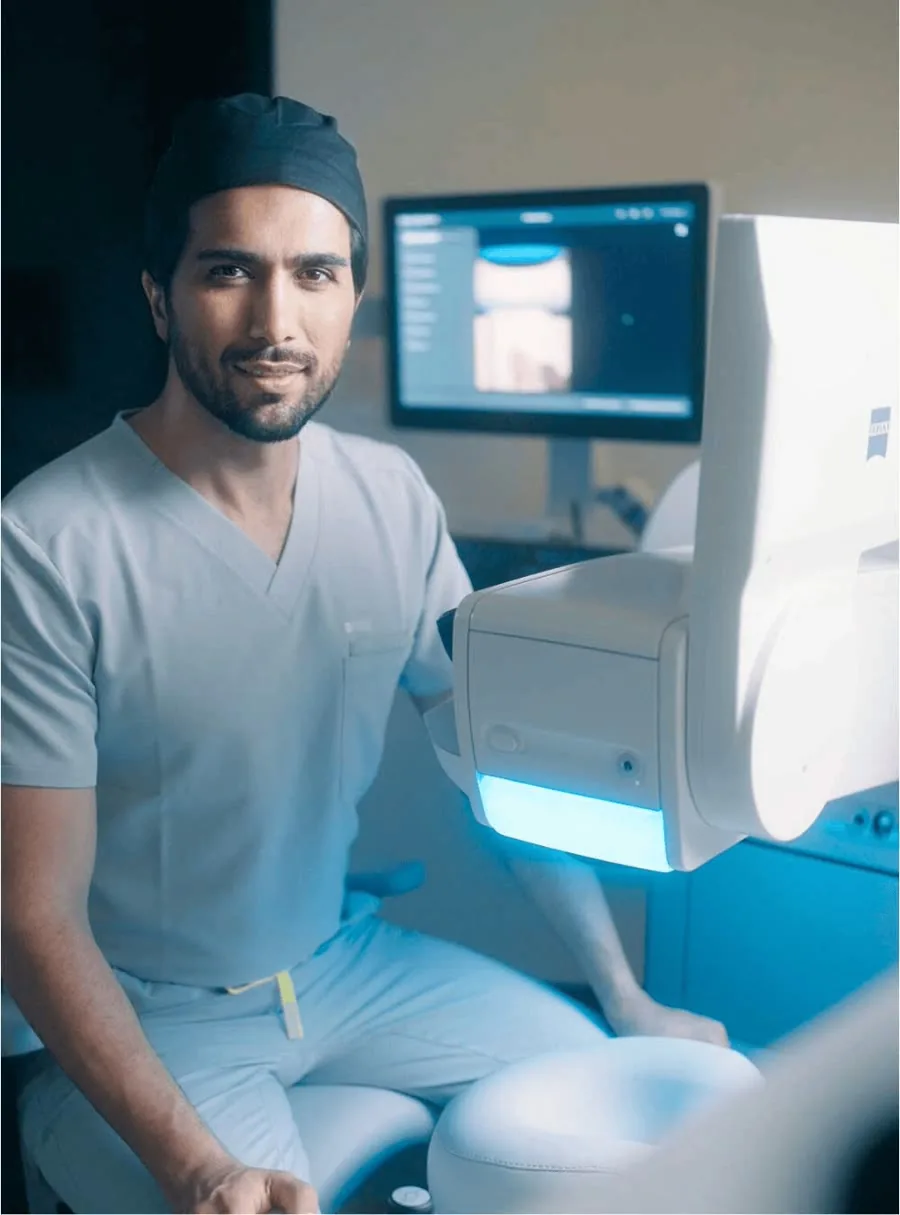
A doctor who does both.
Prof. Dr. Mehdi Shajari performs ICL and laser procedures himself. He has no reason to sell you one or the other: at dr.vision, laser (ZEISS VisuMax 800) and lens surgery are in one hand. Over 20,000 procedures, 12× FOCUS Top Doctor.

ICL or laser? Unsure?
We measure. Then you will know.
Jana from our Patient Care team answers your questions and arranges the pre-operative examination with Prof. Dr. Mehdi Shajari. You go home with a clear recommendation. Call around the clock, WhatsApp Mon–Fri 8:00–19:00, Sat 9:00–15:00.
Go deeper.
This page compares. The individual pages explain the process, healing and experiences in detail:
Process, suitability, long-term data and all risks of the implantable contact lens.
To ICL ProceduresThe keyhole laser up to −8 D: process, healing, results from 412 eyes.
To SMILE Pro ComparisonWhich laser procedure suits you if laser is an option.
To the laser comparison GuidesLimits, measurements and which options remain.
Read the guide ComparisonThe fundamental question, including lens exchange from 45.
View comparison CheckGuidance on all procedures in 2 minutes.
Start the check376 reviews. Average 5.0.
376 Google reviews give dr.vision an average of 5.0 out of 5 stars. dr.vision does not check whether Google reviews come from treated patients.
“Without time pressure, he advised me in a trustworthy, calm, open and competent way and involved me well in the decision about how to proceed.”
“I had researched intensively beforehand and knew that laser treatment was not an option for me - I absolutely wanted an ICL.”
“Prof. Dr. Shajari advised me extremely competently, thoroughly and clearly, and gave me a very good and safe feeling from the start.”
“The laser surgery went great! Many thanks to Prof. Shajari for the friendly and professional treatment!”
Four patients. In their own words.
Suddenly reading at a distance – a new world.
I really had a pleasant impression.
It is an absolute liberation.
It was a very good decision to come here.
Still have questions?
These are the questions patients ask most often in the consultation hours about this comparison. Prof. Dr. Mehdi Shajari
Up to −6 D, laser is usually the first choice with a normal cornea. Between −6 and −8 D, both paths are options; the corneal thickness, the pupil size and the eye surface decide. Above −8 D we recommend the ICL, because the laser would then have to remove so much tissue that vision quality and stability suffer.
Technically it is sometimes possible with a very thick cornea, but at dr.vision we do not use laser above −8 D. For −10 D, the laser would remove roughly 130 to 150 micrometers of cornea. Night vision gets worse, the correction regresses slightly more often, and the cornea is weakened. The ICL corrects −10 D without tissue removal and with very good image quality.
With a thin cornea, Femto-LASIK is usually ruled out because the flap costs additional thickness. With low prescriptions, Trans-PRK is often still possible; with higher prescriptions or a very thin cornea, the ICL, because it leaves the cornea untouched. With suspected keratoconus, we do not use laser.
The ICL. It is inserted through a small access at the edge of the cornea and does not sever the corneal nerves that control tear flow. After laser treatment, dry eyes are frequent in the first weeks, about 3 in 10 after SMILE Pro, more frequent after LASIK. We treat mild dryness beforehand; with pronounced dryness, we advise the ICL.
With both, serious complications are rare, but the risks are different. With laser, they affect the cornea (dry eyes, very rarely a bulging). With the ICL, the eye is opened; rare risks are a rise in pressure, earlier clouding of your own lens and an infection in the eye. With prescriptions up to −6 D, laser is the smaller procedure; above −8 D, the ICL is the safer choice.
In the first weeks, many people see halos after both procedures. After SMILE Pro, they still bother about 5 in 100 after three months. With high prescriptions, night vision tends to decrease after laser because the treatment zone has to be chosen smaller; there the ICL usually does better. We measure the pupil in darkness and discuss the risk beforehand.
The ICL, yes: it can be removed or exchanged for a different size, through the same small access. Laser cannot be reversed, because the removed tissue does not grow back. Remaining prescription after laser can often be enhanced, though; after SMILE Pro this is needed in about 2 in 100.
Then the ICL and your clouded own lens are removed in one operation and replaced with an artificial lens. This is a routine procedure. After laser treatment, cataract surgery is also quite possible; the calculation of the artificial lens is then slightly less accurate, so bring your old laser values.
Yes, in both cases. Both correct the refractive error, not the presbyopia that sets in from about 45. If you are already over 45, you should therefore consider Presbyond or a lens exchange, which addresses distance and near vision together.
Yes. With very high prescriptions and high astigmatism, we sometimes insert the ICL first and correct a small remaining value later with the laser. This combination is called bioptics. It is the exception, not the rule.
For ICL, an individually made lens is ordered for each eye, and there is also a more extensive pre-operative examination (anterior chamber depth, endothelial cells) and usually two surgery appointments. At dr.vision, ICL costs from €6,886 for both eyes, SMILE Pro €5,198, SmartSight €5,198, Femto-LASIK €4,298 and Trans-PRK €3,498, each as a guide price under the GOÄ.
Statutory health insurance usually does not; dr.vision is a private practice, and patients with statutory health insurance pay themselves. Private health insurers reimburse a share depending on the plan, more often with high prescriptions as with the ICL. Beihilfe pays only in exceptional cases, which differ by federal state. You can declare the costs as extraordinary expenses in your tax return. Whether and how much the tax office accepts depends, among other things, on your reasonable burden.
Medically reviewed by Prof. Dr. Mehdi Shajari · As of October 2026
Everything to read and pass on.
Arrives by e-mail in about 60 seconds. No newsletter, just the guide and, if you wish, a follow-up from Patient Care. Privacy policy
How would you like to continue?
It begins with a free consultation. This is followed by the detailed pre-operative examination with Prof. Dr. Mehdi Shajari: corneal tomography, anterior chamber depth, endothelial cells, tear film and pupil in darkness, plus a talk about whether ICL or laser is safer for you. You go home with a written recommendation and a cost estimate.
In Frankfurt, Junghofstraße 16 · all measurements included
Our locations.
 Opening hours
Junghofstraße 16, 60311 Frankfurt am Main
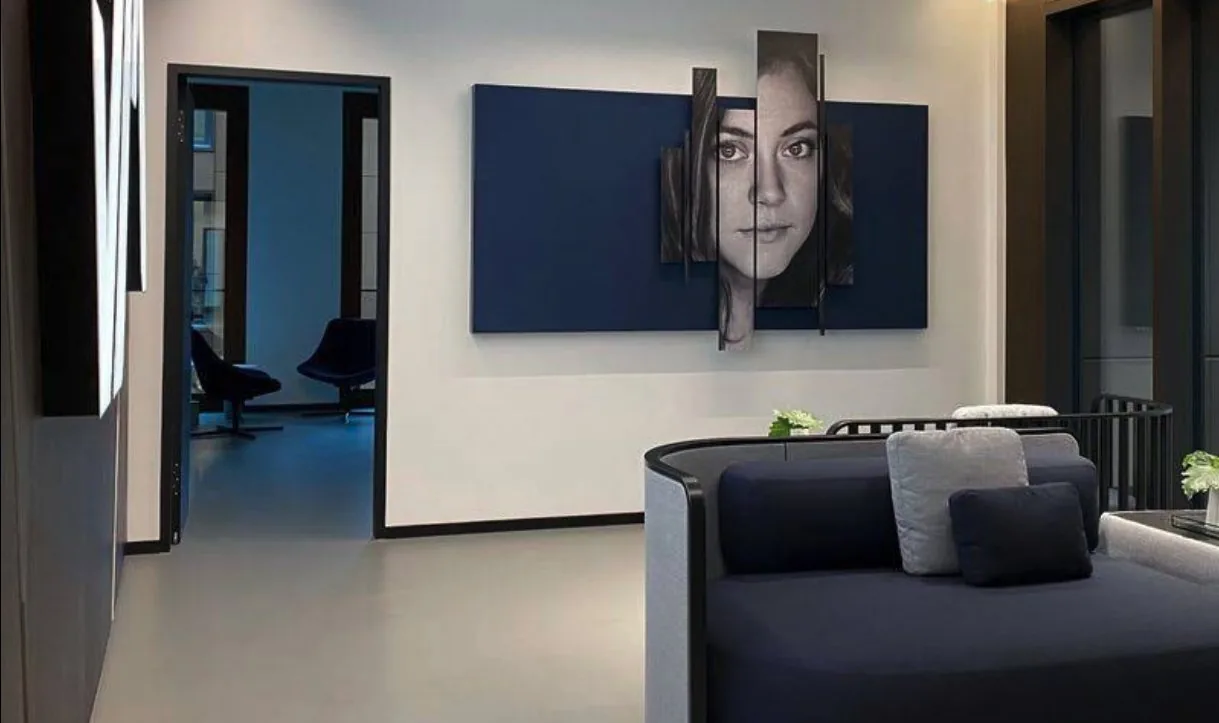 Opening 2027
Breite Straße 69, 40213 Düsseldorf (in the Neuer Stahlhof, corner of Graf-Adolf-Platz)
Until opening: preliminary talk in Frankfurt, Patient Care plans your travel.
Plan route Opening 2027
Lautenschlagerstraße 23, 70173 Stuttgart (2nd floor, step-free access)
Until opening: preliminary talk in Frankfurt, Patient Care plans your travel.
Plan routeI am Dominic Boeschen, 26 years old, I actually come from the region here, from Fulda, and have now moved to Frankfurt for my job, and I was severely nearsighted at minus 8 diopters in both eyes. I have been nearsighted since about 11th or 12th grade in school and have always worn glasses. Lately it had become so bad that even with glasses I only reached 80% vision.
Accordingly, I had looked into alternatives. I actually did not wear contact lenses, simply because it became enormously expensive with these diopters and astigmatism. So I played sports with glasses. And the sweating alone is annoying, because the glasses slide back and forth.
If the glasses then do not sit properly or move slightly, you suddenly do not see quite sharply. That lasts a few seconds, and I quickly missed a ball that way. That was extremely annoying. But when I was at the swimming pool with friends, it was not possible without my friends keeping an eye on me.
Because I could not see them. As soon as they were about 50 cm away, I only saw blurry shapes. I could no longer recognize the face. I no longer knew who it was.
LASIK unfortunately no longer worked for me. Or rather, Prof. Dr. Shajari had not recommended any laser surgery, because it would have been too risky.
Instead, he recommended the ICL, which is a bit more expensive but has significantly fewer risks, and accordingly I was very happy with it. I am now one day after the second surgery and we have just reached 160% vision. But it is already a huge difference, just when I get up, that I do not have to put on my glasses before I can see anything. Instead, I get up and walk to the bathroom completely normally, get ready and head out. I had not been able to do that for so many years.
I cannot do sports yet, or am not allowed to yet, but that will also make an enormous difference. With these high diopters it was very hard to follow balls, because everything moved relatively hard to see and the eye had to correct quite a lot. So I am hoping that the ICL implantation will make it clearly better. You still have this glass ball on the eye. That makes vision a little restricted for now, because there are only a few holes you can look through deliberately.
Because of the glass ball itself everything is a bit darker, but you can already tell that it is getting sharp. When the glass ball is taken off and you do this test here, meaning they really check again how much you see now with the new eye, with the new lens, then you notice a huge difference. I could read the numbers at a distance right away, whereas, with my nearsightedness, it is hard to describe, I could not see anything at all. And then suddenly I can read in the distance. It is really hard to describe, it is completely different, a completely different world.
I actually had consulted several doctors. I was given different recommendations in part. Some said you could still use a laser. Then I spoke with Prof. Dr. Shajari.
I simply felt much better advised. Everything went much faster than with all the doctors I had visited and talked to, who would have had it paid completely privately by me as a statutory health insurance patient. But even there I had more the feeling that it was about selling me something quickly. They always recommended doing something. But I was not told which would necessarily be better; it was simply said that the most expensive is the best, more or less.
When you read up on the internet, you see a lot of bad reports. You very rarely see good reports on the practices' own websites. But now, in the end, I simply relied on how Prof. Dr. Shajari advised me and I am super satisfied.
The whole surgery took maybe three, four, five minutes. Completely painless. I didn't feel anything. It was a bit strange because you looked into the light the whole time, but all good.
My name is Hovakimian. I am a dentist by profession. That means my eyes are very important for my work. I have been very nearsighted since childhood. That also meant a limitation, a big limitation, in sports too, especially water sports, so that you have to be afraid of what happens if you fall into the water, because I always wore contact lenses.
And as it turned out, since a very young age, since I was 15, I have been wearing contact lenses, probably. And at some point the cornea changes. And at certain times of the year I then had bigger problems. And that is how it came about. By chance, I actually came here last year, because I had massive problems.
I also did not tolerate the contact lenses and kept getting infections. And yes, that was what limited me in everyday life, as I said, because with this strong nearsightedness I can see much better with contact lenses than with glasses. And until then, because it was about my eyes and my strong nearsightedness had always made me afraid, I had not dared, because I was getting more and more limited. Both at work, because I kept having the feeling of a foreign body or having pain.
Then I had to take the contact lenses out. Then the tears flow. Or also, as I said, in my private life, during sports activities, where I was really limited. The hard contact lenses, with which I saw better, out, the soft ones in, in case I fall into the water while rowing. So limitations like these as well.
I was sitting in the practice and I had such massive problems. I mean, I had an inflammation or infection and I really had severe problems. I was sitting in the practice and googled. I think on the same day, because you can also make appointments online with him.
And there was the category urgent or pain. And then it worked out. And I had a gap in my schedule. That fit really well.
So sometime around noon. I think it was around noon that I came here. And yes, I really had a pleasant impression. Trustworthy, good, a good impression that he first took care of the problem. And I think I already said it at the first visit, that I have a panic fear of going blind. He took care of my concern, sounded very competent and trustworthy.
And I have to say, it went very, very well. I mean, he did tell me, but I still could not imagine it so well. But I have to say, it went fine. He also had a calming or maybe relaxing effect.
Because I am hyperactive myself. And he explained it so well. But still I could not imagine it. But still, the last surgery was last week. Well, some things are still hard for me.
But I was still able to see patients all day before the second surgery. It was strenuous for my eyes. I had a little pain, but it worked anyway. And I had imagined it to be worse. So it was good.
I do not know, he also seemed very relaxed during the surgery, so he had a calming effect. I like that. No matter what was going on around. Still, he was very focused and had a calming effect. Especially because I was so tense.
On the whole, yes, that he explains well, that he takes good care of the patients. That inspires trust. It is already, well, now I can say it. It was the right decision. Maybe one should take courage after all. And yes, when the time comes, then you know.
But still take courage and then get advice. I mean, if you are very nearsighted. Because these days, technically speaking, there are really many options. I mean, when it comes to the eye area. Then I would say that today there are many technical options. If possible, if you have the options, then you should also use them.
My name is Raquel Schulze Wischeler. I have basically worn glasses since I was 13. I was really nearsighted, you could say. Really, really. I could only see outlines without glasses. I had minus 6 in one eye, a diopter of minus 6, and almost minus five in the right one. I think everyone who wears contact lenses or glasses knows how stressful all of that is. The eye dries out completely. In the evening, when you are lying on the couch, you notice, okay, my eye is super tired, I really do not feel like doing anything anymore. Whether it is contact lenses or glasses. With that diopter, you have rather thick lenses, and you notice that over the day too. And just getting the feeling, or knowing, hey, I do not have to wear anything anymore, neither glasses that I always have to clean, nor contact lenses where I have to watch hygiene, that is an absolute liberation. And that felt more like a dream to me, and then I said, okay, now you dare to do it, and so I will do it.
Interestingly, I had already thought about having my eyes lasered about five years ago, but I was very afraid and then dropped the idea again. And lately I had big problems with my eyes because of chalazia, because my glands in the eyelids do not quite work, and so I had surgery twice. And then I said, okay, since I have already had surgery on my eye, you might as well dare it once more. And then I first just googled, came across dr. vision, saw, oh, there are really great reviews, and by coincidence my eye doctor had worked with him at the university hospital in Munich, and I had an eye doctor appointment beforehand and told her about it, I am getting my eyes lasered, and then she said, well, where? Then I told her the doctor's name. And then she said, yes, I know him, I worked with him. You can go there, he specializes in this, he is really great. And that took away the last bit of doubt for me.
And yes, then I came, had an appointment the next day. And right away I had the feeling that I was in the right hands. He sat down with me, explained all the risks to me, explained how it works, showed me the treatment room. And then the fear was somehow gone, and then I said, okay, I am doing it here. I was thrilled by the professionalism, first of the practice itself, which is superbly organized, and by the speed. You do not have long waiting times, you are examined, you have the feeling, okay, here they really examine thoroughly and extensively, and then of course it is explained to you on the screen, you can see it. So that was just totally professional for me. And so I felt safe right away.
Yes, my biggest fear was the eye itself. It is on the eye. And you have a reflex, a physical one. And the question of course was, okay, do I react, and does something go wrong because of that. But the fear was taken from me relatively quickly. I also talked about the fear. And then during the treatment I saw that the eye was held still. I did not feel that either. And then I calmed down relatively quickly. And I knew the eye was numbed. And so everything worked quite well.
I have no pain. I feel that something has happened to the eye, like a slight pressure, but it is one day after. I was already at work today, I have no pain.
Absolutely, so I can answer that question with yes, and go for it. It's not bad at all, it doesn't hurt at all, it's quick, and the healing process is pretty much there a day later. And it's an absolute quality of life. That's totally great.
I’m Teresa Schwenger, I’m 31 years old, I’m a project manager. I was nearsighted, so I didn’t see well at a distance, and at some point it was just super annoying with contact lenses, putting them in every morning, taking them out again in the evening. I think I wore contact lenses for about ten years, and then I also had the problem that my eye was no longer supplied with oxygen so well, which is why the little vessels grew further into the eye, and so I looked around for an alternative. Glasses were not an alternative for me, because I simply don’t like myself in glasses. It was always an issue with the swimming pool or the lake or the sea. Do you put your contact lenses in, can you dive, do you maybe lose a contact lens, and that was always really annoying. Or also when you stayed somewhere overnight, you always had your little contact lens case, your solutions and care products, which you had to take along, always a whole pack just for the contact lenses. I always found that very annoying, and also on long days, when I had put my contact lenses in very early, in the evening while watching TV I noticed, oh, this really annoys me now, I would like to take them out, and then watching TV with glasses on a couch, really very uncomfortable, and so that was a situation where I am now grateful that I will hopefully or probably never have them again.
And then I looked at which doctors in this area offer laser eye surgery, and I read through lots of reviews and looked at who is very good here. And the doctor here is really rated very, very highly, and I had a totally likeable first conversation with him and felt comfortable right away. I also saw all his awards, the FOCUS awards and so on, which reinforced my impression, and also lots of positive reviews, which I can confirm. So you feel very comfortable, and the work here is very professional. So it was a very good decision to come here, definitely.
Not quite so good. I was very nervous, had many worries and fears too. I would have liked to leave again right away on the day when I was sitting here. But I was received super kindly and warmly. Everything was explained to me well. Everyone was very warm, and they took the nervousness away. So I felt I was in good hands, and when it then started, the nervousness was already a bit less, because I knew that I was simply in good hands.
So I simply arranged the appointment, the first appointment, online, and then I got a call asking me to please stop wearing contact lenses from that point on, so that the eyes are already free of contact lenses, because things can still change there. Then the parking garage is right next door, you walk in here, and it is a very beautiful building and a very beautiful practice, definitely. I was welcomed warmly right away by the receptionists. Everything was explained to me well right away. I was given water and everything. Then I had the first tests. I was totally amazed at how many tests were done and with which devices. It's really incredible what names are on the devices and how expensive these devices are. But really everything was measured that I think can be measured in an eye. Then I had the conversation with the doctor. That was also really great, warm. He answered all the questions I had and took the time for me. I then said I would rather sleep on it for another night, because I am simply the type of person who plays it safe. But at home I actually already knew that I would like to have it done. The next day I called again and made a second appointment. The eyes were checked once more, again with a colleague of the doctor and with him. And then I had another informed-consent talk about what risks there are. I was able to ask my questions again and then got my treatment appointment very quickly. And on the day of the treatment, as I said, I was already here super nervous, but I was also welcomed very warmly. Many of my worries and fears were taken away.
Yes, exactly. So I got up this morning and I could see right away. That was my biggest worry, that I would no longer be able to see as I did before, but I could see perfectly right away. I also saw at a distance again. That was the exciting part in my case. I looked out of the window and also noticed the trees farther away. The outlines, which I otherwise always saw only like this, were clear and distinct. So it really is a change right away. I notice it totally, and it’s super nice.
Definitely, yes, absolutely. I felt super comfortable from the first second to the last. So definitely, if I ever have laser treatment again, then definitely here. I can only recommend it to everyone.
Yes, I definitely should have done it earlier, that's true, because I believe it really gives you a lot of quality of life back, and it is also good for the eyes. Of course, there is the treatment itself, but in the long run, as it was with me, because of the contact lenses, I had these tiny blood vessels, or I have them in my eye, because the eyes were not supplied well. Had I done this earlier with the lasers, it might not be as pronounced. So my appeal would be to do it earlier rather than too late.