 dr.vision
9 of 10
of our trifocal patients no longer need glasses.
Start here
What suits you?
Find out in 2 minutes which procedure suits your eyes.
Start the Suitability CheckOr by age:
< 45yearsGet rid of glasses & contact lenses 45–64yearsGet rid of reading glasses 65+yearsCataract & glasses-free★★★★★ 5.0 · 376 Google reviews · 20,000+ procedures
Decide well
What you should know beforehand.
Who operates?Prof. Dr. Mehdi ShajariFOCUS Top Doctor · operates on every patient personally What does it cost?Laser from €3,498 · Lenses from €6,886Prices for both eyes Is it safe?Safety & risks When will I be fit again?Work, sports, driving Would you rather read in peace first?Decision Guide Freedom from GlassesProcedures
Laser or lens?
Laser eye surgery
SMILE ProSmartSightFemto-LASIKTrans-PRKPRKPresbyond (laser away your reading glasses)All laser procedures at a glanceLaser procedures compared ›Lens surgery
ICLLens exchange (reading glasses)Cataract surgery with premium lensLens types: trifocal, EDOF, toricLens types compared ›Start here
Something wrong with your eyes?
A thorough eye check-up with us clarifies what is behind it.
Book an eye check-up★★★★★ 5.0 · 376 Google reviews
Comparison · Artificial lenses
Trifocal, EDOF or monofocal.
Whether for cataract or lens exchange: the surgery is always the same, the lens determines how you see afterward. Here we compare all lens types in the situations of your daily life, with honest numbers on freedom from glasses and light effects. Prof. Dr. Mehdi Shajari advises you on which one suits your daily life.
 12× FOCUSTop Doctor
In short.
If you drive a lot at night, have a retinal disease or do not mind reading glasses, monofocal serves you best. If you want distance and screen without glasses and few halos, choose EDOF. If you want to live entirely without glasses and have healthy eyes, choose trifocal: 9 in 10 trifocal patients at dr.vision no longer need glasses.
Monofocal if …
€6,998 both eyes
EDOF if …
€7,242 both eyes
Trifocal if …
€7,876 both eyes
Five numbers that decide.
9 of 10
of our trifocal patients no longer need glasses.
<1 of 10
still find halos bothersome after three months with trifocal. At first 3 in 10.
97%
of eyes reach 80% visual acuity or more.
1 of 3
needs the toric version because of astigmatism.
244 €
more for EDOF than for monofocal, both eyes. Trifocal: €878.
22 criteria. Four paths.
Trifocal leads in freedom from glasses, monofocal in contrast and night vision, EDOF in between. The table shows vision without glasses at every distance, light effects, suitability with eye diseases and price side by side, plus monovision as a path with monofocal lenses.
← Swipe sideways to compare →
Compare EDOF with:
| Criterion | Monofocalone focal point | Monovisiontwo monofocal lenses, one eye for near | EDOFextended depth of focus | Trifocalthree focal points |
|---|---|---|---|---|
| How you see without glasses | ||||
| Distance (street, TV) | sharp, best contrast | sharp with the distance eye | sharp | sharp |
| Screen, dashboard (70 cm) | with glasses | usually without | without glasses | without glasses |
| Phone, book (40 cm) | with reading glasses | mostly without, slightly less sharp | often with light reading glasses | without glasses |
| Fine print in low light | Reading glasses | Reading glasses | Reading glasses | sometimes reading glasses |
| No glasses at all | rare | often in daily life, fine print with glasses | frequently, except for fine print | 9 in 10 of our patients |
| Depth perception | unchanged | slightly reduced | unchanged | unchanged |
| Light effects and contrast | ||||
| Halos at night | practically never | practically never | low, depending on the model less often than trifocal | bothersome in 3 of 10 at first, under 1 of 10 after 3 months |
| Contrast at dusk | best | good | almost like monofocal | slightly reduced |
| Night driving, frequent drivers | ideal | good | good | with adaptation, professional drivers rather not |
| Adjustment | immediately | Days to weeks | a few weeks | weeks to months |
| Who it suits | ||||
| Macular disease, diabetes of the retina | yes | yes | in individual cases | no |
| Glaucoma with visual field loss | yes | yes | in individual cases | no |
| After previous laser eye surgery | yes | yes | often good | only with a regular cornea |
| Very large pupils at night | yes | yes | yes | rather not (more halos) |
| Astigmatism | toric possible | toric possible | toric possible | toric possible |
| Precision professions, pilots | yes | to be clarified | usually yes | rather not |
| Long term and costs | ||||
| Durability | lifelong | lifelong | lifelong | lifelong |
| Secondary cataract | about 1 in 10 within 5 years, the same for all | about 1 in 10 within 5 years, the same for all | about 1 in 10 within 5 years, the same for all | about 1 in 10 within 5 years, the same for all |
| Adjusting later | Laser, add-on lens | Laser, add-on lens | Laser, add-on lens | Laser, add-on lens; exchange in the first months |
| Price of cataract surgery, both eyes | €6,998 | €6,998 | €7,242 | €7,876 |
| Toric | Surcharge on request | Surcharge on request | Surcharge on request | Surcharge on request |
| Reimbursement by private health insurance (plan) | mostly in full | mostly in full | Monofocal portion, the rest depends on the plan | Monofocal portion, the rest depends on the plan |
Advantage in this criterionPrices: guide prices for both eyes under the German fee schedule for physicians (GOÄ), for cataract surgery; lens exchange from €6,998
State of the evidence: distance similar for EDOF and trifocal, near better with trifocal, contrast better with EDOF (Cochrane Review CD014891, meta-analyses). Individual pages: Trifocal lens · EDOF lens · Toric lens · Monofocal & other lenses
Distance. Screen. Reading.
Each lens distributes light differently across the three distances of daily life: distance from 5 meters, screen at arm's length, reading at 40 centimeters. Tap through and see where you would still need glasses with which lens.
Tap a lens type. The three images show what you see with it without glasses.

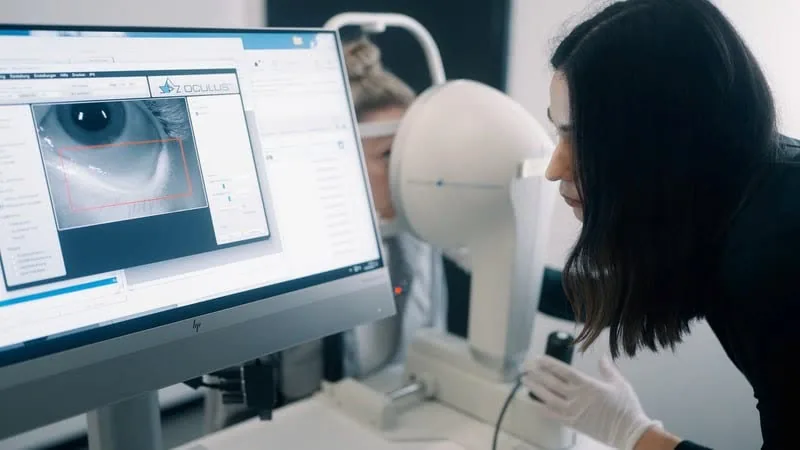
The proven standard with the best contrast and practically no light effects at night. Street, TV, faces without glasses; screen and phone with glasses. For people who drive a lot at night, have a retinal disease or are not bothered by reading glasses, often the wisest choice.
The dominant eye gets a lens for distance, the other is set to be slightly nearsighted (about −1.0 to −1.5 D). The brain uses the right eye for each distance. Practically no halos, monofocal price. In return, somewhat less depth perception; small print remains difficult. We test it beforehand with contact lenses.
Extended depth of focus stretches the focal point into one range instead of splitting it. Driving, cooking, laptop, dashboard without glasses, with almost monofocal contrast and clearly fewer halos than trifocal. Our most frequent recommendation for active people who drive at night.
The light is distributed to distance, screen and near. About 9 in 10 of our trifocal patients manage daily life without glasses. The price: rings around light sources at night, bothersome at first for 3 in 10, after three months for fewer than 1 in 10. Not for macular diseases.
Astigmatism? Then a toric version is added to each type, otherwise every image stays slightly distorted. About one in three people needs it.
Ten everyday moments. Three lenses.
Patients rarely ask us about diopters, but: Can I drive at night? Use the laptop without glasses? Read the menu? The table shows what you can expect with each lens in ten typical situations.
| Situation | Monofocal | EDOF | Trifocal |
|---|---|---|---|
| Driving by day | without glasses | without glasses | without glasses |
| Driving at night, in rain | clearest | good, few halos | halos around headlights, usually less bothersome over time |
| Navigation display, dashboard | often blurry without glasses | sharp | sharp |
| Laptop, screen work | computer glasses | without glasses, the strength of this lens | without glasses |
| Phone, news | Reading glasses | large print without, small print with light glasses | without glasses |
| Book, newspaper | Reading glasses | mostly light reading glasses | without glasses, in good light |
| Menu in a dark restaurant | Reading glasses | Reading glasses | often without, in very little light sometimes with |
| Cooking, housework | partly glasses | without glasses | without glasses |
| Golf, hiking, cycling | without glasses, scorecard with | without glasses | without glasses |
| Handicrafts, precision mechanics | Reading glasses | reading glasses for the finest work | without glasses, very fine work possibly with a magnifier |
“I first ask what you want to see without glasses in daily life, such as the laptop or the menu. The lens follows from that more than from the diopters.”
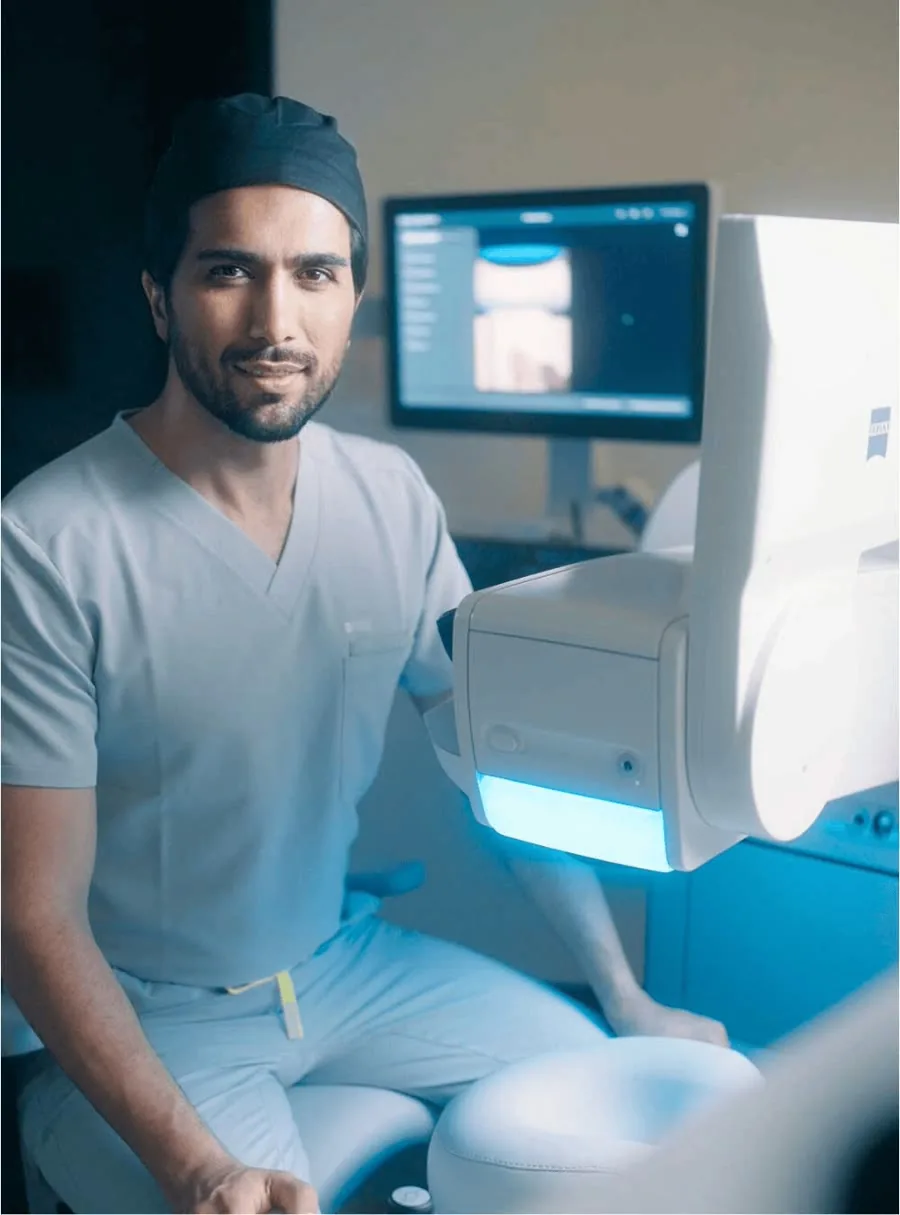 Prof. Dr. Mehdi Shajari
The price of freedom from glasses.
The more focal points a lens has, the more often you see rings around lights at night. With trifocal they bother 3 in 10 at first, fewer than 1 in 10 after three months. EDOF produces clearly fewer, monofocal practically none. Anyone who has seen the effects beforehand chooses more confidently.

Simplified depiction. Photo: Patrick Tomasso, Unsplash (CC0).
Night vision: tap an effect. The photo shows what it looks like.
The lens does not change after surgery; the halos are always there optically. What changes is the brain: it learns to filter out the additional, blurred images of the focal points not needed at the moment. This process is called neuroadaptation. It usually takes a few weeks to a few months.
That is why we ask again specifically after three months. Most people then say they still see the rings when they pay attention, but they are not bothersome. For very few it stays bothersome; then drops, a fine correction or, rarely, a lens exchange in the first months sometimes help.
Large pupils in the dark, an irregular cornea, dry eye and a small residual error in lens power increase light effects. We measure the pupil in darkness, treat dry eye beforehand and correct astigmatism with a toric lens. This makes the risk for you personally smaller than average.
Not every lens suits every eye.
Multifocal lenses split the light. A healthy eye copes well with that; a diseased retina needs every bit of contrast. That is why, before choosing a lens, we examine the macula (OCT, cross-sectional scan of the retina), optic nerve, cornea and pupil.
Age-related macular degeneration, epiretinal membrane, diabetic changes: monofocal, possibly monovision. Not trifocal, EDOF only in individual cases.
In advanced glaucoma the contrast reserve is low. Monofocal is the safe choice, also because later visual field tests are harder to interpret with multifocal lenses.
After LASIK, SMILE or PRK the cornea is changed. EDOF often works well, trifocal only with a regular cornea. Old laser values help with the calculation.
Very large pupils in the dark increase halos. Professional drivers, pilots, surgeons at the microscope: EDOF or monofocal, after consulting the employer or aviation medical examiner.
An irregular cornea distorts the image of every multifocal lens. Here mostly monofocal, possibly toric.
Then all lenses are open to you. Your daily life is what matters. And honestly: perfectionists who notice every small disturbance are often happier with EDOF or monofocal.
The paths between the lenses.
Not every solution means “one lens for both eyes”. With monovision you gain near vision without halos at the monofocal price. With mix & match you combine EDOF and trifocal. And every lens is available as toric if astigmatism is also present, in about one in three people.
Monovision
Two monofocal lenses, the second eye slightly nearsighted (about −1.0 to −1.5 D). Practically no halos, monofocal price. Test beforehand with contact lenses.
Mix & Match
EDOF in the dominant eye, trifocal in the other: more near vision than two EDOF lenses, fewer halos than two trifocal lenses. The decision often follows after the first eye.
Toric
Any lens type with built-in cylinder correction, useful from about 1.0 D. Must be aligned exactly. Additional charge on request.
With premium lenses we usually operate on the second eye one week after the first. In that week we see how precisely the first eye hit the target and how you get along with the lens. Then we adjust the calculation for the second eye or, if needed, choose a different lens type (mix & match). With monofocal lenses, surgery on both eyes on the same day is also possible on request.
A small residual error can be corrected by laser or with a thin add-on lens in front of the first one, which can even add multifocal power. Exchanging the lens is easiest in the first months. If a laser fine correction is medically appropriate, under our concept it is usually possible within 6 months without a co-payment.
Four questions. A first orientation.
Tap what applies to you. The recommendation follows the questions that Prof. Dr. Mehdi Shajari asks in the lens consultation. It does not replace an examination, because only the OCT shows whether your retina tolerates a multifocal lens.
Your orientation
Orientation, not a diagnosis. Which lens suits you is decided by retinal OCT, corneal measurement, pupil and the conversation with Prof. Dr. Mehdi Shajari.
The extra cost, calculated honestly.
At dr.vision, cataract surgery for both eyes costs €6,998 with a monofocal lens, €7,242 with EDOF and €7,876 with a trifocal lens, billed as a private medical service under the German fee schedule for physicians (GOÄ), including pre-operative examination, surgery and aftercare. Lens exchange without cataract also starts at €6,998.
Best contrast, practically no halos. Reading glasses needed; with monovision, more near vision.
€6,998both eyes
Distance to screen without glasses, hardly any halos.
€7,242both eyes
All distances, mostly without glasses, halos at first.
€7,876both eyes
Corrects astigmatism, for every type.
on requestExtra charge per lens type
Guide prices for both eyes under the German fee schedule for physicians (GOÄ), not a fixed price; written cost estimate after the pre-operative examination. Financed from €3.90 a day* (€119 a month over 72 months with down payment) or from €583 a month interest-free over 12 months directly at dr.vision: Calculate monthly installment · What does insurance pay for cataract?
* Representative example: €6,497.47 net loan amount after a €500.53 down payment · 72 months · fixed nominal interest rate 9.49% p.a. · 9.90% effective annual interest rate · monthly installment €118.72 · total amount €8,547.84 (with down payment €9,048.37) · via medipay. Alternatively 0% over 12 months directly at dr.vision.
For cataract, private health insurance (PKV) plans usually reimburse surgery with a monofocal lens in full. In many plans premium lenses count as an additional service: you pay the surcharge yourself, and some plans also cover it. More on private health insurance
Surgery and standard lens under the German fee schedule for physicians (GOÄ) are eligible for Beihilfe (allowance for German civil servants); for premium lenses, separate rules apply depending on the federal government or state. With our cost estimate you can clarify in advance with your Beihilfe office what it covers. More on Beihilfe
dr.vision is a private practice without statutory health insurance accreditation; you pay yourself, after a written cost estimate. You can declare the costs as extraordinary expenses in your tax return. Whether and how much the tax office recognizes depends, among other things, on your reasonable burden. More for patients with statutory health insurance · Deducting costs from your taxes
At dr.vision the extra cost is €244 for EDOF and €878 for trifocal, for both eyes. An artificial lens lasts a lifetime; operated at 65, that is roughly 20 years. Over that time the trifocal lens costs about €44 more per year than the monofocal lens, less than a good pair of reading glasses. Whether it is worth it for you depends less on money than on whether you accept the light effects and whether your retina allows it.
He does research, teaches and trains.
Prof. Dr. Mehdi Shajari advises you personally on lens choice and operates on every patient himself. He implants all lens types, which is why he recommends the one that suits your daily life, even if it is the simplest. Over 20,000 procedures, 12× FOCUS Top Doctor.
“At night behind the wheel you see most clearly with the monofocal lens. Anyone who drives a lot at night is often better served by it, even if they need glasses for near vision.”
Prof. Dr. Mehdi Shajari
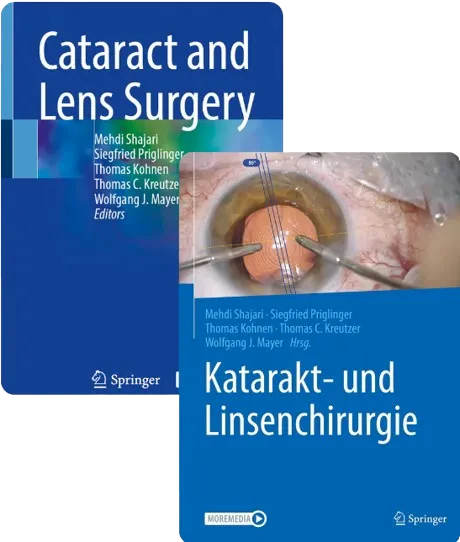
Prof. Dr. Mehdi Shajari has published numerous papers on freedom from glasses, teaches, and has trained several colleagues in this field.

Not sure which lens suits you?
We clarify that together. Call us.
Jana from our Patient Care team answers your questions and arranges the lens consultation with Prof. Dr. Mehdi Shajari. Phone available 24 hours, WhatsApp Mon–Fri 8:00–19:00, Sat 9:00–15:00.
Go deeper.
This page compares. The individual pages explain each lens in detail:
Who it is worth it for, patient experiences, halos, costs.
To the trifocal lens LensExtended depth of focus: strengths and limits.
To the EDOF lens LensHow astigmatism is corrected in lens surgery.
To the toric lens OphthalmologySymptoms, when to operate, how the surgery goes.
To cataract ComparisonGet rid of reading glasses with laser or lens.
View comparison GuidesThe guide with a decision tree.
Read the guide376 reviews. Average 5.0.
376 Google reviews give dr.vision an average of 5.0 out of 5 stars. dr.vision does not check whether Google reviews come from treated patients.
“A new generation of AI-generated lenses is made by Rayner (Galaxy). These are implanted, among others, by the renowned practice Dr Vision. Prof Dr Shajari has very extensive experience with Galaxy, among others, and convinced me both professionally and organizationally. In terms of price, none of them differ much!”
“I give a clear recommendation for Prof. Shajari and his team. From the first, very informative conversation to my lens surgeries, I felt in the best hands.”
“I am happy about my two new lenses. And about having decided on treatment with Dr. Shajari.”
“His explanations and advice are factual and easy to understand. He operates with confidence and very successfully.”
Four patients. In their own words.
I wanted my life back – without glasses, without headaches.
Now I can already read things again.
I was allowed to take off the bandage that very afternoon.
I saw wonderfully bright light.
Still have questions?
These are the questions patients ask most often in the consultation hours about this comparison. Prof. Dr. Mehdi Shajari
None is the best for everyone. Monofocal offers the best contrast and practically no light effects, but you need glasses for reading with it. EDOF makes distance and screen glasses-free with few halos. Trifocal makes 9 in 10 of our patients completely glasses-free, with halos at night in the first months. What matters is your daily life and your retina.
EDOF. It produces clearly fewer halos and keeps more contrast at dusk. With a trifocal lens, 3 in 10 find halos bothersome at first, and fewer than 1 in 10 after three months. For professional drivers we recommend EDOF or monofocal.
For many, yes: at dr.vision the extra cost compared with the monofocal lens is €244 (EDOF) to €878 (trifocal) for both eyes, for a lens that lasts a lifetime. If you drive a lot at night, have a retinal disease or do not mind reading glasses, you are often better served by the monofocal lens.
Both eyes get a monofocal lens; the dominant eye is set for distance, the other slightly nearsighted (about −1.0 to −1.5 D). This way many people manage daily life without glasses, without halos and at the monofocal price. Drawback: slightly less depth perception. We test it beforehand with contact lenses.
The brain usually needs a few weeks to a few months to use the new optics and filter out halos. After three months, most patients report that halos hardly bother them anymore. With EDOF, adaptation is faster; with monofocal lenses none is needed.
Large print, a phone with normal font size and price tags, mostly yes. For fine print, package inserts or in weak light, most people need light reading glasses. If you want to manage entirely without reading glasses, choose trifocal or mix & match.
If you have astigmatism of about 1.0 D or more, usually yes. Without toric correction, the image stays slightly distorted, and multifocal lenses lose effectiveness. The toric version is available for every lens type for an additional charge.
People with macular disease, diabetic retinal changes or glaucoma with visual field loss, with an irregular cornea, very large pupils at night, and jobs with the highest demands on night vision and contrast. For them, EDOF or monofocal is safer.
After laser correction the cornea is changed; this affects the lens calculation and the image quality of multifocal lenses. EDOF lenses then often work well, trifocal lenses only with a regular cornea. Bring your old laser values with you, if available.
Possible, easiest in the first months, before the capsule fuses with the lens; later it is more involved. More often a thin add-on lens or a laser fine adjustment is enough. That is why, with premium lenses, we operate on the eyes one week apart and adapt the second eye to the result of the first.
At dr.vision, cataract surgery for both eyes costs €6,998 with a monofocal lens, €7,242 with EDOF and €7,876 with a trifocal lens, as a guide price under the GOÄ, including the pre-operative examination, surgery by Prof. Dr. Mehdi Shajari and aftercare. For the toric version an extra cost applies on request.
For cataract, private insurers and Beihilfe (allowance for German civil servants) usually reimburse surgery with a monofocal lens, and the extra cost for EDOF or trifocal depending on the plan; with Beihilfe, depending on the federal or state rules. Patients with statutory health insurance are self-paying patients at dr.vision, because we are a private practice. For lens exchange without cataract, reimbursement depends entirely on the plan.
Medically reviewed by Prof. Dr. Mehdi Shajari · As of October 2026
Everything to read and pass on.
Arrives by e-mail in about 60 seconds. No newsletter, just the guide and, if you wish, a follow-up from Patient Care. Privacy policy
How would you like to continue?
You book the lens consultation by phone or online. The first appointment is a free consultation. This is followed by the detailed pre-operative examination with Prof. Dr. Mehdi Shajari: lens, macular OCT, cornea, pupil and biometry (measurement of the eye), plus a conversation about which lens suits your daily life. You go home with a written recommendation and a cost estimate.
In Frankfurt, Junghofstraße 16 · all measurements included
Our locations.
 Opening hours
Junghofstraße 16, 60311 Frankfurt am Main
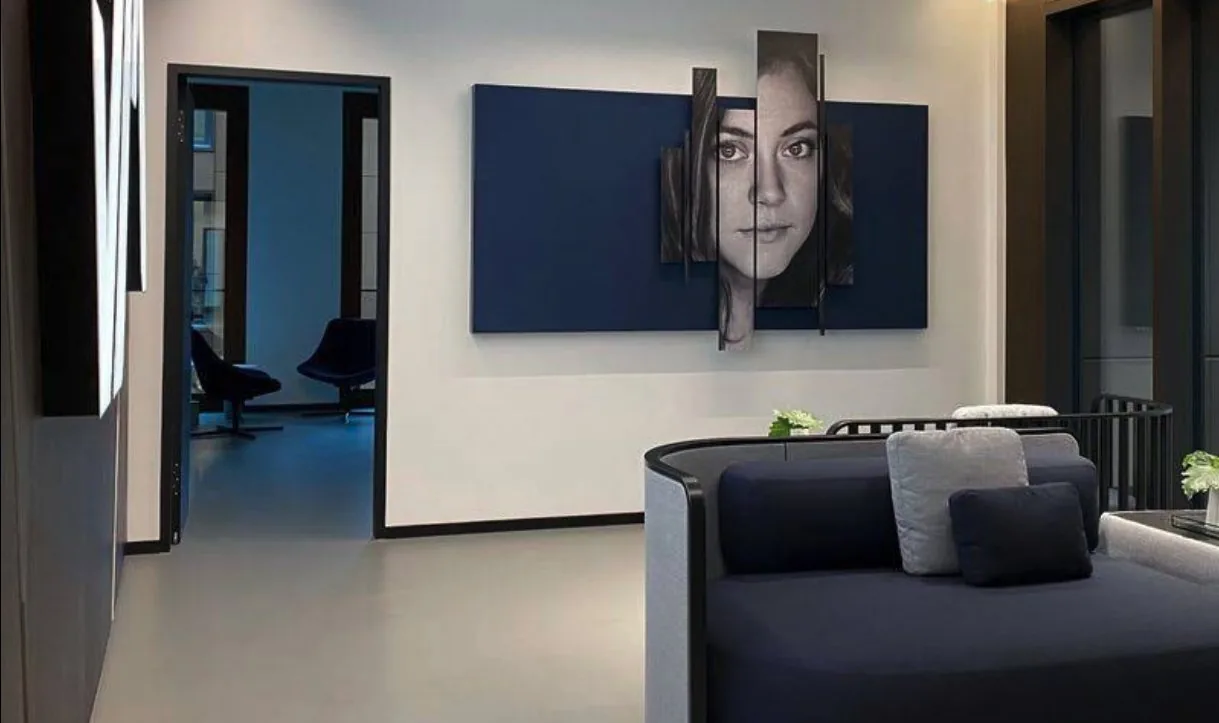 Opening 2027
Breite Straße 69, 40213 Düsseldorf (in the Neuer Stahlhof, corner of Graf-Adolf-Platz)
Until opening: preliminary talk in Frankfurt, Patient Care plans your travel.
Plan route Opening 2027
Lautenschlagerstraße 23, 70173 Stuttgart (2nd floor, step-free access)
Until opening: preliminary talk in Frankfurt, Patient Care plans your travel.
Plan routeMy name is Simone Richter. Before the treatment I had the problem, above all or increasingly, that I could not see well at all anymore at near and intermediate distance, which bothered and limited me extremely. For one thing at work, but of course also in private life, when you go hiking and want to read a map and can't see anything anymore and your glasses fog up or you lose them or break them, which I'm a great artist at. That bothered me a lot, limited me a lot. On top of that, wearing glasses felt to me like it triggered migraines, so the headaches bothered me a lot too, and that is why I decided on the surgery.
I got a lens exchange, so a new trifocal lens, which also comes with certain compromises, I have learned you always have to make a compromise, and and since the topic of freedom from glasses was very important to me, I decided on the trifocal lens.
So I actually came across Professor Shajari on the internet and had the first appointment with the intention of slowly getting used to the idea of progressive glasses. That would have been the next step. I had not dealt with the topic of surgery at all beforehand, because basically I am rather against having anything operated on without great need. And then in the conversation I felt, how should I put it, well taken care of. I did not feel pushed in any direction at all, just got information I did not have before. And with that I started to look into the topic. In between I also dropped it again, but then, through everyday activities, everything I just mentioned, hiking, swimming, cycling, where glasses really torment me, I thought, okay, I'll try this, and I also simply built up trust over time. That was all something that gave me a lot of reassurance, because Professor Shajari always took a lot of time. You know how it is with doctors, and I understand it too. There is a lot of pressure with queues of patients, and in the end you probably always have to answer the same questions. But I always had the feeling that there was enough calm to answer my questions.
The actual course of the surgery, from the pre-operative examinations to the appointment, goes very fast, it is very easy, much easier. I panicked a lot the evening before the first eye and thought, oh my God, how will this go? My head will be screwed down Hannibal Lecter style so that I don't flinch. And I worked myself into my horror scenarios. And it was all actually very relaxed. A very, very nice, good-humored team in the surgery center as well, which I think also helps a lot as a patient. And yes, it goes in no time, you don't feel anything, I think I can say that, and you go home again and everything is fine.
What was very astonishing for me was that I actually did not feel it at all, so during the surgery 0.0 pain. There was one point where Professor Shajari said, now comes a little pressure, and a little pressure came. To call that pain would be saying too much, but you really don't feel more than that. I must say, though, that between the two surgeries, from the first to the second eye, I felt even more unsure, even though that was always well handled and explained.
I think before the surgery it was also very important that, in my perception, it was explained realistically. It was explained well that it is a compromise, that in some ranges of vision it would get worse, but that in sum a visual ability that allows freedom from glasses will result. Now of course that is very subjective. So what does it mean, I will see worse in some ranges? That was a really big panic point for me and it stayed very strong in the time from the first eye to the second eye, because after the first eye I of course had the issue that I had one eye not operated on that doesn't see well and one operated eye that sees so-so after the surgery. Already much better. I also got a smile from people often, because on the second day I could already read with the operated eye, which would have been unthinkable before the surgery and which was also a really big pain point for me. But this panic still led me to this fear, what have you done, you had something operated on for the worse, because of course with glasses an operated and a non-operated eye create a really awkward situation. And now, today, day one after the surgery on the second eye, I am actually very happy at the moment.
I did good research beforehand. I also called my health insurer to ask how they view such operations. I deliberately chose Professor Shajari because he also has a good reputation. You hopefully only do this once in your life, and you don't have, you don't know, so I asked around my circle of acquaintances. What experiences have people had with these operations, which interestingly didn't give such positive feedback in my case. However, they were not patients of Professor Shajari, and some of it was also a while ago, I have to say. Medicine has surely progressed since then. That unsettled me and it was also one of the reasons why I first backed away from the operation again in my carousel of thoughts. But I believe in tapping all the information channels you have, asking all your questions, and really choosing a doctor who gives you a good gut feeling. Because I believe, with all these topics, you can check a lot of facts, and you should. But you also have to have a good feeling.
And I am not now, it was partly also an indication with the cataract in my case. And I am not that old, I could have gotten around this surgery with glasses for a while longer. I am 55, I could certainly have worked around such a surgery with glasses for a while. You have to really think it over carefully, I believe, then that also gives you a good feeling yourself. And if you then feel in good hands, which was the case here, then it can work well.
My name is Björn Kannegießer. For many years I wore glasses, which was especially a problem when reading, when you used your phone, and so on, checked e-mails. It no longer worked without glasses and at some point it reached a degree where you say, if there were a change, what would you do? And to get rid of the glasses, because they are always an obstacle somewhere, every day up, down, up, down, where are the glasses, forgotten again, and so on. And so we said, what alternatives are there, and then we looked into it and we have now taken the step, so to speak.
Yes, my wife is very savvy on the internet; whenever we have to buy, need or compare things, also price comparisons, my wife is always very good at that, she always has a good knack for it, and she took on the matter and came across this, so to speak, and then we tackled it here. Yes, of course you have a lot to do with social media, so also with computers, and it was always annoying, and what I also noticed was that I couldn't wear sunglasses anymore, because either you have sunglasses on and then you can't see anything, I couldn't read either at that moment, so I had to take them off, put the normal glasses on, and it was always up and down like that, sometimes you had two pairs of glasses somehow, the sunglasses you took along and the normal ones. I do have progressive glasses that also tint, but it wasn't the same as sunglasses, and at some point it was all too much for me, and this fiddling with contact lenses, in, out, lost, where is that thing, it was all way too much effort for me somehow and not an alternative for me, and to get rid of these glasses, we actually thought, let's take the step if it's feasible. So even in the first two days I still reached for my glasses by reflex, because I usually always had them on my head, as that was the easiest, and after two, three days it gets less, and now I can already read things again, I have that as of today, the other eye was still bandaged and so on. Now I first have to focus a bit, but I can read things again that I used to, because that's how it is, you know, so it's definitely a good thing, so now of course I first have to acclimate the left one a little, so to speak, but you can already notice it, it's definitely an improvement.
So absolutely, I felt absolutely comfortable here with the professor, the empathy is there, I felt well taken care of, also in the conversations, and of course during the procedures and so on, so I never felt uncomfortable in any way, and from that side I can recommend it, I would do it again, but I am annoyed that I did not do it earlier, I have to say quite honestly.
I am Margit Tappeiner, I am an architect and I am 60 years old.
So I have worn glasses since I was in my mid-20s, and I am farsighted, nearsighted, astigmatic and I also have a squint. So I was used to getting along with my glasses, which I got newly fitted every two years. But what I did notice was, when I criticized samples, these dull colors again and again and this yellow cast. I also missed the brilliance of my work. I mean, I always thought the colors would be more brilliant, the shapes sharper, the way I plan and build. And it was a creeping process, and that is why I did not think it was so important.
I hadn't expected it to reach me now, also because I'm apparently quite young for a cataract. And it is probably actually hereditary. My mother also had a cataract at a very early age.
My husband is a patient of his, my husband is a doctor too. And they hit it off right away as well. And yes, when I get a recommendation from a very good doctor, there is something to it.
Impressive equipment, everything brand new, everything as far as I can judge of the highest quality, and then also the explanation by Shajari himself on the big screens. That way it is simply shown to you visually what is going on in your eyes and not just explained.
At 60 you have so much behind you that you don't get anxious now. And Shajari took away every fear, I have to say. I knew it was a standard procedure, and that is how it was.
So yes, on the same day, I was operated on in the morning, and the most unusual thing was that it is done in two stages. First one eye, then the other. And in this case with a gap of one week. So one eye was operated on and seeing correctly and the other was still with a refractive error. And that was very odd, because I don't wear lenses, because of the squint no lenses. So I could not compensate with a lens on the not yet operated eye. So I had glasses where I took one lens out. So that was pretty spooky for a week.
But yes, I was allowed to take off the dressing already in the afternoon. And then put it on again at night for sleeping. That was great, that was fantastic, but of course everything was glaring. Sensitive to light, but it was wonderful. It was like a new view of things.
Yes of course, I have. Yes, the whole community has already turned up at his place.
My name is Eva Maria Hohmann. On July 16, I had my second eye surgery with Professor Shajari. I received the second lens implant. The first surgery was on July 9, and I am very, very happy with the results. I also found the surgery, which took place while I was awake, so without anesthesia or sedatives, still quite bearable, because I could take part by looking into the light. And Professor Shajari exchanged the lens in the process. After each surgery, I drove home and felt well.
I was simply told by my treating eye doctor that I have a very strong cataract in one eye, and in the other eye as well. And on top of that I am also strongly farsighted. Different on both sides. The right eye was more affected, the left somewhat less. And Professor Shajari operated on the right eye first.
Yes, when I looked through the dressing the next morning, I first noticed that I saw wonderfully bright light. And then there was a note on the kitchen table and I thought, I just read something there. That was no longer possible at all with this eye. So I really could not read anything without glasses.
But I kept having moments of tiredness where I felt exhausted and really just thought, I have to get up now. I just have to go somewhere else now and stop looking at the screen. And in the evening after work I also noticed it very strongly, the problem with the refractive error. So in the evening after work I was no longer able to sit down in front of the TV. It was simply too much for me. And that gradually became more intense over the last months.
Then, thank God, came the preventive check-up at my eye doctor. And then it also came out that the cataract there was already so advanced. And the really very kindly meant advice not to get new glasses but really to think about a lens exchange.
Through my treating eye doctor. The two apparently know each other. He recommended Professor Shajari to me, but also knew patients who had already been to him. And they were all very satisfied. And I also watched one or two YouTube videos by Professor Shajari. And that actually gave me trust as well. I think it is very important, when someone operates on my eyes, that I trust that person.
No, I had no pain. Every now and then I felt a more or less strong pressure. But then Professor Shajari also said, now it presses. Well okay, then it presses. It is bearable and I did not concentrate on it. I just breathed deeply. It does not last long either, this moment where it presses, it comes and it goes. Then it is already fine. So it is not like it presses for half an hour. It passes very quickly. So Professor Shajari, I noticed, also has a very skilled hand at the eye, he also put on this dressing that opens the eye completely. I had only seen that in a picture on YouTube and thought, oh man, but you don't feel it at all. It really can't be noticed. I mean, the eye is numbed through and through beforehand. So the eyelids, the eyeball, they are really insensitive then.
Yes of course, I would always recommend him to anyone who has questions about their eyes, who maybe also has little time, can't find an eye doctor who has an appointment now. With specialist physicians there are often problems getting appointments. I can really only recommend him.
I also found the initial examination, when I was here for the very first time, very detailed and very appealing. Everything was examined with optical devices, very thoroughly. And so Professor Shajari had all my values before the surgery. And I had the feeling, yes, they know what they are doing here. And there are examination devices here that regular eye doctors do not have. For example, the measurement of the eyeball, they do not do that. The other device, the scanner camera for the retina, the back of the eye, I knew that one. The other measuring devices for the eyes, where the glasses prescription is measured, where visual acuity is measured, those are familiar too. But this is really thorough, and I also found the resident physicians and the assistants who performed the examinations all very friendly.
I would simply say, be honest with yourself. If you have an eye problem, tackle it, don't run away from it. It only gets worse with time. You could also have an accident or experience something unpleasant that does not have to be, if your eyes are in the best condition. And eye treatment is, as I once said, not the greatest party, but it goes very fast. As I said, in a nice environment, Professor Shajari is so friendly, also during the surgery, you simply forget what is actually being done. That is a good thing too, and just go, do it and then it is fine.