 dr.vision
1 in 2
have an early clouding of the lens. For most people, surgery comes up at some point.
Start here
What suits you?
Find out in 2 minutes which procedure suits your eyes.
Start the Suitability CheckOr by age:
< 45yearsGet rid of glasses & contact lenses 45–64yearsGet rid of reading glasses 65+yearsCataract & glasses-free★★★★★ 5.0 · 376 Google reviews · 20,000+ procedures
Decide well
What you should know beforehand.
Who operates?Prof. Dr. Mehdi ShajariFOCUS Top Doctor · operates on every patient personally What does it cost?Laser from €3,498 · Lenses from €6,886Prices for both eyes Is it safe?Safety & risks When will I be fit again?Work, sports, driving Would you rather read in peace first?Decision Guide Freedom from GlassesProcedures
Laser or lens?
Laser eye surgery
SMILE ProSmartSightFemto-LASIKTrans-PRKPRKPresbyond (laser away your reading glasses)All laser procedures at a glanceLaser procedures compared ›Lens surgery
ICLLens exchange (reading glasses)Cataract surgery with premium lensLens types: trifocal, EDOF, toricLens types compared ›Start here
Something wrong with your eyes?
A thorough eye check-up with us clarifies what is behind it.
Book an eye check-up★★★★★ 5.0 · 376 Google reviews
Freedom from glasses · from age 65
Cataract surgery as a chance for a life without glasses.
Cataract surgery can also spare you progressive glasses: The artificial lens you choose decides whether you still need glasses afterward. Prof. Dr. Mehdi Shajari operates on you personally, with experience from over 20,000 procedures, and has been named a FOCUS Top Doctor for cataract.
 12× FOCUSTop Doctor
Usually yes, if the eyes and lens are suitable. With a trifocal lens, about 9 in 10 patients in our evaluation manage everyday life without glasses.
1 in 2
have an early clouding of the lens. For most people, surgery comes up at some point.
9 of 10
of our patients with a trifocal lens manage without glasses in everyday life.
approx. 20 min
is how long the surgery takes per eye. Awake, numbed with drops, outpatient.
3 + 1
Monofocal, EDOF, trifocal. With astigmatism, toric in each case.
from 6,998 €
Guide price for both eyes according to the German fee schedule for physicians (GOÄ), with a premium lens from €7,242.
376 reviews. Average 5.0.
“After the first consultation with Prof. Dr. Shajari it was clear that I did not need a second opinion. Six weeks later, with two new lenses, my opinion was fully confirmed. The surgery went smoothly, my presbyopia is gone, and my vision was restored just one day after surgery.”
“After a few minutes the surgery is over and completely painless. Then the magic begins, because just a day later you can see well. I am writing this review on my phone and without glasses … unthinkable before.”
“From the first consultation, surgery and through to the aftercare of my cataract surgery I was very satisfied. With Prof. Dr. Shajari you felt in the best hands at all times. His outstanding competence and, at the same time, empathetic and reassuring manner contribute substantially to that. The result is impressive.”
“I felt very well looked after during the two cataract surgeries, which followed shortly after one another. The result is excellent, and I had no complaints at all after either procedure. I warmly recommend Prof. Dr. Shajari, his expertise and his empathetic manner.”
Four patients. In their own words.
The procedure itself is a breeze.
Four months on, I am glad today that I did this.
I see better than with glasses.
It got better from hour to hour.
Glasses-free from 65 in five answers.
For anyone with three minutes. Each answer leads to the detailed chapter.
That depends on the artificial lens. With the standard lens (monofocal) you see sharply at a distance and read with glasses. With an EDOF or trifocal lens you need no glasses for most or all distances.
The opportunityYour everyday life decides: if you drive a lot at night, you are often better advised with EDOF. If you want to read without glasses and have a healthy retina, with trifocal. If reading glasses do not bother you, with monofocal.
Lens finderNo. There is no age limit for premium lenses. What matters is a healthy retina and macula. With macular degeneration or advanced glaucoma, we advise against it.
When notUsually not, the eye is numbed with drops. The procedure takes about 20 minutes per eye; with premium lenses, the second eye usually follows a week later.
ProcessAt dr.vision for both eyes €6,998 with a monofocal lens, €7,242 with EDOF and €7,876 with a trifocal lens, according to the German fee schedule for physicians (GOÄ). Private health insurance and Beihilfe (allowance for German civil servants) often reimburse a large part of the surgery depending on the plan, and a personal contribution usually remains; private insurance pays for premium lenses depending on the plan, while federal Beihilfe pays only up to the amount of a standard lens.
CostsThe surgery is coming anyway. You choose the lens.
In cataract surgery, your clouded lens is replaced. The new lens determines how you see for the next 20 years. With or without glasses is not a second surgery, just a decision beforehand.
3 Zones
Distance at the top, newspaper at the bottom, the screen somewhere in between. Plus glare and paler colors because of the clouded lens. Many only notice after surgery how much they were missing.
1 distance
The monofocal lens makes distance sharp and high in contrast. For phone, book and screen you still need glasses, usually simple reading glasses instead of progressives.
9 of 10
With a trifocal lens, about 9 in 10 of our patients manage everyday life without glasses; with EDOF, most only need glasses for small print. The price: halos at night at first.
There is no guarantee, and anyone who promises one is leaving something out. What is realistic: with a trifocal lens, most people read, work at a screen and drive without glasses. With very small print in dim light or during long reading sessions, some reach for weak reading glasses. If a small residual refractive error remains after surgery, an enhancement is possible. We discuss beforehand which situations matter to you and choose the lens accordingly.
If your lens is still largely clear but you want to get rid of reading and distance glasses, it is a refractive lens exchange. The surgery is the same, and so are the lenses. More on Get rid of reading glasses and Lens exchange. Everything about the disease itself, symptoms and the right time for surgery is on the page Cataract.
Your everyday life chooses the lens.
The most expensive lens is not the best, but the one that fits your life. Night driving, reading and the health of your retina almost always decide. Answer five questions. You will see which lens probably fits and how you would see with it at a distance, at the screen and when reading.
Choose your answers. The result adjusts immediately.
1 · Do you often drive at night?
2 · How important is reading without glasses to you (book, phone, handicrafts)?
3 · Has your eye doctor found a macular or retinal disease or advanced glaucoma?
4 · Has astigmatism been found?
5 · How do you deal with small visual disturbances, such as rings around lights?
Your lens
You like to read without glasses, rarely drive at night and have a healthy retina.
Orientation, not a diagnosis. Whether a premium lens is an option for your eyes is shown only by the examination of the macula (OCT), cornea and pupil.
Four paths, plus toric. From “reading glasses stay” to “entirely without.”
The surgery is the same for all lenses. What differs is how many distances are sharp without glasses and what you accept in return. For each option, you can see here whom it suits; the lens pages explain the lenses in detail.
Monofocal: sharp in the distance, reading glasses for near.
The monofocal lens has one focal point, usually for distance. It offers the best contrast and hardly any light effects at night. Driving, watching TV and recognizing faces work without glasses; for phone, book and screen you need reading glasses. For many, that is a big gain compared with the progressive glasses before.
The wisest choice if freedom from glasses is not important to you. We do not advise more than you need.
Lens types at a glanceMonovision: two monofocal lenses, set differently.
Yes, partly. With monovision, one eye is set for distance and the other slightly nearsighted (about −1.0 to −1.5 D) for near. The brain uses the right eye for each distance. Advantage: hardly any halos, monofocal price. Disadvantage: somewhat less spatial vision, small print stays difficult. Not everyone tolerates it; where possible, we test it beforehand with contact lenses.
Especially interesting for people who already did well with monovision contact lenses in the past.
View in comparisonEDOF: distance and screen without glasses.
EDOF lenses (extended depth of focus) stretch the focal point into one range instead of splitting it. Distance, dashboard, cooking and laptop work without glasses, with almost monofocal contrast and usually fewer halos than with trifocal. For small print, some people need light reading glasses. Our most common recommendation for active people who drive at night.
In detail, with lens models and studies: EDOF lens, compared: Lens types compared.
Everything about the EDOF lensTrifocal: all distances, usually without glasses.
The trifocal lens distributes the light across three focal points: distance, screen and reading. About 9 in 10 of our trifocal patients manage everyday life without glasses afterward. The price: rings around light sources at night, bothersome at first for 3 in 10, and for fewer than 1 in 10 after three months. A healthy retina and macula are required.
In detail, with experiences and exclusion criteria: Trifocal lens.
Everything about the trifocal lensToric: also corrects the astigmatism.
Without correction, every image stays slightly distorted with astigmatism, and premium lenses lose their advantage. Toric lenses come in monofocal, EDOF and trifocal variants; they are aligned exactly to the axis of your astigmatism. About one in three people needs them.
More on measurement and alignment: Toric lens.
Everything about the toric lens
Not sure which lens suits you?
We clarify that together. Call us.
Jana from our Patient Care team will answer your questions and arrange the preliminary examination with Prof. Dr. Mehdi Shajari. Together with your family members, if you wish. Available by phone 24 hours a day.
Four lens paths. In one table.
The criteria patients from 65 ask about most often: where do I see without glasses, how is night vision, how long does getting used to it take, who is it right for and what does it cost. The green column is our most common recommendation, not automatically yours.
Swipe the table sideways to see all options.
| Criterion | MonofocalStandard lens | Monovision2 × monofocal | EDOFextended depth of focus | Trifocalthree focal points |
|---|---|---|---|---|
| Distance without glasses | yes | yes | yes | yes |
| Screen without glasses | no | usually yes | yes | yes |
| Reading without glasses | no | coarse print | mostly, small print possibly with glasses | yes, in 9 of 10 |
| Halos at night | rare | rare | rare, depending on design | frequent at first, bothersome in 3 in 10, under 1 in 10 after 3 months |
| Contrast | best | very good | almost like monofocal | somewhat lower |
| Depth perception | normal | slightly less | normal | normal |
| Adjustment | hardly | Days to weeks | a few weeks | weeks to months |
| With macular/retinal disease | suitable | suitable | in individual cases | not suitable |
| guide price, both eyes | €6,998 | €6,998 | €7,242 | €7,876 |
Guide prices for both eyes according to the German fee schedule for physicians (GOÄ), including pre-operative examination, biometry, surgery by Prof. Dr. Mehdi Shajari, lenses and aftercare. Toric variant for an extra charge. Frequencies from our own evaluation (n = 1,100, 2022–2026) and the literature. In detail: Lens types compared, Which lens for cataract?
Not age decides. The retina does.
A multi-power lens splits the light across several distances. A healthy eye compensates for this, an eye with a diseased macula or retina does not. That is why, before every lens choice, we examine the macula with OCT, the optic nerve and the cornea. These situations speak against or for certain paths:
Then nothing speaks against a premium lens. There is no age limit for multi-power lenses. What counts is whether you benefit from freedom from glasses in everyday life.
Here the eye needs every bit of contrast. We advise a monofocal lens, in selected cases EDOF, not trifocal. More: Macular degeneration, Diabetes and retina.
Contrast matters here too. Well-controlled glaucoma without visual field loss does not rule out premium lenses. More: Glaucoma.
Calculating the lens power is more difficult, and the cornea often has more aberrations. EDOF is then usually the calmer choice than trifocal. If possible, bring your old values.
Then a multi-power lens in the second eye usually does not make sense, because both eyes have to work together. Monovision setting of the second eye can still help you manage more often without reading glasses.
Honest self-assessment is one of the best criteria. Anyone who expects perfection in night vision will be happier with monofocal or EDOF than with trifocal.
Optical biometry (eye length, corneal curvature in two axes, anterior chamber depth), corneal tomography, OCT of the macula, optic nerve and eye pressure, pupil size in darkness, and tear film. Plus a talk about your daily life. From the measurements, at least two formulas calculate the lens power. You go home with a written recommendation and a cost estimate.
With premium lenses we usually operate on the eyes a week apart: what does not fit on the first eye, we take into account on the second. A small residual refractive error can be corrected by laser or with a thin add-on lens. If halos remain bothersome, the lens can be exchanged in the first months; this is rarely necessary, but possible. That is why we take our time over the choice.
From the call to the last follow-up check.
Four steps, always with the same contact persons. The surgery itself takes about 20 minutes per eye; we take more time for the lens choice. The surgical procedure in detail and healing are shown on Cataract and Cataract surgery: procedure and healing.
Step 1 of 4
One call is enough. We plan everything with you.
Bring: glasses, previous findings, medication list (including blood thinners).
Call 069 509 586 770 (available 24 hours)Step 2 of 4
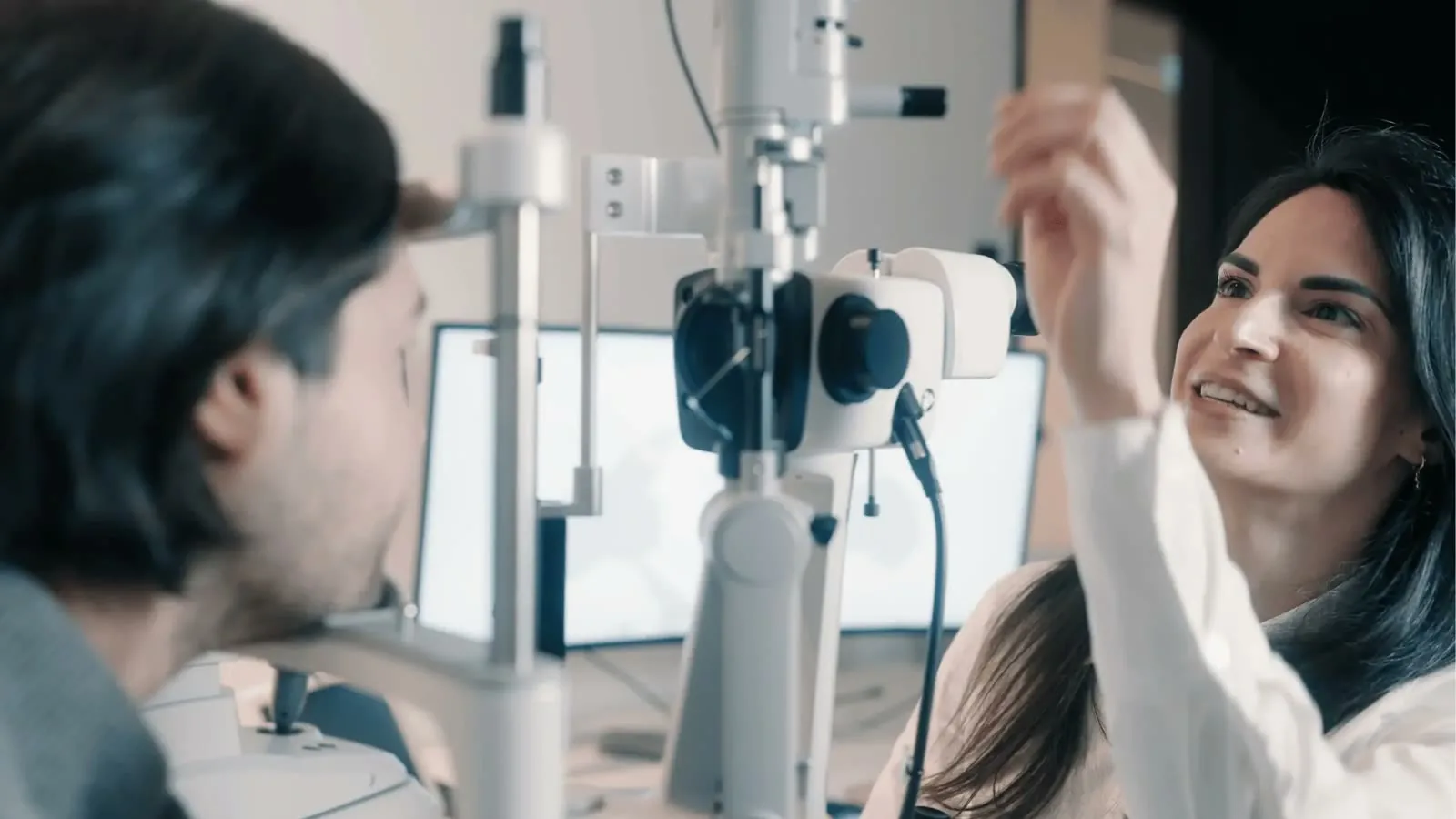
Measure everything. Choose the lens together.
Your pupils are dilated; for a few hours your vision is blurred. Please do not drive yourself. The pre-operative examination is included in the price of the surgery; without a procedure, it is billed separately.
Lens finderStep 3 of 4
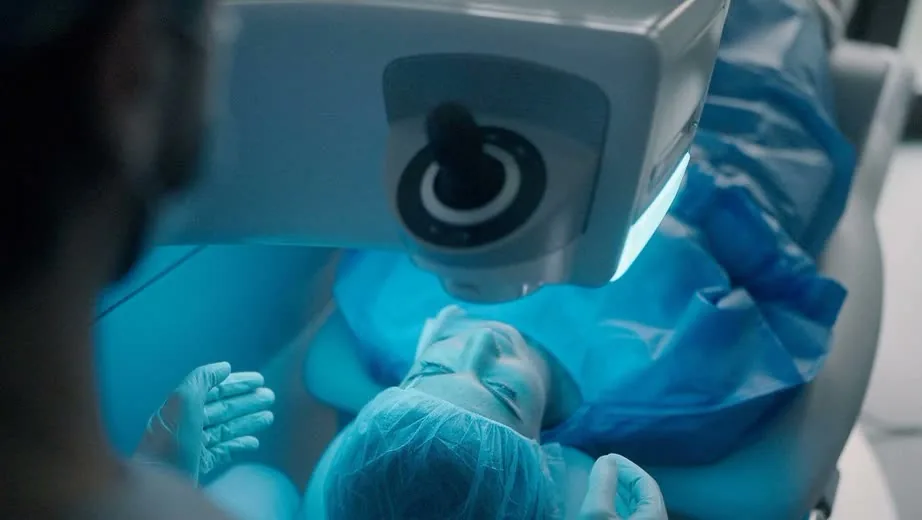
About 20 minutes per eye. Awake, numbed with drops.
About two hours in the practice. Have someone pick you up or take a taxi.
Step 4 of 4

Three follow-up checks, then you are done.
Drops for about four weeks, emergency number around the clock.
The day after surgery, most people already see distance much better, and colors look fresher and bluer. Near vision takes somewhat longer with EDOF and trifocal lenses: the brain has to learn to pick the right image. For most people, reading without glasses gets clearly better in the first weeks, and halos at night fade over three months. Between the two surgeries, the old glasses with the lens removed often help.
| Activity | From when | Note |
|---|---|---|
| Reading, watching TV | immediately | eyes tire faster at first |
| Driving | usually about 1 week after both eyes have been operated on, sometimes earlier; the doctor decides at the follow-up check | at night only once halos no longer bother you |
| Showering, washing hair | from day 2 | no water directly in the eye |
| Walking, light housework | immediately | do not lift heavy things, do not bend over in the first days |
| Gardening | after 1–2 weeks | dust and soil: protective glasses |
| Swimming, sauna | after 2 weeks | only once the incision is securely closed |
| Flying, travel | from day 2 | Secure follow-up appointments beforehand |
Safe does not mean without risk.
Cataract surgery is one of the safest procedures in medicine; the safety rate for procedures by Prof. Dr. Mehdi Shajari is 99.9%. The premium lens brings its own topic: halos at night. All risks of the surgery in detail are on Cataract.
Rings and rays around lights in the dark. An effect of the optics of trifocal and EDOF lenses, not a fault of the surgery.
at first 3 in 10
bothersome with trifocal (noticed by about 4 in 10), usually fewer than 1 in 10 after three months. EDOF usually less often, depending on design; monofocal rare.
Measure the pupil, night drivers rather EDOF, show the effects beforehand. If halos remain bothersome, a lens exchange is possible in the first months.
The capsule behind the artificial lens clouds over months to years later. With premium lenses this is noticed earlier, because they depend on a clear image.
about 1 in 10
within five years.
A YAG laser opens the capsule in a few minutes, usually painlessly, without a cut. The secondary cataract generally does not come back afterward. More: Secondary cataract.
The power achieved differs slightly from the target. With premium lenses this bothers more, because freedom from glasses depends on it.
Enhancement in about 5 of 100
the others manage without or with light glasses.
Biometry with two formulas, eyes a week apart, fine adjustment by laser or add-on lens.
A collection of fluid in the center of the retina a few weeks after surgery. Vision becomes blurrier again.
about 1 in 100
more often with diabetes and existing eye conditions.
Anti-inflammatory drops, OCT check at any suspicion. It usually heals with drops; rarely, further treatment is needed.
The vitreous pulls on the retina and tears it. Signs: flashes, a shower of dark spots, a shadow in the field of vision.
In the first year about 2 in 1,000.
Over the years the risk rises to up to about 1 in 100. More often in men, high nearsightedness and younger patients.
Retinal examination before surgery, information about warning signs, emergency number. Treatable well when detected early.
Bacteria get inside the eye. Signs in the first days: increasing pain, red eye, clearly worse vision.
under 1 in 1,000
Antibiotic into the eye at the end of every surgery, sterile operating room, check the day after the procedure, emergency number around the clock.
Frequencies from our own analysis (n = 1,100, 2022–2026) and literature.
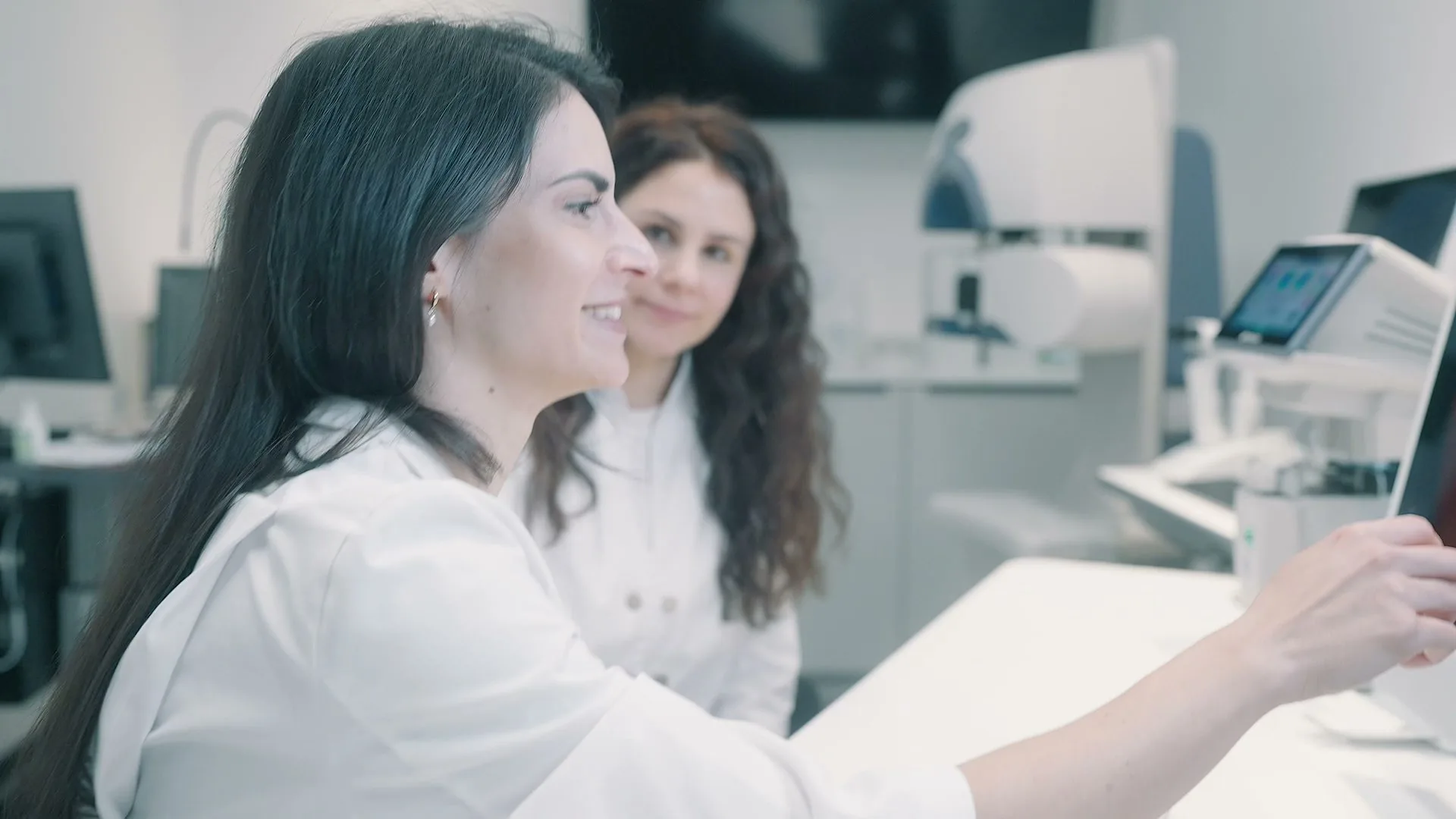
Because the lens stays for life.
One surgeon for both eyes, more than 20,000 procedures, 5.0 stars from 376 reviews. And lens counseling that also tells you when the simplest lens is the best.
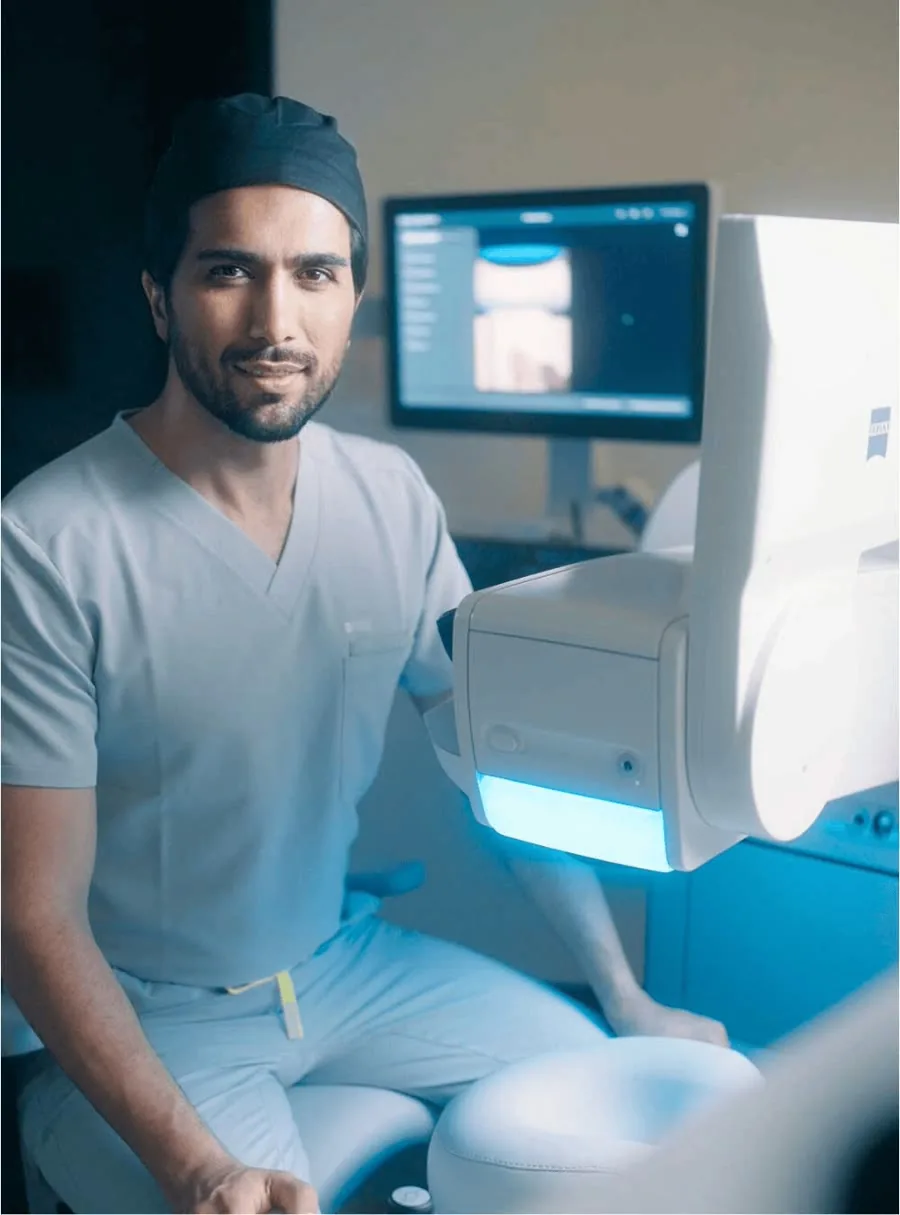
Every procedure: Prof. Dr. Mehdi Shajari. Personally.
Specialist and professor of ophthalmology (German title: außerplanmäßiger Professor), numerous publications on freedom from glasses, teaching and training of several colleagues in this field. At dr.vision he operates himself, not a rotating team. Since 2022 we have evaluated every surgery: 97% achieve a visual acuity of 80% or better.
From €6,998 to €7,876. For both eyes.
Guide prices at dr.vision for both eyes: €6,998 with a monofocal lens, €7,242 with EDOF, €7,876 with a trifocal lens, toric variant for an extra charge. Billing is private according to the German fee schedule for physicians (GOÄ); you receive your written cost estimate after the pre-operative examination. Financed, that is from €3.90 a day, with a one-time down payment.
| Lens | guide price, both eyes | Without glasses | More |
|---|---|---|---|
| Monofocal (also monovision) | €6,998 | Distance (monovision: also intermediate range) | Lens types |
| EDOF | €7,242 | Distance and screen, usually phone | EDOF lens |
| Trifocal | €7,876 | Distance, screen, reading | Trifocal lens |
| Toric (add-on) | on request | also corrects astigmatism | Toric lens |
The guide price includes: pre-operative examination with biometry and macula OCT, surgery on both eyes by Prof. Dr. Mehdi Shajari, lenses, all follow-up checks after surgery, documents for insurance and taxes. Financing: with a down payment from €3.90 per day* via medipay or 0% over 12 months directly with dr.vision (from €583 per month). All details: What does cataract surgery with a premium lens cost?, Financing.
* Representative example: €6,497.47 net loan amount after a €500.53 down payment · 72 months · fixed nominal interest rate 9.49% p.a. · 9.90% effective annual interest rate · monthly installment €118.72 · total amount €8,547.84 (with down payment €9,048.37) · via medipay. Alternatively 0% over 12 months directly at dr.vision.
Appointment for the pre-operative examinationCataract surgery is medically necessary; private health insurers often reimburse a large part of it depending on the plan, and a personal contribution usually remains. Many plans treat premium lenses (EDOF, trifocal, toric) as an additional service: many pay the monofocal portion, you pay the extra charge. More: Private health insurance.
The surgery and the standard lens are eligible for Beihilfe (allowance for German civil servants) according to the German fee schedule for physicians (GOÄ); the remaining costs are reimbursed by the private supplementary insurance depending on the plan; a personal contribution usually remains. For premium lenses, separate rules apply depending on the federal or state authority. We write the application accordingly. More: Beihilfe.
dr.vision is a private practice without a statutory insurance license. Patients with statutory health insurance are self-paying patients with us: You pay for the treatment yourself, based on a cost estimate, financed on request, with a down payment from €3.90 per day. If standard care is enough for you, we will tell you so. More: Statutory health insurance.
| Procedures | Cataract surgery: the clouded lens is exchanged for an artificial lens, monofocal, EDOF or trifocal, toric with astigmatism |
|---|---|
| Duration | about 20 minutes per eye, about two hours in the practice, second eye with premium lenses usually a week later |
| Anesthesia | Drops, sedative on request |
| Without glasses | Monofocal: distance · EDOF: distance and screen, usually phone as well · Trifocal: distance, screen, reading, about 9 in 10 manage everyday life without glasses |
| Age | no age limit, a healthy retina and macula are what matter |
| Not for trifocal | Macular and retinal diseases, advanced glaucoma, professional drivers |
| Follow-up checks | the day after surgery, after one week, final check after 1–3 months, drops for about four weeks |
| Driving | usually about 1 week after both eyes have been operated on, the doctor decides at the follow-up check |
| Enhancement | in about 5 of 100, by laser or add-on lens |
| Costs for both eyes | €6,998 monofocal, €7,242 EDOF, €7,876 trifocal (guide prices), toric for an additional charge, can be financed with a down payment from €3.90 per day or 0% over 12 months |
| Insurance | private health insurance depending on the plan, Beihilfe (allowance for German civil servants) for surgery and standard lens, patients with statutory health insurance pay themselves |
| Doctor | Prof. Dr. Mehdi Shajari |
| Location | Junghofstraße 16, 60311 Frankfurt am Main · Düsseldorf and Stuttgart 2027 (preliminary talk already in Frankfurt) |
Go deeper.
This page answers the question about freedom from glasses. The disease, the surgery and the lenses in detail:
Symptoms, when to operate, surgical procedure, risks, with vision simulation.
To the cataract page SurgeryThe surgery at dr.vision, devices, surgery days, appointments.
To the surgery page DecisionThe guide with a decision tree and everyday scenarios.
Read the guide CostsPrivate health insurance, Beihilfe, co-payment for premium lenses.
View costs AfterwardThe weeks after surgery, day by day.
Learn more Younger than 65?From 45 without cataract: Presbyond or lens exchange.
Learn moreStill have questions?
“These are the questions I hear most often in consultation hours. Here are my answers.” Prof. Dr. Mehdi Shajari
That depends on the lens. Monofocal: distance without glasses, reading with. EDOF: distance and screen without, small print sometimes with light reading glasses. Trifocal: about 9 in 10 of our patients manage everyday life without glasses, sometimes with them for small print. With astigmatism, a toric lens is needed for this.
The one that fits your everyday life and your eyes. With a healthy retina and little night driving, the trifocal lens offers the most freedom from glasses; with a lot of night driving, the EDOF lens. If reading glasses do not bother you, you are best served with the monofocal lens.
No, there is no age limit. What matters is a healthy macula and retina and whether you benefit from freedom from glasses in everyday life. With macular degeneration or advanced glaucoma, we advise a monofocal lens.
Two monofocal lenses, set differently: one eye for distance, one slightly nearsighted for near. This way many people read coarse print without glasses, with hardly any halos and at the monofocal price. Not everyone tolerates it; where possible, we test it beforehand.
Usually not sensible if the first eye has a monofocal lens, because both eyes have to work together. Monovision setting of the second eye can still help you manage more often without reading glasses. We check this individually.
Usually not. The eye is numbed with drops; you feel touch and pressure. Afterward the eye feels scratchy for a few hours, as if there were a grain of sand in it. Increasing pain is not normal; if so, call us.
Usually not. The surgery is done through a small incision in the cornea, which has no blood vessels. ASS (aspirin), Marcumar and new anticoagulants can usually be continued. We coordinate this with you at the pre-operative examination and, if applicable, with your family doctor.
Yes, please come with someone. On the day of surgery and at the pre-operative examination with dilated pupils, you must not drive yourself. Have someone pick you up or take a taxi. Family members are welcome at the consultation.
Distance is usually clearly better the day after surgery. Reading without glasses gets better with EDOF and trifocal lenses in the first weeks, because the brain adapts. Halos at night fade over about three months.
Possible, but involved and easiest in the first months. More often, a fine adjustment by laser or a thin add-on lens is enough. That is why we take our time over the lens choice and operate on the eyes a week apart with premium lenses.
At dr.vision for both eyes €6,998 with a monofocal lens, €7,242 with EDOF and €7,876 with a trifocal lens, according to the German fee schedule for physicians (GOÄ); toric for an extra charge. Included are the pre-operative examination, surgery by Prof. Dr. Mehdi Shajari, lenses and aftercare.
dr.vision is a private practice without a statutory insurance license. Patients with statutory health insurance are self-paying patients with us and pay for the entire treatment themselves, including the lens. Private health insurance and Beihilfe (allowance for German civil servants) often reimburse a large part of the surgery depending on the plan, and a personal contribution usually remains; private insurance pays for premium lenses depending on the plan, while federal Beihilfe pays only up to the amount of a standard lens.
Medically reviewed by Prof. Dr. Mehdi Shajari · As of October 2026
Read in peace. Discuss with your family.
Arrives by e-mail in about 60 seconds. No newsletter, just the guide and, if you wish, a follow-up from Patient Care. Privacy policy
How would you like to continue?
Online, by phone at 069 509 586 770 (reachable 24 hours), or by WhatsApp. The first appointment is a free consultation. This is followed by the detailed pre-operative examination with Prof. Dr. Mehdi Shajari: lens, retina, macula OCT, biometry, and a talk about which lens suits your daily life. You go home with a written recommendation and a cost estimate. Easiest: Call us at 069 509 586 770 (reachable 24 hours).
In Frankfurt, Junghofstraße 16 · all measurements included
Our locations.
 Opening hours
Junghofstraße 16, 60311 Frankfurt am Main
 Opening 2027
Breite Straße 69, 40213 Düsseldorf (in the Neuer Stahlhof, corner of Graf-Adolf-Platz)
Until opening: preliminary talk in Frankfurt, Patient Care plans your travel.
Plan route Opening 2027
Lautenschlagerstraße 23, 70173 Stuttgart (2nd floor, step-free access)
Until opening: preliminary talk in Frankfurt, Patient Care plans your travel.
Plan routeYes, my name is Alexa Brum, I am 76 years old and had cataracts in both eyes, and I had one eye operated on at one of the many university hospitals here in the Rhine-Main area, and afterward I was a bit down, because it took a very long time until I could see somewhat properly again, and I was not prepared for that. My daughter, who is a doctor, searched around on the internet and came across this practice, with Professor Shajari, and it sounded very good right away. So I came here.
I find the equipment of the practice exceptionally good. I have never been examined so thoroughly. Really everything was checked, and in the eye that had already been operated on, they also found a small effusion in the retina. I have never experienced that something like that was examined. And I was informed very, very well about everything that could happen and how it works, so I had no concerns at all.
I had surgery on my right eye and can tell you that I notice absolutely nothing. The eye feels wonderful. My vision is great considering it was only yesterday. I am allowed to drive again, which I was not before. I really see well, and the surgery went so comfortably. Professor Shajari explained everything he was doing as he went. I had a transparent plexiglass shield on with holes so that it was ventilated. I could see right away. That was a completely new experience for me. Everything was terribly bright, but of course my pupil was still very dilated too. But from the first moment I simply felt comfortable and normal. And today I was allowed to take it off. I was told I may drive. I believe the values are excellent. And I do not have the feeling that anything was done to my eye, except that I can see better. The procedure itself is a breeze, actually more of an interesting experience.
What I noticed here, quite apart from the really very well-kept and spacious ambiance, but that is less important to me from a medical standpoint than what came next. The technical equipment of the practice, I found that quite extraordinary. That an OCT of the eye was also done, and with what speed, or speed is maybe the wrong word, the work was done so efficiently. Yes, there are so many devices that check and analyze the eye. I can't remember everything that was done in detail. That is really impressive and it builds trust.
And then I have to say, Professor Shajari is an extraordinarily pleasant doctor who seems very warm-hearted, who really meets you where you are. I can imagine that even if you are anxious, which I am not at all, but if you are an anxious type, he really meets you wonderfully there. And he explains everything. During the conversation, the results of this technical examination are shown on a large screen, and every little detail is explained. I have honestly never experienced this kind of explanation down to the last detail. And I think that is great and good to know.
In the left eye there was still a small pocket of fluid in the retina. Today I asked again, and he had it checked once more and showed me the difference between the two scans; it has almost resolved already, it is almost gone. So simply being informed like that, right? And he also said we simply have to give it time now, it will probably go away, and if not, then we can do this and that, so that you are informed all around and completely free of fear, because you know that this can be done, that can be done, and this doctor really does it well. So I believe he is very competent. At least that is how I feel about him. I will stay here too. As a patient you feel noticed as you are, whether you are more anxious or not, whether you are unsure at certain points. Earlier I went to a good eye doctor whom I knew well, but such a comprehensive and broad view of these visual problems, I did not experience that with eye doctors either. I have the feeling that he has a tremendous overview of the whole spectrum of what can happen with eyes.
I already have.
You already have?
Yes, I already did.
I would say that the everyday problems you have, that your vision changes with age. Of course it is clear that you need glasses. But if you are worried or a bit afraid, then this is the right place, because your fear is also caught and taken care of.
My name is Peter Weigand. I am 80 years old. I suffer from macular degeneration in both eyes, which is especially pronounced in the left eye and developed in the right eye in 2022.
Before an upcoming cataract operation, I contacted the professor to get advice, and I was also looking for a new surgeon for my future regular injections. I have been a patient of Professor Shajari since the summer of 2023, and I must expressly praise the extremely punctual, truly comfortable treatment given with the utmost attention. I have now had over 40 injections from various doctors, and no one does it with such professionalism, kindness and reassurance of the patient.
Both cataract operations went to my utmost satisfaction. It was on time, it went without major problems. Afterward I could see well, given the circumstances, and today, four months later, I am glad that I did it, and I can only expressly recommend Professor Shajari as an eye surgeon and as a doctor who is devoted to his patients.
The comfortable process, the human warmth during this phase of the operation and in the preparation for it, and the pleasant, calm atmosphere during the operation give you a sense of security and made the whole thing, which on the eyes is not necessarily so pleasant, actually go off without any problems. And I can only recommend Professor Shajari in the warmest terms as an eye surgeon and, in this case I must say it, also as a person who is supposed to treat you.
So my name is Roski, I am 81 years old now. I already had glasses, I've worn them since I was 16. Back then I couldn't see far. Now presbyopia has been added.
But then I noticed, after I had bought a new pair of glasses a few years ago, I was very dissatisfied, because my wife could still see better than I could. You always notice that when cycling, with the signs for cyclists. They are those small, labeled signs. She could read them, I couldn’t, despite glasses.
That is when I got the idea to go to the eye doctor. And after I knew that it had to be done, I looked on the internet, my eye doctor also gave me a few recommendations. And then I looked at what people say about it on the internet. And then I came across Professor Shajari. Shajari, yes. Difficult with the names.
Essentially, first, the recommendation from my eye doctor, although he named several. Second, of course, I looked on the internet to see what people write. And another point was that he and the staff, and also the professor, with his services and his manner, were very positive, only positive reviews. I'd say, if two out of 10 reviews are negative, that's already nothing, and if there are none at all, one negative can always be among them, but here there was nothing negative at all. I found that very good.
He still has that thing on his eyes right now, but I already noticed, with the left eye I can see far clearly better than with the right eye. So you can already tell that it has turned out great.
Yes, definitely, I would definitely advertise for it. I would of course tell everyone, you can go there without worry. Let me put it this way, it is much more pleasant than a visit to the dentist, this whole thing.
Krzysztof Trukan, as I already said, I am 75 years old.
My vision has been declining for decades, especially in the left eye, because I only had 40% light getting through because of the cataract. And for years I put it off, but now, on medical advice, I decided to change that. I had already been to a colleague of a professor a year ago, who did not give me the trust I needed for a surgery like this. And then I turned to the professor here and am absolutely thrilled with the result.
Yes, I informed myself a bit, the surgery is very low-risk, with few sources of error, but something can still happen to the eye, that's clear. Of course I had concerns and I already had some problems in my eye, something on the lens had possibly grown attached at one spot, and the other doctor wanted to take me to the hospital for the procedure and made me more afraid than confident, and here I had the feeling that there were no problems at all. There is always a risk with any surgery, but the professor told me, after 10,000 surgeries I have never had a problem. What he could not guarantee was the success in percent of visual strength. You can only see that afterwards anyway.
I have to say, a week ago on Wednesday I looked with the operated eye and could not believe it. Without glasses I see everything in the distance. And yesterday after the surgery I also peeked through the shield, and it got better from hour to hour. And now I look at her and see her perfectly.
It went very fast, about ten days, two weeks. So the first meeting, then everything explained and measured, and then ten days later was the first procedure.
Yes, so the trust was there very early thanks to his personality. The professor is very trustworthy. And I am emotional now, because I have the feeling it is fantastic.
As soon as vision declines, as soon as it gets gray, the cataract, it is a road of no return. It does not go back, it never gets better, it only gets worse. The sooner you do it, the easier it may be for the eye to get used to the new vision.
You are facing cataract surgery, and the main question is which lens should be implanted now and what lens types there actually are. That is exactly the topic we will deal with. We go through all the lens types that exist, that is trifocal lenses, monofocal lenses and so on, and look at the characteristics of these lenses. That means we look at what the advantages and disadvantages are and which is the ideal lens for you.
My name is Mehdi Shajari, I am a professor of ophthalmology, and I have actually spent most of my life working on which lens comes into question for which patient. There are two things that matter when we want to choose the right lens for you. One is the lens type, that is the optics, and the second is the lens power, and we deal with the lens power first. What exactly matters there? To see that, let us look at the eye.
You can see here that there are a few essential components, namely the cornea, the old lens and the retina. And one of the very important parameters is the axial length. That is, how large the eye is, and we are mainly interested in the stretch from the cornea to the retina. That is what we commonly call the axial length. And why is that so important?
The longer the eye is, the less the light has to be bent by the newly implanted lens so that it still lands on the retina. Let me give a short example. Let us assume you have a relatively long eye. For example 30 millimeters. That would already be extremely long. But let us assume it.
With a 30-millimeter eye you need a very weak lens. The lens power is then usually around two, three, four diopters. So really a very weak lens that we have to insert to focus the light on the retina. In most patients the axial length is around 24 millimeters. That means the eye is about 24 millimeters long.
And then we need a lens power of around 20 diopters. That cannot be compared with what we usually have in glasses. As you can see, this number is much higher. But it is what would cause the light to fall exactly on the retina.
And that is ultimately what we want. The difficult part of the whole matter, or the problematic part, is this: it is not that easy to hit exactly the right lens power. Why? To see that, let us look at how the lens is set up.
The natural lens is round and relatively thick. The artificial lens that we insert is very thin. And where exactly this artificial lens ends up sitting, that is, whether it sits a little further forward or a little further back in the old position, we cannot predict exactly. A difference of just one millimeter, so one millimeter too far forward or back, can account for up to about three diopters of refractive error.
And that is the reason why, when we insert lenses, we always tell the patient: we will reach our goal in only 80 percent of cases. In 20 percent of cases we will miss it. And that is true even when we use the most modern diagnostics available to us, and we do that here in our practice, for example. Even if we really use the most modern diagnostics, we still have an error rate of 20 percent. You need to know that beforehand.
Let us now assume that the eye has been measured exactly and that we insert a lens that focuses the light exactly on the retina. Now the question is: what kind of lens do we insert? So what kind of optics do we choose for you? And that is the topic of the next section.
When it comes to lens optics, there are several options for us to choose from. One is monofocal lenses, then we have the so-called monofocal plus lenses, the EDOF lenses and the trifocal lenses. All very complex names, but we will go through them one by one now. What matters is how well they cover the functional ranges we use in seeing.
As human beings, we mainly have to function in three ranges. One is seeing up close, so essentially reading, that reading distance, classically 40 centimeters. Then we have, and this is becoming more and more important for us, working at a monitor. Here, typically, an extended arm's length matters for us, so up to 80 centimeters.
We also call this intermediate vision, so essentially the middle range of vision we need. And then comes the last one, and that is distance vision. So how well can we see far away? Can we, for example, simply see into the distance, or can we make out something at a distance?
That is distance vision. Now let us go through the individual types of lenses. What do we do with a monofocal lens? We can focus the light on one range.
That means we can decide whether we would rather see sharply in the distance or rather see sharply up close. Most patients we set for distance. But that also means they will need glasses for the other ranges, so for the intermediate distance and for near. So we would have the situation: distance, intermediate distance and near.
And with a monofocal lens we can set it so that you see sharply in the distance. For the other two ranges you would need glasses. With a monofocal plus lens, the light is stretched out a little lengthwise. That is very hard to picture, but ultimately it is a similar principle to depth of field.
That means we reduce the depth of focus in that range, in a way, so that you can see more at a certain distance. So we can set it, for example, so that when we set you for distance, you can see the distance but also part of the intermediate range well, so that you would not need glasses for these two ranges. EDOF lenses are similar. EDOF lenses also have the advantage that you can see well in the distance as well as at the intermediate distance.
That means they have somewhat more strength at the intermediate distance, but nowadays they are hardly used anymore. EDOF, by the way, stands for Extended Depth of Focus, but because they have disadvantages compared with the monofocal plus lens without offering real advantages, their use is quite limited. And then there is the fourth option, or actually the third if you take EDOF out, and that is trifocal lenses. With trifocal lenses we can see sharply at distance, at the intermediate distance and up close.
The question a patient naturally asks now is: why should we not always use trifocal lenses? They are often called premium lenses, and this term could hardly be more misleading. Just because trifocal lenses are the most expensive and because they can actually cover these three distances does not mean they are the best lenses for you. Because there is one thing we have left out of this whole equation so far, and that is optical quality.
And that is a very decisive point. You can picture it like this: nothing comes for free. The more we divide the light among distances, the less light is available for each individual range. And that means we have a loss of contrast, and we do not see things as clearly.
In addition, we can have optical phenomena. What comes up very often in this context is the term halos, so rings of light, glows that we see around a light source. And they can be extremely disturbing. That means, if you want to go through the whole picture, you would have to say that we have the best optical quality with monofocal lenses, so with very classic monofocal lenses.
Then monofocal plus, which have a relatively good optical quality. I would even say almost two and a half out of three possible points. Then there are the EDOF lenses and the classic trifocals. Because trifocals split the light so strongly, they usually also have the poorest optical quality.
So, we should move away from speaking of premium lenses, because all of them have their advantages and disadvantages. Let us now simply go through what I typically recommend to patients. Or where which lens is used. We will now look at that in detail.
Which of these lens optics is ultimately best for you depends very much on your everyday life. You could say that monofocal lenses, so the lenses that really have the best optics, are suitable above all for patients who want to see as well as possible in one range and are also willing to wear glasses for the other ranges. So whom I recommend them to very often is people who, for example, depend on extremely sharp vision for their work. So if someone is an engineer, a mechanical engineer, an architect, where every single millimeter really counts, then I usually tend to recommend a monofocal lens.
With this monofocal lens, you can then correct all ranges with one pair of glasses and see super sharp at all distances, because the optical quality is by far the best. The trifocal lens, the one that really gives us a certain freedom from glasses at all distances, is the one I implant for patients who come to me and say, I absolutely want to be glasses-free. That is the most important thing for me. I am then also prepared to accept compromises in optical quality.
I am willing to accept optical phenomena too, but I absolutely want to be free of glasses. These are mostly rather young patients, so those who receive an early lens exchange, around the age of 50 to 60, where it really is about being free of glasses at distance, at computer distance and when reading.
But it must be said, you absolutely have to be willing to compromise. In my opinion, perfectionists are not suited to trifocal lenses. And then there is the middle option, and that is the monofocal plus lens. With the monofocal plus lens, as we said, we can see well in the distance as well as at the intermediate distance.
And that is actually what matters for most patients. Because it reduces the optical quality only very slightly. So you can actually say, hardly reduces the optical quality at all. You do not notice it in that sense, since most patients have poor optical quality from the start anyway, because they have the cataract.
They notice no loss compared with the classic monofocal lens. But they still have a certain independence from glasses. The example I always give the patient: in everyday life, for example when driving, you would not need glasses. Or if you sit in a restaurant and want to look at the menu without glasses, because it is printed somewhat larger, then you manage without glasses.
That means a large part of your life works without glasses. But if you really want to read a text for a longer time, if, for example, you want to enjoy a good book in the evening and read it for longer, then you need light reading glasses. So when it is about freedom and at the same time a certain degree of optical quality, the monofocal plus lens is usually the right choice for most people. And there is one more thing you can do with the monofocal plus lens, to perhaps ensure complete freedom from glasses.
And we will come to that in the last chapter. Namely, the so-called blended vision. Let us come to the topic of blended vision. What is it, actually? What is behind it?
So we said that three ranges interest us in seeing. We are interested in distance, intermediate distance and near. And we said that with a monofocal plus lens we can cover the distance well, up to the intermediate distance. Near, we do not quite manage.
With blended vision we now use a trick. Namely, we set our two eyes differently. For example, we set the right eye for distance and intermediate distance. And the left eye, there we go somewhat more toward near.
That means we set it so that we can also see part of the near range with it. That means we deliberately make the patient somewhat more nearsighted in the left eye. So that, together, with both eyes, we have covered almost the whole range. The advantage of the whole thing, when we play with both eyes, is that we do not cause any additional optical phenomena.
Yes, because we do not change the optics of the lens. That is the really big difference from the trifocal lens. With the trifocal lens, with each eye on its own, that is, if we cover one eye, so to speak, we would see sharply at all distances. Yes, but with a great many optical phenomena.
With the monofocal plus lens, with one eye we would see only distance and intermediate distance. But together, with both eyes, when both are open, and that is the way we usually go through life, we can cover almost all ranges and then perhaps even have complete independence from glasses. This is not that trivial. It may sound relatively simple at first glance, but it really is not that trivial. A great many things have to be taken into account, and this method is also not an option for every patient.
There are patients who cannot cope even with a minimal difference, because it is necessary: we have to make one eye slightly nearsighted. This has to be weighed up carefully and discussed before surgery. But if the patient is a suitable candidate, this is usually one of the best options available today to give the patient good optical quality as well as freedom from glasses. As a small extra, I would like to talk about blue-light-filtering lenses and toric lenses.
You will certainly hear about these at your informed-consent talk as well. Blue-light-filtering lenses, as the name says, filter out some blue light. As a result, the world looks somewhat more yellowish. Does that make sense?
The current state of studies is that this blue filter does hardly anything for the health of the eye. It was once under discussion whether it might protect against things like macular degeneration, but this could not be confirmed so far. The other thing to say is that, of course, color perception is somewhat different. With the blue filter, the world looks somewhat more yellowish.
For patients who have a cataract, this takes less getting used to, because the cataract acts as a natural blue filter. The world already looks somewhat more yellowish, so they do not notice the change in colors so much when they receive a blue-light-filtering lens. At first glance it therefore looks more natural to them and like what they are used to. Patients who are operated on without a blue filter, on the other hand, then see the actual colors after the cataract surgery and often talk about a blue tint in the colors.
But that is completely normal, and this blue tint will also go away over time, usually about two to three months after the cataract surgery, because the brain has then gotten used to the actual colors, the way the real world looks, and has essentially calculated this blue filter out altogether. Toric lenses are the other topic: when are they used at all? We know that astigmatism exists. That means many people suffer from so-called astigmatism.
What does it look like? Let us look at it here in the diagram. With astigmatism, the light is refracted more strongly in different planes at the cornea. So let us assume, for example, that in the vertical plane the light is refracted more strongly than in the horizontal one.
So in that plane the light is refracted more strongly. Accordingly, the light is somewhat compressed. And if we were to form an image on the retina, it would not appear as a point but as a line on the retina. That means the image is somewhat compressed or distorted.
And to correct that, we have to insert a toric lens. Toric lenses also correct the astigmatism. And then you should use a toric lens. The current state of science is that whenever astigmatism is present, it should also be corrected.
In other words, you should then always use a toric lens, because it improves the optical quality overall, the image quality overall at the retina. The nice thing about toric lenses is that we can combine them with all other lens models. That means there are monofocal toric lenses, monofocal plus toric lenses, EDOF toric lenses and trifocal toric lenses. So whenever you have astigmatism that is regular, that is, one that can be corrected with lens optics, it should also be corrected with these toric lenses, because that gives you the best optical quality.
So, let us summarize the whole thing once more. Ultimately, two things are decisive. First, the lens power, which is of course something the doctor mainly has to decide: the correct lens power for your eye. And the other is the type of optics. And there it is an interplay between what you wish for and what your eye can actually deliver.
For someone for whom it really matters to have perfect optical quality, I recommend a monofocal lens. Then, however, you have to be fitted with glasses for the other ranges. For someone who absolutely wants freedom from glasses, the best option is the trifocal lens. But you have to accept a great many compromises. The optical quality is the poorest there.
And for people who are willing to make certain compromises on independence from glasses, who are okay with wearing glasses now and then, the monofocal plus option is usually the best. Especially in combination with so-called blended vision. That means we set one eye for distance and the other eye somewhat for near. Because that gives us very good optical quality and, at the same time, hopefully also a high degree of independence from glasses.
Thank you very much for listening to us for so long. I hope you were able to take something away. If you have questions, feel free to write them to me in the comments. I will answer them on this topic.
Otherwise, simply come to our practice and we will look at your eye closely and find the best lens that is suitable for you. Thank you very much.