 dr.vision
about 1 in 10
of patients develop a secondary cataract within five years with our hydrophobic lenses. Generally it is 1 to 2 in 10.
Start here
What suits you?
Find out in 2 minutes which procedure suits your eyes.
Start the Suitability CheckOr by age:
< 45yearsGet rid of glasses & contact lenses 45–64yearsGet rid of reading glasses 65+yearsCataract & glasses-free★★★★★ 5.0 · 376 Google reviews · 20,000+ procedures
Decide well
What you should know beforehand.
Who operates?Prof. Dr. Mehdi ShajariFOCUS Top Doctor · operates on every patient personally What does it cost?Laser from €3,498 · Lenses from €6,886Prices for both eyes Is it safe?Safety & risks When will I be fit again?Work, sports, driving Would you rather read in peace first?Decision Guide Freedom from GlassesProcedures
Laser or lens?
Laser eye surgery
SMILE ProSmartSightFemto-LASIKTrans-PRKPRKPresbyond (laser away your reading glasses)All laser procedures at a glanceLaser procedures compared ›Lens surgery
ICLLens exchange (reading glasses)Cataract surgery with premium lensLens types: trifocal, EDOF, toricLens types compared ›Start here
Something wrong with your eyes?
A thorough eye check-up with us clarifies what is behind it.
Book an eye check-up★★★★★ 5.0 · 376 Google reviews
Secondary cataract · YAG laser capsulotomy
See clearly again. Treatment in a few minutes.
Is your vision becoming cloudy again after cataract surgery? This is usually a secondary cataract, and it can be corrected with a laser in a few minutes, as an outpatient and without an incision. You usually see clearly after one day.
 12× FOCUSTop Doctor
Common. Harmless. Fixed in minutes.
about 1 in 10
of patients develop a secondary cataract within five years with our hydrophobic lenses. Generally it is 1 to 2 in 10.
a few min
per eye, outpatient, without an incision, with numbing drops.
usually 1 day
until vision is clear again; the dilated pupil needs a few hours.
one-time
The opening in the capsule stays open. A second laser treatment is very rarely needed.
GOÄ
Billed under the German fee schedule for physicians (GOÄ); private health insurance (PKV) and Beihilfe usually reimburse.
Secondary cataract in five answers.
For anyone with three minutes. Each answer leads to the detailed chapter.
A clouding of the thin capsule in which the artificial lens sits after cataract surgery. Lens cells left behind grow over the capsule and scatter the light. The artificial lens itself stays clear.
To the chapterAfter a period of clear vision, vision becomes hazy again, lights glare, contrasts flatten, reading becomes harder. It feels like before cataract surgery.
SimulationWith a YAG laser that makes a small opening in the clouded capsule within a few minutes. Without an incision, without an injection, with numbing drops, sitting at a device like the one used for the examination.
To the processRarely. Eye pressure can rise temporarily, and a few floating spots are normal for days. Serious consequences such as retinal detachment are rare, about 1 in 100, and more common in high nearsightedness.
RisksBilled under the GOÄ, costs depending on scope. Private health insurance and Beihilfe usually reimburse the treatment; patients with statutory health insurance are self-paying patients with us.
CostsNot the lens. The casing behind it.
A secondary cataract is a clouding of the rear lens capsule, the wafer-thin casing in which the artificial lens sits after cataract surgery. It is the most common consequence of this surgery. Generally, about 1 to 2 in 10 patients develop a secondary cataract within five years. With the hydrophobic lenses we use, it is about 1 in 10. The cataract itself cannot come back.
In cataract surgery, the clouded lens is removed, but its casing stays as a support for the artificial lens. A few cells left behind can grow on this casing. They form a fine veil right in the line of sight. A laser opens this veil, and the light is free again.
0.005 mm
The rear capsule is a transparent membrane that holds the artificial lens in place. It is deliberately preserved during cataract surgery because it stabilizes the lens securely.
Months
Individual lens cells, which cannot be removed completely even with the most careful surgery, migrate over the capsule and cloud it. This happens slowly and unnoticed.
3–4 mm
The YAG laser makes a small round opening in the capsule, about as large as the pupil. The artificial lens stays in place, held by the edge of the capsule.
| Form | What happens | Typical |
|---|---|---|
| Regenerative secondary cataract (Elschnig pearls) | Lens cells form small, pearl-like bubbles on the capsule | most common form, develops over months to years |
| Fibrotic secondary cataract | the capsule thickens and forms whitish folds or streaks | often earlier, in the first months after surgery |
| Capsule shrinkage (capsular phimosis) | the front capsule opening contracts | rare, more common with pseudoexfoliation; different laser cut |
Vision becomes hazy again.
Typically, vision was clear at first after cataract surgery and then becomes hazy again over months: contrasts flatten, lights glare, reading in dim light becomes harder. Pain or redness are not part of it. See the four stages and the result after the laser on a real photo.
Choose a stage. The photo shows it.

Simplified illustration. How much a secondary cataract bothers you is individual and also depends on the type of artificial lens.
Stage
Clear, high in contrast, colors vivid. This is how most people see after cataract surgery. Remember the city lights.
| Complaint after cataract surgery | Points to a secondary cataract | Points to something else |
|---|---|---|
| Slowly hazy again, glare | yes, typical, months to years after surgery | dry eye, if it varies over the day and blinking helps, see Dry eye |
| Blurred a few weeks after surgery, distortion | rather rare this early | Swelling of the macula (macular edema), needs drops instead of a laser |
| Sharp at a distance, but no longer up close | no | Residual refractive error or expected reading glasses with a monofocal lens |
| Floating spots, flashes of light, shadows | no | Floaters or retina: with flashes or shadows, have your eyes examined today |
Sitting. Without an incision. In a few minutes.
A secondary cataract is treated with an Nd:YAG laser that makes a small round opening in the clouded capsule (capsulotomy). The treatment takes a few minutes per eye, is done sitting at a device like the one used for the normal examination and needs only numbing drops. Including preparation and pressure check, you are in the practice for about 1–2 hours.

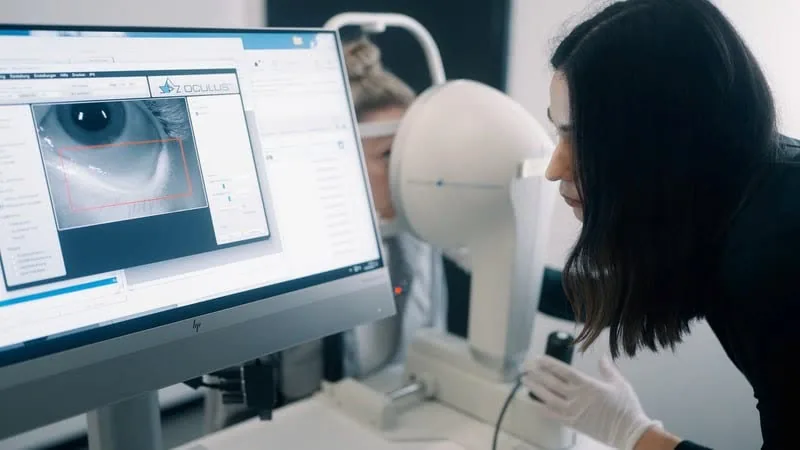
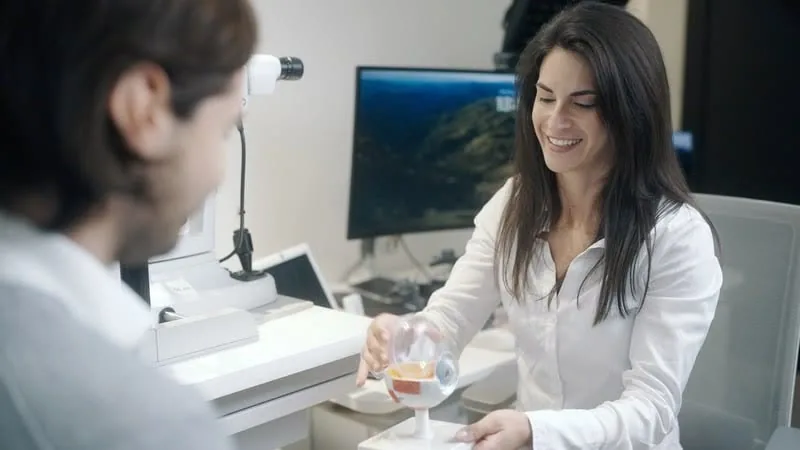 0:00 · Dilate the pupil
Pupil-dilating drops take effect in about 20–30 minutes. A further drop prevents eye pressure from rising after the laser. In addition, a numbing drop for the cornea.
0:30 · Contact lensYou sit at a device like the one used for the eye examination. A small contact lens with gel rests on the eye, focuses the laser and holds the lid open. You feel only a light touch.
0:32 · Laser pulsesWith a few short laser pulses, the capsule is opened in the center, usually in a cross shape or round. You see brief flashes of light and hear a clicking sound. It does not hurt. After a few minutes it is over.
1:30 · Pressure checkAbout one hour after the laser, your eye pressure is measured. You receive anti-inflammatory drops for a few days and go home accompanied. Vision usually clears within a day.
There is no fixed point in time. The laser is used when the secondary cataract noticeably disturbs your everyday vision, visual acuity has dropped or glare affects you while driving. A mild secondary cataract without symptoms can be monitored. A few weeks after cataract surgery, the laser is used only in exceptional cases, because the eye should settle first.
If the patient cannot sit still at the slit lamp, the capsule is very thick and fibrotic or the cornea is heavily clouded, the capsule can also be opened or polished in a small surgery. In small children this is usually done directly during the lens surgery. For the vast majority of adults, the laser is the treatment of choice.
Usually clear again the next day.
On the day of treatment, you will still see blurred and glared through the dilated pupil for a few hours; usually vision is as clear again the next day as after cataract surgery. Small floating spots, remnants of the capsule, are normal for a few days to weeks. You use drops for a few days and can do almost everything again right away.
| Activity | From when | Good to know |
|---|---|---|
| Reading, TV, screens | as soon as the pupil is small again, usually in the evening | before that it glares and is blurred |
| Driving | not on the day of treatment, usually from the next day | when you see well again; come with someone or by train |
| Work | usually the next day | no sick note needed, except for jobs with high visual demands on the same day |
| Sports, swimming, sauna | sports usually after 1–2 days, swimming and sauna after 3 days | no wound, only a short period of rest |
| Makeup, showering | immediately | do not rub the eye |
| Drops | 3–7 days | anti-inflammatory, as scheduled |
Small pieces of capsule float in the vitreous and usually sink down within days to weeks.
On the first day because of the dilated pupil and slight irritation. Fades by itself.
New flashes of light, a shower of soot-like spots, a shadow in your field of vision, increasing pain or clearly worse vision. This must be examined the same day.
Very safe. But not entirely without risk.
YAG capsulotomy is one of the safest procedures on the eye. Often there is only a temporary rise in eye pressure, which is prevented with drops. Serious consequences such as retinal detachment are rare, about 1 in 100, more common in high nearsightedness; that is why you will know the warning signs after the treatment.
Small capsule remnants can slow the outflow of aqueous humor for a few hours.
common, usually slight
relevant in about 1 in 20.
A pressure-lowering drop before the laser, measurement after one hour, especially careful with glaucoma.
Loosened pieces of capsule in the vitreous, like small floaters.
almost always
for days to a few weeks.
Reassure and wait. They sink down and are filtered out by the brain. More at Floaters.
The eye reacts with slight irritation: sensitivity to light, some redness.
common
usually mild and without consequences.
Anti-inflammatory drops for a few days.
A laser pulse can leave tiny traces on the artificial lens.
common
almost always without noticeable effects.
Place the focus just behind the capsule, with as little energy as possible.
Fluid collects in the center of the retina, vision becomes blurred or distorted, usually after a few weeks.
under 1 in 100
Anti-inflammatory drops, OCT check (cross-sectional scan of the retina) if you have symptoms. Usually recedes with treatment.
The retina detaches, often weeks or months later. Signs: new flashes, a shower of soot-like spots, a shadow in your field of vision.
about 1 in 100
more common in high nearsightedness and younger patients.
Examine the retina beforehand, use only as much energy as needed, explain the warning signs. If there is any suspicion, examination the same day.
Frequencies from the specialist literature and the DOG/BVA guideline on Nd:YAG capsulotomy.
Not completely. Making it less frequent, yes.
A secondary cataract cannot be prevented completely, but it can be made less frequent: by thoroughly removing the lens remnants during surgery and by artificial lenses with a sharp rear edge that slow the migration of cells. Even so, about 1 to 2 in 10 patients generally develop a secondary cataract within five years, about 1 in 10 with our hydrophobic lenses. Because it is so easy to treat, it is no reason to postpone cataract surgery.
Careful suctioning and polishing of the capsule removes as many lens cells as possible. A round, well-centered capsule opening that overlaps the edge of the artificial lens keeps the cells at a distance.
Modern artificial lenses have a square rear edge that acts like a barrier. Which lens suits you is explained at cataract surgery.
Treat inflammation consistently, attend follow-up checks. With diabetes or uveitis, we pay particular attention to early clouding.
If you are unhappy with a multifocal lens and are considering an exchange, you should clarify this before the laser: after a capsule opening, a lens exchange is more difficult.
| Criterion | Monitor | YAG laser capsulotomy | Surgical capsule opening |
|---|---|---|---|
| For whom | mild secondary cataract without symptoms | almost all adults with a bothersome secondary cataract | children, very thick capsule, unable to sit still |
| Process | check-ups as scheduled | outpatient, sitting, a few minutes, numbing drops | surgery in the operating room |
| Effect | none, clouding usually increases slowly | usually clear vision the next day, lasting | lasting |
| Risks | none | pressure rise, rarely macular edema or retinal detachment | surgical risks as with any procedure on the eye |
| Do new glasses help? | no, the veil remains | – | – |

Hazy again after cataract surgery?
Call us. We will clarify this quickly.
Jana from our Patient Care team arranges the examination, even if you had surgery elsewhere. If it is a secondary cataract, laser treatment can often be done at the same or next appointment. Phone reachable 24 hours, WhatsApp Mon–Fri 8:00–19:00, Sat 9:00–15:00.
Because clarity needs no waiting time.
At dr.vision, examination and laser are often possible on the same day, and specialist physicians in ophthalmology tell you honestly whether it really is a secondary cataract. 5.0 stars from 376 reviews.
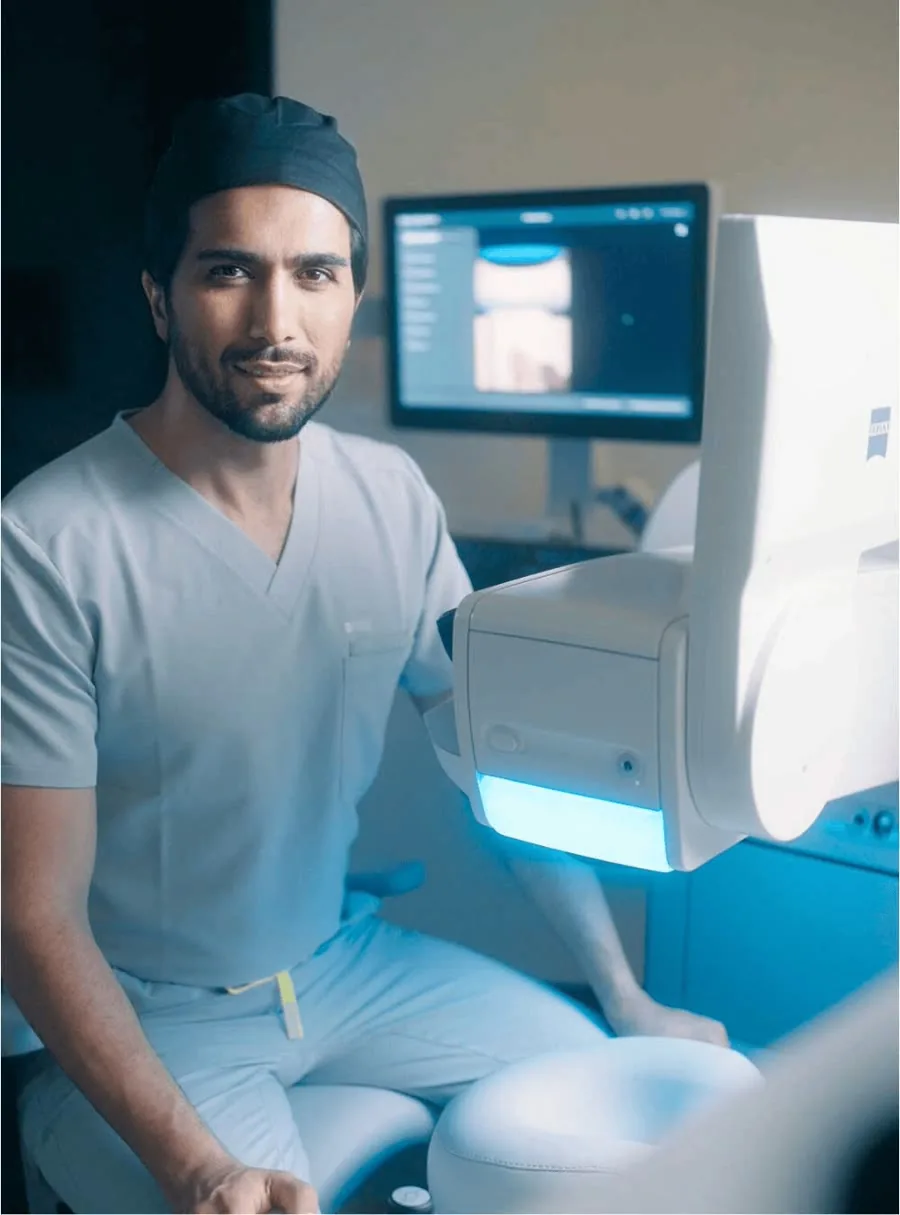
The surgeon and his team.
Prof. Dr. Mehdi Shajari operates on every patient himself. He is a specialist physician and professor of ophthalmology (German title: außerplanmäßiger Professor) with a focus on cataract and lens surgery. Aftercare is provided by our team of doctors. You are examined and treated by the same team, even if you had surgery elsewhere.
“If vision becomes hazy again months after cataract surgery, it is not a new cataract. We fix the secondary cataract with a short laser treatment without an incision, in a few minutes.”
Prof. Dr. Mehdi Shajari
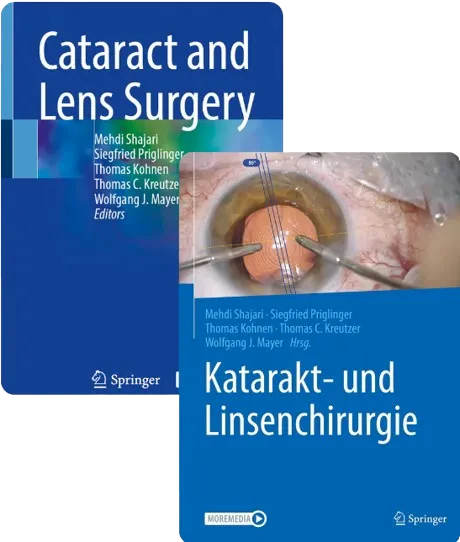
Whoever operates on cataracts knows secondary cataract best. Prof. Dr. Mehdi Shajari has published numerous papers on freedom from glasses, teaches, and has trained several colleagues in this field.
Medically necessary. Clearly billed.
YAG laser treatment of a secondary cataract is billed under the GOÄ. It is medically necessary: private health insurance (PKV) and Beihilfe usually reimburse it, and in practices accredited for statutory insurance it is covered by statutory health insurance. At dr.vision, as a private practice, patients with statutory health insurance pay themselves.
Under the GOÄCosts depending on scope · written cost estimate in advance
Treatment of a secondary cataract is medically necessary; private health insurance (PKV) plans usually reimburse it under the GOÄ. A prior approval of costs is usually not needed; you receive your written cost estimate in advance.
YAG capsulotomy is usually eligible for Beihilfe. Your private supplementary insurance reimburses the remaining share depending on the plan. More at Beihilfe.
dr.vision is a private practice without statutory insurance accreditation; you pay yourself with us. In practices accredited for statutory insurance, treating a secondary cataract is covered by statutory health insurance. More at Statutory health insurance.
| What | Clouding of the rear lens capsule after cataract surgery; not a new cataract |
|---|---|
| Frequency | about 1 in 10 with our hydrophobic lenses (generally 1 to 2 in 10) within 5 years |
| Symptoms | hazy vision again, glare, flat contrasts, months to years after surgery |
| Treatment | Nd:YAG laser capsulotomy, a few minutes, without an incision, numbing drops |
| Afterward | usually clear the next day; do not drive on the day of treatment; drops for a few days |
| Risks | pressure rise (temporary), floating spots; rarely macular edema, retinal detachment about 1 in 100 |
| Recurrence | practically never, treatment usually one-time |
| Costs | under the GOÄ, depending on scope; written cost estimate in advance |
| Insurance | private health insurance (PKV) and Beihilfe usually; covered by statutory health insurance in practices accredited for statutory insurance; at dr.vision patients with statutory health insurance as self-paying patients |
| Doctors | Prof. Dr. Mehdi Shajari, senior physician Ivana Pavlovic, Dr. Claudia Grunwald |
| Location | Junghofstraße 16, 60311 Frankfurt am Main · Düsseldorf and Stuttgart 2027 (preliminary talk already in Frankfurt) |
Go deeper.
This page answers everything about secondary cataract. Related topics on their own pages:
Symptoms, lens choice and surgery. Secondary cataract is the most common consequence of the surgery.
To the page SurgeryProcedure, lenses and costs of the surgery.
To the page Floating spotsSpots after the laser are normal. When they no longer are.
To the page Similar complaintsFluctuating, hazy vision after surgery can also be due to the tear film.
To the page376 reviews. Average 5.0.
376 Google reviews give dr.vision an average of 5.0 out of 5 stars. dr.vision does not check whether Google reviews come from treated patients.
“This week I had to have my secondary cataract lasered, and here too I am very grateful for the professional care! Many thanks, dear Professor Shajari!”
“Both eyes have a visual acuity of 125%. The aftercare is professional too.”
“Got an appointment for cataract surgery super fast. Everything friendly, helpful, competent, and the result is impressive after just 1 to 2 days.”
“Thanks to the modern technology, you need only a fraction of the time you would otherwise spend in a comparable practice.”
Four patients. In their own words.
The procedure itself is a breeze.
There was no numbing with injections, as I had imagined.
It got better from hour to hour.
I was so calm, I never would have thought.
Still have questions?
The questions we hear most often in consultation hours, with our answers. Prof. Dr. Mehdi Shajari and senior physician Ivana Pavlovic
No. A cataract cannot come back, because your own clouded lens was removed during surgery. With a secondary cataract, the wafer-thin capsule behind the artificial lens, in which the lens sits, becomes cloudy. The artificial lens itself stays clear. A short laser treatment opens the capsule, after which vision is usually as good as after surgery.
It is the most common consequence of cataract surgery. Generally, about 1 to 2 in 10 patients develop a secondary cataract within five years that should be treated. With the hydrophobic lenses we use, it is about 1 in 10. Younger patients, people with diabetes or inflammation in the eye are affected more often. In children it almost always develops.
Usually months to a few years after cataract surgery, rarely in the first weeks and sometimes only after many years. Typically, vision was clear after surgery at first and then slowly becomes hazy again.
No. The eye is numbed with drops, and you sit at a device like the one used for the normal eye examination. You hear a soft clicking and see brief flashes of light. A slight feeling of pressure from the contact lens is possible; pain is not to be expected.
The laser itself usually takes only a few minutes per eye. Including pupil dilation, treatment and a pressure check afterward, you are in the practice for about one to two hours.
Not on the day of treatment: the pupil stays dilated for a few hours, and vision is glared and blurred. As a rule, you may drive again the next day if you see well. Come with someone or by public transport.
Practically not in the same place. The opening in the capsule stays open permanently, and the treatment is as a rule one-time. Very rarely, cells grow into the opening from the edge; then it can be enlarged with the laser.
Yes, in the first days. They are small pieces of the capsule floating in the vitreous, and they usually sink down within days to weeks. New flashes of light, a shower of soot-like spots or a shadow in your field of vision, however, are warning signs for the retina: in that case, please contact us the same day. More on this on the Floaters page.
YAG laser treatment is billed under the GOÄ. The costs depend on the scope. You receive a written cost estimate in advance.
Secondary cataract treatment is medically necessary. Private health insurance and Beihilfe usually reimburse it under the GOÄ. In practices accredited for statutory insurance, it is covered by statutory health insurance. dr.vision is a private practice: patients with statutory health insurance pay themselves with us or have the laser done by their own eye doctor accredited for statutory insurance.
Medically reviewed by Prof. Dr. Mehdi Shajari · As of October 2026
How would you like to continue?
You make the appointment by phone or online. At the first appointment we check whether it really is a secondary cataract: eye test, a look at the capsule, artificial lens and retina. If it is the cause, the laser can often be done at the same appointment or the next one. Bring the lens passport from your cataract surgery if you had surgery elsewhere.
In Frankfurt, Junghofstraße 16 · examination and laser often on one day
Our locations.
 Opening hours
Junghofstraße 16, 60311 Frankfurt am Main
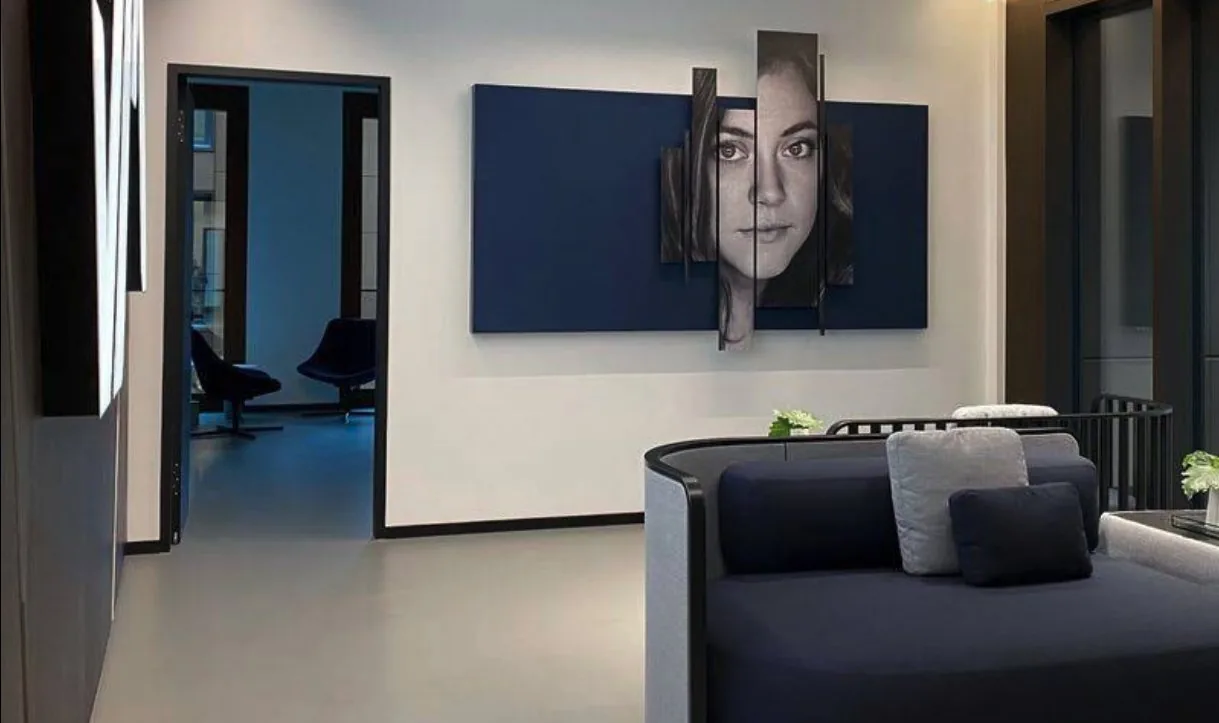 Opening 2027
Breite Straße 69, 40213 Düsseldorf (in the Neuer Stahlhof, corner of Graf-Adolf-Platz)
Until opening: preliminary talk in Frankfurt, Patient Care plans your travel.
Plan route Opening 2027
Lautenschlagerstraße 23, 70173 Stuttgart (2nd floor, step-free access)
Until opening: preliminary talk in Frankfurt, Patient Care plans your travel.
Plan routeYes, my name is Alexa Brum, I am 76 years old and had cataracts in both eyes, and I had one eye operated on at one of the many university hospitals here in the Rhine-Main area, and afterward I was a bit down, because it took a very long time until I could see somewhat properly again, and I was not prepared for that. My daughter, who is a doctor, searched around on the internet and came across this practice, with Professor Shajari, and it sounded very good right away. So I came here.
I find the equipment of the practice exceptionally good. I have never been examined so thoroughly. Really everything was checked, and in the eye that had already been operated on, they also found a small effusion in the retina. I have never experienced that something like that was examined. And I was informed very, very well about everything that could happen and how it works, so I had no concerns at all.
I had surgery on my right eye and can tell you that I notice absolutely nothing. The eye feels wonderful. My vision is great considering it was only yesterday. I am allowed to drive again, which I was not before. I really see well, and the surgery went so comfortably. Professor Shajari explained everything he was doing as he went. I had a transparent plexiglass shield on with holes so that it was ventilated. I could see right away. That was a completely new experience for me. Everything was terribly bright, but of course my pupil was still very dilated too. But from the first moment I simply felt comfortable and normal. And today I was allowed to take it off. I was told I may drive. I believe the values are excellent. And I do not have the feeling that anything was done to my eye, except that I can see better. The procedure itself is a breeze, actually more of an interesting experience.
What I noticed here, quite apart from the really very well-kept and spacious ambiance, but that is less important to me from a medical standpoint than what came next. The technical equipment of the practice, I found that quite extraordinary. That an OCT of the eye was also done, and with what speed, or speed is maybe the wrong word, the work was done so efficiently. Yes, there are so many devices that check and analyze the eye. I can't remember everything that was done in detail. That is really impressive and it builds trust.
And then I have to say, Professor Shajari is an extraordinarily pleasant doctor who seems very warm-hearted, who really meets you where you are. I can imagine that even if you are anxious, which I am not at all, but if you are an anxious type, he really meets you wonderfully there. And he explains everything. During the conversation, the results of this technical examination are shown on a large screen, and every little detail is explained. I have honestly never experienced this kind of explanation down to the last detail. And I think that is great and good to know.
In the left eye there was still a small pocket of fluid in the retina. Today I asked again, and he had it checked once more and showed me the difference between the two scans; it has almost resolved already, it is almost gone. So simply being informed like that, right? And he also said we simply have to give it time now, it will probably go away, and if not, then we can do this and that, so that you are informed all around and completely free of fear, because you know that this can be done, that can be done, and this doctor really does it well. So I believe he is very competent. At least that is how I feel about him. I will stay here too. As a patient you feel noticed as you are, whether you are more anxious or not, whether you are unsure at certain points. Earlier I went to a good eye doctor whom I knew well, but such a comprehensive and broad view of these visual problems, I did not experience that with eye doctors either. I have the feeling that he has a tremendous overview of the whole spectrum of what can happen with eyes.
I already have.
You already have?
Yes, I already did.
I would say that the everyday problems you have, that your vision changes with age. Of course it is clear that you need glasses. But if you are worried or a bit afraid, then this is the right place, because your fear is also caught and taken care of.
In front of you sits Stefan Paul. I am 60 years old and live in Wershofen. That is in the Eifel. Nobody knows it, but my office is at the Nürburgring, and everybody knows that.
I have worn glasses since I was six years old. Over the many years that have now passed, my vision got worse and worse, naturally. But I could always compensate well with glasses. Until what felt like last year. Despite new glasses, I noticed myself that my vision was somehow deteriorating rapidly. Alarmingly, even very, very fast. And I had no explanation for it at all. So of course I went to the eye doctor, and they diagnosed, well, probably cataract. That was a shock at first, but thanks to eye medicine, which has really advanced unbelievably far in terms of technology.
A colleague I had just worked with on a project in Hamburg, who by the way used to be an optician in his earlier life, said there is a doctor and an authority on these topics in Frankfurt who calls himself dr. vision. Type that into the internet and you will find him. And that's how it was. Then I read through Prof. Shajari's website and decided fairly spontaneously that I absolutely had to go there. It all looked sensational. Then, he is also recommended through, of course I do say, the FOCUS list of top doctors, and about three or four weeks ago I had a conversation with him here. He then did the examination, by the way an examination with devices that I had never seen before in my life. I have really been to many different eye doctors, but none of those doctors had the devices that Prof. Shajari uses, and I decided spontaneously and right away to have the surgery done here.
And yes, what is the procedure? In my case, there was this sedative tablet first. Then you sit down on a treatment chair and are practically prepared. You get a surgical gown put on and are prepared for the surgery. And at some point Professor Shajari joins, and then it gets down to business. Then the eye is covered accordingly, and a surgical drape comes over it so that the blinking is stopped, because otherwise he could not operate at all. And then the numbing is done with drops. And they need a certain time to take effect, about 10 to 15 minutes it felt like. But there is no numbing with injections or such martial things, as I had imagined, by the way. None of that is the case; instead it is numbed with drops, and honestly you notice relatively little of the surgery. You do notice light effects and partly also a little pressure, probably from instruments you use. But it is all bearable, and you really do not need to be afraid of it.
And of course you should have it done by people who have huge experience. That is the case with Professor Shajari. He has done this surgery 10,000 times in his life and has the routine to match. And it is like in any profession: what you can do routinely, what you have done often, you then also do very, very well. And that is exactly it. So if you pick the right surgeon, and if the chemistry and the human side fit too, then I would say the fear can be set aside.
Incidentally, I can only advise everyone who has this surgery ahead of them to communicate openly if there are fears. There are people who have no fear of something like this at all, and I can only congratulate them. But in my case the fear was really huge. I cannot describe it any other way. It was really enormous, because for me it was the worst-case scenario. Surgery on the eye and having to, let's say, experience it consciously, I will say more about that in a moment, was certainly no picnic for me. And at the preliminary examination I had asked whether he could not knock me out completely during the surgery. And then he said, Mr. Paul, I can do that in theory, but the result will not be good. Why? He said, well, because you have to cooperate. At the very least when I insert the new lens, you have to look into the light. And if I have knocked you out completely, I cannot talk to you, and you do not look into the light. The consequence is that I have to adjust and insert the new lens practically without your help, and under certain circumstances it may then not fit as precisely as when you are there and help.
So do not put it off, check individually how severe things are. For example, I have also heard of people who already have limitations in their color perception. So they could no longer distinguish colors at all. Keyword road traffic. If you no longer know whether the traffic light is red or green right now, I find that really serious. So you should not let it get that far. And my tip is: do not research for long, come here to Frankfurt.
Krzysztof Trukan, as I already said, I am 75 years old.
My vision has been declining for decades, especially in the left eye, because I only had 40% light getting through because of the cataract. And for years I put it off, but now, on medical advice, I decided to change that. I had already been to a colleague of a professor a year ago, who did not give me the trust I needed for a surgery like this. And then I turned to the professor here and am absolutely thrilled with the result.
Yes, I informed myself a bit, the surgery is very low-risk, with few sources of error, but something can still happen to the eye, that's clear. Of course I had concerns and I already had some problems in my eye, something on the lens had possibly grown attached at one spot, and the other doctor wanted to take me to the hospital for the procedure and made me more afraid than confident, and here I had the feeling that there were no problems at all. There is always a risk with any surgery, but the professor told me, after 10,000 surgeries I have never had a problem. What he could not guarantee was the success in percent of visual strength. You can only see that afterwards anyway.
I have to say, a week ago on Wednesday I looked with the operated eye and could not believe it. Without glasses I see everything in the distance. And yesterday after the surgery I also peeked through the shield, and it got better from hour to hour. And now I look at her and see her perfectly.
It went very fast, about ten days, two weeks. So the first meeting, then everything explained and measured, and then ten days later was the first procedure.
Yes, so the trust was there very early thanks to his personality. The professor is very trustworthy. And I am emotional now, because I have the feeling it is fantastic.
As soon as vision declines, as soon as it gets gray, the cataract, it is a road of no return. It does not go back, it never gets better, it only gets worse. The sooner you do it, the easier it may be for the eye to get used to the new vision.
My name is Christa Poschmann, I am 81 years old and had a cataract. I was extremely sensitive to bright light, even in the supermarket I had to wear sunglasses everywhere, and over the last half year it got worse, so that I could not judge stairs, how high they were, or whether there were any depressions, so that was really no longer pleasant.
I researched on the internet, and the more I read, the more I informed myself, the more I knew this has to be someone who really understands his field. And above all total transparency, that was the most important thing for me. Because otherwise you basically never find out how qualified someone is. I watched YouTube, all these little videos. And then I knew one hundred percent that this was the right doctor for me. After that I had no fears or concerns at all anymore.
Very good. I mean, it was so pleasant, the whole atmosphere and the spaciousness. And you felt more like you were in a hotel lobby. So the fears are not there. Otherwise, normally, a waiting room is not so nice. And it also went quickly without problems, without waiting time.
All I can really say is that I had zero problems with fear, zero. Because from the moment I knew about these drops, yes, no problems then with my circulation, which I otherwise would have feared. I could get up afterward, I could drive home, all wonderful. I was so calm, I never would have thought, because I simply trusted that, as I said, everything would go well.
And I also felt practically nothing. I concentrated on the light, and because I knew something was being done to the lens, I felt a small pressure and thought, ah, now it is almost over. So, that was it. Nothing, nothing, really. I had read that it could happen. And then I thought, you have no pain, no problems, zero problems.
The interesting thing is that you can determine exactly how the eye has changed after the surgery. Because the other one, the right one was the bad one, was operated on first. I could cover the other eye and then saw that the operated eye, where half was removed, which is a plus, that with it, and I have a good view from the living room, I could see everything, could see far, wonderful colors and everything sharp, yes, all the outlines sharp, and the other eye, which had not yet been operated on, there I first noticed that colors were no longer nice, as it already is white, gray, brown, yes, and just much worse than the operated eye.
If he asked me where he should go, where otherwise I am careful, then I would say from the bottom of my heart, Professor Shajari. Because, as I said, I am so satisfied, and of course I would pass that on. And I would want the person who asks me, whom I know, to go to the best.