 dr.vision
5.0
Stars on average from 376 Google reviews, as of November 2026.
Start here
What suits you?
Find out in 2 minutes which procedure suits your eyes.
Start the Suitability CheckOr by age:
< 45yearsGet rid of glasses & contact lenses 45–64yearsGet rid of reading glasses 65+yearsCataract & glasses-free★★★★★ 5.0 · 376 Google reviews · 20,000+ procedures
Decide well
What you should know beforehand.
Who operates?Prof. Dr. Mehdi ShajariFOCUS Top Doctor · operates on every patient personally What does it cost?Laser from €3,498 · Lenses from €6,886Prices for both eyes Is it safe?Safety & risks When will I be fit again?Work, sports, driving Would you rather read in peace first?Decision Guide Freedom from GlassesProcedures
Laser or lens?
Laser eye surgery
SMILE ProSmartSightFemto-LASIKTrans-PRKPRKPresbyond (laser away your reading glasses)All laser procedures at a glanceLaser procedures compared ›Lens surgery
ICLLens exchange (reading glasses)Cataract surgery with premium lensLens types: trifocal, EDOF, toricLens types compared ›Start here
Something wrong with your eyes?
A thorough eye check-up with us clarifies what is behind it.
Book an eye check-up★★★★★ 5.0 · 376 Google reviews
Patient Experiences & Reviews
What patients really say.
5.0 stars from 376 Google reviews, 30 video patient experiences, sorted by procedure. And openly: what happens when someone is not satisfied.
 12× FOCUSTop Doctor
5.0 stars. 376 voices.
5.0
Stars on average from 376 Google reviews, as of November 2026.
30
Patients tell their treatment stories on video.
12×
FOCUS Top Doctor (2023–2027: cataract, refractive surgery, corneal diseases, glaucoma as well since 2025): Prof. Dr. Mehdi Shajari.
4 of 10
patients travel more than 150 kilometers.
20,000+
eye procedures, each one performed personally by Prof. Dr. Mehdi Shajari.
376 reviews. Average 5.0.
376 Google reviews give dr.vision an average of 5.0 out of 5 stars. dr.vision does not check whether Google reviews come from treated patients.
“Professor Doctor Shajari delivered an incredibly outstanding performance. I have been treated several times and was extremely satisfied each time.”
“Very friendly already at registration, and also at the appointment I was greeted and treated very courteously and kindly.”
“A great surgeon and doctor in his field, and I had 100% trust.”
“My ICL surgery was 24h ago and I already see super sharp. I had both eyes done on the same day and should have done it much sooner.”
Experiences in five answers.
For everyone who has two minutes. Each answer leads to the detailed chapter.
With 5.0 out of 5 stars from 376 Google reviews (as of November 2026). Patients write the reviews themselves on Google.
To the reviewsYes. 30 patients report on video, sorted by procedure: SMILE Pro/SmartSight, Femto-LASIK, PRK, ICL, lens exchange and cataract. Filter by your procedure.
Filter storiesThat the surgery was shorter and calmer than feared, that Prof. Dr. Mehdi Shajari operates himself and that they already saw clearly better the day after.
To the patient filmThen our Patient Care team is there for you, reachable 24 hours at 069 509 586 770. Your trust matters to us: we take care of your concern until it is resolved, and you get a follow-up check with your doctor at short notice.
How we handle criticismGuide prices for both eyes: SMILE Pro €5,198, SmartSight €5,198, Femto-LASIK €4,298, ICL from €6,886, lens exchange from €6,998. The initial consultation about freedom from glasses is free.
All pricesOn average 5.0 out of 5 stars.
On Google, 376 patients have reviewed dr.vision Frankfurt, with an average of 5.0 stars (as of November 2026). They write the texts themselves.
| Platform | Rating | Number | Who reviews | date |
|---|---|---|---|---|
| 5.0 out of 5 | 376 | Anyone with a Google account; treatment is not verified | November 2026 | |
| Video patient experiences | no stars | 30 videos | only patients treated by us, with consent | November 2026 |
| Jameda | 5 stars | 81 | Account with e-mail confirmation; some of the reviews carry the label “appointment verified” | November 2026 |
| Trustpilot | 4.8 out of 5 | 90 | Anyone with a Trustpilot account; “verified” only if contact with the practice is confirmed | November 2026 |
Notice under § 5b para. 3 UWG: dr.vision does not check whether Google reviews come from treated patients. The video patient experiences come exclusively from patients who were treated at dr.vision.
30 videos. Six procedures.
Choose your procedure. You will see the video patient experiences that dr.vision has published with patients' consent, sorted by procedure.
“Not even 24h after surgery, better than ever.”
Hesitated for years out of fear: “Then everything went quickly.”
“Coming here was a very good decision.”
Femto-LASIK for nearsightedness and early presbyopia, previously tested with contact lenses.
After years of problems with contact lenses, to the ICL.
“Thought about it for years – today I am just glad.”
From faded colors to clear vision.
“The procedure itself is a piece of cake.”
SMILE Pro at −6 D, on the recommendation of her eye doctor
“It is an absolute liberation.”
SMILE Pro after years with glasses and contact lenses
“Constantly switching between glasses & contact lenses – not anymore.”
One day after SMILE Pro, interview in English
„For a lifetime of good vision, I think it’s worth it.“
Laser eye surgery with PRK
“It really was not that bad.”
Laser eye surgery, procedure not named in the video
“Sometimes I could not recognize my friends anymore!”
ICL at −8 diopters
“Suddenly reading at a distance – a new world.”
Refractive lens exchange
“I wanted my life back – without glasses, without headaches.”
Refractive lens exchange
“Now I can already read things again.”
Cataract surgery after unclear diagnoses
“I see clearly again”
Cataract surgery and injection therapy for macular degeneration
“Today, after four months, I am glad that I did it.”
Congenital cataract
“Suddenly seeing colors again.”
Cataract with gradual symptoms
“If I had known that, I would have come much sooner.”
Cataract surgery after a second opinion
“Could not tell shampoo apart.”
One day after cataract surgery
“I see better than with glasses.”
Cataract surgery
“It got better from hour to hour.”
One day after cataract surgery
“You come home and wonder about the red that is somewhere in the yard.”
Cataract surgery with coexisting glaucoma
“There was no fear at all. A little excitement, yes.”
Cataract surgery
“I didn’t see two headlights, but about six or eight on each side.”
Cataract surgery, dealing with the fear of it
“There was no anesthesia with injections, the way I had imagined.”
Cataract surgery
“I saw a wonderful bright light.”
Cataract surgery
“I was so calm, I never would have thought it.”
Cataract surgery, interview in English
“I didn’t feel rushed as a patient.”
Individual experiences cannot be applied to other patients.
In their own words.
One film, 2 minutes 22 seconds, edited together from interviews with patients after laser eye surgery, lens surgery and cataract surgery. The full transcript is below, word for word.
“The whole eye was completely swollen shut, and then I happened to be here with Professor Shajari. That really was by chance, and I then learned that I was with one of the best cataract surgeons there is.”
“The result was as good as I never would have expected in my life. And now, after one month, I am glad that I did it.”
“I have no complaints at all. When I walk through Frankfurt, I can make out the tops of the skyscrapers and see everything exactly again. Without glasses, without contact lenses, without discomfort. That is wonderful.”
“I had the feeling that they know what they are doing here.”
“Professor Shajari is so friendly, even during the surgery. You simply forget what is actually being done.”
“Really a different outlook on life. I walked in, finally saw people, noticed people. I actually even regret that I did not do it a few years ago.”
“I was incredibly happy. I was actually counting the days until it was finally time.”
“That was great. It was fantastic, it was like a whole new view of things.”
“Then I also saw all his awards, such as the FOCUS awards, etc., which reassured me even more, and also a great many positive reviews, which I can confirm as well.”
“I felt great, from the first second to the last. So definitely: if I ever have laser surgery again, then definitely here. I can only recommend it to everyone.”
“Of course I can recommend him without reservation. Truly flawless from A to Z.”
“From the first moment on, I had the impression that I was in very professional and good hands. Not only his qualification: he has a wonderful, calm presence, which I find extremely important as a patient.”
“Today it feels as if the surgery had never happened. Mind you, the surgery was yesterday morning. So, great, I really have to say. I was absolutely thrilled.”
“My tip is: do not spend long researching, just come here.”
“A week ago on Wednesday, I looked with the operated eye and could not believe it: I see everything without glasses. So, he is very trustworthy, and I am emotional now because I feel that this is fantastic.”
“Today, four months later, I am glad that I did it, and I can only recommend Professor Shajari emphatically, as an eye surgeon and as a doctor who truly cares.”
“This doctor really does it well. So I think he is very, very competent. That is how I feel about him. I am staying here, too.”
“What I can tell people: if you do not want to make too many wrong attempts, you should come straight here.”
Transcript compiled from the on-screen subtitles and the audio track (automatic speech recognition), smoothed in wording only where words were spoken twice. Video: drvision.de, 2025.
Four in ten travel in.
About 4 in 10 dr.vision patients live more than 150 kilometers from Frankfurt, from 14 countries. For them, usually less than 72 hours pass from the pre-operative examination to the first follow-up check; the further follow-up checks are often done by the eye doctor at home.
Criticism is not an image problem. It is a finding.
If you have a concern after your treatment at dr.vision, you can reach Patient Care 24 hours a day at 069 509 586 770. We do our best to resolve your concern and, if needed, arrange an appointment with your doctor at short notice. Most concerns can be explained medically and treated. After SMILE Pro, dry eyes affect about 3 in 10 in the first weeks, and about 2 in 100 eyes need an enhancement.
Phone 069 509 586 770 reachable 24 hours, WhatsApp Mon–Fri 8:00–19:00, Sat 9:00–15:00. On WhatsApp, Patient Care usually replies within 10–15 minutes.
A follow-up appointment with the doctor who treated you, with measurement instead of guesswork: visual acuity, tear film, cornea, lens position.
Open, even when a result is not as planned. Treatment depends on the cause: drops, patience with an explanation, enhancement, laser for secondary cataract.
By a colleague in the practice or externally. You receive your findings in full. Second opinion
Increasing pain, clearly worse vision or a strongly reddened eye in the days after surgery: call immediately. The emergency number from your documents is there for this.
Every complaint is discussed in the team so that the same mistake does not happen twice.
The honest list.
| What bothers | How common | What helps |
|---|---|---|
| Dry eyes after laser treatment | 3 in 10 in the first weeks (SMILE Pro) | Artificial tears, usually temporary; more under Dry eyes after laser eye surgery |
| Halos and glare at night | frequent at first, about 5 in 100 after 3 months (SMILE Pro) | Usually decrease over weeks; pupil measurement beforehand |
| Residual error, enhancement needed | about 2 in 100 eyes (SMILE Pro) | Fine adjustment after stabilization, see Enhancement |
| Halos with a trifocal lens | frequent at first, bothersome in 3 in 10, under 1 in 10 after 3 months | Getting used to it; in rare cases lens exchange |
| Secondary cataract after lens surgery | about 1 in 10 within 5 years | YAG laser, a few minutes, outpatient |
Doctors may not disclose who their patient is and what happened during treatment (Section 203 of the German Criminal Code (StGB), professional code of conduct for physicians). This also applies when the patient writes about it publicly. A reply such as “At your pre-operative examination we found …” would already be a violation.
That is why we reply on Google in a factual and general way and ask for a personal conversation. If you read a critical review and see a brief reply beneath it: that is not a lack of interest, but a duty.
Every procedure on the eye has some variation. If an eye deviates from the target and the residual error bothers you in daily life, an enhancement is possible once the values have stabilized, usually after three months. What it costs and what is already included in your guide price is stated in writing in your cost estimate.
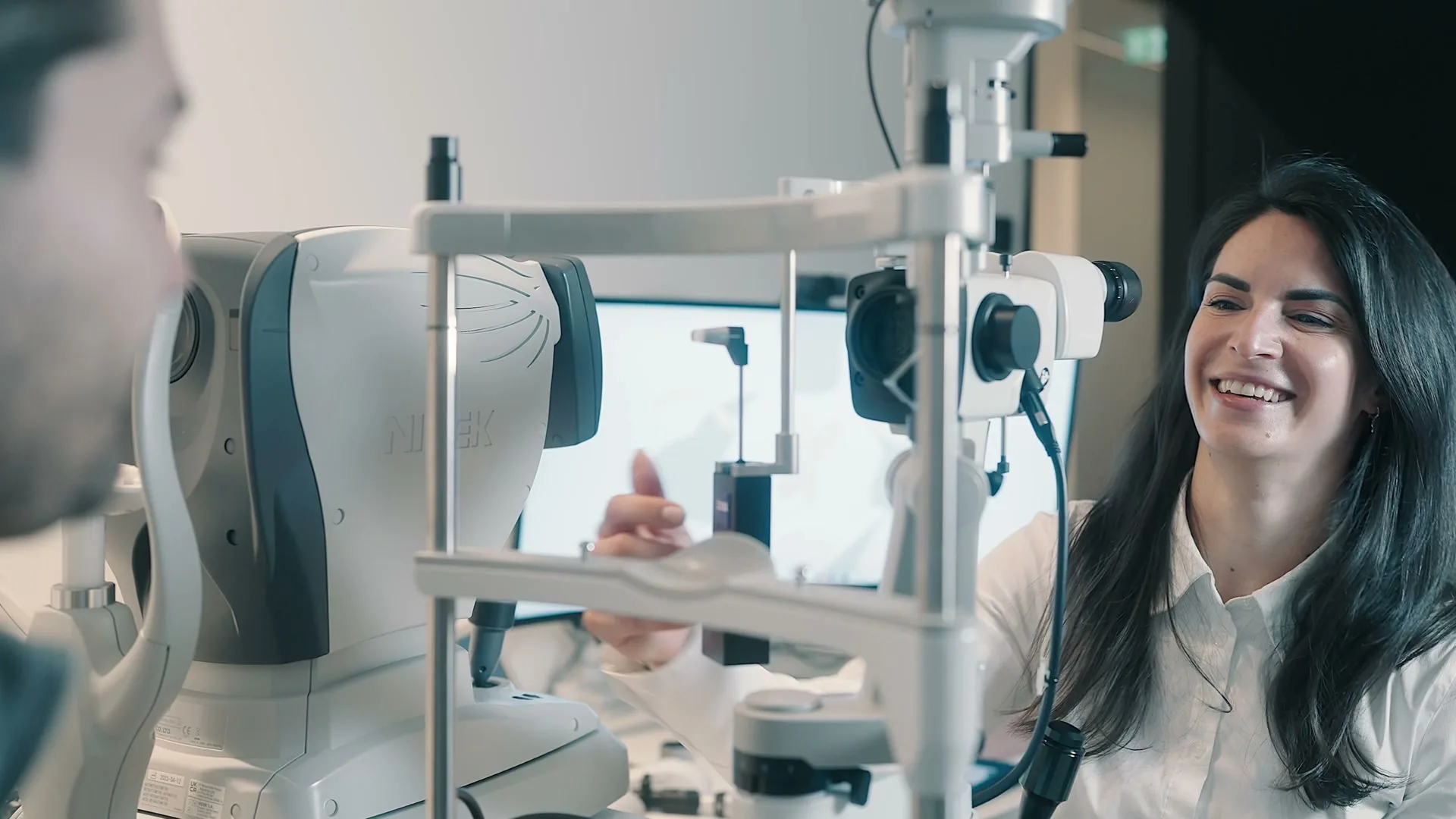
Because they are accompanied from the first call to the last follow-up check.
One surgeon for both eyes, 20,000+ procedures, 5.0 stars from 376 reviews. And a team that knows you from the first call to the last follow-up check.
Seals, with a method.
Prof. Dr. Mehdi Shajari has been listed 12 times as a FOCUS Top Doctor, most recently in 2026, and the practice received the German Customer Award in 2024. More important than the seal is how it comes about; that is why the method is included.
| Award | Who awards it | What counts | Year |
|---|---|---|---|
| FOCUS Top Doctor (Prof. Dr. Mehdi Shajari) | FOCUS Gesundheit, physician list | Recommendations from professional colleagues, scientific publications and patient reviews; FOCUS Gesundheit discloses the method | 12× in total, 2023, 2024, 2025 and 2026 |
| German Customer Award (dr.vision) | German Customer Awards, assessment by seven criteria, including transparency, communication and customer feedback | Patient satisfaction | 2024 |
| Google review (dr.vision Frankfurt) | Patients, public | 1–5 stars with free text | 5.0 of 376, as of November 2026 |
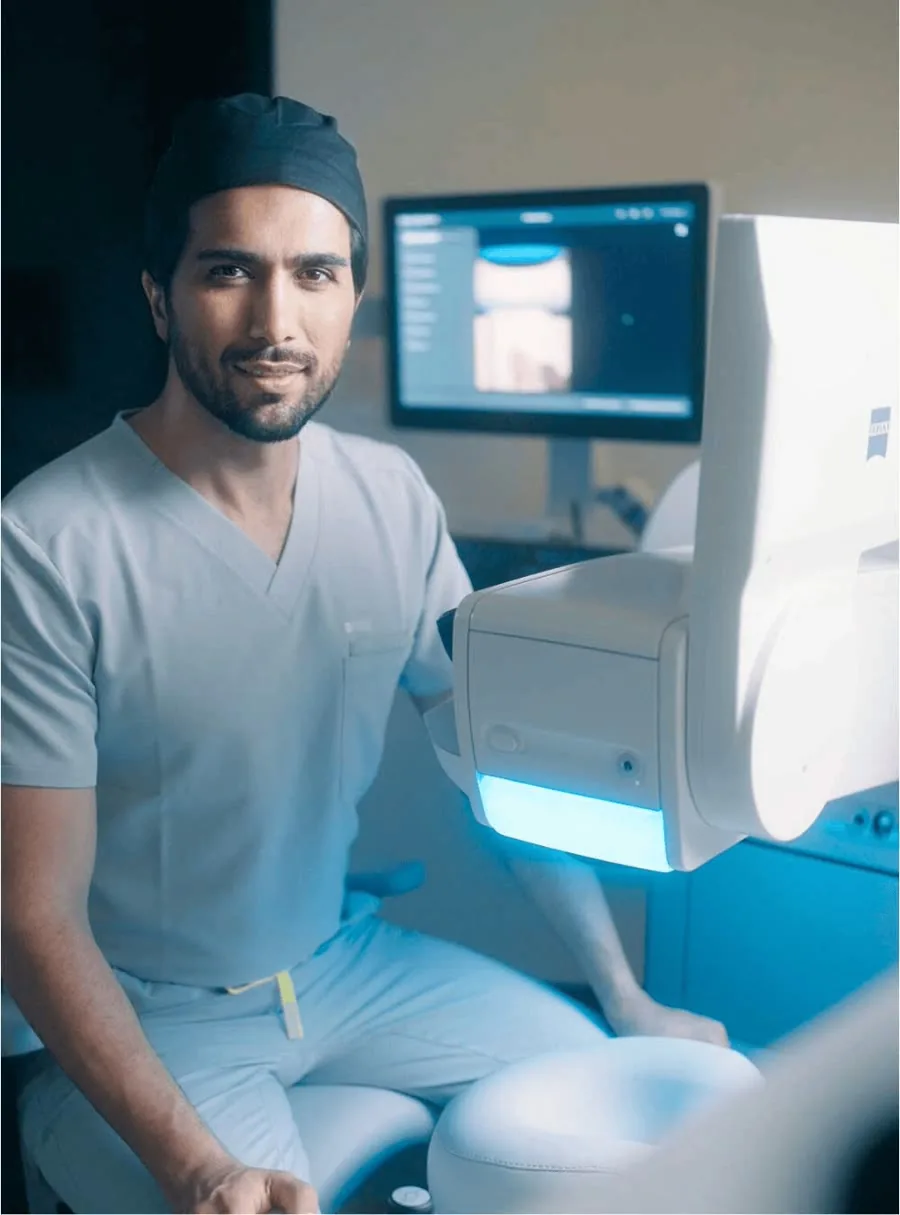
Prof. Dr. Mehdi Shajari. Personally.
Specialist physician and professor of ophthalmology (German title: außerplanmäßiger Professor), author of numerous publications on freedom from glasses, and teacher and trainer of several colleagues in this field. He examines you himself before every procedure and operates on every eye personally. In ophthalmology you will also see senior physician (Oberärztin) Ivana Pavlovic and Dr. Claudia Grunwald.
Still have questions?
The star rating comes from Google: 5.0 of 376 reviews (as of November 2026). Google checks whether an account is genuine, not whether someone was treated by us; we cannot verify that for Google reviews. The video patient reports on this page, in contrast, come exclusively from patients whom we treated ourselves and who agreed to publication.
You can see all Google reviews in the Google profile of dr.vision Frankfurt. There you can sort by “Newest” or “Lowest” to read critical voices as well. You can find the video patient reports on this page and on our YouTube channel.
Because we follow Google’s rules. Since 2019, Google no longer shows review stars when a practice marks up reviews about itself on its own website. This page therefore does not mark up the reviews again and links directly to the Google profile instead.
Call Patient Care (069 509 586 770, reachable 24 hours) or write via WhatsApp. You get a follow-up check with your doctor at short notice. Common reasons such as dry eyes or a small residual error can be treated; after SMILE Pro, about 2 in 100 eyes need an enhancement.
Yes, but only in general terms in public. Medical confidentiality forbids us from giving details of your treatment online, even confirming that you were with us. We therefore ask for a personal conversation and clarify everything else directly with you.
No. We offer neither discounts nor gifts for reviews; when we ask for a review, we do not ask only satisfied patients. Purchased or rewarded reviews are misleading and prohibited by Google’s guidelines.
They show how the process and care feel, not what your result will be. That depends on your eyes. Numbers are more reliable: after SMILE Pro, 96% of our eyes saw fully sharp without glasses after three months (visual acuity 1.0 or better) (412 eyes, 01/2024–01/2026). The pre-operative examination clarifies whether this applies to you.
Most describe the treatment as surprisingly short and painless. The eye is numbed with drops; you feel pressure and touch, usually no pain. In the first hours afterward the eye may burn or water. Increasing pain is not normal; if it occurs, call us immediately.
Gladly. You write a Google review directly in the Google profile of dr.vision Frankfurt. If you would like to talk about your treatment in a video, tell Patient Care; recordings are made only with your written consent, which you can withdraw at any time.
Medically reviewed by Prof. Dr. Mehdi Shajari · As of October 2026
Have your own experience.
The first appointment for freedom from glasses is a free consultation. After that comes the detailed pre-operative examination with Prof. Dr. Mehdi Shajari. You go home with a written recommendation and a cost estimate. In ophthalmology, you book a regular appointment.
In Frankfurt, Junghofstraße 16 · all measurements included
Our locations.
 Opening hours
Junghofstraße 16, 60311 Frankfurt am Main
 Opening 2027
Breite Straße 69, 40213 Düsseldorf (in the Neuer Stahlhof, corner of Graf-Adolf-Platz)
Until opening: preliminary talk in Frankfurt, Patient Care plans your travel.
Plan route Opening 2027
Lautenschlagerstraße 23, 70173 Stuttgart (2nd floor, step-free access)
Until opening: preliminary talk in Frankfurt, Patient Care plans your travel.
Plan routeMy name is Raquel Schulze Wischeler. I have basically worn glasses since I was 13. I was really nearsighted, you could say. Really, really. I could only see outlines without glasses. I had minus 6 in one eye, a diopter of minus 6, and almost minus five in the right one. I think everyone who wears contact lenses or glasses knows how stressful all of that is. The eye dries out completely. In the evening, when you are lying on the couch, you notice, okay, my eye is super tired, I really do not feel like doing anything anymore. Whether it is contact lenses or glasses. With that diopter, you have rather thick lenses, and you notice that over the day too. And just getting the feeling, or knowing, hey, I do not have to wear anything anymore, neither glasses that I always have to clean, nor contact lenses where I have to watch hygiene, that is an absolute liberation. And that felt more like a dream to me, and then I said, okay, now you dare to do it, and so I will do it.
Interestingly, I had already thought about having my eyes lasered about five years ago, but I was very afraid and then dropped the idea again. And lately I had big problems with my eyes because of chalazia, because my glands in the eyelids do not quite work, and so I had surgery twice. And then I said, okay, since I have already had surgery on my eye, you might as well dare it once more. And then I first just googled, came across dr. vision, saw, oh, there are really great reviews, and by coincidence my eye doctor had worked with him at the university hospital in Munich, and I had an eye doctor appointment beforehand and told her about it, I am getting my eyes lasered, and then she said, well, where? Then I told her the doctor's name. And then she said, yes, I know him, I worked with him. You can go there, he specializes in this, he is really great. And that took away the last bit of doubt for me.
And yes, then I came, had an appointment the next day. And right away I had the feeling that I was in the right hands. He sat down with me, explained all the risks to me, explained how it works, showed me the treatment room. And then the fear was somehow gone, and then I said, okay, I am doing it here. I was thrilled by the professionalism, first of the practice itself, which is superbly organized, and by the speed. You do not have long waiting times, you are examined, you have the feeling, okay, here they really examine thoroughly and extensively, and then of course it is explained to you on the screen, you can see it. So that was just totally professional for me. And so I felt safe right away.
Yes, my biggest fear was the eye itself. It is on the eye. And you have a reflex, a physical one. And the question of course was, okay, do I react, and does something go wrong because of that. But the fear was taken from me relatively quickly. I also talked about the fear. And then during the treatment I saw that the eye was held still. I did not feel that either. And then I calmed down relatively quickly. And I knew the eye was numbed. And so everything worked quite well.
I have no pain. I feel that something has happened to the eye, like a slight pressure, but it is one day after. I was already at work today, I have no pain.
Absolutely, so I can answer that question with yes, and go for it. It's not bad at all, it doesn't hurt at all, it's quick, and the healing process is pretty much there a day later. And it's an absolute quality of life. That's totally great.
So, my name is Zhao Xingshu, I come from China and have been working in Germany for 20 years. I have been nearsighted since childhood in China, and it has always bothered me a lot. In Germany I started doing sports and also tech. I work a lot with computers and my phone. And I always had to switch between glasses and contact lenses. And as I grew older, it became very, very unpleasant and also very time-consuming for me.
I have always wanted to find someone who is not only professional but can also offer good service. Then I read about it online and found the professor. Then I called him, and the appointment came very, very quickly. And the next day I was already here and met my professor. He made a very professional impression on me. And also really very nice and kind. And what I liked best is the speed of the services. And I think that is actually what is most lacking in Germany.
The first impression was not the typical eye doctor's practice but a very professional consulting company. Well, because I myself work in a technical role for consulting companies, the first moment felt a bit very different to me, but at the same time I liked it a lot, because I really like this customer-focused, patient-focused approach, the fast speed with the appointment, and the professional consultation. That was my first impression.
Of course, absolutely. I have already sent my husband here, and my child. Yes, and I think I would recommend it to all my Chinese friends in Frankfurt as well.
Hi, I'm Kathy. I have been living in Frankfurt for five years and I've had glasses for many many years and I do a lot of sports. I'm very active and so I also have like quite dry eyes so when I was wearing contacts it was bothering me usually after eight nine hours. So yeah I was looking for a solution to kind of adapt to my lifestyle of constantly doing sports, running, et cetera, and not having to deal with all the contacts. I swim a lot too.
And so a few of my friends have gotten LASIK as well as SMILE was something that one of my friends was mentioning. And then a very close friend of mine said that she knew a doctor who was extremely highly rated in Frankfurt. I'm usually a bit scared of medical procedures. And so I did my research. He's won tons of awards. He was also part of the university clinic. So I trusted that he knew what he was doing.
So I came for quite a few consultations with him. I think I spoke with maybe like three, four or five times and he was always, you know, he took his time to explain things to me. I didn't feel like I was being rushed. I also had another consultation in another clinic and I felt like it was more of a business there. And so, which is fine, but it's just, you know, it's your eyes, I want it to be with someone who really knows what he's doing and lets you kind of decide. So the reason why I went with Mehdi in the end was because he kind of laid out all the different procedures as well as the pros and cons and then he kind of let the patient, you know, not select. He obviously will give you probably the ultimate decision but yeah he allows you to kind of come to a decision as well.
In all honesty, so I thought it was, I didn't do like my full full research of, because I don't like to look and see what happens because then I'll have it playing in my head when it's happening. So I left a bit to the imagination so I knew, you know, what the procedure was about, how it's kind of done. But it was definitely more intrusive than I expected. It was extremely fast. So the laser was like 10 seconds. And then the doctor has to come in and do some manual things inside. So definitely choosing a very good doctor is extremely important because I thought it was just laser, done. Everything was just like in the machine, but it wasn't. The doctor is doing quite a lot of manual work afterwards. So I didn't expect that part. But can I say it was pleasant? No, you can definitely feel, but there was no pain, but you feel pressure on your eye for maybe like a minute and then the other one, but for a lifetime of good vision, I think it's worth it. But it's definitely not like, you know, getting ice cream or something. It's...
So this facility is quite new actually. So I think it opened maybe one and a half years ago. So it's definitely picked up. Like there's so many patients here now and also different doctors here, but extremely nice. So probably one of the highest end facilities that I can go to. But for me, I like having very clean facilities, obviously. But when it's super, super high end, then I do some of my research, like is this doctor? What's the background of the doctor? But because I know Mehdi, and I know that he came from the university clinic, he had the credibility plus the environment, you know. So you don't necessarily want to go to a dentist that has like gold everywhere, because then you're like, hmm. And they do a bit of research, but yeah. For him, it was a very good combination. So extremely professional. They take care of their patients. They ask you if you want water or coffee. Usually in a waiting room, you get nothing. So yeah, it was very nice. So.
Hi, I'm Sebastian, 37, I live near Frankfurt, and I have somehow always been annoyed that I have to change glasses so often. I have kids now, who knock them off my head or smear them. And for me that was mainly a hassle problem. Apart from the fact that I naturally have weak eyesight, but I actually always got along quite well with glasses. And then I tried contact lenses and noticed that my eyes are dry and it all didn't fit together so well. And then I saw that this offer exists here and first informed myself. So, what does one actually do? There are so many treatments you could have. I went a bit too deep down the rabbit hole and watched videos and saw what these surgeries look like, and at first I kept my distance. It took half a year until I had gathered my courage and thought, well, it can't be that bad. So many thousands of people do it. And then I simply looked more closely at which treatment suits me. Before the doctor had even advised me, I don't know if I am the perfect patient if I already come with an idea, but I came here with the goal of having a PRK treatment. So basically the treatment that many patients are a bit afraid of. Rightly so, you always read in experience reports that it probably hurts quite a bit and that it is the most unpleasant of all the variants, with long healing times and long aftercare times.
So I have a refractive error, diagnosed since fifth grade or so, but not particularly bad. Somewhere between one and two diopters, it got a little worse over time, then I was at one and a half or 1.75, and from about eighth grade, ninth grade or so, it stayed stable. So it simply didn't change at all anymore. And it really only bothered me in that the glasses themselves are of course an obstacle. But that is bearable, it's not really that bad. It became more unpleasant when I started, for example, sports where glasses get in the way.
Climbing, bouldering and things like that, you don't necessarily want to start with glasses on, and that was annoying. Then I started with contact lenses, always had dry eyes, always had to rub my eye, push them around, and I didn't like that at all. Then of course I looked at what solutions there are, how I can get away from this somehow. I can say that my fear beforehand turned out not to be entirely justified, because the whole thing was basically not that bad for me. You have your eyes lasered, and of course that is an uneasy feeling.
And you also go home with swollen-shut eyes, maybe. Everything is not so great, it burns a little. But compared with the stories I had heard, what really happened to me, I have to say, it was really not that bad. You can take painkillers, and I should say, the first day it burns a little, but by far not as badly as is often said, in my case. And on the second day I hardly noticed it anymore, and on the third it was okay.
In terms of pain, that is. Of course you can't see anything right away. You may have to wait a little until your eyes can open again, the swelling has gone down and so on. But from then on it is actually a simple, straightforward healing process. It gets better every day, the vision gets better.
And I think after one week, that was it, I could already make out everything again reasonably well. And now, after a month, I am glad that I did it. I have no complaints at all. When I walk through Frankfurt, I can see the tops of the skyscrapers and see everything sharply again, without glasses, without contact lenses, without discomfort. It is wonderful.
The thing is, I have two children, and my two boys are not necessarily careful when it comes to touching my eyes. Now and then a hand lands in my eye, and perhaps not all that gently. And when I think about it after gathering my information, that something in the eye might actually not be firmly healed yet. Because with LASIK or other treatments, a disc or a piece of a disc is cut, so to speak, folded back and then put back.
This flap, exactly. It only heals at the outer edge. And when I imagine someone hitting it with force, I don't feel comfortable. Of course, I also know, you hear from doctors too, that it is not necessarily the force you need to lift this flap again.
But nevertheless I simply don't feel comfortable with it and couldn't warm to it at all. And PRK is actually a method that, according to my research, really many people have had done, and which is routinely used in the armed forces or other organizations, where force on the eye is perhaps more likely to occur. But if they do it, how bad can it really be for me? And this putting things into perspective is what in the end made me say, okay, this is my variant, this is how I want to do it.
And it worked well. I think that is true for everyone who starts out with this bad gut feeling. You try to optimize, you know, what can I do so that the whole thing goes well. And when you look around, of course you look for someone who treats the eyes and has a certain reputation.
A doctor, professor, doctor, someone who works at the university hospital, is of course exactly right. For me it was also close to work, so there were simply geographical reasons to come here as well. But it all fit together well. The information material was good, I could look closely at what the prices are, what the conditions are, and I could make an appointment where I could also speak directly with the doctor.
That is also very important to me, not to speak with just anyone but with the doctor, and also to know that the person I speak with at the start is the one who will treat me. Basically I would say it was a good decision, I would do it again, and it is certainly not as bad as is often said. Very many people have the surgery, few people have problems with it, and we all know the internet, often only those who have problems speak up. Don't trust it too much, get in contact, find out how I can do this, which doctor can support me.
In this case it was very easy, the first conversation was directly with the treating doctor, and then you see whether you feel up to it or not. Definitely, I had very positive experiences, I am satisfied with the result. No complaints to this day, of course.
My name is Laura. I had my eyes lasered in April by Dr. Shajari, because I saw very badly with both eyes and it limited me a lot in everyday life. Especially driving was not possible at all without glasses, and I can’t tolerate contact lenses. I find that unpleasant, and handling them just didn’t fit into my everyday life. I also found glasses very unpleasant even after wearing them for a long time, and above all you depend on them so much. If I forgot my glasses, I couldn’t work, I couldn’t see at university, I couldn’t take part in everyday life. And what was really one of the worst things, too, in private situations: I was outside, I didn’t recognize friends, I didn’t say hello to them, I didn’t recognize colleagues, and sometimes I even thought, that’s my father, that’s my mother, and then I said hello to people, and it was totally limiting. I really didn’t recognize people, I couldn’t really share in everyday life.
I was generally a patient on verifyMED, and I also learned through friends that he used to be a senior physician at a large hospital and enjoyed a very good reputation there. I heard that through friends, and I liked him a lot. The reviews are very positive. And when I had the first consultation appointment, because I actually also had consultation appointments elsewhere, it was immediately clear to me: I'm getting my laser treatment here. I already knew that with the eye, the doctor has to be the right fit, that's very important, especially with the eye, because everything is at stake there, I think.
On that day I had minimal pain, but it is really manageable, more of an unpleasant feeling. You can also take a painkiller, and then it was okay. You have to get used to it first, the eyes are very sensitive. But the next day it was really as if there had never been a surgery. So you can see right away, it is not unpleasant. You just have to keep taking the drops. There is a plan for that, which Dr. Shajari writes out. And in hindsight it wasn’t a big procedure.
I was in a bar here with friends, and it was really a different feeling of life. I walked in, finally saw people, noticed people. I didn’t feel uneasy, because without glasses I used to be like, do I know that person or not. It was simply a completely new feeling of life.
I tell everyone, I have also already recommended it to friends who had it done, who are very satisfied, I would do it again any time. For me, at the beginning, I was unsure, because I am still very young. I am only 24, because many people say, wait with it. Because the eyes will, even Dr. Shajari can’t stop that, still get a little worse. For me it has now even gone to much better, on purpose. If they get worse, I will still see 100 percent. I now see 160 percent, definitely pretty crazy.
And I would just urge people to do it as early as possible. Don’t think about it for long, just do it. Because I actually even regret that I didn’t do it a few years ago.
I am Dominic Boeschen, 26 years old, I actually come from the region here, from Fulda, and have now moved to Frankfurt for my job, and I was severely nearsighted at minus 8 diopters in both eyes. I have been nearsighted since about 11th or 12th grade in school and have always worn glasses. Lately it had become so bad that even with glasses I only reached 80% vision.
Accordingly, I had looked into alternatives. I actually did not wear contact lenses, simply because it became enormously expensive with these diopters and astigmatism. So I played sports with glasses. And the sweating alone is annoying, because the glasses slide back and forth.
If the glasses then do not sit properly or move slightly, you suddenly do not see quite sharply. That lasts a few seconds, and I quickly missed a ball that way. That was extremely annoying. But when I was at the swimming pool with friends, it was not possible without my friends keeping an eye on me.
Because I could not see them. As soon as they were about 50 cm away, I only saw blurry shapes. I could no longer recognize the face. I no longer knew who it was.
LASIK unfortunately no longer worked for me. Or rather, Prof. Dr. Shajari had not recommended any laser surgery, because it would have been too risky.
Instead, he recommended the ICL, which is a bit more expensive but has significantly fewer risks, and accordingly I was very happy with it. I am now one day after the second surgery and we have just reached 160% vision. But it is already a huge difference, just when I get up, that I do not have to put on my glasses before I can see anything. Instead, I get up and walk to the bathroom completely normally, get ready and head out. I had not been able to do that for so many years.
I cannot do sports yet, or am not allowed to yet, but that will also make an enormous difference. With these high diopters it was very hard to follow balls, because everything moved relatively hard to see and the eye had to correct quite a lot. So I am hoping that the ICL implantation will make it clearly better. You still have this glass ball on the eye. That makes vision a little restricted for now, because there are only a few holes you can look through deliberately.
Because of the glass ball itself everything is a bit darker, but you can already tell that it is getting sharp. When the glass ball is taken off and you do this test here, meaning they really check again how much you see now with the new eye, with the new lens, then you notice a huge difference. I could read the numbers at a distance right away, whereas, with my nearsightedness, it is hard to describe, I could not see anything at all. And then suddenly I can read in the distance. It is really hard to describe, it is completely different, a completely different world.
I actually had consulted several doctors. I was given different recommendations in part. Some said you could still use a laser. Then I spoke with Prof. Dr. Shajari.
I simply felt much better advised. Everything went much faster than with all the doctors I had visited and talked to, who would have had it paid completely privately by me as a statutory health insurance patient. But even there I had more the feeling that it was about selling me something quickly. They always recommended doing something. But I was not told which would necessarily be better; it was simply said that the most expensive is the best, more or less.
When you read up on the internet, you see a lot of bad reports. You very rarely see good reports on the practices' own websites. But now, in the end, I simply relied on how Prof. Dr. Shajari advised me and I am super satisfied.
The whole surgery took maybe three, four, five minutes. Completely painless. I didn't feel anything. It was a bit strange because you looked into the light the whole time, but all good.
My name is Simone Richter. Before the treatment I had the problem, above all or increasingly, that I could not see well at all anymore at near and intermediate distance, which bothered and limited me extremely. For one thing at work, but of course also in private life, when you go hiking and want to read a map and can't see anything anymore and your glasses fog up or you lose them or break them, which I'm a great artist at. That bothered me a lot, limited me a lot. On top of that, wearing glasses felt to me like it triggered migraines, so the headaches bothered me a lot too, and that is why I decided on the surgery.
I got a lens exchange, so a new trifocal lens, which also comes with certain compromises, I have learned you always have to make a compromise, and and since the topic of freedom from glasses was very important to me, I decided on the trifocal lens.
So I actually came across Professor Shajari on the internet and had the first appointment with the intention of slowly getting used to the idea of progressive glasses. That would have been the next step. I had not dealt with the topic of surgery at all beforehand, because basically I am rather against having anything operated on without great need. And then in the conversation I felt, how should I put it, well taken care of. I did not feel pushed in any direction at all, just got information I did not have before. And with that I started to look into the topic. In between I also dropped it again, but then, through everyday activities, everything I just mentioned, hiking, swimming, cycling, where glasses really torment me, I thought, okay, I'll try this, and I also simply built up trust over time. That was all something that gave me a lot of reassurance, because Professor Shajari always took a lot of time. You know how it is with doctors, and I understand it too. There is a lot of pressure with queues of patients, and in the end you probably always have to answer the same questions. But I always had the feeling that there was enough calm to answer my questions.
The actual course of the surgery, from the pre-operative examinations to the appointment, goes very fast, it is very easy, much easier. I panicked a lot the evening before the first eye and thought, oh my God, how will this go? My head will be screwed down Hannibal Lecter style so that I don't flinch. And I worked myself into my horror scenarios. And it was all actually very relaxed. A very, very nice, good-humored team in the surgery center as well, which I think also helps a lot as a patient. And yes, it goes in no time, you don't feel anything, I think I can say that, and you go home again and everything is fine.
What was very astonishing for me was that I actually did not feel it at all, so during the surgery 0.0 pain. There was one point where Professor Shajari said, now comes a little pressure, and a little pressure came. To call that pain would be saying too much, but you really don't feel more than that. I must say, though, that between the two surgeries, from the first to the second eye, I felt even more unsure, even though that was always well handled and explained.
I think before the surgery it was also very important that, in my perception, it was explained realistically. It was explained well that it is a compromise, that in some ranges of vision it would get worse, but that in sum a visual ability that allows freedom from glasses will result. Now of course that is very subjective. So what does it mean, I will see worse in some ranges? That was a really big panic point for me and it stayed very strong in the time from the first eye to the second eye, because after the first eye I of course had the issue that I had one eye not operated on that doesn't see well and one operated eye that sees so-so after the surgery. Already much better. I also got a smile from people often, because on the second day I could already read with the operated eye, which would have been unthinkable before the surgery and which was also a really big pain point for me. But this panic still led me to this fear, what have you done, you had something operated on for the worse, because of course with glasses an operated and a non-operated eye create a really awkward situation. And now, today, day one after the surgery on the second eye, I am actually very happy at the moment.
I did good research beforehand. I also called my health insurer to ask how they view such operations. I deliberately chose Professor Shajari because he also has a good reputation. You hopefully only do this once in your life, and you don't have, you don't know, so I asked around my circle of acquaintances. What experiences have people had with these operations, which interestingly didn't give such positive feedback in my case. However, they were not patients of Professor Shajari, and some of it was also a while ago, I have to say. Medicine has surely progressed since then. That unsettled me and it was also one of the reasons why I first backed away from the operation again in my carousel of thoughts. But I believe in tapping all the information channels you have, asking all your questions, and really choosing a doctor who gives you a good gut feeling. Because I believe, with all these topics, you can check a lot of facts, and you should. But you also have to have a good feeling.
And I am not now, it was partly also an indication with the cataract in my case. And I am not that old, I could have gotten around this surgery with glasses for a while longer. I am 55, I could certainly have worked around such a surgery with glasses for a while. You have to really think it over carefully, I believe, then that also gives you a good feeling yourself. And if you then feel in good hands, which was the case here, then it can work well.
My name is Björn Kannegießer. For many years I wore glasses, which was especially a problem when reading, when you used your phone, and so on, checked e-mails. It no longer worked without glasses and at some point it reached a degree where you say, if there were a change, what would you do? And to get rid of the glasses, because they are always an obstacle somewhere, every day up, down, up, down, where are the glasses, forgotten again, and so on. And so we said, what alternatives are there, and then we looked into it and we have now taken the step, so to speak.
Yes, my wife is very savvy on the internet; whenever we have to buy, need or compare things, also price comparisons, my wife is always very good at that, she always has a good knack for it, and she took on the matter and came across this, so to speak, and then we tackled it here. Yes, of course you have a lot to do with social media, so also with computers, and it was always annoying, and what I also noticed was that I couldn't wear sunglasses anymore, because either you have sunglasses on and then you can't see anything, I couldn't read either at that moment, so I had to take them off, put the normal glasses on, and it was always up and down like that, sometimes you had two pairs of glasses somehow, the sunglasses you took along and the normal ones. I do have progressive glasses that also tint, but it wasn't the same as sunglasses, and at some point it was all too much for me, and this fiddling with contact lenses, in, out, lost, where is that thing, it was all way too much effort for me somehow and not an alternative for me, and to get rid of these glasses, we actually thought, let's take the step if it's feasible. So even in the first two days I still reached for my glasses by reflex, because I usually always had them on my head, as that was the easiest, and after two, three days it gets less, and now I can already read things again, I have that as of today, the other eye was still bandaged and so on. Now I first have to focus a bit, but I can read things again that I used to, because that's how it is, you know, so it's definitely a good thing, so now of course I first have to acclimate the left one a little, so to speak, but you can already notice it, it's definitely an improvement.
So absolutely, I felt absolutely comfortable here with the professor, the empathy is there, I felt well taken care of, also in the conversations, and of course during the procedures and so on, so I never felt uncomfortable in any way, and from that side I can recommend it, I would do it again, but I am annoyed that I did not do it earlier, I have to say quite honestly.
I am 74 years old, my name is Fayez Chbib.
My vision was getting worse and I went to several eye doctors, but it was always the same examinations, pressure measurement and so on, but nobody recommended what could be done so that I could see better again.
I think someone from my family was in treatment here, and my sister told me, go to them, that is the right address. And then I called and an appointment was made.
I did not know for sure what I had, but I suspected that I had a cataract because I could no longer see dark things so well. Without mentioning the other eye doctors from before, I said, ask your sister, my sister knows good doctors, I suppose, which has now also proven right, I had never made an appointment before. It was pleasant, it went relatively quickly, and I was also impressed by the equipment, everything seemed to me to be state of the art. My wife was there too, she said, I think we are in the right practice here.
Of course, I could tell right the next day that it was better than before. And today I also found that I can see relatively well with my left eye.
What struck me very positively was, first of all, the equipment and how I was examined. I saw that for the first time here in Germany. And what was also impressive was all the data, how it was transferred immediately from A to B and how the professor then has everything on his three monitors. That was impressive. Everything was actually very trust-inspiring for me, yes. Because you shouldn't mess around with your eyes.
What I can tell people is, if you don't want to make too many wrong attempts, you should come here right away.
My name is Peter Weigand. I am 80 years old. I suffer from macular degeneration in both eyes, which is especially pronounced in the left eye and developed in the right eye in 2022.
Before an upcoming cataract operation, I contacted the professor to get advice, and I was also looking for a new surgeon for my future regular injections. I have been a patient of Professor Shajari since the summer of 2023, and I must expressly praise the extremely punctual, truly comfortable treatment given with the utmost attention. I have now had over 40 injections from various doctors, and no one does it with such professionalism, kindness and reassurance of the patient.
Both cataract operations went to my utmost satisfaction. It was on time, it went without major problems. Afterward I could see well, given the circumstances, and today, four months later, I am glad that I did it, and I can only expressly recommend Professor Shajari as an eye surgeon and as a doctor who is devoted to his patients.
The comfortable process, the human warmth during this phase of the operation and in the preparation for it, and the pleasant, calm atmosphere during the operation give you a sense of security and made the whole thing, which on the eyes is not necessarily so pleasant, actually go off without any problems. And I can only recommend Professor Shajari in the warmest terms as an eye surgeon and, in this case I must say it, also as a person who is supposed to treat you.
Yes, I am Elvira Siemens, I am 45 years old, I currently work as a teacher, and in fact I also worked for ten years earlier as a nurse in the eye operating room and knew a little of what was coming when I now had this surgery.
The first time I found out at all that I have a cataract, I was 17, because I wanted to get a driver’s license and failed the driver’s test and also did not get through the medical report at first. Then I found out that I have a congenital cataract, which means it is inborn, and I was born with it and did not know it any other way, and I was quite surprised that I was then told I cannot see all that well, but I had not felt limited. It is actually the case that I have a congenital cataract on both sides, in both eyes, but on the right it was more or less central and on the left it was rather peripheral, which is why my left eye could compensate superbly for whatever loss of vision there was, and I never noticed anything.
Nobody noticed anything.
No, I also never had the feeling that I see in any way limited. I actually then worked in the eye operating room at the university hospital, and of course I was then with the experts on site and knew exactly how the steps of the surgery go and how it works. And they, of course, always monitored it and so on, but then at some point I did notice a worsening of my vision, and then five or six years ago I was told that a subcapsular cataract is forming as well, meaning yet another worsening of the vision I had anyway. And then, honestly, I let it slide a bit, because I always thought, well, I can still see fine. And at some point I thought, now it really is getting worse and worse.
And then two or three months ago I had an eye infection. I had a chalazion, the whole eye was completely swollen shut. And then I happened to be here with Professor Shajari. That was really by chance. And then I found out that I am with one of the best cataract surgeons there is. After I also talked with my old colleagues, they told me, yes, no, whatever you do, stay with him. Yes, he is one of the good ones, really good. Well, and after my chalazion had healed, he measured my eyes again, and then it was somehow quite clear that my visual acuity was very poor.
Well, I was thrilled. Super nice, super friendly, extremely helpful, very attentive. First of all, getting appointments at all, my appointment was super fast, but in this practice in general you get appointments very quickly and easily, and I think the team works together really well. The professor himself, I found him incredibly friendly and caring, and you really feel that you are taken seriously, and at times I said, I actually only wanted to ask a question, I don't want to take up your time unnecessarily. I actually only wanted to write an email, and he said no, no, come in now, let's take a look. That is really very friendly and caring.
The result was as good as I never in my life would have expected, because you really could completely, the result is at 100 percent, yes, again. My eye has not gotten used to it yet, I must say. I still have a high sensitivity to glare, but what can be measured is apparently a perfect result.
So I have to say, what was the biggest aha moment for me was actually that I could see colors again so strongly. In recent years, for example, the colors pink and turquoise are much new for me. So pink roses are pink, they were always so milky. That is, for example, something I find truly wonderful, really great.
Some patients have already been here after I had been here, whom I sent here. And last but not least, my family will also come here soon for a check-up, my husband too, I think, definitely. It is absolutely recommendable, and I also know that patients who are perhaps not privately insured still take the money in hand and say, I will do the follow-up checks here. So I have the feeling that you are simply incredibly well looked after here. Just from the modern technology and everything, it is quick and then friendly. I think many patients are also willing to spend the money there.
Well, my name is Monika Meier. I was here because my nephew signed me up when I complained about reduced vision. And he made an appointment for me right away. I came here and the professor and I went through all the pre-operative examinations. And the result was that I have a cataract, which I did not know and was not really aware of, and then I decided fairly quickly to have the operations done, even at short notice.
It all comes on so gradually. So I wasn't surprised about it. I knew that with older people, it just happens. And recently I had a kind of veil, a kind of shadow, on my right eye. At first it was like a bit of lint, and then it got a little smeared, and then I was here very quickly. And then I did feel a little odd. And as I said, all the other symptoms that I know of now develop so gradually that you don't really notice them. If I had known that, I would have come much earlier and had the surgery much earlier.
Well, the professor, all the staff, also in the clinic, very friendly, very caring, very accommodating. I always felt well looked after, really the best. Honestly, it can't be done any better, I really have to say that.
But immediately, yes, with the first eye too. Already the next day I could tell that I see more sharply defined contours and everything is brighter than I had been aware of in the past. Now, after the second eye, the professor said that I now have visual acuity above 100 percent, and I notice that too.
You do have concerns when something is done to your eyes. You are afraid of having your eyesight limited even more in some way, or of losing it completely. And one thing I had was that I could hardly imagine how I could keep my eye open the whole time so that the surgery could be done properly. But that is no issue at all. It is so technically advanced, so flawless, and everything feels so natural and matter-of-course. And it is simply no problem. You don't need to be afraid at all.
Yes, my name is Martina Franke. I was born in 1966 and I did not want to admit it, but I actually saw very badly before the surgery. So that when I had my care products in the bathroom, I no longer knew whether I had the shampoo in my hand or the conditioner. That is, how often did it happen to me that I put shampoo in my hair twice although I needed the conditioner. And I could no longer cope in the supermarket either. I no longer saw colors so nicely either. And the problem was, when I saw someone from further away, I did not recognize them at all anymore. And that was also very bad for my professional environment.
So the surgery on the second eye was yesterday and the surgery on the first eye was 14 days ago. That was great, because I had appointments, I could not do them in the usual period of one week, and instead consideration was taken.
I see colors and I can read. I had no glasses for driving, although there I did, I mean there it would actually have been necessary, and I had a pair of glasses for reading, and because I just did not want to admit it, I always bought them at DM, and at some point I had arrived at three, had to squint already, and now I can read everything. So it is really fantastic, and I could actually do that after the first surgery already, and he does it fantastically, because he sets it so that you can see both up close and further away, for example watching television. That means you can shop in the supermarket again, you can see the daily newspaper, you can see your care products in the bathroom. Unfortunately you also see every flaw in the skin, but there is always something.
And actually the professor was my second opinion. I had been to another professor, and he already said, um, cataract, we have to do something, and you also do not see so well anymore, which I did not want to admit either. And I thought, well, what he says. And then I thought, I need a second opinion. And then I came to Prof. Dr. Shajari and it was great from the start. I was so enthusiastic that it was completely clear to me, after the initial conversation, after the examinations here, which were top-notch professional, which were on schedule, the practice is incredibly well organized, everyone here is incredibly friendly. So it was wonderful, and therefore it was completely clear. No, this is not my second opinion, this is my first doctor. And since I am no longer allowed to go to my actual eye doctor, the professor will now have to be my eye doctor.
With Professor Shajari, no. That was completely clear to me, he showed competence from the start, he simply radiates it, and you feel in good hands. No, I had no concerns at all.
And my husband accompanied me here. He is a very critical person, and he came along because he said that for a second opinion, he'd better come with me. He was also completely enthusiastic, and my husband also said that if he had known beforehand what possibilities there are, he would have come to the professor here as well.
Yes, absolutely. Yes, five points are actually enough.
So my name is Roski, I am 81 years old now. I already had glasses, I've worn them since I was 16. Back then I couldn't see far. Now presbyopia has been added.
But then I noticed, after I had bought a new pair of glasses a few years ago, I was very dissatisfied, because my wife could still see better than I could. You always notice that when cycling, with the signs for cyclists. They are those small, labeled signs. She could read them, I couldn’t, despite glasses.
That is when I got the idea to go to the eye doctor. And after I knew that it had to be done, I looked on the internet, my eye doctor also gave me a few recommendations. And then I looked at what people say about it on the internet. And then I came across Professor Shajari. Shajari, yes. Difficult with the names.
Essentially, first, the recommendation from my eye doctor, although he named several. Second, of course, I looked on the internet to see what people write. And another point was that he and the staff, and also the professor, with his services and his manner, were very positive, only positive reviews. I'd say, if two out of 10 reviews are negative, that's already nothing, and if there are none at all, one negative can always be among them, but here there was nothing negative at all. I found that very good.
He still has that thing on his eyes right now, but I already noticed, with the left eye I can see far clearly better than with the right eye. So you can already tell that it has turned out great.
Yes, definitely, I would definitely advertise for it. I would of course tell everyone, you can go there without worry. Let me put it this way, it is much more pleasant than a visit to the dentist, this whole thing.
Krzysztof Trukan, as I already said, I am 75 years old.
My vision has been declining for decades, especially in the left eye, because I only had 40% light getting through because of the cataract. And for years I put it off, but now, on medical advice, I decided to change that. I had already been to a colleague of a professor a year ago, who did not give me the trust I needed for a surgery like this. And then I turned to the professor here and am absolutely thrilled with the result.
Yes, I informed myself a bit, the surgery is very low-risk, with few sources of error, but something can still happen to the eye, that's clear. Of course I had concerns and I already had some problems in my eye, something on the lens had possibly grown attached at one spot, and the other doctor wanted to take me to the hospital for the procedure and made me more afraid than confident, and here I had the feeling that there were no problems at all. There is always a risk with any surgery, but the professor told me, after 10,000 surgeries I have never had a problem. What he could not guarantee was the success in percent of visual strength. You can only see that afterwards anyway.
I have to say, a week ago on Wednesday I looked with the operated eye and could not believe it. Without glasses I see everything in the distance. And yesterday after the surgery I also peeked through the shield, and it got better from hour to hour. And now I look at her and see her perfectly.
It went very fast, about ten days, two weeks. So the first meeting, then everything explained and measured, and then ten days later was the first procedure.
Yes, so the trust was there very early thanks to his personality. The professor is very trustworthy. And I am emotional now, because I have the feeling it is fantastic.
As soon as vision declines, as soon as it gets gray, the cataract, it is a road of no return. It does not go back, it never gets better, it only gets worse. The sooner you do it, the easier it may be for the eye to get used to the new vision.
My name is Thomas Eckert, I am 65 years old, I am an apple wine innkeeper in Frankfurt-Niederrad.
I simply noticed deficits. I used to be able to look into the distance without any problem. For reading I had needed reading glasses for many years already, and I noticed that seeing into the distance was also becoming more and more problematic. So I decided to simply have it examined and went to Professor Shajari, whom I found through the internet, and within a few minutes he told me, it is a cataract in both eyes and must be removed surgically.
When driving at night it was really problematic. The oncoming lights affected the eye so much that it took a very long time until it became somewhat normal again. That means the eye was always under strain. And finally, and this was decisive, I noticed it at soccer, in the soccer stadium, that suddenly I could no longer even distinguish the numbers on the players' backs from the seating area.
I now have new lenses in both eyes, and I just had the last follow-up check and I feel absolutely fantastic. The most decisive thing as far as visual acuity is concerned will only turn out now, because the last eye was only done yesterday. I will wait and see. But I see incredibly well. He already said I am at 100 percent. And what was the most decisive and most striking thing from the first day was simply the light conditions, the brightness. Before, prior to the surgery, everything was ultimately as if seen through a very fine stocking in front of the eye. It was really dull in comparison. You come home and are amazed at the red that is standing somewhere in the yard or in the garden, a color you had certainly not seen in that way for years.
I simply opened the page on the internet in Frankfurt, and ultimately I wanted short distances, because I still have a lot to do. And Dr. Shajari's practice was, I believe, one of the first things I saw. And I called and it was completely problem-free. I got my first appointment right away. After that, on the very first day, we had already fixed the two surgery dates plus the examinations that followed. And everything happened exactly to the hour, to the minute, as agreed. And those are things I like.
I am 65 now, so we have also already been to one practice or another. It is of course spectacular when we now come into this, I have also experienced others, I simply like taking that in, because I immediately believe that with all this madness, how beautiful it all is, the corresponding equipment is of course there too. And I simply follow that. And from the first moment here I had the impression that I was in very professional and good hands.
I'm not particularly anxious about medical matters. By nature I have complete trust in our medicine. I have that, and that something can always go wrong somewhere, that may be, but that's not who I am and that's not how I approach things.
Then you are seated in the chair, the eye is treated with drops and moistened. With this chair you go into the operating room. Dr. Shajari is of course also a very calm person. So it's not the case that he makes you nervous on top of everything. None of that is the case. I wasn't nervous, he wasn't nervous. Yes, and then it begins. You simply look up into the light, and the eye is apparently taped open so that it can't close anymore. And yet you can still look down or look up, because you get instructions from him. Look straight ahead or look up, look straight ahead or look up, and then these reflexes come. Then everything went wonderfully, and I went home with my eye taped shut.
And today, well, last night I had a headache, which was not the case at all with the right eye. Then I got on my bike and came here, and now I have the final check and a one hundred percent result.
I would say at any time, if a conversation comes up or if I hear something and someone says, my God, I have this here or I cannot see there, I would say at any time, I went to Dr. Shajari, what happened to me there was simply all top.
My name is Ingo Michel, I will be 57 in the summer, I am a tax advisor. Last year it was found that I have glaucoma. It was quite severe, it was treated, there was also eye drop treatment, but the normal procedure was pretty much exhausted. At some point I had something like a blinder, and, well, it's clear that this is not normal.
At some point I went to the optician, who sent me to the eye doctor. The eye doctor took me to the hospital as an emergency. That was a bit surprising for me. But she also explained that every further day could cause further damage. That was in May last year, and they treated it as an emergency and set me up with a therapy. With this therapy, some laser treatment was done and there were eye drops as well, but that is a relatively large amount. The eye doctor said that the maximum had actually already been reached to achieve a result that is still pretty much at the limit. She said this is not really a nice long-term solution. And that's why I can, maybe this is an opportunity, only recommend, if something like this happens, to act immediately. Because it won't get better, it will only get worse, if anything. You have to say that very clearly.
The eye doctor recommended the professor. It was a very strong recommendation. I know from a professional point of view, from my clients, that this procedure is apparently a real routine procedure. So that is what it is, there is no need to be afraid. And he had also explained that to me, credibly. And then I said, well, either have it done now or not. And if you do it, then you also have to simply surrender to the matter.
So no, nothing at all. There was no fear at all. A little excitement, yes, but that was very small. Everything was fine. I can’t say anything against it.
I was here three and a half weeks ago for a pre-operative examination. Quite a few images were taken there with different devices. Don’t ask me about all the measurements and whatever else. And then the professor basically went through the test results with me. He said, okay, the problem is not glaucoma alone, I also have a cataract on top of it. And the problem in my case specifically is apparently that, because of the cataract, because of the clouding of the lens, he cannot say exactly now whether my visual field limitation is caused by the glaucoma alone or perhaps by the cataract as well. That is why it made sense to have both operated on now. That means I got new lenses and he placed a stent.
The surgery was yesterday, the actual operation was maybe 20 minutes. Before that you lie there for three quarters of an hour and keep getting drops in the eyes, probably so that they are numbed a little or something. And by feel, I would say, the exchange of the lens, I didn’t notice anything of that at all. As if nothing had happened. He then placed the stent, I first thought he was inserting the lens, and that had long been done. And this stent, that was a bit of pressure, it was a touch uncomfortable, really just a touch, so it is nothing you cannot bear. And for an hour it felt like a stye, as if you had something you would like to scratch somehow, and after that it was over. So I must also say, I have nothing now. Mind you, the surgery was yesterday morning, so, great.
The surgery was, among other things, to reduce the eye pressure. That was measured today. It is drastically reduced. So good, if it stays like that. I had expected that I would see only blurry for maybe a week or ten days. No, that is not the case. So I see, so it feels today as if the surgery had never happened. I really must say that. I was absolutely thrilled. I had prepared for eight to ten days when nothing can be gotten out of that eye. The doctor thought two days, I said, well, for me, add three or four days on top anyway as a buffer. Nothing, I looked at an e-mail this morning quite normally and answered it. Great, so it was very, very harmless, considering it is the eye, where the fear is perhaps big. That is a huge gain.
No, you don’t notice anything of it. He described it to me somehow, the natural lens is liquefied and suctioned out, it all sounds a bit gruesome. The new one is inserted, it then unfolds, and you don’t notice any of that. So I am already, I am not sensitive, but it is also not that I force the issue. You don’t notice anything of it. So this cataract surgery or cataract or however it is called, I noticed nothing of that. The only thing you notice is, as I said, the insertion of this stent. Yes, that pushes a bit, but goodness, the dentist is considerably more unpleasant.
I can only say that getting an eye doctor appointment at all was half the catastrophe, even as a private patient. Here everything went super smoothly, the organization here is very good too. The assistants here are very well prepared, you simply have to say that. And what was important to me before the surgery, I asked him who would operate. He said, I operate exclusively. Completely natural, and that was kind of reassuring, a sort of pillow of calm, I'd say. And I could rely on that, that was good.
Yes, if someone is afraid or something like that, no, I don’t need to be. So that is... Of course I had thought about it, what is being done there? And someone is handling instruments in my eye. Nothing, nothing, nothing. So no unpleasant noises, nothing grinding, like at the dentist, I always say. Nothing, nothing at all. Drops are given again and again and suddenly the thing is done. So I was... That was actually very pleasant.
Angela Meyer, I am 62 now, going to be 63. I have a children's casting agency and I also have a lot of work at the computer, which eventually led me here, because my eyesight was getting worse.
It was diagnosed a year ago. I simply noticed that I was seeing worse at a distance, when driving and especially in the evening when it got darker. The light scattered a lot. For example, I didn't see two headlights, but about six or eight on each side. It scattered incredibly. When the air was humid or it was raining, with the reflection from below, it was even worse. Then it was found that I had an early cataract, and I wasn't quite ready for that. Then it actually started in the fall; all summer it was more or less okay again. I also didn't drive in the dark in the evenings anymore, I didn't have to. And my near vision got better, so I thought, oh well, with my inner attitude my eyesight is now improving, because suddenly I no longer needed reading glasses. Now I know: Professor Shajari explained to me what the cause is. And then fall came, it got darker in the evenings again, and it was noticeable that things had gotten worse. Especially in the dark at a distance, I noticed that even at our TV, which is about four and a half, five meters away, I suddenly couldn't read anything anymore. And then I said, now it's time.
Well, it starts with the fact that probably everyone who is facing an eye surgery, and that was how it was for me too, has the feeling that maybe afterward you might see worse or nothing at all. As with any operation on another part of the body, something negative can always happen. I did not have that so strongly, but that is also a bit of an inner attitude with me. When the time is right for me, as was the case with other things so far, then I can let myself in very well. And of course I looked around for where to go, read up, and last year, when it came out that it would be a cataract, I came across Professor Shajari through my search and kept that in the back of my mind. Then it was fall, and I looked it up again, and based on the qualifications, and also because he is very highly praised in exactly this area that affected me, I said, that's it, I'll find out more there.
I was able to put the fear aside completely. And that was also the case at my first conversation, because for me it is very important how the meeting with someone goes. So the human side plays a big role for me, apart from the qualifications. And then I had an introductory appointment here, and it was completely clear to me. And since I am also going on vacation and wanted to have it done fairly quickly beforehand, the fear was zero right away. And this really wonderful human manner, apart from the qualifications, took me so far that I also told him, he then said there is an appointment next week, but that is quick. And then he says, I am in the flow now. That is exactly what I said to him. Professor Shajari, I am in the flow. I am convinced and I had no fear at all anymore.
From the reception there to the gentleman who prepared me and who was so pleasant even when putting on the little cap and the little gown, and radiated such calm, that I felt well looked after from the start. But also then, when you have to close your eyes and are not allowed to open them again except for the drops, how the people approach you. For me in particular it was totally pleasant. They always said so, they didn't just come. I have experienced it differently before. Always coming and saying, I am coming over again now, I'm back, now there will be more drops. Then comes the numbing, these several drops, then you are wheeled into the operating room. And there too, the staff always said exactly what was being done, Professor Shajari as well, always pointing out, now it may get brighter, now you may feel some pressure. So well prepared that I, as a patient, could not be startled at all. Look into the bright light, or now it will get darker for a moment. Everything was said in a way that completely took away my fear, and also any possible moment of shock. So I really had zero. With the first eye last week, and yesterday with the second eye, none at all.
Well, after the surgery you have this cover on the eye, and the eye is still numb. By the way, I had no pain at all, neither last week nor now. But it is still a bit milky, because it is still numb. But you can, I could, after about two hours already see really good improvements in the contours, and over the course of the day it kept getting better. It is still a bit milky though, you also still have this eye patch on, whether that is Plexiglas or whatever it is. Now I just had the eye patch taken off, half an hour or a quarter of an hour ago, and the surgery on this eye was yesterday. And I already have super eyesight here. The cataract was not quite as pronounced as on the left eye, but this eyesight was already so great with all the letter and number recognition that it was very astonishing. I had that on this eye last week, only a day later, but the cataract was also much more pronounced there. And I had very hard lenses. Literally as if I were over 80. Very pronounced, very unusual for my age. So in both eyes as if I were actually 20 years older. And on the left eye the eyesight was just tested, or was being tested. And there I am at 100 percent. So I could read even this small, although I actually had myself set for distance, so that I can now read, what do you call them, menus and things like that, but also smaller print I could already read really well.
I have already done that. Yes, one hundred percent. As I said, it is not only his qualification. He has a wonderful, calm presence, which I find extremely important as a patient, and the explanation does not fall into medical clichés, but is such that I, as a patient who has nothing to do with the subject, understood everything completely and do not feel awkward asking questions. Yes, because there are also doctors who explain similarly well, but if you have a question, that is basically already too much, and I do not have that here at all. So 100 out of 100 points.
In front of you sits Stefan Paul. I am 60 years old and live in Wershofen. That is in the Eifel. Nobody knows it, but my office is at the Nürburgring, and everybody knows that.
I have worn glasses since I was six years old. Over the many years that have now passed, my vision got worse and worse, naturally. But I could always compensate well with glasses. Until what felt like last year. Despite new glasses, I noticed myself that my vision was somehow deteriorating rapidly. Alarmingly, even very, very fast. And I had no explanation for it at all. So of course I went to the eye doctor, and they diagnosed, well, probably cataract. That was a shock at first, but thanks to eye medicine, which has really advanced unbelievably far in terms of technology.
A colleague I had just worked with on a project in Hamburg, who by the way used to be an optician in his earlier life, said there is a doctor and an authority on these topics in Frankfurt who calls himself dr. vision. Type that into the internet and you will find him. And that's how it was. Then I read through Prof. Shajari's website and decided fairly spontaneously that I absolutely had to go there. It all looked sensational. Then, he is also recommended through, of course I do say, the FOCUS list of top doctors, and about three or four weeks ago I had a conversation with him here. He then did the examination, by the way an examination with devices that I had never seen before in my life. I have really been to many different eye doctors, but none of those doctors had the devices that Prof. Shajari uses, and I decided spontaneously and right away to have the surgery done here.
And yes, what is the procedure? In my case, there was this sedative tablet first. Then you sit down on a treatment chair and are practically prepared. You get a surgical gown put on and are prepared for the surgery. And at some point Professor Shajari joins, and then it gets down to business. Then the eye is covered accordingly, and a surgical drape comes over it so that the blinking is stopped, because otherwise he could not operate at all. And then the numbing is done with drops. And they need a certain time to take effect, about 10 to 15 minutes it felt like. But there is no numbing with injections or such martial things, as I had imagined, by the way. None of that is the case; instead it is numbed with drops, and honestly you notice relatively little of the surgery. You do notice light effects and partly also a little pressure, probably from instruments you use. But it is all bearable, and you really do not need to be afraid of it.
And of course you should have it done by people who have huge experience. That is the case with Professor Shajari. He has done this surgery 10,000 times in his life and has the routine to match. And it is like in any profession: what you can do routinely, what you have done often, you then also do very, very well. And that is exactly it. So if you pick the right surgeon, and if the chemistry and the human side fit too, then I would say the fear can be set aside.
Incidentally, I can only advise everyone who has this surgery ahead of them to communicate openly if there are fears. There are people who have no fear of something like this at all, and I can only congratulate them. But in my case the fear was really huge. I cannot describe it any other way. It was really enormous, because for me it was the worst-case scenario. Surgery on the eye and having to, let's say, experience it consciously, I will say more about that in a moment, was certainly no picnic for me. And at the preliminary examination I had asked whether he could not knock me out completely during the surgery. And then he said, Mr. Paul, I can do that in theory, but the result will not be good. Why? He said, well, because you have to cooperate. At the very least when I insert the new lens, you have to look into the light. And if I have knocked you out completely, I cannot talk to you, and you do not look into the light. The consequence is that I have to adjust and insert the new lens practically without your help, and under certain circumstances it may then not fit as precisely as when you are there and help.
So do not put it off, check individually how severe things are. For example, I have also heard of people who already have limitations in their color perception. So they could no longer distinguish colors at all. Keyword road traffic. If you no longer know whether the traffic light is red or green right now, I find that really serious. So you should not let it get that far. And my tip is: do not research for long, come here to Frankfurt.
My name is Eva Maria Hohmann. On July 16, I had my second eye surgery with Professor Shajari. I received the second lens implant. The first surgery was on July 9, and I am very, very happy with the results. I also found the surgery, which took place while I was awake, so without anesthesia or sedatives, still quite bearable, because I could take part by looking into the light. And Professor Shajari exchanged the lens in the process. After each surgery, I drove home and felt well.
I was simply told by my treating eye doctor that I have a very strong cataract in one eye, and in the other eye as well. And on top of that I am also strongly farsighted. Different on both sides. The right eye was more affected, the left somewhat less. And Professor Shajari operated on the right eye first.
Yes, when I looked through the dressing the next morning, I first noticed that I saw wonderfully bright light. And then there was a note on the kitchen table and I thought, I just read something there. That was no longer possible at all with this eye. So I really could not read anything without glasses.
But I kept having moments of tiredness where I felt exhausted and really just thought, I have to get up now. I just have to go somewhere else now and stop looking at the screen. And in the evening after work I also noticed it very strongly, the problem with the refractive error. So in the evening after work I was no longer able to sit down in front of the TV. It was simply too much for me. And that gradually became more intense over the last months.
Then, thank God, came the preventive check-up at my eye doctor. And then it also came out that the cataract there was already so advanced. And the really very kindly meant advice not to get new glasses but really to think about a lens exchange.
Through my treating eye doctor. The two apparently know each other. He recommended Professor Shajari to me, but also knew patients who had already been to him. And they were all very satisfied. And I also watched one or two YouTube videos by Professor Shajari. And that actually gave me trust as well. I think it is very important, when someone operates on my eyes, that I trust that person.
No, I had no pain. Every now and then I felt a more or less strong pressure. But then Professor Shajari also said, now it presses. Well okay, then it presses. It is bearable and I did not concentrate on it. I just breathed deeply. It does not last long either, this moment where it presses, it comes and it goes. Then it is already fine. So it is not like it presses for half an hour. It passes very quickly. So Professor Shajari, I noticed, also has a very skilled hand at the eye, he also put on this dressing that opens the eye completely. I had only seen that in a picture on YouTube and thought, oh man, but you don't feel it at all. It really can't be noticed. I mean, the eye is numbed through and through beforehand. So the eyelids, the eyeball, they are really insensitive then.
Yes of course, I would always recommend him to anyone who has questions about their eyes, who maybe also has little time, can't find an eye doctor who has an appointment now. With specialist physicians there are often problems getting appointments. I can really only recommend him.
I also found the initial examination, when I was here for the very first time, very detailed and very appealing. Everything was examined with optical devices, very thoroughly. And so Professor Shajari had all my values before the surgery. And I had the feeling, yes, they know what they are doing here. And there are examination devices here that regular eye doctors do not have. For example, the measurement of the eyeball, they do not do that. The other device, the scanner camera for the retina, the back of the eye, I knew that one. The other measuring devices for the eyes, where the glasses prescription is measured, where visual acuity is measured, those are familiar too. But this is really thorough, and I also found the resident physicians and the assistants who performed the examinations all very friendly.
I would simply say, be honest with yourself. If you have an eye problem, tackle it, don't run away from it. It only gets worse with time. You could also have an accident or experience something unpleasant that does not have to be, if your eyes are in the best condition. And eye treatment is, as I once said, not the greatest party, but it goes very fast. As I said, in a nice environment, Professor Shajari is so friendly, also during the surgery, you simply forget what is actually being done. That is a good thing too, and just go, do it and then it is fine.
My name is Christa Poschmann, I am 81 years old and had a cataract. I was extremely sensitive to bright light, even in the supermarket I had to wear sunglasses everywhere, and over the last half year it got worse, so that I could not judge stairs, how high they were, or whether there were any depressions, so that was really no longer pleasant.
I researched on the internet, and the more I read, the more I informed myself, the more I knew this has to be someone who really understands his field. And above all total transparency, that was the most important thing for me. Because otherwise you basically never find out how qualified someone is. I watched YouTube, all these little videos. And then I knew one hundred percent that this was the right doctor for me. After that I had no fears or concerns at all anymore.
Very good. I mean, it was so pleasant, the whole atmosphere and the spaciousness. And you felt more like you were in a hotel lobby. So the fears are not there. Otherwise, normally, a waiting room is not so nice. And it also went quickly without problems, without waiting time.
All I can really say is that I had zero problems with fear, zero. Because from the moment I knew about these drops, yes, no problems then with my circulation, which I otherwise would have feared. I could get up afterward, I could drive home, all wonderful. I was so calm, I never would have thought, because I simply trusted that, as I said, everything would go well.
And I also felt practically nothing. I concentrated on the light, and because I knew something was being done to the lens, I felt a small pressure and thought, ah, now it is almost over. So, that was it. Nothing, nothing, really. I had read that it could happen. And then I thought, you have no pain, no problems, zero problems.
The interesting thing is that you can determine exactly how the eye has changed after the surgery. Because the other one, the right one was the bad one, was operated on first. I could cover the other eye and then saw that the operated eye, where half was removed, which is a plus, that with it, and I have a good view from the living room, I could see everything, could see far, wonderful colors and everything sharp, yes, all the outlines sharp, and the other eye, which had not yet been operated on, there I first noticed that colors were no longer nice, as it already is white, gray, brown, yes, and just much worse than the operated eye.
If he asked me where he should go, where otherwise I am careful, then I would say from the bottom of my heart, Professor Shajari. Because, as I said, I am so satisfied, and of course I would pass that on. And I would want the person who asks me, whom I know, to go to the best.
I'm Portia Gray. I'm 48 years old. Originally from Florida. Moved here to Frankfurt August last year. I was here for cataract surgery on both eyes. I had LASIK previously. We didn't know if it was possible to have 20-20 after the surgery. I've had before Dr. Shajari. I'm actually from the United States and I've had doctors, I've seen doctors there and the same diagnosis, you know, because of the LASIK, it'll be hard to even promise 20-20 vision afterwards. I've been offered like upgraded lenses for like twice the price of the surgery. So when I moved here in Germany, I started looking for doctors to have the surgery done and I came across Dr. Shajari and and we talked about it and I talked to him about the upgraded lenses and he's like, I don't think you need it. So I chose him, I went with him.
Had my first surgery last week for the right eye, which was very bad. I think actually my night vision was very bad on my right eye. And this week I had the left eye done and we had our check for both and I'm 20-20. I had no pain after the surgery. I mean, I didn't really know what to expect. I haven't had it done before other than the LASIK, but everything was really good.
So I studied his background online and his credentials. And also after talking to him I really liked, I like intuition you know when you talk to someone and you build that trust and that was something that I had that I sensed in him when I when I consulted with him the first time and he explained to me everything you know I didn't feel rushed as a patient because sometimes doctors don't really like explaining things to people but I didn't have that that feeling with him and you know he did tell me like how many surgeries he's done and no adverse reactions to like 10 000 surgeries or whatever so that's good especially since it's my eyes so I really researched doctors both United States and here and after meeting with him I decided to go for it just the fact that I'll be awake when it's being done that was the greatest fear but I had some anxiety the first operation, but it was okay, it wasn't that long. And he would tell me exactly what he was doing the whole time, you know, you're gonna feel pressure, so that's kinda, that helped, because it kinda eased, and it prepared me for what was gonna happen.
I liked how it looked. I actually sent a picture to my husband and my friends. Like, I'm a lawyer, and most law offices look, like, you know, posh. And that's my first impression when I got here. Like, it looks like a law firm rather than a doctor's office. And it was so fast. I didn't have to wait that long. Everyone was very courteous, and especially I speak English, and everyone was okay with that. And yeah, it was very, the whole process, the first time for my consultation, the whole process was so efficient. And that was also one of the reasons I considered doing it here because of that. It's my first impression. Everyone was courteous, professional, and very efficient.
Yes, I already actually did. One of my husband's colleagues was looking for an eye doctor and I I gave her his information
I'm Duilio, I'm 22 years old. I was nearsighted before, with a prescription of minus 4.75. I actually looked into laser eye surgery a few years ago. But this practice didn't exist yet back then, and I informed myself a bit about it, and now I've finally come to the conclusion to have my eyes lasered.
So there was a free initial consultation here. I came here, first took a look at the practice, and I found the technology to be state of the art, and I also found Professor Shajari to be a very empathetic and very likable doctor, also very young, and so I then decided to have my eyes lasered here.
So the process was actually quite simple. You first came into a small room, where the eyes were cleaned a little, it burned briefly and then they were numbed and that was it. They were numbed with eye drops and then it went straight to the operating room and right there I was laid on the bed of the laser, the Carl ZEISS VisuMax 800, which is the newest laser, and then he actually started operating right away. I think I was only in the operating room for 15 to 20 minutes in total, while the laser itself took about ten seconds per eye.
Right, so after the surgery I got up first and couldn't see very sharply yet. I saw it as if it were milky cloudy. So my vision was milky cloudy, as if you were looking through a plastic cup when you hold it in front of your eyes. But I could already see better, or at least I had the feeling that I could already see almost better than I did before without glasses.
When I came for the follow-up check the day after, the optician took off the protective glasses and then I could really see, I saw him clearly, I saw the devices clearly, we did the tests, he said yes, you are at 100 percent in one eye, 125 percent in the other, exactly, so it was a great feeling, I then took out my sunglasses right away, because the sun was shining that day, and I went for a little walk through downtown Frankfurt. It was very nice, as I said, to see everything clearly without glasses not even 24 hours after the surgery, I think it was about half a day, 13, 14 hours after the surgery, yes, so it was really great.
Yes, so I'm Sevim, I'm 35 years old, and for many years now I've had the issue that I always wore a lot of contact lenses, but because of that I have very dry eyes. I couldn't really get used to glasses. Over the last few months I did wear them, to go easy on my eyes a bit, but in the long run I wanted a lasting solution, especially for sports and for activities where you don't want to always depend on glasses.
It actually started when I got my driver's license at 18; that was the first time I needed glasses for driving. Back then I still had a very slight vision problem. I think it started at minus 0.5 and minus 0.25 and then it actually got worse over the years. Also during my studies, because I read a lot, it kept getting worse. And then, I'm a lawyer, I took the state exam twice, and with each state exam it went down by about minus two. Exactly. And now I had minus four on the right side, until yesterday, and minus 3.75 on the left. So already a clear impairment in everyday life when you don't have a vision aid.
What bothered me most in general, when I was walking around, was simply that I couldn't see certain things sharply in the distance. I could tell from afar, while driving for example, that there was a sign there, but what was written on it, no chance. And then I started to blink and squint, because that always helps a bit with astigmatism. It really bothered me, and during sports it also annoyed me a lot that the glasses always slide down because of sweat and so on, and that is really annoying.
So I started to inform myself a few years ago about what comes into question. And then I went to a university hospital in Mainz and informed myself about the different procedures. I had a good feeling there too, but I always had real respect. Simply because it is a procedure on the eye and there are always horror scenarios in your head. What if you're one of the 0.0-something percent who then maybe can't see anything at all later. And then I dropped the idea again for the time being.
Then last year I took it up again, because I was having more and more problems with the contact lenses. Small infections again and again, and because of that I had to wear glasses a lot again and was really annoyed by it. And then last year I came to the practice here for the first time; I actually just googled for good reviews, and right at the first visit I had a very good feeling. That is, the feeling that I'm really in good hands here, that the doctor really takes time, explains everything calmly and also isn't annoyed when you have a follow-up question or so. I always find that very disturbing with doctors, because the patient simply has many questions, and when everything is answered, and very calmly, you simply get a good feeling. And in the end it is of course also the trust in the doctor that encourages you to choose one or the other.
The first impression, when you walk into the practice, everything is somehow super chic, super clean and everyone is just very nice. You don't always get that at the doctor's, I think. Mostly you already have such annoyed medical assistants who give you the feeling right at the start that it's somehow stressful and so on, and here everything is actually always very calm, and for a procedure like this, that gave me a lot of trust.
That was a few weeks ago, and then I got the appointment for today, for yesterday, for the surgery, and for today the aftercare. That means between the decision, I'm doing it, and the procedure it was a few weeks. So not throughout all those weeks. I was really looking forward to it. I actually counted the days until it was finally time, and on the day itself I thought, oh no. You simply have respect for it, and I also have respect for the job and for the procedure as such, but there too I have to say I was completely well looked after, because the doctor talked with me the whole time. He kept reassuring me that everything is fine, that I'm doing everything right, and that was very calming. And he had also explained all the individual steps beforehand. So I knew exactly what was coming, and also during the procedure, I was slightly nervous, I was excited for sure, but I tried to cooperate well so that I don't wobble or anything, and then everything went very, very fast.
After getting up it was already like, okay, wow, I see better, and I also notice that it keeps getting better bit by bit. When I look into the distance, I think about what I saw before and what I see now. And you simply notice steadily that it keeps getting better. And I just found out that I'm already at 100 percent with my vision. So it really goes, really goes fast.
I think I informed myself very well. For me personally, it's always important to know what is going to happen. Because for me it gave a lot of calm that I already knew the individual steps. I also read up a bit more on the procedure, the differences between the procedures, and thought about what the consequences are and what the side effects could be. For me personally, it simply helps to know what is happening to me. And I think that's a tip I can give, too: of course, choose the doctor very carefully. I definitely recommend this doctor. I think I did everything right here. So I can really only encourage everyone to take this step as well.
I’m Teresa Schwenger, I’m 31 years old, I’m a project manager. I was nearsighted, so I didn’t see well at a distance, and at some point it was just super annoying with contact lenses, putting them in every morning, taking them out again in the evening. I think I wore contact lenses for about ten years, and then I also had the problem that my eye was no longer supplied with oxygen so well, which is why the little vessels grew further into the eye, and so I looked around for an alternative. Glasses were not an alternative for me, because I simply don’t like myself in glasses. It was always an issue with the swimming pool or the lake or the sea. Do you put your contact lenses in, can you dive, do you maybe lose a contact lens, and that was always really annoying. Or also when you stayed somewhere overnight, you always had your little contact lens case, your solutions and care products, which you had to take along, always a whole pack just for the contact lenses. I always found that very annoying, and also on long days, when I had put my contact lenses in very early, in the evening while watching TV I noticed, oh, this really annoys me now, I would like to take them out, and then watching TV with glasses on a couch, really very uncomfortable, and so that was a situation where I am now grateful that I will hopefully or probably never have them again.
And then I looked at which doctors in this area offer laser eye surgery, and I read through lots of reviews and looked at who is very good here. And the doctor here is really rated very, very highly, and I had a totally likeable first conversation with him and felt comfortable right away. I also saw all his awards, the FOCUS awards and so on, which reinforced my impression, and also lots of positive reviews, which I can confirm. So you feel very comfortable, and the work here is very professional. So it was a very good decision to come here, definitely.
Not quite so good. I was very nervous, had many worries and fears too. I would have liked to leave again right away on the day when I was sitting here. But I was received super kindly and warmly. Everything was explained to me well. Everyone was very warm, and they took the nervousness away. So I felt I was in good hands, and when it then started, the nervousness was already a bit less, because I knew that I was simply in good hands.
So I simply arranged the appointment, the first appointment, online, and then I got a call asking me to please stop wearing contact lenses from that point on, so that the eyes are already free of contact lenses, because things can still change there. Then the parking garage is right next door, you walk in here, and it is a very beautiful building and a very beautiful practice, definitely. I was welcomed warmly right away by the receptionists. Everything was explained to me well right away. I was given water and everything. Then I had the first tests. I was totally amazed at how many tests were done and with which devices. It's really incredible what names are on the devices and how expensive these devices are. But really everything was measured that I think can be measured in an eye. Then I had the conversation with the doctor. That was also really great, warm. He answered all the questions I had and took the time for me. I then said I would rather sleep on it for another night, because I am simply the type of person who plays it safe. But at home I actually already knew that I would like to have it done. The next day I called again and made a second appointment. The eyes were checked once more, again with a colleague of the doctor and with him. And then I had another informed-consent talk about what risks there are. I was able to ask my questions again and then got my treatment appointment very quickly. And on the day of the treatment, as I said, I was already here super nervous, but I was also welcomed very warmly. Many of my worries and fears were taken away.
Yes, exactly. So I got up this morning and I could see right away. That was my biggest worry, that I would no longer be able to see as I did before, but I could see perfectly right away. I also saw at a distance again. That was the exciting part in my case. I looked out of the window and also noticed the trees farther away. The outlines, which I otherwise always saw only like this, were clear and distinct. So it really is a change right away. I notice it totally, and it’s super nice.
Definitely, yes, absolutely. I felt super comfortable from the first second to the last. So definitely, if I ever have laser treatment again, then definitely here. I can only recommend it to everyone.
Yes, I definitely should have done it earlier, that's true, because I believe it really gives you a lot of quality of life back, and it is also good for the eyes. Of course, there is the treatment itself, but in the long run, as it was with me, because of the contact lenses, I had these tiny blood vessels, or I have them in my eye, because the eyes were not supplied well. Had I done this earlier with the lasers, it might not be as pronounced. So my appeal would be to do it earlier rather than too late.
My name is Markus Mielert. Before the surgery I was nearsighted and had presbyopia in its early stage, and that was corrected with LASIK.
In everyday life, glasses are definitely a limitation again and again, especially in bad weather, rain for example, but then also in summer with sunglasses, with non-prescription ones at the beach and so on. So there are always situations where glasses are limiting. And that always bothered me, besides the look, also that glasses are maybe not always 100% pretty. And what also came on top, a point I hadn’t thought of at all beforehand, was this presbyopia. I only found that out when I was here with Professor Shajari. He told me about it, and only then did I notice that I was affected at all. What I noticed in everyday life, for example: I looked at a phone list at work and wanted to look up a number and could hardly make it out. And I hadn’t been aware of that at all before, but this process apparently went very fast and then kept getting worse.
Yes, of course, in Frankfurt there are naturally many options for getting laser treatment. Of course, the first impression online is decisive. Both the look of the professor, that he made a very competent impression, and the reviews. The online reviews are the opener for the first contact. I actually only went to him, because the first conversation with him was also immediately great, he gave me a perfect impression, in the sense that he is 110 percent on top of his field. I am in very good hands, and so I didn't look any further at all.
First I sent an e-mail, because I don’t have private health insurance. I first wanted to know how it works with the pre-operative examination, what costs would come my way. Then I made this appointment, the first contact. Then I had a talk with him and first an eye test. At the second appointment the detailed tests were done, to determine that I am suitable for it, which procedure I am suitable for. That actually went very quickly. That was this second appointment, with all the tests. One thing he recommended to me, which was also very good: he recommended that I wear contact lenses with different strengths that simulate this post-surgery vision, because with this presbyopia combined with nearsightedness it has a different effect, since you have to treat the eyes differently with the laser. And that was also great, because through these contact lenses you could already see that the vision is perhaps a bit different from what you would have expected. That is very good, but it takes getting used to, and it was good to know what is coming.
Yes, it was very busy. It was always very calm in his office. There were many helping hands. Yes, no, but great, everyone was super focused and concentrated, calm, it was a good atmosphere, no stress, no hectic, nothing that gave you the feeling that something was not okay. I felt very welcome from the start, also with the preparation and so on, it was wonderful. During the surgery too, of course, it is a delicate thing on the eye. But he kept telling me, very reassuringly, which step of the process we were at, that everything was going well, and gave the impression that there were no problems. That was actually wonderful, and as I said, it actually went quite fast, faster than you would think.
I can of course recommend him without reservation, really flawless from A to Z. Laser eye surgery itself was always a topic that I could rule out for myself, because I didn't want to take the risk that something might go wrong. But probably the technology has now simply advanced so far that it has been perfected compared to how it was before. And I know now – I was lasered yesterday, and today the vision is wonderful. Let's see how it is in the long term, but as of now I would say it was the perfect decision. And I believe it makes life much better and of higher quality, without glasses, without restrictions. And I am looking forward to that.
My name is Hovakimian. I am a dentist by profession. That means my eyes are very important for my work. I have been very nearsighted since childhood. That also meant a limitation, a big limitation, in sports too, especially water sports, so that you have to be afraid of what happens if you fall into the water, because I always wore contact lenses.
And as it turned out, since a very young age, since I was 15, I have been wearing contact lenses, probably. And at some point the cornea changes. And at certain times of the year I then had bigger problems. And that is how it came about. By chance, I actually came here last year, because I had massive problems.
I also did not tolerate the contact lenses and kept getting infections. And yes, that was what limited me in everyday life, as I said, because with this strong nearsightedness I can see much better with contact lenses than with glasses. And until then, because it was about my eyes and my strong nearsightedness had always made me afraid, I had not dared, because I was getting more and more limited. Both at work, because I kept having the feeling of a foreign body or having pain.
Then I had to take the contact lenses out. Then the tears flow. Or also, as I said, in my private life, during sports activities, where I was really limited. The hard contact lenses, with which I saw better, out, the soft ones in, in case I fall into the water while rowing. So limitations like these as well.
I was sitting in the practice and I had such massive problems. I mean, I had an inflammation or infection and I really had severe problems. I was sitting in the practice and googled. I think on the same day, because you can also make appointments online with him.
And there was the category urgent or pain. And then it worked out. And I had a gap in my schedule. That fit really well.
So sometime around noon. I think it was around noon that I came here. And yes, I really had a pleasant impression. Trustworthy, good, a good impression that he first took care of the problem. And I think I already said it at the first visit, that I have a panic fear of going blind. He took care of my concern, sounded very competent and trustworthy.
And I have to say, it went very, very well. I mean, he did tell me, but I still could not imagine it so well. But I have to say, it went fine. He also had a calming or maybe relaxing effect.
Because I am hyperactive myself. And he explained it so well. But still I could not imagine it. But still, the last surgery was last week. Well, some things are still hard for me.
But I was still able to see patients all day before the second surgery. It was strenuous for my eyes. I had a little pain, but it worked anyway. And I had imagined it to be worse. So it was good.
I do not know, he also seemed very relaxed during the surgery, so he had a calming effect. I like that. No matter what was going on around. Still, he was very focused and had a calming effect. Especially because I was so tense.
On the whole, yes, that he explains well, that he takes good care of the patients. That inspires trust. It is already, well, now I can say it. It was the right decision. Maybe one should take courage after all. And yes, when the time comes, then you know.
But still take courage and then get advice. I mean, if you are very nearsighted. Because these days, technically speaking, there are really many options. I mean, when it comes to the eye area. Then I would say that today there are many technical options. If possible, if you have the options, then you should also use them.
My name is Andreas Feiner. I am 45 years old and I am a consultant. I could see relatively little. I was very nearsighted and had developed presbyopia.
So it was always relatively unpleasant to be out and about without glasses or without a vision aid. I talked with a few doctors, and for most of them it was a sales pitch, as if they were at a Tupperware party. I didn't like that. What I liked here is that I came with an idea that the professor said he would not do with me because I was still too young and it might cause problems later. That gave me trust.
It was a very, very good impression. But that is not so important for me anyway. I think what was very, very good was, in the end, the examination beforehand, the explanation of everything and then also the procedure itself. Practically back to normal right afterward. You wear an eye patch for one day, but it is like a window.
You can already sense that it has gotten better. And I had no pain. To get informed far enough that you feel comfortable with it. Because it is a procedure on the eyes. And that was something that was a big decision for me.
I carried this around with me for many years. And it was important for me that I could feel reasonably comfortable with it. Thank you.
I am Margit Tappeiner, I am an architect and I am 60 years old.
So I have worn glasses since I was in my mid-20s, and I am farsighted, nearsighted, astigmatic and I also have a squint. So I was used to getting along with my glasses, which I got newly fitted every two years. But what I did notice was, when I criticized samples, these dull colors again and again and this yellow cast. I also missed the brilliance of my work. I mean, I always thought the colors would be more brilliant, the shapes sharper, the way I plan and build. And it was a creeping process, and that is why I did not think it was so important.
I hadn't expected it to reach me now, also because I'm apparently quite young for a cataract. And it is probably actually hereditary. My mother also had a cataract at a very early age.
My husband is a patient of his, my husband is a doctor too. And they hit it off right away as well. And yes, when I get a recommendation from a very good doctor, there is something to it.
Impressive equipment, everything brand new, everything as far as I can judge of the highest quality, and then also the explanation by Shajari himself on the big screens. That way it is simply shown to you visually what is going on in your eyes and not just explained.
At 60 you have so much behind you that you don't get anxious now. And Shajari took away every fear, I have to say. I knew it was a standard procedure, and that is how it was.
So yes, on the same day, I was operated on in the morning, and the most unusual thing was that it is done in two stages. First one eye, then the other. And in this case with a gap of one week. So one eye was operated on and seeing correctly and the other was still with a refractive error. And that was very odd, because I don't wear lenses, because of the squint no lenses. So I could not compensate with a lens on the not yet operated eye. So I had glasses where I took one lens out. So that was pretty spooky for a week.
But yes, I was allowed to take off the dressing already in the afternoon. And then put it on again at night for sleeping. That was great, that was fantastic, but of course everything was glaring. Sensitive to light, but it was wonderful. It was like a new view of things.
Yes of course, I have. Yes, the whole community has already turned up at his place.
Yes, my name is Alexa Brum, I am 76 years old and had cataracts in both eyes, and I had one eye operated on at one of the many university hospitals here in the Rhine-Main area, and afterward I was a bit down, because it took a very long time until I could see somewhat properly again, and I was not prepared for that. My daughter, who is a doctor, searched around on the internet and came across this practice, with Professor Shajari, and it sounded very good right away. So I came here.
I find the equipment of the practice exceptionally good. I have never been examined so thoroughly. Really everything was checked, and in the eye that had already been operated on, they also found a small effusion in the retina. I have never experienced that something like that was examined. And I was informed very, very well about everything that could happen and how it works, so I had no concerns at all.
I had surgery on my right eye and can tell you that I notice absolutely nothing. The eye feels wonderful. My vision is great considering it was only yesterday. I am allowed to drive again, which I was not before. I really see well, and the surgery went so comfortably. Professor Shajari explained everything he was doing as he went. I had a transparent plexiglass shield on with holes so that it was ventilated. I could see right away. That was a completely new experience for me. Everything was terribly bright, but of course my pupil was still very dilated too. But from the first moment I simply felt comfortable and normal. And today I was allowed to take it off. I was told I may drive. I believe the values are excellent. And I do not have the feeling that anything was done to my eye, except that I can see better. The procedure itself is a breeze, actually more of an interesting experience.
What I noticed here, quite apart from the really very well-kept and spacious ambiance, but that is less important to me from a medical standpoint than what came next. The technical equipment of the practice, I found that quite extraordinary. That an OCT of the eye was also done, and with what speed, or speed is maybe the wrong word, the work was done so efficiently. Yes, there are so many devices that check and analyze the eye. I can't remember everything that was done in detail. That is really impressive and it builds trust.
And then I have to say, Professor Shajari is an extraordinarily pleasant doctor who seems very warm-hearted, who really meets you where you are. I can imagine that even if you are anxious, which I am not at all, but if you are an anxious type, he really meets you wonderfully there. And he explains everything. During the conversation, the results of this technical examination are shown on a large screen, and every little detail is explained. I have honestly never experienced this kind of explanation down to the last detail. And I think that is great and good to know.
In the left eye there was still a small pocket of fluid in the retina. Today I asked again, and he had it checked once more and showed me the difference between the two scans; it has almost resolved already, it is almost gone. So simply being informed like that, right? And he also said we simply have to give it time now, it will probably go away, and if not, then we can do this and that, so that you are informed all around and completely free of fear, because you know that this can be done, that can be done, and this doctor really does it well. So I believe he is very competent. At least that is how I feel about him. I will stay here too. As a patient you feel noticed as you are, whether you are more anxious or not, whether you are unsure at certain points. Earlier I went to a good eye doctor whom I knew well, but such a comprehensive and broad view of these visual problems, I did not experience that with eye doctors either. I have the feeling that he has a tremendous overview of the whole spectrum of what can happen with eyes.
I already have.
You already have?
Yes, I already did.
I would say that the everyday problems you have, that your vision changes with age. Of course it is clear that you need glasses. But if you are worried or a bit afraid, then this is the right place, because your fear is also caught and taken care of.
“The whole eye was completely swollen shut, and then I happened to be here with Professor Shajari. That really was by chance, and I then learned that I was with one of the best cataract surgeons there is.”
“The result was as good as I never would have expected in my life. And now, after one month, I am glad that I did it.”
“I have no complaints at all. When I walk through Frankfurt, I can make out the tops of the skyscrapers and see everything exactly again. Without glasses, without contact lenses, without discomfort. That is wonderful.”
“I had the feeling that they know what they are doing here.”
“Professor Shajari is so friendly, even during the surgery. You simply forget what is actually being done.”
“Really a different outlook on life. I walked in, finally saw people, noticed people. I actually even regret that I did not do it a few years ago.”
“I was incredibly happy. I was actually counting the days until it was finally time.”
“That was great. It was fantastic, it was like a whole new view of things.”
“Then I also saw all his awards, such as the FOCUS awards, etc., which reassured me even more, and also a great many positive reviews, which I can confirm as well.”
“I felt great, from the first second to the last. So definitely: if I ever have laser surgery again, then definitely here. I can only recommend it to everyone.”
“Of course I can recommend him without reservation. Truly flawless from A to Z.”
“From the first moment on, I had the impression that I was in very professional and good hands. Not only his qualification: he has a wonderful, calm presence, which I find extremely important as a patient.”
“Today it feels as if the surgery had never happened. Mind you, the surgery was yesterday morning. So, great, I really have to say. I was absolutely thrilled.”
“My tip is: do not spend long researching, just come here.”
“A week ago on Wednesday, I looked with the operated eye and could not believe it: I see everything without glasses. So, he is very trustworthy, and I am emotional now because I feel that this is fantastic.”
“Today, four months later, I am glad that I did it, and I can only recommend Professor Shajari emphatically, as an eye surgeon and as a doctor who truly cares.”
“This doctor really does it well. So I think he is very, very competent. That is how I feel about him. I am staying here, too.”
“What I can tell people: if you do not want to make too many wrong attempts, you should come straight here.”