 dr.vision
When is it too thin?
For Femto-LASIK, SMILE Pro and SmartSight, below 480 µm. For all lasers: at least 250 µm of supporting tissue must remain.
The limitsStart here
What suits you?
Find out in 2 minutes which procedure suits your eyes.
Start the Suitability CheckOr by age:
< 45yearsGet rid of glasses & contact lenses 45–64yearsGet rid of reading glasses 65+yearsCataract & glasses-free★★★★★ 5.0 · 376 Google reviews · 20,000+ procedures
Decide well
What you should know beforehand.
Who operates?Prof. Dr. Mehdi ShajariFOCUS Top Doctor · operates on every patient personally What does it cost?Laser from €3,498 · Lenses from €6,886Prices for both eyes Is it safe?Safety & risks When will I be fit again?Work, sports, driving Would you rather read in peace first?Decision Guide Freedom from GlassesProcedures
Laser or lens?
Laser eye surgery
SMILE ProSmartSightFemto-LASIKTrans-PRKPRKPresbyond (laser away your reading glasses)All laser procedures at a glanceLaser procedures compared ›Lens surgery
ICLLens exchange (reading glasses)Cataract surgery with premium lensLens types: trifocal, EDOF, toricLens types compared ›Start here
Something wrong with your eyes?
A thorough eye check-up with us clarifies what is behind it.
Book an eye check-up★★★★★ 5.0 · 376 Google reviews
Laser eye surgery thin cornea · Guides
Too thin for LASIK does not mean too thin for everything.
Even with a thin cornea, there is often a path to freedom from glasses: usually Trans-PRK, for high values the ICL. Which procedure suits your eyes, we clarify in the free initial consultation.
 12× FOCUSTop Doctor
With a thin cornea, Trans-PRK is usually the first choice, because no flap is cut and more supporting tissue remains. For Femto-LASIK, SMILE Pro and SmartSight, the KRC (German Commission on Refractive Surgery) lists a thickness below 480 µm as a contraindication; after any laser procedure, at least 250 µm of residual bed must remain. If that is not enough or the values are above −8 D, the ICL is the suitable alternative, and from about 45 to 50 years of age, lens exchange.
Source: Commission on Refractive Surgery (KRC) of the DOG and the BVA, as of 05/2024. Reviewed by Prof. Dr. Mehdi Shajari, as of October 25, 2026.
The most important points first.
The five questions that patients with a thin cornea ask most often in consultation hours, each with a short answer and the section that goes deeper.
For Femto-LASIK, SMILE Pro and SmartSight, below 480 µm. For all lasers: at least 250 µm of supporting tissue must remain.
The limitsAbout 12 to 15 µm per diopter. At −5 D that is around 65 µm, plus the flap or cap.
To the calculatorUsually Trans-PRK, with high values or a very thin cornea the ICL, from about 45 to 50 years of age lens exchange.
The comparison tableNot necessarily. An evenly thin cornea is often healthy. Tomography shows the difference.
The distinctionToo thin for LASIK does not mean too thin for everything. A second opinion with tomography clarifies which paths are open.
How we measureBelow 500 µm it gets tight, below 480 µm critical.
An average cornea is about 540 µm thick in the center. Values below about 500 µm count as thin. For Femto-LASIK, SMILE Pro and SmartSight, the Commission on Refractive Surgery (KRC) sets the limit at 480 µm, and for all laser procedures the following applies: at least 250 µm of supporting tissue must remain after the ablation, also after an enhancement.
540 µm
In the center of the cornea, measured optically. A little more than half a millimeter.
480 µm
Below this starting thickness, Femto-LASIK, SMILE Pro and SmartSight are not indicated according to the KRC.
250 µm
This much supporting tissue must remain after every laser ablation, also after an enhancement.
| Thickness in the center | Classification | What usually comes into question (guidance) |
|---|---|---|
| over 560 µm | Rather thick | All laser procedures within the diopter limits |
| 500 to 560 µm | Normal | SMILE Pro, SmartSight, Femto-LASIK, Trans-PRK; with high values, check the residual bed |
| 480 to 500 µm | Thin | Trans-PRK often better; flap and cap procedures only with low values and unremarkable tomography |
| below 480 µm | Very thin | No Femto-LASIK, no SMILE Pro and no SmartSight (KRC); Trans-PRK with low values, otherwise ICL |
| thinnest point not in the center or uneven | Suspected corneal weakness | No laser, keratoconus work-up; check ICL or cross-linking |
The limits of 480 µm and 250 µm come from the KRC recommendations (05/2024). The classification “thick, normal, thin” is guidance from the literature, not a standard. Measured values differ by a few micrometers depending on the device.
Calculate it yourself. With open assumptions.
As a rule of thumb, the laser removes 12 to 15 µm per diopter. With Femto-LASIK, a flap of about 110 µm is added, with SMILE Pro a cap of about 120 µm; with Trans-PRK, the removed surface layer grows back. Two values are decisive: the residual bed (at least 250 µm) and the share of tissue the procedure changes (PTA; from 40% a risk marker in studies).
| Term | What it means | Limit value |
|---|---|---|
| Pachymetry | Measurement of corneal thickness, today optical over the whole area | Starting value for all calculations |
| Ablation depth | How much tissue the laser removes in the center | Rule of thumb 12–15 µm per diopter |
| Residual bed / residual stroma | Supporting tissue under the flap or cap after the ablation | at least 250 µm (KRC); ≤ 300 µm linked to higher risk in studies |
| Residual thickness | Total thickness of the cornea after the procedure | depends on the procedure |
| PTA (percent tissue altered) | Share of the cornea that the flap/cap plus ablation change | from 40% the strongest risk marker for ectasia in studies |
Set corneal thickness and diopters.
Corneal thickness in the center
Nearsightedness
Calculation example
Important: This is a rough estimate, not a suitability assessment. The actual ablation depends on zone, astigmatism and laser profile, and the shape of the cornea (tomography) counts for more than the thickness. An unremarkable calculation does not rule out keratoconus, and a tight calculation does not rule out the ICL.
PTA = (flap or cap thickness + ablation) ÷ starting thickness, according to Santhiago et al. 2014. The values for flap, cap and ablation are typical sizes; at dr.vision, Prof. Dr. Mehdi Shajari sets them individually for each eye.
Four paths. One almost always fits.
With a thin cornea, four options come into question: PRK/Trans-PRK (€3,498), with sufficient reserve SMILE Pro (€5,198), SmartSight (€5,198) or Femto-LASIK (€4,298), the ICL (from €6,886) without any tissue removal, and from about 45 to 50 years the lens exchange (from €6,998). The table shows what each option costs your cornea and what it demands of you; prices are guide prices for both eyes.
| Criterion | Trans-PRK | SMILE Pro | Femto-LASIK | ICL | Lens exchange |
|---|---|---|---|---|---|
| Cornea used up | Ablation only; surface layer grows back | Cap approx. 120 µm + ablation | Flap approx. 110 µm + ablation | Nothing | Nothing |
| Minimum thickness (KRC) | Residual bed ≥ 250 µm | ≥ 480 µm, residual ≥ 250 µm | ≥ 480 µm, residual ≥ 250 µm | none; anterior chamber ≥ 2.8 mm, endothelium ≥ 2,000/mm² | none |
| Values (KRC scope of application) | up to −6 D (borderline range −8) | −1 to −8 D | up to −8 D, up to +3 D (borderline +4) | from −1 D, sensible from −6 | all values with presbyopia (without: borderline range) |
| Pain afterward | 4–5 days of burning | Hardly any | Hardly any | Hardly any | Hardly any |
| Fit for work (office) | 5–7 days | 1–2 days | 1–2 days | 1–2 days | 2–3 days |
| Dry eyes | Temporary | 3 in 10 in the first weeks | Temporary, rather more common | Rarely | Rarely |
| Reversible | No | No | No | Yes, lens can be removed | No |
| Particularly suitable | Thin cornea, combat sports, low values | Sufficiently thick cornea, sports, quick return | Sufficiently thick cornea, farsightedness | Very thin cornea, from −6 D | From approx. 45–50 with presbyopia |
| Price both eyes | €3,498 | €5,198 | €4,298 | from €6,886 | from €6,998 |
Swipe the table sideways →
Limits according to KRC 05/2024; dry eyes with SMILE Pro from our patient information; downtimes are guide values. You can read the detailed comparison of all lasers under Laser procedures compared, and lens versus laser under ICL or laser?
Often yes. Because nothing is lifted.
Trans-PRK shapes only the surface: The laser removes the roughly 50 µm thin top layer, which grows back in a few days, and shapes the cornea underneath. Because no flap and no cap are cut, with the same amount of removal about 60 to 70 µm more load-bearing tissue remains than with Femto-LASIK, SMILE Pro or SmartSight. The price for this: 4 to 5 days of burning and a longer healing time.
Cornea between about 450 and 500 µm, nearsightedness up to about −6 D, unremarkable tomography. Also with combat sports or jobs in which a flap would be a problem.
Bandage lens for 4 to 5 days, office work usually after 5 to 7 days, full visual acuity after 1 to 3 months. Superficial scars (haze) are more common with higher values.
If less than 250 µm of residual bed would remain even after Trans-PRK, with values above −8 D, or with signs of keratoconus. Then the ICL is usually the better path.
Everything about the procedure, pain and healing: Trans-PRK · PRK
Only with reserve.
For all three procedures, the same limits apply according to the KRC: at least 480 µm starting thickness and at least 250 µm residual stroma under the cap or flap. At 500 µm and −3 D this can be enough, at 490 µm and −6 D usually not. SMILE Pro spares the front, especially strong layers, because only a small incision of a few millimeters is made; the cap still uses up thickness.
Possible with low to medium values, if the residual bed stays clearly above 250 µm and the share of tissue altered is below 40%. Advantage: fewer dry eyes, quick return to everyday life.
The same limits. In farsightedness, the laser removes tissue at the edge, not in the center; central thickness is then less critical.
After SMILE, an enhancement with SMILE is not possible (KRC). It is usually done on the surface and again needs reserve. More under Enhancement.
The front layers of the cornea bear the most load. SMILE cuts through them only via a small access, LASIK via a flap all the way around. Laboratory studies therefore point to somewhat better stability after SMILE. The KRC nevertheless sets the same limits for both procedures, and ectasia has also been described after SMILE. That is why we do not treat tight corneas differently just because the procedure is called SMILE.
When the cornea should not give up anything more.
The ICL is a lens that is placed in front of your own lens. It removes no tissue; corneal thickness plays no role for it. It is the better choice if less than 250 µm residual bed would remain after a laser, for values above −8 D, or if the cornea shows signs of weakness. Guide price for both eyes: from €6,886.
Anterior chamber at least about 2.8 mm deep, endothelial cells at least 2,000 per mm² (KRC), stable values. We measure this at the pre-operative examination.
No ablation, no ectasia risk from the procedure, the lens can be removed again. A residual error can also be corrected without removing corneal tissue.
A procedure inside the eye with its own, rare risks (eye pressure, lens clouding, infection) and yearly checks of the inner side of the cornea. The KRC advises against doing both eyes on one day.
In detail: ICL · ICL or laser? · from about 45 to 50: Lens exchange
Thin is not a finding. Uneven is.
Many people have a naturally thin but healthy cornea. In keratoconus, the cornea is thinner at one spot, usually below the center, and bulges forward in a cone shape; it often begins between 15 and 30 and progresses. Corneal tomography shows the difference. In (early) keratoconus, the KRC lists every laser procedure as a contraindication.
| Feature | Thin, healthy cornea | Keratoconus (also early) |
|---|---|---|
| Thickness distribution | Even, thinnest point near the center | Thinnest point often off-center, thickness drops quickly toward the center |
| Shape (tomography) | Regular, front and back surfaces symmetrical | Bulging, especially of the back surface; asymmetric curvature |
| Progress | Stable over years | Increasing astigmatism, frequently changing glasses prescription |
| Laser eye surgery | Possible depending on residual bed (often Trans-PRK) | No (KRC contraindication) |
| What then? | Trans-PRK, ICL or lens exchange | Cross-linking, to usually halt progression (cornea usually from 400 µm), later ICL if needed |
Do your glasses prescription values change every year, is your astigmatism increasing, do you often rub your eyes, or does keratoconus run in your family? Then mention this at the pre-operative examination. More under Keratoconus and cross-linking.
Not one point. The whole cornea.
Before every procedure, the KRC requires an optical measurement of corneal thickness over a diameter of at least 6 mm (tomography). This shows us not only the thickness in the center, but the thinnest point, the shape of the front and back surfaces, and the distribution of thickness. For this, you leave out soft contact lenses for 10–14 days, rigid lenses for several weeks.
A slit-scanning device measures the front and back surfaces and calculates the thickness at every point from them. This also reveals a thinnest point outside the center.
Optically or with ultrasound. Different devices measure a few micrometers differently, so we only compare values from the same method.
You see your maps and are told which procedure is possible with how much reserve and which is not.
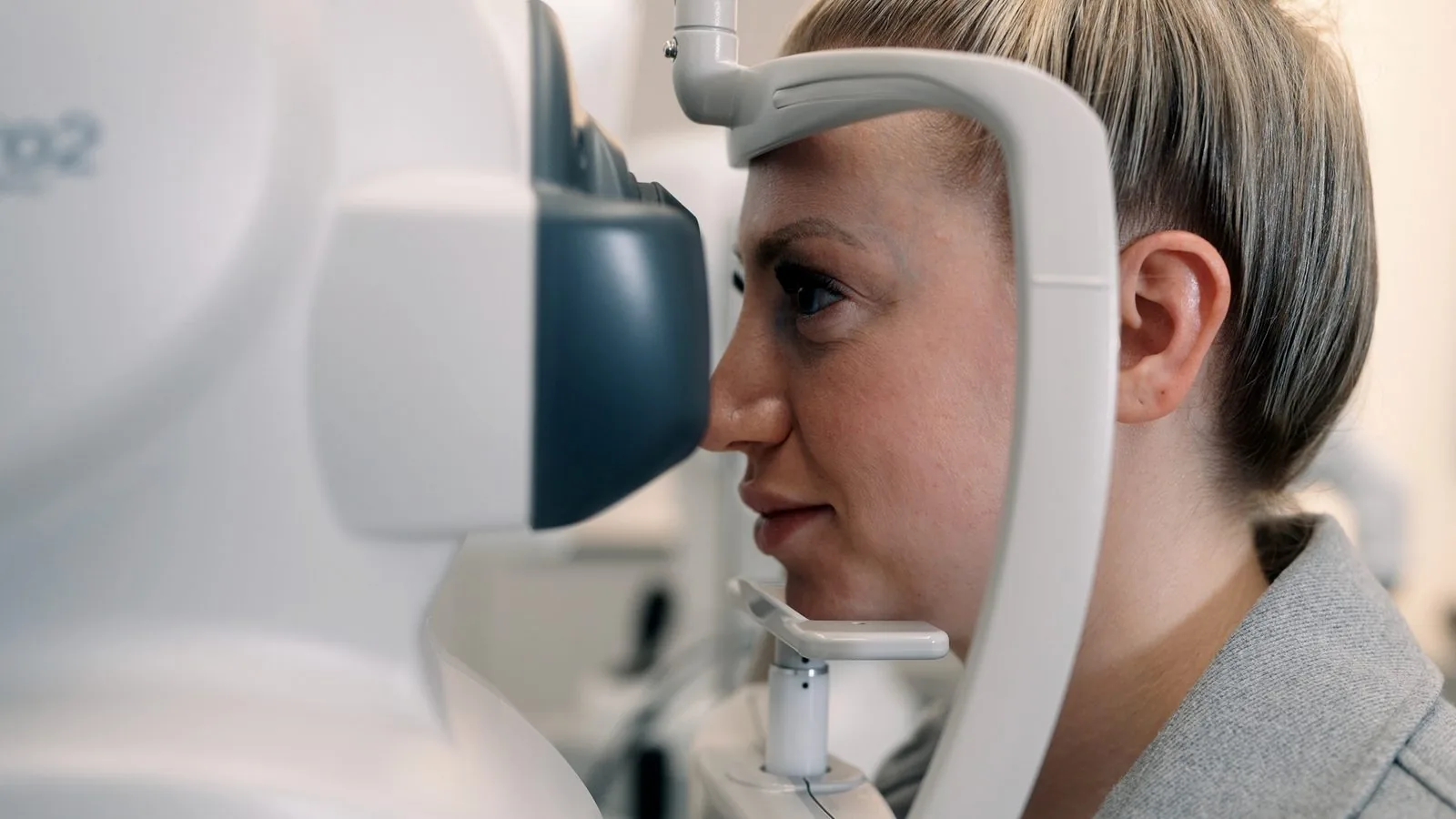
Bring your findings with you. Often the rejection dates from a time when only LASIK was offered; sometimes it is justified because the tomography is abnormal. We explain both to you. More under Second opinion.

Prof. Dr. Mehdi Shajari.
At dr.vision, Prof. Dr. Mehdi Shajari himself decides, based on your tomography, whether your cornea is enough for laser treatment. Because we offer Trans-PRK, SMILE Pro, SmartSight, Femto-LASIK, ICL and lens exchange, we do not have to sell you anything that does not fit when your cornea is thin: we recommend the path with the greatest reserve.
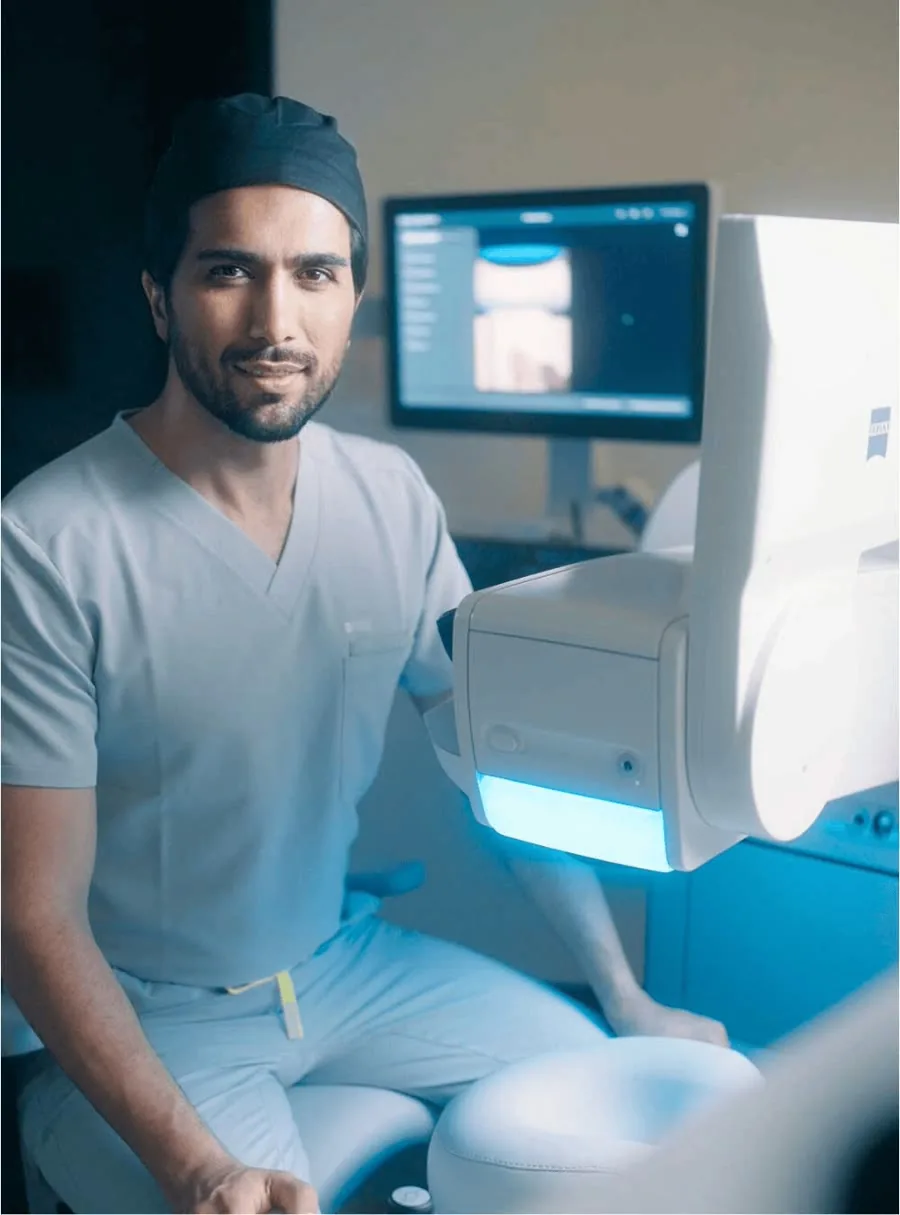
Prof. Dr. Mehdi Shajari. Personally.
Specialist in ophthalmology and professor of ophthalmology (German title: außerplanmäßiger Professor), specialized in refractive surgery. He evaluates your tomography himself and operates himself; over his career he has performed 20,000+ procedures. Lasering is done on the ZEISS VisuMax 800 (SMILE Pro) and the SCHWIND ATOS (SmartSight).
At dr.vision
Whoever examines you beforehand also operates on you: Prof. Dr. Mehdi Shajari in person.
Front and back surfaces, thickness distribution, thinnest point. Not just one measuring point in the center.
We plan so that more than 250 µm of supporting tissue remains even after a possible enhancement.
If laser is not safe: ICL or lens exchange with the same surgeon, without a referral.
A thin cornea does not cost extra. The procedure decides.
Guide prices for both eyes at dr.vision: PRK/Trans-PRK €3,498, Femto-LASIK €4,298, SMILE Pro €5,198, SmartSight €5,198, ICL from €6,886, lens exchange from €6,998. Billing is private-practice, under the German fee schedule for physicians (GOÄ); you receive the written cost estimate after the pre-operative examination. Financing from €3.90 a day*, for example SMILE Pro: €95 a month over 72 months or from €433 a month interest-free over 12 months directly with dr.vision.
* Representative example: €5,198 net loan amount · 72 months · fixed borrowing rate 9.49% p.a. · 9.90% effective annual interest rate · monthly installment €94.97 · total amount €6,837.84 · via medipay. Example 0% over 12 months directly with dr.vision: €5,198 cash price · no down payment · fixed borrowing rate 0% p.a. · 0% effective annual interest rate · monthly installment €433.17, last installment €433.13 · total amount €5,198.
No flap, more residual tissue.
€3,498both eyes
Small incision, quick healing.
€5,198both eyes
The cornea stays untouched.
from €6,886both eyes
Also for near vision.
from €6,998both eyes
Guide prices for both eyes according to the GOÄ, including pre-operative examination, procedure by Prof. Dr. Mehdi Shajari and aftercare. Patients with statutory health insurance are self-paying patients with us; private insurers reimburse depending on the plan. All prices: Prices · Monthly installments: Financing
Go deeper.
This page answers the question about the thin cornea. The detailed pages on the procedures:
Procedure, pain, healing and who the surface treatment suits.
To Trans-PRKNo ablationThe implantable lens for high values and a thin cornea.
To ICLComparisonRisks, strengths and weaknesses side by side.
Read the comparisonCorneal weaknessHow to recognize it and how cross-linking usually halts it.
Learn moreTurned down?When a second assessment is worthwhile.
Learn moreTechnical termsPachymetry, lenticule, flap, PTA and other terms briefly explained.
To the glossary376 reviews. Average 5.0.
376 Google reviews give dr.vision an average of 5.0 out of 5 stars. dr.vision does not check whether Google reviews come from treated patients.
“The examinations carried out were of the highest professionalism and were explained in detail, so that no questions were left open.”
“Great experience with laser eye surgery. The pre-operative examinations by the assistant team, as well as the procedure by Dr. Shajari, were more than satisfactory”
“I went through all the necessary examinations and Dr. Prof. Shajari promised me the surgery/transplantation of the ICL lens!”
“In the preliminary talk, because of my -9 diopters and my astigmatism, I was advised to get ICL lenses.”
Four patients. In their own words.
Constantly switching between glasses & contact lenses – not anymore.
It was a very good decision to come here.
At times I could no longer recognize my friends!
Less than 24h after surgery, better than ever.
Still have questions?
The questions patients ask most often about this during consultation hours. Prof. Dr. Mehdi Shajari
For Femto-LASIK, SMILE Pro and SmartSight, the Commission on Refractive Surgery (KRC) lists a corneal thickness below 480 µm as a contraindication. In addition, at least 250 µm of tissue must remain under the flap or cap after the ablation. Whether your cornea is too thin therefore also depends on your diopters. For Trans-PRK there is no minimum thickness of its own, but the same residual bed limit of 250 µm.
In the center about 540 µm on average, so a little over half a millimeter. Most values lie between about 500 and 580 µm. A thin cornea is not a disease in itself, as long as its shape is regular.
As a rule of thumb about 12 to 15 µm per diopter of nearsightedness, depending on the diameter of the treatment zone and the laser profile. At −6 D that is around 70 to 90 µm. The laser calculates the exact depth for your eye; the calculator on this page only shows the order of magnitude.
Usually Trans-PRK. It cuts no flap and no cap, so more load-bearing tissue remains than with Femto-LASIK, SMILE Pro or SmartSight. It heals more slowly: 4 to 5 days of burning, office work usually after 5 to 7 days. For high values or a very thin cornea, the ICL is usually more suitable, because it removes no tissue at all.
Sometimes. For SMILE Pro and SmartSight, the same limits apply according to the KRC as for Femto-LASIK: at least 480 µm starting thickness and 250 µm residual stroma under the cap. SMILE spares the front, strong corneal layers somewhat more, but uses up a similar amount of thickness through the cap. With a tight cornea and medium values, Trans-PRK is usually the better choice.
When too little tissue would remain after a laser ablation, when the values are above −8 D, or when the cornea shows signs of weakness. The ICL is placed in front of your own lens and leaves the cornea untouched. Requirements are enough space in the eye (anterior chamber at least about 2.8 mm) and enough endothelial cells.
From about 45 to 50 years of age, when presbyopia is added, yes. Lens exchange corrects the refractive error with an artificial lens and does not affect corneal thickness. At a younger age the ICL is the better choice, because your own lens can still focus.
Not necessarily. Many people have a naturally thin but completely healthy cornea. In keratoconus, the cornea is thinner at one spot and bulges forward in a cone shape. Corneal tomography, which measures the front and back surfaces, shows this. With signs of (early) keratoconus, laser treatment is not done.
Keratectasia is a bulging of the cornea after a laser procedure, because too little supporting tissue is left or the cornea was already weak beforehand. It is very rare, with SMILE Pro well below 1 in 1,000. The risk rises with a small residual bed, a high share of tissue altered (PTA) and undetected keratoconus. That is why we measure the whole cornea before every procedure.
Often yes. “Too thin for LASIK” does not mean “too thin for everything”: Trans-PRK or ICL often still come into question. Conversely, a rejection because of abnormal tomography can be justified. Bring all your findings; we will explain what the reason is. More on this under Second opinion.
Yes. Contact lenses temporarily change the shape and thickness of the cornea. You leave out soft lenses for 10–14 days, rigid lenses for several weeks beforehand. Otherwise the measurement can come out falsely thin or falsely curved.
Only if enough reserve remains after the first procedure: according to the KRC, the limit of 250 µm residual bed also applies after repeat procedures. With a tight cornea, we therefore plan with reserve from the start or advise the ICL, where a residual error can be corrected without removing corneal tissue.
Medically reviewed by Prof. Dr. Mehdi Shajari · As of October 2026
How would you like to continue?
With the pre-operative examination with Prof. Dr. Mehdi Shajari: corneal tomography, thickness distribution, tear film and your values. You see your maps and go home with a written recommendation on which procedure is possible with how much reserve, and a cost estimate.
In Frankfurt, Junghofstraße 16 · detailed pre-operative examination with Prof. Dr. Mehdi Shajari
Our locations.
 Opening hours
Junghofstraße 16, 60311 Frankfurt am Main
 Opening 2027
Breite Straße 69, 40213 Düsseldorf (in the Neuer Stahlhof, corner of Graf-Adolf-Platz)
Until opening: preliminary talk in Frankfurt, Patient Care plans your travel.
Plan route Opening 2027
Lautenschlagerstraße 23, 70173 Stuttgart (2nd floor, step-free access)
Until opening: preliminary talk in Frankfurt, Patient Care plans your travel.
Plan routeSo, my name is Zhao Xingshu, I come from China and have been working in Germany for 20 years. I have been nearsighted since childhood in China, and it has always bothered me a lot. In Germany I started doing sports and also tech. I work a lot with computers and my phone. And I always had to switch between glasses and contact lenses. And as I grew older, it became very, very unpleasant and also very time-consuming for me.
I have always wanted to find someone who is not only professional but can also offer good service. Then I read about it online and found the professor. Then I called him, and the appointment came very, very quickly. And the next day I was already here and met my professor. He made a very professional impression on me. And also really very nice and kind. And what I liked best is the speed of the services. And I think that is actually what is most lacking in Germany.
The first impression was not the typical eye doctor's practice but a very professional consulting company. Well, because I myself work in a technical role for consulting companies, the first moment felt a bit very different to me, but at the same time I liked it a lot, because I really like this customer-focused, patient-focused approach, the fast speed with the appointment, and the professional consultation. That was my first impression.
Of course, absolutely. I have already sent my husband here, and my child. Yes, and I think I would recommend it to all my Chinese friends in Frankfurt as well.
I’m Teresa Schwenger, I’m 31 years old, I’m a project manager. I was nearsighted, so I didn’t see well at a distance, and at some point it was just super annoying with contact lenses, putting them in every morning, taking them out again in the evening. I think I wore contact lenses for about ten years, and then I also had the problem that my eye was no longer supplied with oxygen so well, which is why the little vessels grew further into the eye, and so I looked around for an alternative. Glasses were not an alternative for me, because I simply don’t like myself in glasses. It was always an issue with the swimming pool or the lake or the sea. Do you put your contact lenses in, can you dive, do you maybe lose a contact lens, and that was always really annoying. Or also when you stayed somewhere overnight, you always had your little contact lens case, your solutions and care products, which you had to take along, always a whole pack just for the contact lenses. I always found that very annoying, and also on long days, when I had put my contact lenses in very early, in the evening while watching TV I noticed, oh, this really annoys me now, I would like to take them out, and then watching TV with glasses on a couch, really very uncomfortable, and so that was a situation where I am now grateful that I will hopefully or probably never have them again.
And then I looked at which doctors in this area offer laser eye surgery, and I read through lots of reviews and looked at who is very good here. And the doctor here is really rated very, very highly, and I had a totally likeable first conversation with him and felt comfortable right away. I also saw all his awards, the FOCUS awards and so on, which reinforced my impression, and also lots of positive reviews, which I can confirm. So you feel very comfortable, and the work here is very professional. So it was a very good decision to come here, definitely.
Not quite so good. I was very nervous, had many worries and fears too. I would have liked to leave again right away on the day when I was sitting here. But I was received super kindly and warmly. Everything was explained to me well. Everyone was very warm, and they took the nervousness away. So I felt I was in good hands, and when it then started, the nervousness was already a bit less, because I knew that I was simply in good hands.
So I simply arranged the appointment, the first appointment, online, and then I got a call asking me to please stop wearing contact lenses from that point on, so that the eyes are already free of contact lenses, because things can still change there. Then the parking garage is right next door, you walk in here, and it is a very beautiful building and a very beautiful practice, definitely. I was welcomed warmly right away by the receptionists. Everything was explained to me well right away. I was given water and everything. Then I had the first tests. I was totally amazed at how many tests were done and with which devices. It's really incredible what names are on the devices and how expensive these devices are. But really everything was measured that I think can be measured in an eye. Then I had the conversation with the doctor. That was also really great, warm. He answered all the questions I had and took the time for me. I then said I would rather sleep on it for another night, because I am simply the type of person who plays it safe. But at home I actually already knew that I would like to have it done. The next day I called again and made a second appointment. The eyes were checked once more, again with a colleague of the doctor and with him. And then I had another informed-consent talk about what risks there are. I was able to ask my questions again and then got my treatment appointment very quickly. And on the day of the treatment, as I said, I was already here super nervous, but I was also welcomed very warmly. Many of my worries and fears were taken away.
Yes, exactly. So I got up this morning and I could see right away. That was my biggest worry, that I would no longer be able to see as I did before, but I could see perfectly right away. I also saw at a distance again. That was the exciting part in my case. I looked out of the window and also noticed the trees farther away. The outlines, which I otherwise always saw only like this, were clear and distinct. So it really is a change right away. I notice it totally, and it’s super nice.
Definitely, yes, absolutely. I felt super comfortable from the first second to the last. So definitely, if I ever have laser treatment again, then definitely here. I can only recommend it to everyone.
Yes, I definitely should have done it earlier, that's true, because I believe it really gives you a lot of quality of life back, and it is also good for the eyes. Of course, there is the treatment itself, but in the long run, as it was with me, because of the contact lenses, I had these tiny blood vessels, or I have them in my eye, because the eyes were not supplied well. Had I done this earlier with the lasers, it might not be as pronounced. So my appeal would be to do it earlier rather than too late.
My name is Laura. I had my eyes lasered in April by Dr. Shajari, because I saw very badly with both eyes and it limited me a lot in everyday life. Especially driving was not possible at all without glasses, and I can’t tolerate contact lenses. I find that unpleasant, and handling them just didn’t fit into my everyday life. I also found glasses very unpleasant even after wearing them for a long time, and above all you depend on them so much. If I forgot my glasses, I couldn’t work, I couldn’t see at university, I couldn’t take part in everyday life. And what was really one of the worst things, too, in private situations: I was outside, I didn’t recognize friends, I didn’t say hello to them, I didn’t recognize colleagues, and sometimes I even thought, that’s my father, that’s my mother, and then I said hello to people, and it was totally limiting. I really didn’t recognize people, I couldn’t really share in everyday life.
I was generally a patient on verifyMED, and I also learned through friends that he used to be a senior physician at a large hospital and enjoyed a very good reputation there. I heard that through friends, and I liked him a lot. The reviews are very positive. And when I had the first consultation appointment, because I actually also had consultation appointments elsewhere, it was immediately clear to me: I'm getting my laser treatment here. I already knew that with the eye, the doctor has to be the right fit, that's very important, especially with the eye, because everything is at stake there, I think.
On that day I had minimal pain, but it is really manageable, more of an unpleasant feeling. You can also take a painkiller, and then it was okay. You have to get used to it first, the eyes are very sensitive. But the next day it was really as if there had never been a surgery. So you can see right away, it is not unpleasant. You just have to keep taking the drops. There is a plan for that, which Dr. Shajari writes out. And in hindsight it wasn’t a big procedure.
I was in a bar here with friends, and it was really a different feeling of life. I walked in, finally saw people, noticed people. I didn’t feel uneasy, because without glasses I used to be like, do I know that person or not. It was simply a completely new feeling of life.
I tell everyone, I have also already recommended it to friends who had it done, who are very satisfied, I would do it again any time. For me, at the beginning, I was unsure, because I am still very young. I am only 24, because many people say, wait with it. Because the eyes will, even Dr. Shajari can’t stop that, still get a little worse. For me it has now even gone to much better, on purpose. If they get worse, I will still see 100 percent. I now see 160 percent, definitely pretty crazy.
And I would just urge people to do it as early as possible. Don’t think about it for long, just do it. Because I actually even regret that I didn’t do it a few years ago.
I'm Duilio, I'm 22 years old. I was nearsighted before, with a prescription of minus 4.75. I actually looked into laser eye surgery a few years ago. But this practice didn't exist yet back then, and I informed myself a bit about it, and now I've finally come to the conclusion to have my eyes lasered.
So there was a free initial consultation here. I came here, first took a look at the practice, and I found the technology to be state of the art, and I also found Professor Shajari to be a very empathetic and very likable doctor, also very young, and so I then decided to have my eyes lasered here.
So the process was actually quite simple. You first came into a small room, where the eyes were cleaned a little, it burned briefly and then they were numbed and that was it. They were numbed with eye drops and then it went straight to the operating room and right there I was laid on the bed of the laser, the Carl ZEISS VisuMax 800, which is the newest laser, and then he actually started operating right away. I think I was only in the operating room for 15 to 20 minutes in total, while the laser itself took about ten seconds per eye.
Right, so after the surgery I got up first and couldn't see very sharply yet. I saw it as if it were milky cloudy. So my vision was milky cloudy, as if you were looking through a plastic cup when you hold it in front of your eyes. But I could already see better, or at least I had the feeling that I could already see almost better than I did before without glasses.
When I came for the follow-up check the day after, the optician took off the protective glasses and then I could really see, I saw him clearly, I saw the devices clearly, we did the tests, he said yes, you are at 100 percent in one eye, 125 percent in the other, exactly, so it was a great feeling, I then took out my sunglasses right away, because the sun was shining that day, and I went for a little walk through downtown Frankfurt. It was very nice, as I said, to see everything clearly without glasses not even 24 hours after the surgery, I think it was about half a day, 13, 14 hours after the surgery, yes, so it was really great.