 dr.vision
about 20 min
is how long an ICL or lens exchange surgery takes per eye. Awake, with numbing drops, outpatient.
Start here
What suits you?
Find out in 2 minutes which procedure suits your eyes.
Start the Suitability CheckOr by age:
< 45yearsGet rid of glasses & contact lenses 45–64yearsGet rid of reading glasses 65+yearsCataract & glasses-free★★★★★ 5.0 · 376 Google reviews · 20,000+ procedures
Decide well
What you should know beforehand.
Who operates?Prof. Dr. Mehdi ShajariFOCUS Top Doctor · operates on every patient personally What does it cost?Laser from €3,498 · Lenses from €6,886Prices for both eyes Is it safe?Safety & risks When will I be fit again?Work, sports, driving Would you rather read in peace first?Decision Guide Freedom from GlassesProcedures
Laser or lens?
Laser eye surgery
SMILE ProSmartSightFemto-LASIKTrans-PRKPRKPresbyond (laser away your reading glasses)All laser procedures at a glanceLaser procedures compared ›Lens surgery
ICLLens exchange (reading glasses)Cataract surgery with premium lensLens types: trifocal, EDOF, toricLens types compared ›Start here
Something wrong with your eyes?
A thorough eye check-up with us clarifies what is behind it.
Book an eye check-up★★★★★ 5.0 · 376 Google reviews
Lens surgery
When the laser is no longer the best answer.
Above −8 diopters, with a thin cornea, dry eyes or from about 45, a lens in the eye often corrects better than any laser. Here you learn which lens surgery suits your age and your eyes: ICL, lens exchange or cataract surgery with a premium lens. Prof. Dr. Mehdi Shajari operates on every patient himself.
 12× FOCUSTop Doctor
About 20 minutes per eye. From €6,886 for both eyes.
about 20 min
is how long an ICL or lens exchange surgery takes per eye. Awake, with numbing drops, outpatient.
3
Lens surgeries: ICL, lens exchange, cataract surgery with a premium lens. Which one suits you is decided by your own lens.
−8 D
Above that, with a thin cornea, or from about age 45, a lens is usually the better choice. From −6 D, it is possible alongside the laser.
2–3 Days
until office work. Most people see sharply the day after surgery.
from 6,886 €
Guide price ICL, both eyes. Lens exchange from €6,998. Or in monthly installments, with a down payment from €3.90 a day*.
376 reviews. Average 5.0.
“Bottom line: very professional treatment, personal care and a result that fully convinced me.”
“Performed by a professional. I liked the good organization, the calming atmosphere and the friendly staff.”
“I felt very well looked after during the two cataract surgeries in quick succession. The result is excellent, and I had no complaints at all after either procedure.”
“The practice is very modern, the team is very friendly and everything is very well organized.”
Four patients. In their own words.
I wanted my life back – without glasses, without headaches.
Now I can already read things again.
I was allowed to take off the bandage that very afternoon.
I saw wonderfully bright light.
Lens surgery in five answers.
For anyone with three minutes. Each answer leads to the detailed chapter.
For nearsightedness above −8 D, farsightedness above about +4 D, a thin or irregular cornea, dry eyes, and from about 45, when reading glasses come into play.
To the chapterThree: the ICL is added to the eye, and your own lens stays. With lens exchange and cataract surgery, an artificial lens replaces your own lens.
The three pathsAbove all the condition of your own lens: young and clear points to the ICL, presbyopic to lens exchange, clouded to cataract surgery. Plus diopters and cornea.
To the checkVery safe, but a procedure inside the eye. The most serious complication, an infection, affects fewer than 1 in 1,000. More common and harmless is the secondary cataract after lens exchange.
Risks comparedGuide prices for both eyes: ICL from €6,886, lens exchange from €6,998, cataract surgery with a premium lens from €7,242. Billing is private, according to the German fee schedule for physicians (GOÄ); patients with statutory health insurance are self-paying patients.
CostsThe laser takes away. The lens adds.
A laser shapes the cornea by removing tissue. The higher the diopters, the more has to go, and at about −8 D a sensible limit is reached. A lens, by contrast, corrects without tissue loss, even −15 D or farsightedness above +4 D. In six situations, we therefore tend to advise a lens.
A laser would have to remove so much cornea that stability and image quality suffer. The ICL corrects up to about −18 D and leaves the cornea untouched. To the ICL
Farsightedness can be treated well with a laser only up to about +4 D. Above that, an ICL helps; from about 45, usually the lens exchange, which also replaces reading glasses.
A cornea that is too thin or a stable keratoconus often rules out laser treatment. A lens does not weaken the cornea, because it takes nothing away from it.
Every laser cuts through corneal nerves, which is why dry eyes are its most common side effect, with SMILE Pro in 3 in 10 in the first weeks. Lens surgeries largely leave these nerves alone.
From about 45, your own lens loses its ability to focus. A laser changes little about that. A lens exchange with an EDOF lens (extended depth of focus) or a trifocal lens replaces distance glasses and reading glasses in one procedure. To lens exchange
Then it is a cataract surgery, and with a premium lens you usually become glasses-free as well. Laser treatment would help only briefly, because the clouding continues. Cataract surgery with a premium lens
Under 45, up to −8 D, with a healthy, sufficiently thick cornea: then SMILE Pro/SmartSight (€5,198 each) or Femto-LASIK (€4,298) are faster, less expensive and involve no procedure inside the eye. To SMILE Pro
“As soon as the laser would have to remove too much cornea, for example above −8 diopters, I advise a lens. From about 45 also when reading glasses come into play.”
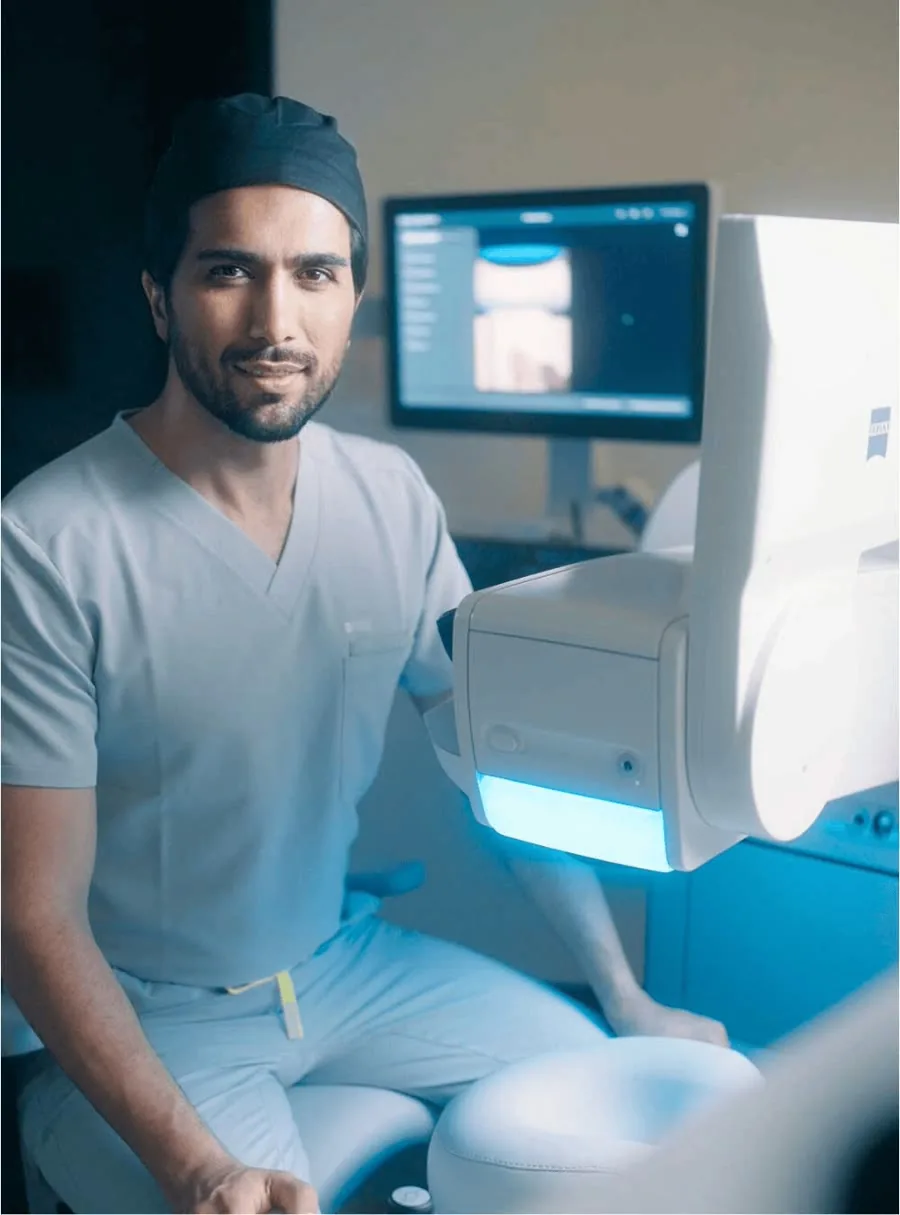 Prof. Dr. Mehdi Shajari
The cornea is about half a millimeter thick in the center. For each diopter of nearsightedness, a laser removes about 12–15 micrometers, depending on the treatment zone. At −8 D, that quickly adds up to over 100 micrometers. For the cornea to stay stable, enough residual tissue must remain; if it becomes too thin, a bulging (keratectasia) threatens.
In addition comes image quality: the more the cornea is reshaped, the more likely higher-order aberrations arise, which are noticeable at night as halos and less contrast. A lens in the eye corrects high values more cleanly optically, because it sits closer to where the image is formed.
That is why −8 D is not a rigid prohibition with us: From −6 D, we actively suggest the lens as an alternative, and above −8 D we recommend it. What matters is your measured cornea, not the number alone.
Presbyopia develops because your own lens becomes stiffer and can no longer switch to near vision. A laser can set one eye slightly nearsighted for near vision, which is the principle of Presbyond (€6,398 for both eyes). This works well with moderate values and a clear lens. But the lens itself keeps aging and clouds over in the following decades. A lens exchange addresses the problem where it sits and rules out a later cataract.
Four questions. One honest direction.
Age, diopters, cornea and the condition of your own lens usually decide which path suits. In 30 seconds, the check gives you an orientation based on the same rules we use to advise at the pre-operative examination. It does not replace a measurement.
Laser-or-lens check · 30 seconds
Your age
Your glasses values (stronger eye)
Cornea and eyes
Has an eye doctor found a clouding of the lens?
Orientation, not a diagnosis. A safe decision is possible only after measuring the cornea, anterior chamber, lens and retina. The detailed test is in the Suitability Check.
Lens added. Or lens instead.
Every eye has its own lens. As long as it is young and clear, we place a second one in front of it. If it becomes stiff or cloudy, we replace it with an artificial lens that never ages again.
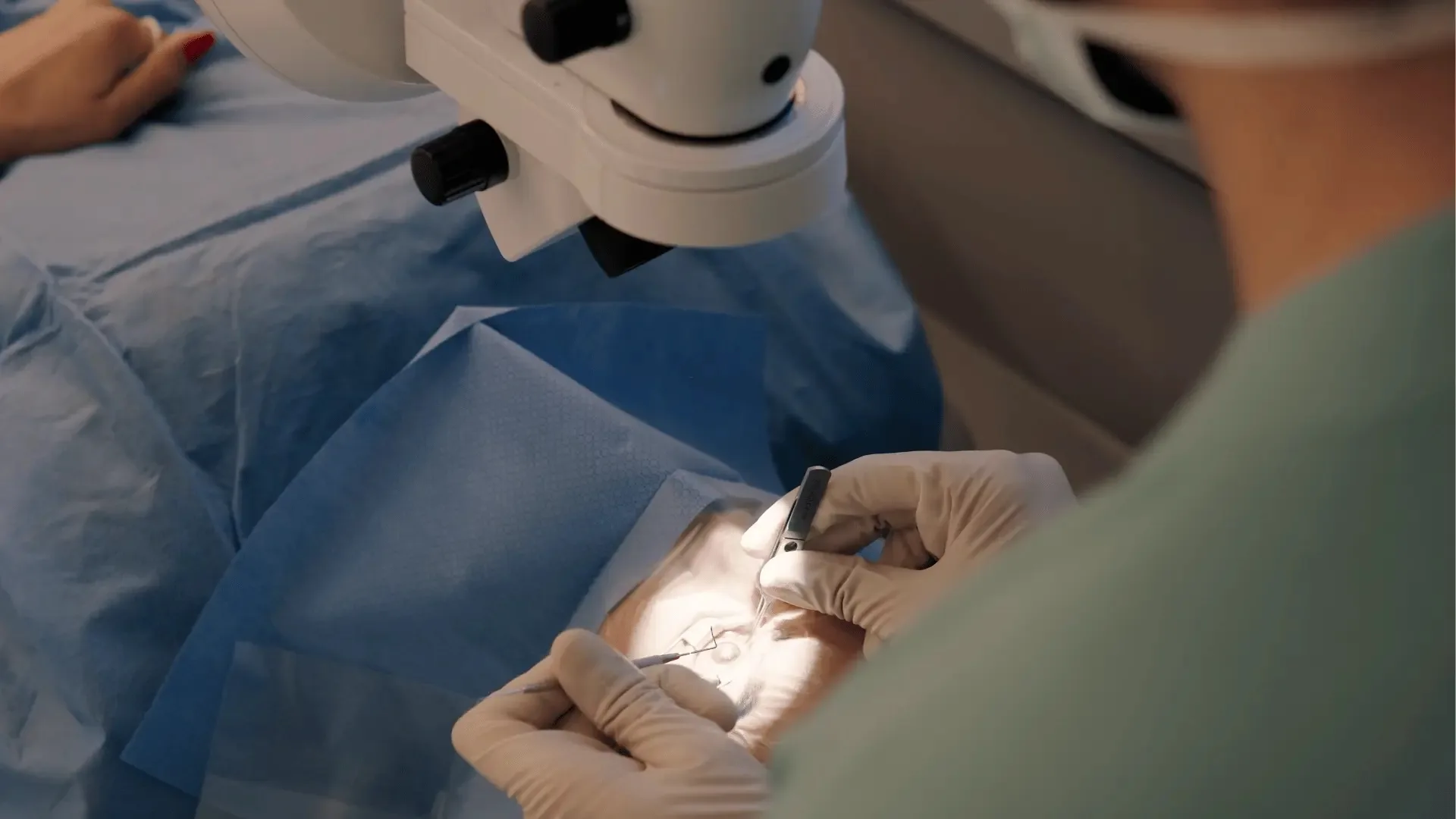
Three procedures, one principle: the correction sits in the eye instead of on the cornea. Which one suits depends mainly on your age and the condition of your own lens. Each card leads to the detailed page with suitability, process, risks and costs.
A wafer-thin lens is placed in front of your own lens. Nothing is removed; your own lens continues to focus.
from €6,886Guide price for both eyes
To ICLThe clear but presbyopic natural lens is exchanged for an artificial lens, with EDOF or trifocal optics on request.
from €6,998Guide price both eyes
To lens exchangeThe cloudy lens has to come out anyway. With a premium lens, we also correct glasses prescription and reading glasses in the same surgery.
from €7,242Guide price both eyes, premium lens
To cataract surgery+1 lens
The ICL sits between the iris and your own lens. Your lens is kept and continues to focus. This is the reason why the ICL is intended mainly for people under 45.
1 for 1
Your own lens is removed with ultrasound, and an artificial lens unfolds in the empty capsular bag. Technically, this is the same surgery as for cataract, only on a lens that is still clear.
An astigmatism can be corrected in the same surgery. ICL and artificial lens are available for this as a toric variant. To the toric lens
If you have your lens exchanged, you choose how you see afterwards. A monofocal lens makes one distance sharp, usually the distance; for near vision, reading glasses remain. An EDOF lens extends the sharp range from distance to the screen, with few light effects. A trifocal lens divides the light between distance, intermediate range and near; 9 in 10 of our trifocal patients need no glasses afterwards, and at first halos are common at night. The toric variant additionally corrects an astigmatism. What this means for distance, the screen and reading is shown by the lens comparison on the lens exchange page; all types in detail under Lens types compared.
Artificial lenses made of acrylic do not age, generally stay clear, and are not rejected by the body. They remain in the eye for life. What can occur years later is secondary cataract: a clouding of the capsule behind the artificial lens, in about 1 in 10 within five years, corrected with a five-minute laser treatment. The ICL also lasts permanently. It is only removed when your own lens becomes cloudy decades later; then in the same surgery in which the cataract is treated.
Besides the ICL, there are phakic lenses that are attached to the iris (iris clip) or sit in the anterior chamber. They are used less often today because they lie closer to the sensitive inner layer of the cornea. An add-on lens is a second, thin artificial lens that is placed in front of the first after a lens exchange or a cataract surgery to correct a residual refractive error. Which lens comes into question for you, we discuss after the measurement.
Twelve criteria. One look.
The laser is the fastest and least expensive path as long as cornea and values are suitable. The ICL is superior for high values under 45 and the only one that is reversible. From about 45, lens exchange is the only solution that permanently replaces distance and reading glasses. The table shows how they differ.
| Criterion | Laser (SMILE Pro) | ICL | Lens exchange | Cataract surgery + premium lens |
|---|---|---|---|---|
| Typical age | 18–45 | 21–45 | from about 45–50 | when the lens is cloudy, usually from 60 |
| Nearsightedness | up to −8 D | up to about −18 D | practically unlimited | practically unlimited |
| Farsightedness | Femto-LASIK up to about +4 D | up to about +10 D | ideal, also high values | yes |
| Reading glasses | remains from about 45 (except Presbyond) | remains from about 45 | with EDOF/trifocal usually no longer | with EDOF/trifocal usually no longer |
| Own lens | stays | stays | is replaced | is replaced |
| Reversible | no | yes, removable | no, lens can be exchanged | no, lens can be exchanged |
| Cataract later | comes, as with everyone | comes, ICL is then removed as well | can no longer develop | resolved |
| Dry eyes | 3 in 10 in the first weeks | rare | temporarily possible, less often than after laser surgery | common, usually temporary |
| Night vision | Halos common at first, after 3 months about 5 in 100 | Light rings possible at first | Trifocal: 3 in 10 at first, under 1 in 10 after 3 months | like lens exchange; monofocal practically none |
| Main risk | Keratectasia, well under 1 in 1,000 | Eye pressure, lens clouding (rare) | Retinal detachment, increased with high nearsightedness | Macular edema about 1 in 100 |
| Work from | 1–2 days | 1–2 days | 2–3 days | 2–3 days per eye |
| Price both eyes | €5,198 | from €6,886 | from €6,998 | from €7,242 |
Guide prices for both eyes under the German fee schedule for physicians (GOÄ). Frequencies from our own evaluation and the literature. The full comparisons: Laser or lens? · ICL or laser? · Lens exchange or Presbyond?
Under 45, reading glasses are not yet an issue
Up to −8 D nearsightedness or up to about +4 D farsightedness
Cornea thick and regular enough, no tendency to dryness
Under 45 with high values the ICL, from about 45 the lens exchange, with clouding the cataract surgery
Above −8 D, above +4 D, or distance and reading glasses at the same time
Thin cornea, stable keratoconus, dry eyes, early lens clouding
If your own lens becomes presbyopic or cloudy years or decades later, we remove the ICL in the same surgery in which your own lens is exchanged for an artificial lens. For you, that is one procedure. The new artificial lens is calculated so that it also corrects your nearsightedness, with optics for near vision on request.
If a small residual refractive error remains after a lens exchange, it can be corrected from about three months after surgery with a laser on the cornea, or with an add-on lens. If a laser fine correction is medically sensible, it is usually possible without co-payment within 6 months under our concept.
After LASIK, SMILE or PRK, the cornea is shaped differently. The standard formulas for lens power then tend to miss. We use special formulas for eyes that have had surgery and, if available, your old measurements from before the laser treatment. Please therefore bring all documents from the earlier treatment. With trifocal lenses after earlier laser treatment, we are more cautious, because the cornea may already bring aberrations with it.

Unsure whether laser or lens?
We clarify this together. In an initial consultation.
Jana from our Patient Care team answers your questions and arranges the pre-operative examination with Prof. Dr. Mehdi Shajari, around the clock.
Four steps. Approx. 20 minutes per eye in the operating room.
ICL and lens exchange proceed similarly: initial consultation, thorough measurement, an outpatient procedure of about 20 minutes per eye with numbing drops, then three follow-up checks. We usually operate on the eyes at two appointments shortly one after the other. The details for each procedure are on the individual pages.
Step 1 of 4
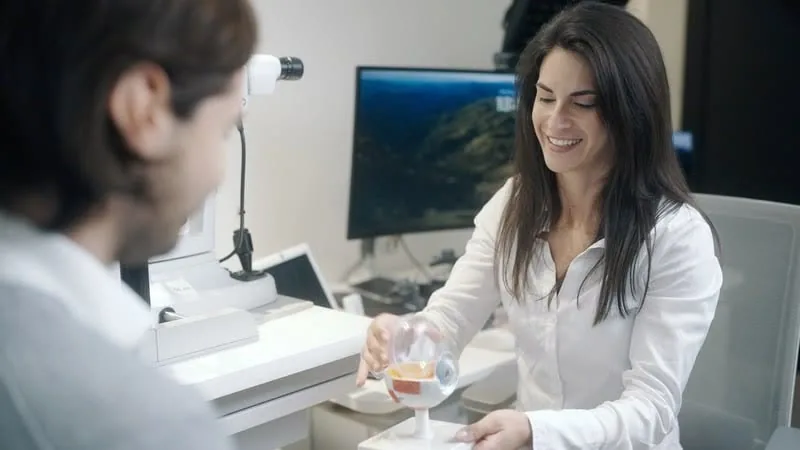
Laser or lens? Weighed honestly.
Please bring: glasses, glasses prescription, contact lens data, previous findings. You can wear your contact lenses to the consultation. The consultation is free of charge.
Appointment for the pre-operative examinationStep 2 of 4

Measuring what the lens needs.
You go home with a written recommendation and a cost estimate. The ICL is ordered for your eye; the delivery time is about 1 to 8 weeks.
Step 3 of 4
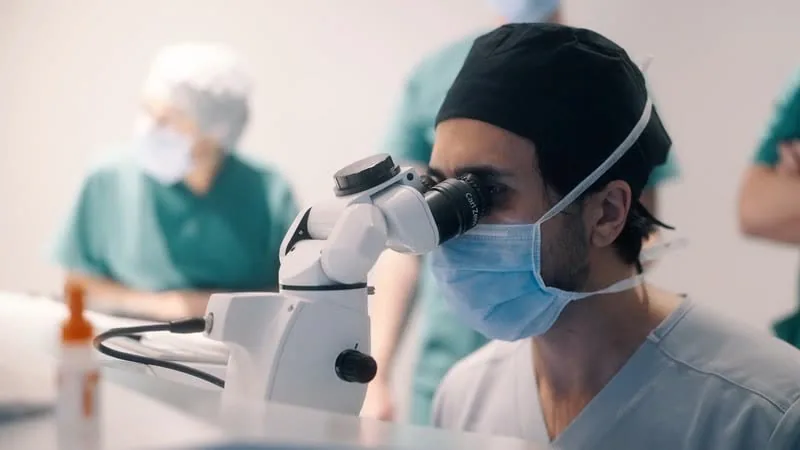
About 20 minutes per eye. Awake, numbed with drops.
Please come with an escort; you will not drive yourself on this day.
Step 4 of 4
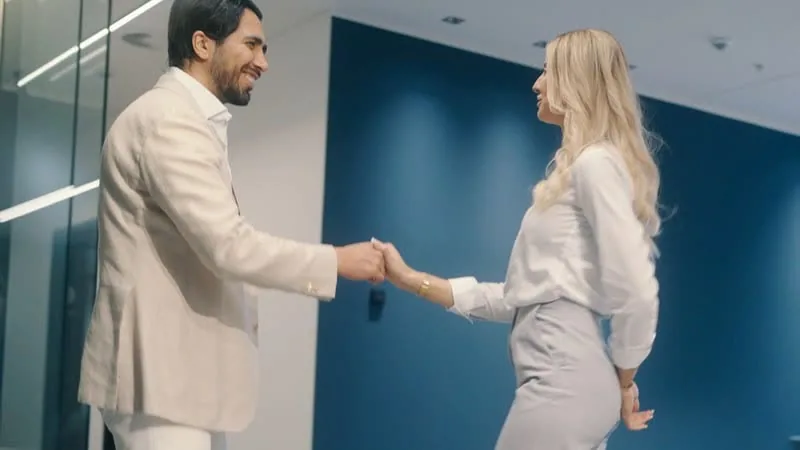
Three follow-up checks, then you are done.
Drops for about four weeks. The follow-up checks are included in the price, emergency number around the clock.
| Activity | After ICL | After lens exchange |
|---|---|---|
| Sharp vision | usually on day 1 | Distance on day 1, near vision with premium lenses often only after weeks |
| Office work, screen | after 1–2 days | after 2–3 days |
| Driving | after the follow-up check, if visual acuity is sufficient | after the follow-up check, at night only once halos subside |
| Light sports | after 1 week | after 1 week |
| Swimming, sauna | after 2 weeks | after 2–4 weeks |
| Combat sports, ball sports | after 2 weeks at the earliest, after consultation | after 4 weeks |
| Eye makeup | after 1 week | after 2 weeks |
With the ICL, we usually operate on the eyes on two consecutive days. With lens exchange with a premium lens, there is usually a week in between: whatever deviates from the target on the first eye, we take into account in the calculation for the second. For patients who travel a long way, we plan the appointments so that you have everything done in a few days.
For patients traveling a long way
Under 72 hours hrs
Examined, operated, checked.
Questions? We help with travel, accommodation and appointments. More under Traveling from farther away.
Your travel plan
We plan values, wishes, appointments and an overnight stay within walking distance together.
All measurements, lens selection, talk with Prof. Dr. Mehdi Shajari. For the ICL, two trips: first the pre-operative examination, then after the delivery time the surgery trip.
About 20 minutes per eye, about 2 hours on site.
Further follow-up checks on request with your local eye doctor, following our plan.
Every path has its own risk.
Lens surgeries are procedures inside the eye and therefore different, not necessarily riskier than a laser. The safety rate for procedures by Prof. Dr. Mehdi Shajari is 99.9%. The most serious complication, infection, affects fewer than 1 in 1,000. Choose a risk to see frequency and countermeasures.
The capsule behind the artificial lens clouds months to years after the procedure, and vision becomes milky again. The artificial lens itself stays clear.
about 1 in 10
within five years after lens exchange or cataract surgery, somewhat more often in younger patients; not with the ICL.
A YAG laser opens the capsule within a few minutes, without an incision and painlessly. After that, the secondary cataract generally does not come back. More about secondary cataract
Rings and rays around lights in the dark. With trifocal and EDOF lenses a result of the optics, with the ICL mainly with large pupils.
at first 3 in 10
bothersome with trifocal lenses, under 1 in 10 after three months. EDOF much rarer, monofocal practically never.
Measure the pupil, treat frequent night drivers rather with EDOF or monofocal lenses, and show the effects beforehand. See halos
If the ICL sits too close to your own lens or is too large, the outflow of aqueous humor can be disturbed or your own lens can cloud earlier.
rare (according to the Commission on Refractive Surgery)
Much rarer than before with modern ICL models with a central opening. An earlier clouding of your own lens occurs with modern ICLs in about 1–2 in 100 eyes within eight years, usually when the distance to your own lens is too small.
Exact size selection after measurement, check of the distance (“vault”) on day 1 and after one week. If necessary, the ICL is exchanged or removed.
The retina detaches from its base. Signs: flashes, a shower of soot-like spots, a shadow. Highly nearsighted eyes are naturally at greater risk, and a lens exchange increases the risk further.
about 1 in 100
after cataract surgery overall; clearly higher in young, highly nearsighted eyes after lens exchange.
Check the retina with a wide pupil before every lens surgery, treat weak spots with a laser beforehand, and recommend the ICL rather for young nearsighted patients. More on this
The result deviates slightly from the target; a slight nearsightedness or farsightedness or an astigmatism remains.
about 2 out of 10
are more than 0.5 D off target; about 5 in 100 need an enhancement.
Optical biometry, two formulas, adjustment on the second eye. If a residual error bothers you, we correct it with a laser or an add-on lens.
Bacteria get inside the eye. Signs in the first days: increasing pain, redness, worse vision. The most serious complication of any lens surgery.
under 1 in 1,000
Sterile procedure room, antibiotic at the end of surgery, check on day 1, emergency number around the clock. If infection is suspected, we treat on the same day.
Frequencies from our own evaluation (cataract surgery, n = 1,100, 2022–2026) and the literature. All risks of laser eye surgery compared: Laser eye surgery risks.

Because laser and lens come from one source.
At dr.vision, there are both paths and one surgeon for all: over 20,000 procedures, 5.0 stars from 376 reviews.
Every procedure: Prof. Dr. Mehdi Shajari. Personally.
Prof. Dr. Mehdi Shajari operates on every patient himself. He is a specialist in ophthalmology with a professorship and habilitation at the University of Frankfurt, has 80+ publications on lens and corneal surgery, teaches, and has trained several colleagues in this field.
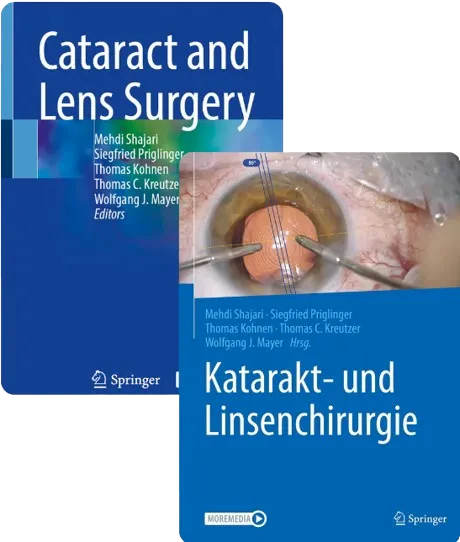
Prof. Dr. Mehdi Shajari has published numerous papers on freedom from glasses, teaches, and has trained several colleagues in this field.
What you get with us.
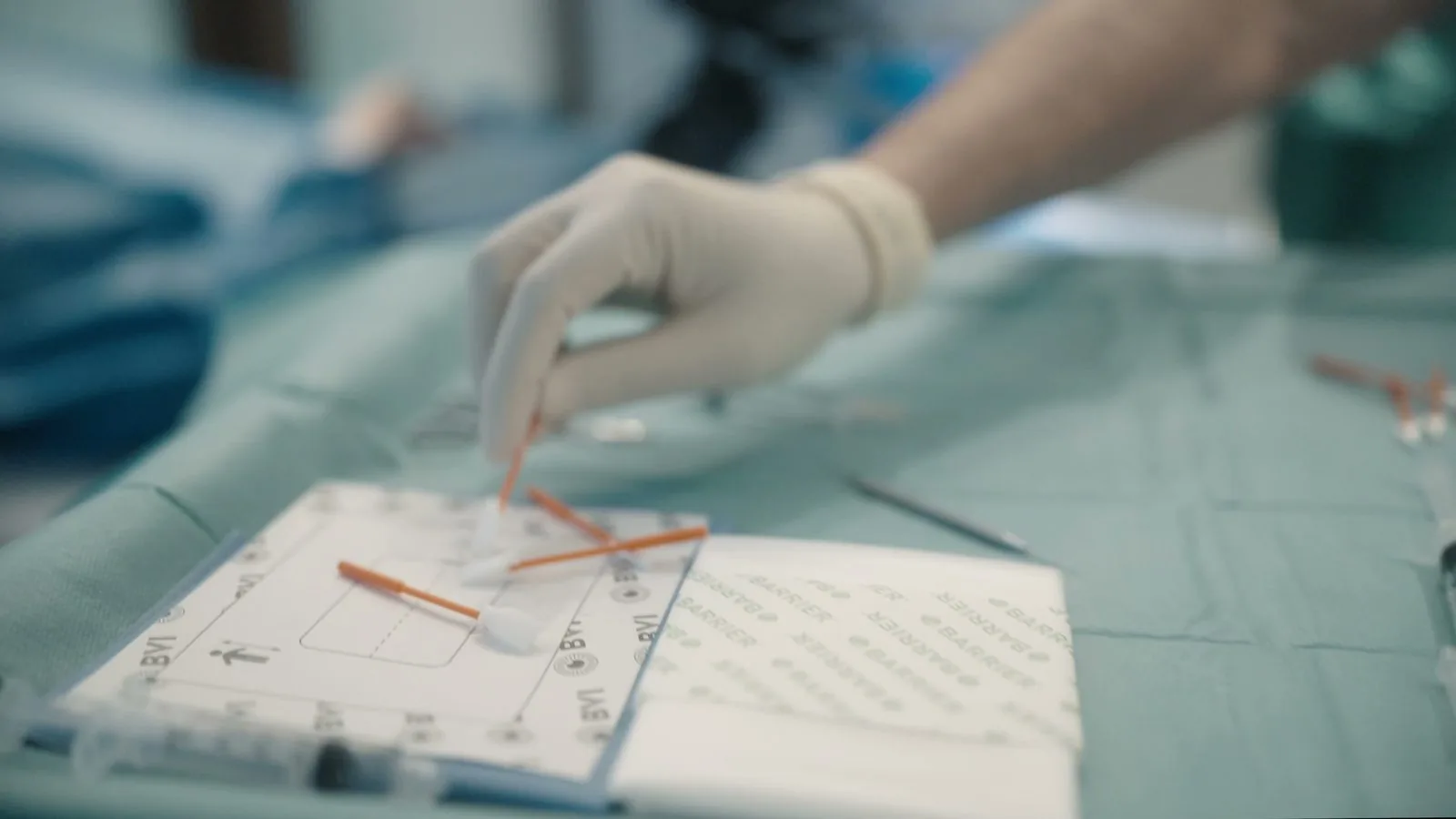
One surgeon
Laser and lens, both eyes, every procedure.
Reviews
5,0
376 Google reviews
Both paths
We recommend what suits your eyes.
Cornea, anterior chamber, endothelium, optical biometry, retina, and macular OCT. You go home with a written recommendation and a cost estimate.
5,0
★★★★★
from 376 Google reviews
Whoever performs your pre-operative examination also operates on you.
Emergency number around the clock.
If a residual refractive error bothers you: within 6 months, usually without co-payment.
Monofocal, EDOF, trifocal, toric. No tie to one manufacturer.
ZEISS VisuMax 800 in the same practice, if a laser fine-tuning makes sense after the lens.
Billing under the German fee schedule for physicians (GOÄ), written cost estimate, financed on request.
Jana answers questions about the process, appointments and costs via WhatsApp, usually within 10–15 minutes. Phone available 24 hours, WhatsApp Mon–Fri 8:00–19:00, Sat 9:00–15:00.
Patient Care
Junghofstraße 16, free parking in the parking garage under the practice.
Transparent prices. In writing before surgery.
Guide prices for both eyes: from €6,886 for the ICL, from €6,998 for lens exchange, from €7,242 for cataract surgery with a premium lens. Billing is private, according to the German fee schedule for physicians (GOÄ); you receive your exact cost estimate after the pre-operative examination. Patients with statutory health insurance are self-paying patients with us. All details under What does lens surgery cost?
from €6,886Guide price · ICL, both eyes · billed according to the GOÄ
* Representative example: €6,497.47 net loan amount after €388.53 down payment · 72 months · fixed borrowing rate 9.49% p.a. · 9.90% effective annual rate · monthly installment €118.72 · total amount €8,547.84 (with down payment €8,936.37) · via medipay. Alternatively 0% over 12 months directly with dr.vision. More under Financing.
Whether private health insurance (PKV) reimburses an ICL or a lens exchange depends on the plan; many plans pay in cases of high refractive error or when glasses are not sufficient. Cataract surgery is medically necessary and is generally reimbursed, premium lenses depending on the plan. Private reimbursement
Beihilfe (allowance for German civil servants) reimburses cataract surgery according to GOÄ; for ICL and lens exchange, it decides case by case and depending on federal or state rules. With our cost estimate, you can clarify in advance with your Beihilfe office what it will cover. Costs with Beihilfe
dr.vision is a private practice without a statutory insurance license. The health insurer does not reimburse our services; you pay yourself, after a written cost estimate, with financing on request. You can declare the costs as extraordinary expenses in your tax return. Whether and how much the tax office recognizes depends, among other things, on your reasonable burden. Costs for patients with statutory health insurance

Financing calculator
1Which treatment?
2How long would you like to pay?
3Your installment
– per day
–
Non-binding example calculation based on the guide price, as in the price calculator. 12 months interest-free directly at dr.vision, 24–72 months through medipay: 9.49% fixed nominal interest rate p.a., 9.90% effective annual interest rate, interest rate as of 12/2025. Daily rate = monthly installment ÷ 30.44 days. If the installment over 72 months is above €3.90 a day, a one-time down payment reduces it to €3.90. Representative example in the footnote*. Photo: Direct Media, StockSnap (CC0).
The price of a lens surgery includes more material and effort: the ICL is made individually for each eye, and premium artificial lenses are optically complex implants. In addition come further measurements (anterior chamber, endothelium, biometry) and a sterile operating room instead of a laser room. You can claim the costs as extraordinary expenses in your tax return. Whether and how much the tax office recognizes depends, among other things, on your reasonable burden. More under Tax; we are not tax advisors.
You are not alone
Questions about reimbursement? Our Patient Care team can help: 069 509 586 770 (available 24 hours)
| Procedures | ICL (phakic lens), lens exchange (refractive lens exchange), cataract surgery with a premium lens |
|---|---|
| A lens instead of a laser | above −8 D, above about +4 D, thin cornea, dry eyes, from about 45, lens clouding |
| Duration | about 20 minutes per eye, about 2 hours on site |
| Anesthesia | Drops, sedative on request |
| Fit for work (office) | ICL after 1–2 days, lens exchange after 2–3 days |
| Reversible | ICL yes; artificial lens can be exchanged, own lens cannot be restored |
| Costs for both eyes | ICL from €6,886, lens exchange from €6,998, cataract surgery with a premium lens from €7,242 |
| Insurance | Billing under the German fee schedule for physicians (GOÄ), private health insurance depending on the plan, Beihilfe (allowance for German civil servants) depending on federal or state level, patients with statutory health insurance as self-paying patients |
| Surgeon | Prof. Dr. Mehdi Shajari |
| Location | Junghofstraße 16, 60311 Frankfurt am Main · Düsseldorf and Stuttgart 2027 (preliminary talk already in Frankfurt) |
Go deeper.
This page is the overview. Each procedure and each lens type has its own page with suitability, process, risks and costs:
The lens in front of your own lens for high values under 45. Reversible, from €6,886 for both eyes.
To ICL ProceduresFrom about 45, get rid of reading and distance glasses, with the lens comparison at three distances.
To lens exchange ProceduresWith cataract, usually becoming glasses-free as well: which lens, what it costs.
To the surgery page ComparisonWhich artificial lens suits your daily life, with halos and contrast compared.
View comparison ComparisonThe decision in detail: limits, special cases, costs.
To the comparison Lens typeHow astigmatism is corrected as well during the lens surgery.
Learn moreStill have questions?
“These are the questions I hear most often in consultation hours. Here are my answers.” Prof. Dr. Mehdi Shajari
For nearsightedness, we recommend a lens from about −8 diopters, for farsightedness from about +4 diopters. This is not a rigid limit: Between −6 and −8 diopters, both are possible. If the cornea is thin or the eyes tend toward dryness, the lens can be the better choice even at lower values. What matters is the measurement during the pre-operative examination.
Between 45 and 55, there are several good answers. With moderate values and a clear lens, Presbyond (laser) can reduce reading glasses. With higher values, farsightedness or first changes in the lens, lens exchange is usually the more lasting solution, because it also rules out a later cataract. We measure both and tell you what suits you better.
The ICL is added to the eye, your own lens stays and continues to focus; it is reversible and intended mainly for people under 45. With lens exchange, your own lens is replaced by an artificial lens; from about 45, this also solves reading glasses and rules out a later cataract, but it is not reversible.
Not in general, but different. With laser treatment, the risks concern the cornea, such as dry eyes. With lens surgeries, the operation is inside the eye; the most serious complication, an infection, is very rare at fewer than 1 in 1,000. With high values, the lens is often even the safer choice, because the laser would otherwise have to remove too much cornea.
No. The eye is numbed with drops, you are awake and feel touch and pressure, but as a rule no pain. A mild sedative is available on request. Afterwards, the eye feels scratchy for a few hours, as if there were a grain of sand.
The procedure itself takes about 20 minutes per eye. With preparation and rest, you are on site for about two hours. You may not drive yourself afterwards.
Usually not. With the ICL, there are usually one to two days between the eyes; with lens exchange with a premium lens, about a week, so that we can adjust the calculation for the second eye.
For life. Artificial lenses made of acrylic do not age and generally stay clear. What can occur years later is secondary cataract, a clouding of the capsule behind the lens in about 1 in 10 within five years. It is corrected with a short laser treatment.
Yes, your own lens keeps aging and can become cloudy decades later, as in every person. The ICL is then removed in the same surgery in which the cloudy lens is replaced. After a lens exchange, by contrast, a cataract can no longer develop.
Office work is usually possible after 2–3 days. Sports after about a week, swimming and sauna after two to four weeks. Driving as soon as the follow-up check shows that visual acuity is sufficient.
At dr.vision, as a guide price for both eyes: ICL from €6,886, lens exchange from €6,998, cataract surgery with a premium lens from €7,242. Billing is according to GOÄ; you receive your written cost estimate after the pre-operative examination.
dr.vision is a private practice without statutory insurance accreditation; patients with statutory health insurance are self-paying patients. Private health insurance and Beihilfe (allowance for German civil servants) usually reimburse cataract surgery, ICL and lens exchange depending on the plan and findings. With our cost estimate, you can clarify in advance with your insurer or Beihilfe office what it covers.
Medically reviewed by Prof. Dr. Mehdi Shajari · As of October 2026
Not ready yet? Everything important to read again and to pass on.
Arrives by e-mail in about 60 seconds. No newsletter, just the guide and, if you wish, a follow-up from Patient Care. Privacy policy
How would you like to continue?
You arrange the consultation by phone or online. The first appointment is a free initial consultation: we measure the cornea and lens and discuss whether laser or lens is the better path for you. After that follows the detailed pre-operative examination with Prof. Dr. Mehdi Shajari. You go home with a written recommendation and a cost estimate.
In Frankfurt, Junghofstraße 16 · all measurements included
Our locations.
 Opening hours
Junghofstraße 16, 60311 Frankfurt am Main
 Opening 2027
Breite Straße 69, 40213 Düsseldorf (in the Neuer Stahlhof, corner of Graf-Adolf-Platz)
Until opening: preliminary talk in Frankfurt, Patient Care plans your travel.
Plan route Opening 2027
Lautenschlagerstraße 23, 70173 Stuttgart (2nd floor, step-free access)
Until opening: preliminary talk in Frankfurt, Patient Care plans your travel.
Plan routeMy name is Simone Richter. Before the treatment I had the problem, above all or increasingly, that I could not see well at all anymore at near and intermediate distance, which bothered and limited me extremely. For one thing at work, but of course also in private life, when you go hiking and want to read a map and can't see anything anymore and your glasses fog up or you lose them or break them, which I'm a great artist at. That bothered me a lot, limited me a lot. On top of that, wearing glasses felt to me like it triggered migraines, so the headaches bothered me a lot too, and that is why I decided on the surgery.
I got a lens exchange, so a new trifocal lens, which also comes with certain compromises, I have learned you always have to make a compromise, and and since the topic of freedom from glasses was very important to me, I decided on the trifocal lens.
So I actually came across Professor Shajari on the internet and had the first appointment with the intention of slowly getting used to the idea of progressive glasses. That would have been the next step. I had not dealt with the topic of surgery at all beforehand, because basically I am rather against having anything operated on without great need. And then in the conversation I felt, how should I put it, well taken care of. I did not feel pushed in any direction at all, just got information I did not have before. And with that I started to look into the topic. In between I also dropped it again, but then, through everyday activities, everything I just mentioned, hiking, swimming, cycling, where glasses really torment me, I thought, okay, I'll try this, and I also simply built up trust over time. That was all something that gave me a lot of reassurance, because Professor Shajari always took a lot of time. You know how it is with doctors, and I understand it too. There is a lot of pressure with queues of patients, and in the end you probably always have to answer the same questions. But I always had the feeling that there was enough calm to answer my questions.
The actual course of the surgery, from the pre-operative examinations to the appointment, goes very fast, it is very easy, much easier. I panicked a lot the evening before the first eye and thought, oh my God, how will this go? My head will be screwed down Hannibal Lecter style so that I don't flinch. And I worked myself into my horror scenarios. And it was all actually very relaxed. A very, very nice, good-humored team in the surgery center as well, which I think also helps a lot as a patient. And yes, it goes in no time, you don't feel anything, I think I can say that, and you go home again and everything is fine.
What was very astonishing for me was that I actually did not feel it at all, so during the surgery 0.0 pain. There was one point where Professor Shajari said, now comes a little pressure, and a little pressure came. To call that pain would be saying too much, but you really don't feel more than that. I must say, though, that between the two surgeries, from the first to the second eye, I felt even more unsure, even though that was always well handled and explained.
I think before the surgery it was also very important that, in my perception, it was explained realistically. It was explained well that it is a compromise, that in some ranges of vision it would get worse, but that in sum a visual ability that allows freedom from glasses will result. Now of course that is very subjective. So what does it mean, I will see worse in some ranges? That was a really big panic point for me and it stayed very strong in the time from the first eye to the second eye, because after the first eye I of course had the issue that I had one eye not operated on that doesn't see well and one operated eye that sees so-so after the surgery. Already much better. I also got a smile from people often, because on the second day I could already read with the operated eye, which would have been unthinkable before the surgery and which was also a really big pain point for me. But this panic still led me to this fear, what have you done, you had something operated on for the worse, because of course with glasses an operated and a non-operated eye create a really awkward situation. And now, today, day one after the surgery on the second eye, I am actually very happy at the moment.
I did good research beforehand. I also called my health insurer to ask how they view such operations. I deliberately chose Professor Shajari because he also has a good reputation. You hopefully only do this once in your life, and you don't have, you don't know, so I asked around my circle of acquaintances. What experiences have people had with these operations, which interestingly didn't give such positive feedback in my case. However, they were not patients of Professor Shajari, and some of it was also a while ago, I have to say. Medicine has surely progressed since then. That unsettled me and it was also one of the reasons why I first backed away from the operation again in my carousel of thoughts. But I believe in tapping all the information channels you have, asking all your questions, and really choosing a doctor who gives you a good gut feeling. Because I believe, with all these topics, you can check a lot of facts, and you should. But you also have to have a good feeling.
And I am not now, it was partly also an indication with the cataract in my case. And I am not that old, I could have gotten around this surgery with glasses for a while longer. I am 55, I could certainly have worked around such a surgery with glasses for a while. You have to really think it over carefully, I believe, then that also gives you a good feeling yourself. And if you then feel in good hands, which was the case here, then it can work well.
My name is Björn Kannegießer. For many years I wore glasses, which was especially a problem when reading, when you used your phone, and so on, checked e-mails. It no longer worked without glasses and at some point it reached a degree where you say, if there were a change, what would you do? And to get rid of the glasses, because they are always an obstacle somewhere, every day up, down, up, down, where are the glasses, forgotten again, and so on. And so we said, what alternatives are there, and then we looked into it and we have now taken the step, so to speak.
Yes, my wife is very savvy on the internet; whenever we have to buy, need or compare things, also price comparisons, my wife is always very good at that, she always has a good knack for it, and she took on the matter and came across this, so to speak, and then we tackled it here. Yes, of course you have a lot to do with social media, so also with computers, and it was always annoying, and what I also noticed was that I couldn't wear sunglasses anymore, because either you have sunglasses on and then you can't see anything, I couldn't read either at that moment, so I had to take them off, put the normal glasses on, and it was always up and down like that, sometimes you had two pairs of glasses somehow, the sunglasses you took along and the normal ones. I do have progressive glasses that also tint, but it wasn't the same as sunglasses, and at some point it was all too much for me, and this fiddling with contact lenses, in, out, lost, where is that thing, it was all way too much effort for me somehow and not an alternative for me, and to get rid of these glasses, we actually thought, let's take the step if it's feasible. So even in the first two days I still reached for my glasses by reflex, because I usually always had them on my head, as that was the easiest, and after two, three days it gets less, and now I can already read things again, I have that as of today, the other eye was still bandaged and so on. Now I first have to focus a bit, but I can read things again that I used to, because that's how it is, you know, so it's definitely a good thing, so now of course I first have to acclimate the left one a little, so to speak, but you can already notice it, it's definitely an improvement.
So absolutely, I felt absolutely comfortable here with the professor, the empathy is there, I felt well taken care of, also in the conversations, and of course during the procedures and so on, so I never felt uncomfortable in any way, and from that side I can recommend it, I would do it again, but I am annoyed that I did not do it earlier, I have to say quite honestly.
I am Margit Tappeiner, I am an architect and I am 60 years old.
So I have worn glasses since I was in my mid-20s, and I am farsighted, nearsighted, astigmatic and I also have a squint. So I was used to getting along with my glasses, which I got newly fitted every two years. But what I did notice was, when I criticized samples, these dull colors again and again and this yellow cast. I also missed the brilliance of my work. I mean, I always thought the colors would be more brilliant, the shapes sharper, the way I plan and build. And it was a creeping process, and that is why I did not think it was so important.
I hadn't expected it to reach me now, also because I'm apparently quite young for a cataract. And it is probably actually hereditary. My mother also had a cataract at a very early age.
My husband is a patient of his, my husband is a doctor too. And they hit it off right away as well. And yes, when I get a recommendation from a very good doctor, there is something to it.
Impressive equipment, everything brand new, everything as far as I can judge of the highest quality, and then also the explanation by Shajari himself on the big screens. That way it is simply shown to you visually what is going on in your eyes and not just explained.
At 60 you have so much behind you that you don't get anxious now. And Shajari took away every fear, I have to say. I knew it was a standard procedure, and that is how it was.
So yes, on the same day, I was operated on in the morning, and the most unusual thing was that it is done in two stages. First one eye, then the other. And in this case with a gap of one week. So one eye was operated on and seeing correctly and the other was still with a refractive error. And that was very odd, because I don't wear lenses, because of the squint no lenses. So I could not compensate with a lens on the not yet operated eye. So I had glasses where I took one lens out. So that was pretty spooky for a week.
But yes, I was allowed to take off the dressing already in the afternoon. And then put it on again at night for sleeping. That was great, that was fantastic, but of course everything was glaring. Sensitive to light, but it was wonderful. It was like a new view of things.
Yes of course, I have. Yes, the whole community has already turned up at his place.
My name is Eva Maria Hohmann. On July 16, I had my second eye surgery with Professor Shajari. I received the second lens implant. The first surgery was on July 9, and I am very, very happy with the results. I also found the surgery, which took place while I was awake, so without anesthesia or sedatives, still quite bearable, because I could take part by looking into the light. And Professor Shajari exchanged the lens in the process. After each surgery, I drove home and felt well.
I was simply told by my treating eye doctor that I have a very strong cataract in one eye, and in the other eye as well. And on top of that I am also strongly farsighted. Different on both sides. The right eye was more affected, the left somewhat less. And Professor Shajari operated on the right eye first.
Yes, when I looked through the dressing the next morning, I first noticed that I saw wonderfully bright light. And then there was a note on the kitchen table and I thought, I just read something there. That was no longer possible at all with this eye. So I really could not read anything without glasses.
But I kept having moments of tiredness where I felt exhausted and really just thought, I have to get up now. I just have to go somewhere else now and stop looking at the screen. And in the evening after work I also noticed it very strongly, the problem with the refractive error. So in the evening after work I was no longer able to sit down in front of the TV. It was simply too much for me. And that gradually became more intense over the last months.
Then, thank God, came the preventive check-up at my eye doctor. And then it also came out that the cataract there was already so advanced. And the really very kindly meant advice not to get new glasses but really to think about a lens exchange.
Through my treating eye doctor. The two apparently know each other. He recommended Professor Shajari to me, but also knew patients who had already been to him. And they were all very satisfied. And I also watched one or two YouTube videos by Professor Shajari. And that actually gave me trust as well. I think it is very important, when someone operates on my eyes, that I trust that person.
No, I had no pain. Every now and then I felt a more or less strong pressure. But then Professor Shajari also said, now it presses. Well okay, then it presses. It is bearable and I did not concentrate on it. I just breathed deeply. It does not last long either, this moment where it presses, it comes and it goes. Then it is already fine. So it is not like it presses for half an hour. It passes very quickly. So Professor Shajari, I noticed, also has a very skilled hand at the eye, he also put on this dressing that opens the eye completely. I had only seen that in a picture on YouTube and thought, oh man, but you don't feel it at all. It really can't be noticed. I mean, the eye is numbed through and through beforehand. So the eyelids, the eyeball, they are really insensitive then.
Yes of course, I would always recommend him to anyone who has questions about their eyes, who maybe also has little time, can't find an eye doctor who has an appointment now. With specialist physicians there are often problems getting appointments. I can really only recommend him.
I also found the initial examination, when I was here for the very first time, very detailed and very appealing. Everything was examined with optical devices, very thoroughly. And so Professor Shajari had all my values before the surgery. And I had the feeling, yes, they know what they are doing here. And there are examination devices here that regular eye doctors do not have. For example, the measurement of the eyeball, they do not do that. The other device, the scanner camera for the retina, the back of the eye, I knew that one. The other measuring devices for the eyes, where the glasses prescription is measured, where visual acuity is measured, those are familiar too. But this is really thorough, and I also found the resident physicians and the assistants who performed the examinations all very friendly.
I would simply say, be honest with yourself. If you have an eye problem, tackle it, don't run away from it. It only gets worse with time. You could also have an accident or experience something unpleasant that does not have to be, if your eyes are in the best condition. And eye treatment is, as I once said, not the greatest party, but it goes very fast. As I said, in a nice environment, Professor Shajari is so friendly, also during the surgery, you simply forget what is actually being done. That is a good thing too, and just go, do it and then it is fine.