 dr.vision
From when can laser treatment be done?
From 18, according to the Refractive Surgery Commission. Before that, the eye is still changing.
Why 18?Start here
What suits you?
Find out in 2 minutes which procedure suits your eyes.
Start the Suitability CheckOr by age:
< 45yearsGet rid of glasses & contact lenses 45–64yearsGet rid of reading glasses 65+yearsCataract & glasses-free★★★★★ 5.0 · 376 Google reviews · 20,000+ procedures
Decide well
What you should know beforehand.
Who operates?Prof. Dr. Mehdi ShajariFOCUS Top Doctor · operates on every patient personally What does it cost?Laser from €3,498 · Lenses from €6,886Prices for both eyes Is it safe?Safety & risks When will I be fit again?Work, sports, driving Would you rather read in peace first?Decision Guide Freedom from GlassesProcedures
Laser or lens?
Laser eye surgery
SMILE ProSmartSightFemto-LASIKTrans-PRKPRKPresbyond (laser away your reading glasses)All laser procedures at a glanceLaser procedures compared ›Lens surgery
ICLLens exchange (reading glasses)Cataract surgery with premium lensLens types: trifocal, EDOF, toricLens types compared ›Start here
Something wrong with your eyes?
A thorough eye check-up with us clarifies what is behind it.
Book an eye check-up★★★★★ 5.0 · 376 Google reviews
Laser eye surgery age · Guides
Usually from 18. There is no fixed limit upward.
Laser eye surgery is usually possible from age 18, if your values have been stable for 12 months. There is no fixed upper limit, but from about 45, a different procedure is usually a better fit. In the free initial consultation, we clarify what suits you.
 12× FOCUSTop Doctor
Laser eye surgery is possible from age 18 if your glasses prescription has not changed for at least 12 months; for many nearsighted people that is only the case in their early 20s. There is no fixed upper limit. From about 45, however, presbyopia sets in in the lens, which a laser for distance does not fix: then Presbyond or a lens exchange usually makes more sense, from the mid-50s and with early clouding of the lens almost always the lens exchange.
Source for the age limit: KRC recommendations of the DOG and BVA, as of 05/2024 (treatment under the age of 18 is a contraindication).
In five answers.
For anyone with three minutes. Each answer leads to the detailed chapter.
From 18, according to the Refractive Surgery Commission. Before that, the eye is still changing.
Why 18?No. The values must also have been stable for at least 12 months, measured from glasses prescriptions or two examinations.
Stable valuesPresbyopia begins. Anyone who has laser treatment for distance needs reading glasses within a few years, except with monovision or Presbyond.
From 40 and 45No. But from the mid-50s the lens begins to cloud; then a lens exchange can address distance glasses, reading glasses and cataract at once.
Laser or lensThat depends on age, diopters and cornea. The age roadmap shows the options for your stage of life.
Age scheduleYour age roadmap. From 18 to 70.
Between 21 and 39, laser is the simplest solution for most people. From 45 the answer shifts step by step from the cornea to the lens, from about 55 the lens exchange is usually the better choice. Set your age and see which procedures come into question for your stage of life.
Set your age, choose your starting point.
Your age
What you wear today
Stage of life 21–39
Guidance based on the recommendations of the Refractive Surgery Commission, no substitute for an examination. Whether your cornea, your lens and your values are suitable is shown by the pre-operative examination. To the detailed Suitability Check
Allowed from 18, but in many nearsighted people the values are still changing. Laser treatment is only done once they have been stable for 12 months.
SMILE Pro · SmartSight · Femto-LASIK · Trans-PRKValues stable, lens flexible, cornea heals quickly. Here the laser correction is simplest and lasts longest without reading glasses.
SMILE Pro and SmartSight up to −8 D · Femto-LASIK · Trans-PRK · ICL from −6 DLaser treatment for distance works, but reading glasses come within a few years. Decide now: full distance correction or think about near vision already.
Laser for distance · consider monovisionYour own lens no longer focuses sharply. A laser for distance in both eyes does not bring reading back, Presbyond or a lens exchange does.
Presbyond · lens exchange · Femto-LASIK (farsightedness)The lens begins to cloud. A lens exchange can address distance glasses, reading glasses and the later cataract in one procedure.
Lens exchange · Presbyond only with a clear lensFrom about 65, more than half have early clouding of the lens. Cataract surgery with a premium lens can then also largely replace glasses.
Cataract surgery with premium lensA refractive error can be corrected in two places: at the cornea (laser) or at the lens (artificial lens). The cornea hardly changes in adulthood; a laser correction therefore generally stays stable in the long term. The lens, on the other hand, ages: from about 40 it loses its elasticity (presbyopia), from about 65 it shows early clouding in more than half of people (cataract).
From this follows the rule of thumb: the younger, the more likely the cornea. The older, the more likely the lens. In between is a phase from about 45 to 60 in which both are possible and the examination of the lens decides. The retina is also important: in nearsighted eyes, a lens exchange increases the risk of retinal detachment, especially under 50. That is one of the reasons why at this age we prefer to work on the cornea or with an ICL.
According to the KRC, SMILE Pro and SmartSight are within their range of application for nearsightedness up to −8 D, and Femto-LASIK likewise up to −8 D (borderline range up to −10 D). Between −6 and −8 D, both are possible: laser or implantable contact lens (ICL); the pre-operative examination decides. Above that, in younger years we use the ICL; it is placed in addition in front of your own lens and can be removed again. From about 45 to 50, lens exchange becomes an alternative for high values. More on this on the page ICL or laser.
Because the eye is still growing before that.
The Refractive Surgery Commission (KRC) of the DOG and BVA lists treatment under the age of 18 as a contraindication for all refractive procedures, from laser to artificial lens. The reason: in children and teenagers the eye is still growing in length, and every millimeter means roughly 2 to 3 diopters more nearsightedness. An eye that is lasered too early becomes nearsighted again.
Applies equally to SMILE Pro, SmartSight, Femto-LASIK, Trans-PRK, ICL and lens exchange. A parent's consent does not change this.
According to the KRC, the age limit does not apply to therapeutic procedures, such as corneal cross-linking for progressive keratoconus. That is treatment of a disease, not a glasses correction.
If a child's nearsightedness increases quickly, low-dose atropine drops, special lenses for glasses or contact lenses can slow it down. The pediatric eye doctor clarifies this.
Your child is 17 and wants laser treatment right after the Abitur? A pre-operative examination from 17 makes sense: it documents the values, and a year later the second measurement shows whether they are stable. Laser treatment is done after the 18th birthday at the earliest.
12 months without significant change.
Laser treatment is done when your glasses prescription has changed by no more than about 0.5 diopters over at least 12 months. That matters more than your date of birth: in many nearsighted people the value still increases slightly until the mid-20s. Anyone who has laser treatment too early risks an enhancement or glasses again.
| Influence | What happens | What we do |
|---|---|---|
| Growth until the early 20s | In some people nearsightedness still increases until the mid-20s, especially with a lot of near work and an early start | Compare old glasses prescriptions or measure twice, usually 12 months apart |
| Soft contact lenses | Slightly deform the cornea, the measurement becomes inaccurate | Pause before the pre-operative examination: 10–14 days, before the procedure another 3 days |
| Pregnancy and breastfeeding | Hormones temporarily change the cornea and tear film | Wait until breastfeeding is over and the values are stable again; more at laser eye surgery during pregnancy |
| Diabetes, fluctuating blood sugar | The refractive power of the lens fluctuates with the sugar | Only with well-controlled blood sugar and a healthy retina |
| Medications (e.g. cortisone) | Can affect the lens and eye pressure | Discuss the medication list at the pre-operative examination |
| Early cataract | The lens becomes denser, the eye becomes more nearsighted (“second sight”) | No laser, but lens exchange or cataract surgery |
Stability criterion: MSD Manual Professional, “Refractive Surgery” (refraction stable for at least one year). The limit of 0.5 D is a measure commonly used in practice.
If documents are missing, we measure at the pre-operative examination and repeat the measurement after a few months. For farsighted people under 45, the KRC also prescribes a measurement with pupil-dilating drops, because the young lens masks part of the farsightedness.

Unsure whether your values are stable yet?
We clarify that in a talk. Call us.
Jana from our Patient Care team tells you which documents to bring and arranges the pre-operative examination with Prof. Dr. Mehdi Shajari. Reachable around the clock.
Yes. If you know what the lens has in store.
Between 40 and 50, presbyopia begins in almost everyone: the lens loses its elasticity, and reading text moves further away. A laser for distance changes nothing about that. Anyone who has laser treatment for distance at 42 sees far sharply and usually needs reading glasses from the mid-40s. That is not a fault of the procedure, but biology.
Distance
The classic correction with SMILE Pro, SmartSight or Femto-LASIK. Best visual acuity at distance, also at night. Makes sense if reading glasses do not bother you or you are still well under 45.
1 + 1
The non-dominant eye is set slightly nearsighted. The brain picks the suitable eye for each distance. Not everyone tolerates this: according to the Ärzteblatt, about 6 in 10 cope well. That is why we test it beforehand with contact lenses.
45–60
A further development of monovision: both eyes additionally get more depth of focus, and the transition between distance and near becomes smoother. Typical between 45 and 60, as long as the lens is clear. More on the page Presbyond.
If you have −1 to −3 D, you often read without glasses at 45, because the nearsightedness offsets the presbyopia. If both eyes are corrected for distance, this reading ability is gone. Here we almost always advise monovision or Presbyond.
A slight farsightedness is unnoticeably offset by the young lens. From 40 this no longer works, and distance and near become blurry at the same time. Femto-LASIK corrects farsightedness up to about +4 D; above that, ICL or lens exchange come into question.
Whether monovision or Presbyond suits you is shown by trial wear with contact lenses over a few days, in daily life, when driving, at the screen.
| Age | Typical near addition | What that means in daily life |
|---|---|---|
| 40 | approx. +0.75 D | Small print in dim light becomes tiring |
| 45 | approx. +1.25 D | Menu and phone at arm's length |
| 50 | approx. +1.75 D | Reading without glasses hardly possible any more |
| 55–60 | approx. +2.25 to +2.5 D | Final value, after that the need hardly increases any more |
Typical average values from the optometric literature; varying individually.
Without a fixed limit. But with a turning point.
The KRC names no maximum age. It does name a contraindication that becomes more and more common with age: symptomatic cataract. From about 65, more than half of people have early clouding of the lens. Anyone who then has the cornea lasered is correcting an eye whose lens will soon have to be replaced anyway. That is why from about 55 the lens exchange is usually the better choice.
| Criterion | Laser (SMILE Pro, SmartSight, Femto-LASIK, Presbyond) | Lens exchange |
|---|---|---|
| Typical age | 18 to about 50 (Presbyond 45–60) | Usually from about 50–55 |
| Corrects presbyopia? | Only with monovision or Presbyond | Usually, with a trifocal lens; partly with EDOF |
| Cataract later? | Comes as in everyone; surgery remains possible | Can no longer develop; a secondary cataract is possible, which is treated briefly with a laser |
| Procedure | On the cornea, the eye stays closed | Inside the eye, like cataract surgery |
| Retinal risk in nearsighted people | Not increased | Increased, according to the KRC especially under 50 |
| Price for both eyes (guide price) | €4,298 to €6,398 | from €6,998 |
| When does it make sense? | Clear lens, stable values, sufficient cornea | Early clouding, high values from about 50, wish for freedom from glasses at all distances |
Presbyond remains possible if the examination shows no clouding and you can live with some residual glasses use; we usually do not perform a pure distance correction with laser over 50.
Here we advise the lens exchange. It corrects distance and near vision and takes care of cataract surgery in advance.
Then cataract surgery with a premium lens is the solution. Laser only comes into question for fine correction afterward.
In a lens exchange, your own, still elastic lens is removed. At a young age the vitreous still lies firmly against the retina; the procedure can trigger a vitreous detachment and thus raise the risk of retinal detachment. The KRC expressly points out that this risk rises with pre-existing nearsightedness, “especially when used below the age of 50”. In addition, you give up a lens that would still work well for years. That is why under 50 we prefer the cornea or, with high values, the ICL.
The laser itself works the same at any age. With age, however, the likelihood of dry eyes rises, and the lens usually already has some clouding. A laser would then correct a refractive error that changes again with the lens anyway. That is why from the mid-60s we recommend the lens practically always. Exception: fine correction after cataract surgery when a small residual error is bothersome.
Every procedure has its time window.
All procedures start at 18. What differs is until when they make sense and for which values. The diopter limits come from the KRC recommendations (range of use), the prices are guide prices for both eyes at dr.vision.
| Procedures | Sensible age | Values (range of use) | Particularly suitable | Price both eyes |
|---|---|---|---|---|
| SMILE Pro | 18 to approx. 45 | Nearsightedness −1 to −8 D, astigmatism up to 5 D | Sports, quick return to daily life, dry eyes less often than after LASIK | €5,198 |
| SmartSight | 18 to approx. 45 | Nearsightedness up to −8 D, astigmatism up to 5 D | Nearsighted people, also with astigmatism | €5,198 |
| Femto-LASIK | 18 to approx. 50 | Nearsightedness up to −8 D, farsightedness up to +3 D, astigmatism up to 5 D | Farsightedness, monovision | €4,298 |
| Trans-PRK | 18 to approx. 50 | Nearsightedness up to −6 D (borderline range −8), astigmatism up to 5 D | Thin cornea, combat sports | €3,498 |
| ICL | about 21 to 45 | From about −6 D, especially above −8 D; also farsightedness above +4 D | High nearsightedness, thin cornea | from €6,886 |
| Presbyond | approx. 45 to 60 | Presbyopia with or without refractive error, clear lens | Usually without reading glasses, without a procedure inside the eye | €6,398 |
| Lens exchange | usually from 50–55 | All values, also very high ones; with presbyopia | Distance and reading glasses, early clouding | from €6,998 |
Swipe the table sideways →
Values: KRC recommendations 05/2024. The age windows are our experience-based values for the most sensible choice, not limits of the KRC. Whether a procedure is safe for your eyes is decided by the pre-operative examination (corneal thickness, topography, lens, retina).
The correction usually stays stable. The eye keeps aging nonetheless.
Laser correction of the cornea is usually stable in the long term. In about 2 in 100 eyes, a small residual error remains that can be corrected with an enhancement; in our own analysis it was 0.6% (SMILE Pro, n = 412). What changes over the years are the other parts of the eye: the lens and the tear film.
The cornea is reshaped. Visual acuity and values stabilize in the first weeks to months. If a bothersome residual error remains, an enhancement is possible.
Presbyopia develops in the lens, not in the cornea. Anyone who had laser treatment for distance at a young age needs them like people of the same age without a laser. Presbyond is often possible even after earlier laser treatment if the cornea is thick enough.
Laser treatment does not block anything. Only the calculation of the artificial lens is more demanding, because the cornea has been changed. With the old measurements from before the laser treatment it becomes more accurate.
Keep your measurements from before the laser treatment. At dr.vision you receive a written report with your baseline values after the procedure. Decades later you give it to the doctor who operates on your cataract.
The serious, very rare risks (infection, corneal bulging) hardly depend on age; corneal bulging (ectasia) is more of an issue for younger patients with an undetected weakness of the cornea, which is why we measure the cornea precisely. With age, dry eyes become more common, especially in women after menopause, and with farsightedness a slight regression of the effect. You will find all risks with their frequencies on the page Laser eye surgery risks; there is a separate page on dry eyes after the procedure.
An enhancement is possible as long as at least 250 µm of corneal tissue remains under the treated zone; according to the KRC, this limit also applies after follow-up procedures. That is why we plan from the first procedure so that a reserve remains. For presbyopia later, the lens is often the better way than a second laser.
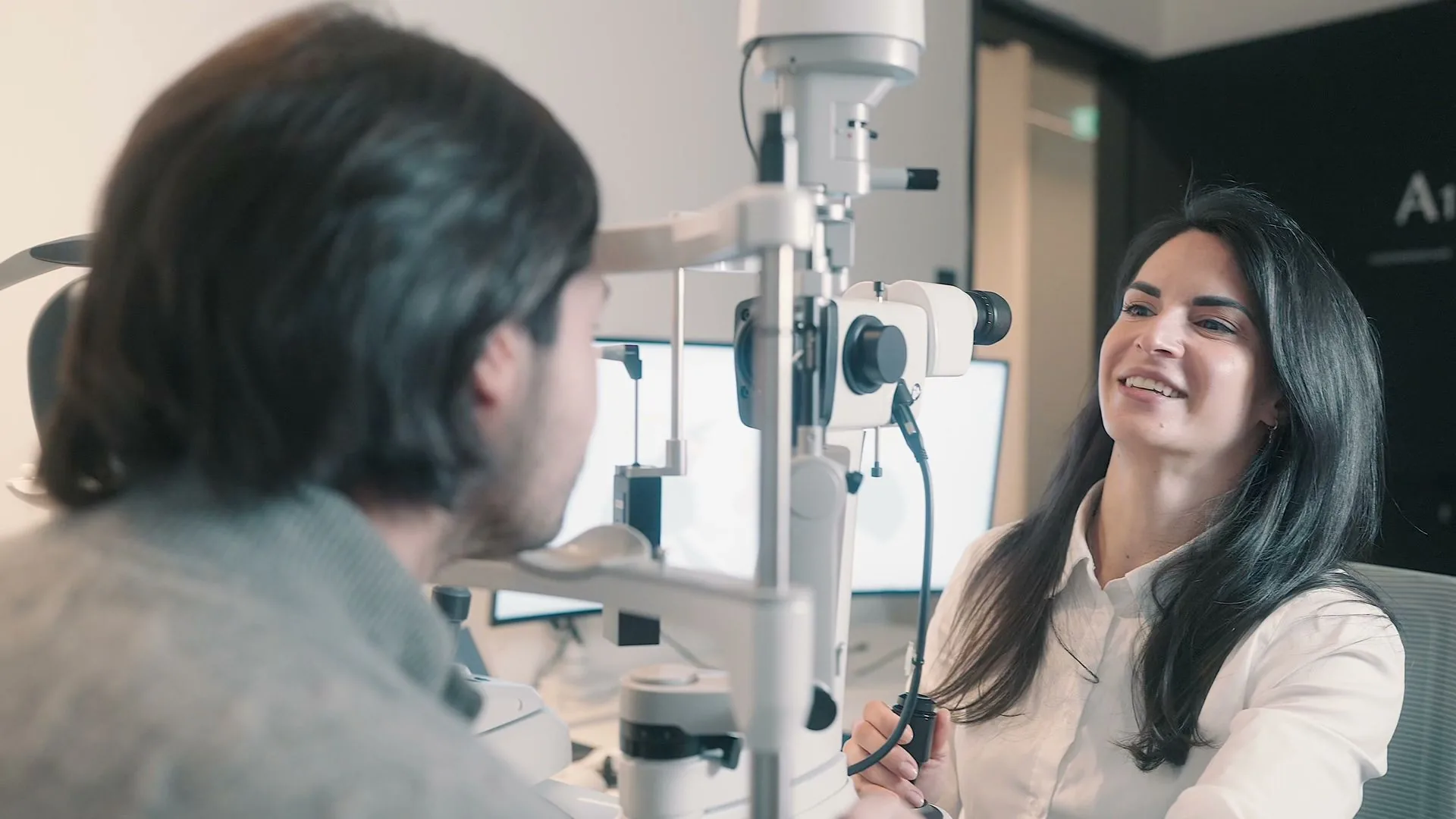
A decision that fits your life.
At dr.vision, Prof. Dr. Mehdi Shajari offers laser, ICL and lens exchange, so all paths for every age. That makes the consultation honest: we do not recommend the procedure we have, but the one that suits your eyes and your age.
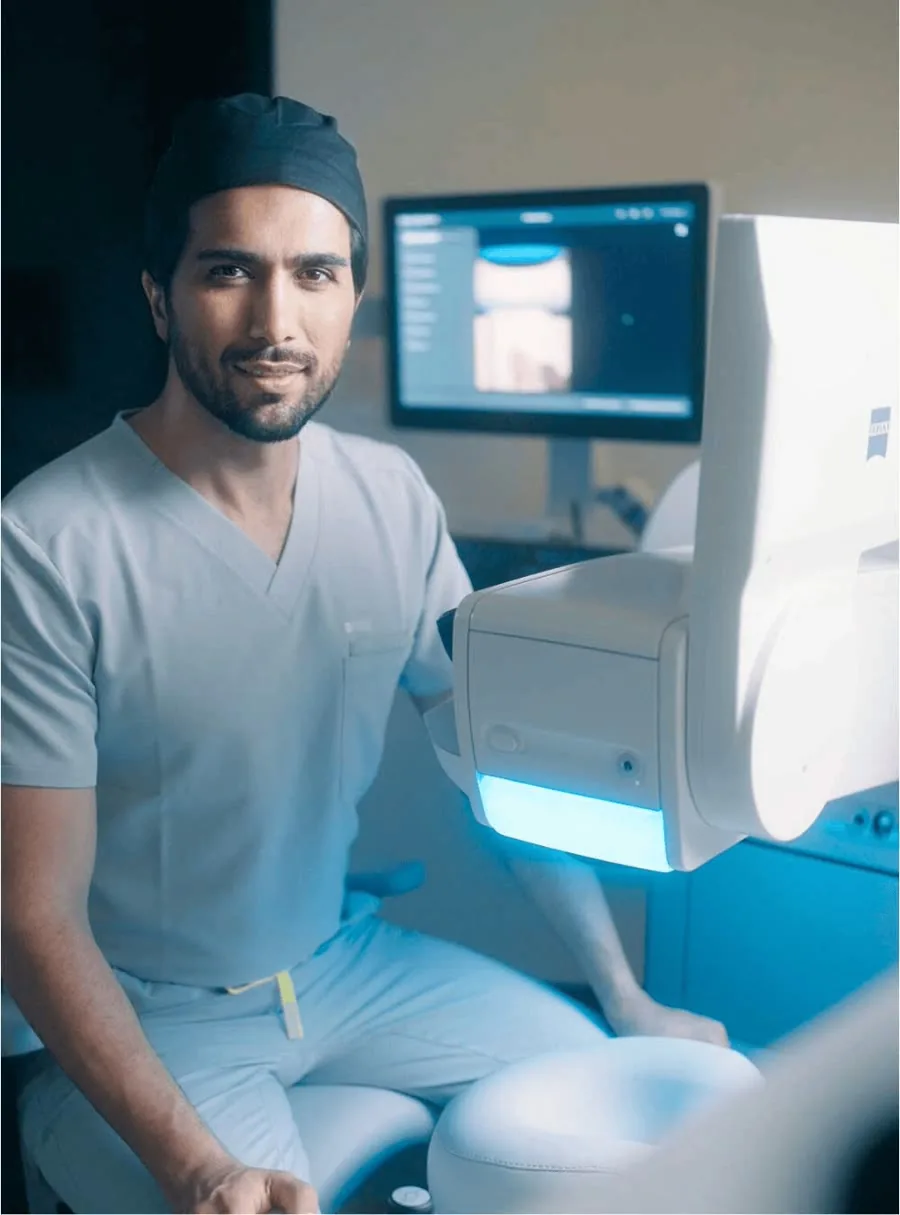
Prof. Dr. Mehdi Shajari. Personally.
Specialist in ophthalmology and professor (German title: außerplanmäßiger Professor) of ophthalmology, with numerous publications on freedom from glasses, and teaching and training of several colleagues in this field. He examines and operates on the cornea as well as on the lens; in his career he has performed 20,000+ procedures. So at our practice, the decision between laser and lens is made by someone who does both himself.
At dr.vision
Whoever examines you beforehand also operates on you: Prof. Dr. Mehdi Shajari in person.
SMILE Pro on the ZEISS VisuMax 800, SmartSight on the SCHWIND ATOS, Femto-LASIK, Trans-PRK, ICL, Presbyond and lens exchange. No recommendation for lack of alternatives.
From 40 we check the lens for first clouding, in nearsighted people the retina with a wide pupil. That decides between laser and lens.
From 40 you test monovision or Presbyond beforehand with contact lenses in daily life, before we change anything.
The price depends on the procedure, not on the year of birth.
Guide prices for both eyes at dr.vision: PRK/Trans-PRK €3,498, Femto-LASIK €4,298, SMILE Pro €5,198, SmartSight €5,198, Presbyond €6,398, ICL from €6,886, lens exchange from €6,998. Billing is private-practice, under the German fee schedule for physicians (GOÄ); you receive the written cost estimate after the pre-operative examination. Financing from €3.90 a day*, for example SMILE Pro: €95 a month over 72 months or from €433 a month interest-free over 12 months directly with dr.vision.
Keyhole procedure without a flap, up to −8 D.
€5,198both eyes
Keyhole procedure without a flap, up to −8 D.
€5,198both eyes
Also for farsightedness and monovision.
€4,298both eyes
Usually without reading glasses, with a clear lens.
€6,398both eyes
Distance and reading glasses, no more cataract.
from €6,998both eyes
Guide prices for both eyes according to the GOÄ, including pre-operative examination, procedure by Prof. Dr. Mehdi Shajari and aftercare. Patients with statutory health insurance are self-paying patients with us, private insurers reimburse depending on the plan. All prices and what is included: Prices · Monthly installments: Financing
* Representative example: €5,198 net loan amount · 72 months · fixed borrowing rate 9.49% p.a. · 9.90% effective annual interest rate · monthly installment €94.97 · total amount €6,837.84 · via medipay. Example 0% over 12 months directly with dr.vision: €5,198 cash price · no down payment · fixed borrowing rate 0% p.a. · 0% effective annual interest rate · monthly installment €433.17, last installment €433.13 · total amount €5,198.
Go deeper.
This page answers the age question. The detailed pages on your situation:
All options for nearsighted people, farsighted people and astigmatism before presbyopia.
View options45+Presbyond, monovision and lens exchange in detail, with trial wear.
Learn moreFrom 65How cataract surgery becomes an opportunity to get rid of both pairs of glasses.
Learn moreDecisionThe comparison for everyone between 45 and 60 who is torn between the two paths.
Read the comparisonSafetyAll risks of all procedures with frequencies and everyday comparisons.
View risksAftercareHow often a residual error remains, when the laser is repeated and what it costs.
To the guides376 reviews. Average 5.0.
376 Google reviews give dr.vision an average of 5.0 out of 5 stars. dr.vision does not check whether Google reviews come from treated patients.
“Yesterday I had my laser appointment, SMILE procedure. Already today I can see (previously over 4 diopters!) almost perfectly!”
“I am grateful for the great care and can warmly recommend Prof. Shajari!”
“I would like to share my experience with Prof. Dr. Mehdi Shajari of Dr. Vision Frankfurt, with whom I had my eyes lasered earlier this year.”
“After research, we chose Dr. Vision and the newest ‘Smile Pro method’ for reasons of expertise, because our eyesight is very valuable to us.”
Four patients. In their own words.
Constantly switching between glasses & contact lenses – not anymore.
It was a very good decision to come here.
At times I could no longer recognize my friends!
Less than 24h after surgery, better than ever.
Still have questions?
The questions patients ask most often about this during consultation hours. Prof. Dr. Mehdi Shajari
From age 18. The Refractive Surgery Commission (KRC) of the DOG and BVA lists treatment under the age of 18 as a contraindication for all refractive procedures. In addition, the values must have been stable for at least 12 months. For many nearsighted people that is only the case in their early 20s.
No, there is no fixed upper limit. From about 45, however, the laser corrects only part of the problem, because presbyopia develops in the lens. From the mid-50s and at the latest with early clouding of the lens, a lens exchange is usually the better solution. According to the KRC, a symptomatic cataract rules out laser eye surgery.
No. A parent's consent does not change the medical recommendation: under 18, refractive laser treatment is not done, because the eye is still changing. If your child's nearsightedness increases quickly, myopia control with the pediatric eye doctor is the right way.
Usually, your glasses prescription should have changed by no more than about 0.5 D over at least 12 months. Please bring old glasses prescriptions or findings. If they are missing, we measure twice, usually 12 months apart.
Yes, if you know what comes afterward: distance vision stays sharp, but between 40 and 50, presbyopia begins in almost everyone. Then you need reading glasses for reading, regardless of whether you have had laser treatment. Anyone who wants to avoid that discusses monovision or Presbyond.
If both eyes are fully corrected for distance: yes, for small print usually already now or within a few years. With Presbyond, one eye is set slightly for near, so that you usually manage without reading glasses; you test this beforehand with contact lenses.
Caution. Slightly nearsighted people at 48 often read without glasses precisely because the nearsightedness offsets the presbyopia. If both eyes are corrected for distance, this reading ability is lost. Here monovision or Presbyond usually makes more sense than a full distance correction.
Usually from the mid-50s, and always when your own lens shows first clouding. With a clear lens and a good cornea, Presbyond is also possible between 45 and 60. Under 50 we are cautious with the lens exchange in nearsighted people, because the risk of retinal detachment is higher.
The laser correction of the cornea is generally stable in the long term. What changes are other parts of the eye: from about 45 the lens (presbyopia), later the clouding of the lens. In about 2 in 100 eyes a residual error remains that can be corrected with an enhancement.
Yes. The calculation of the artificial lens is more involved after a laser correction, but has become much more accurate with new calculation models. Keep your measurements from before the laser treatment. At dr.vision you receive them in writing.
The cornea generally heals well at any adult age. With age, however, the tendency toward dry eyes increases, especially in women after menopause. That is why we measure the tear film before every procedure and treat dry eyes beforehand.
No. The price depends on the procedure, not on age: SMILE Pro €5,198, SmartSight €5,198, Femto-LASIK €4,298, PRK/Trans-PRK €3,498, Presbyond €6,398, each a guide price for both eyes. You receive the written cost estimate after the pre-operative examination.
Medically reviewed by Prof. Dr. Mehdi Shajari · As of October 2026
Not ready yet? Everything important to read again and to pass on.
Arrives by e-mail in about 60 seconds. No newsletter, just the guide and, if you wish, a follow-up from Patient Care. Privacy policy
How would you like to continue?
The first step is the free initial consultation, then the detailed pre-operative examination with Prof. Dr. Mehdi Shajari: cornea, lens, retina and your values. You go home with a written recommendation for your age and your eyes and a cost estimate.
In Frankfurt, Junghofstraße 16 · all measurements included
Our locations.
 Opening hours
Junghofstraße 16, 60311 Frankfurt am Main
 Opening 2027
Breite Straße 69, 40213 Düsseldorf (in the Neuer Stahlhof, corner of Graf-Adolf-Platz)
Until opening: preliminary talk in Frankfurt, Patient Care plans your travel.
Plan route Opening 2027
Lautenschlagerstraße 23, 70173 Stuttgart (2nd floor, step-free access)
Until opening: preliminary talk in Frankfurt, Patient Care plans your travel.
Plan routeSo, my name is Zhao Xingshu, I come from China and have been working in Germany for 20 years. I have been nearsighted since childhood in China, and it has always bothered me a lot. In Germany I started doing sports and also tech. I work a lot with computers and my phone. And I always had to switch between glasses and contact lenses. And as I grew older, it became very, very unpleasant and also very time-consuming for me.
I have always wanted to find someone who is not only professional but can also offer good service. Then I read about it online and found the professor. Then I called him, and the appointment came very, very quickly. And the next day I was already here and met my professor. He made a very professional impression on me. And also really very nice and kind. And what I liked best is the speed of the services. And I think that is actually what is most lacking in Germany.
The first impression was not the typical eye doctor's practice but a very professional consulting company. Well, because I myself work in a technical role for consulting companies, the first moment felt a bit very different to me, but at the same time I liked it a lot, because I really like this customer-focused, patient-focused approach, the fast speed with the appointment, and the professional consultation. That was my first impression.
Of course, absolutely. I have already sent my husband here, and my child. Yes, and I think I would recommend it to all my Chinese friends in Frankfurt as well.
I’m Teresa Schwenger, I’m 31 years old, I’m a project manager. I was nearsighted, so I didn’t see well at a distance, and at some point it was just super annoying with contact lenses, putting them in every morning, taking them out again in the evening. I think I wore contact lenses for about ten years, and then I also had the problem that my eye was no longer supplied with oxygen so well, which is why the little vessels grew further into the eye, and so I looked around for an alternative. Glasses were not an alternative for me, because I simply don’t like myself in glasses. It was always an issue with the swimming pool or the lake or the sea. Do you put your contact lenses in, can you dive, do you maybe lose a contact lens, and that was always really annoying. Or also when you stayed somewhere overnight, you always had your little contact lens case, your solutions and care products, which you had to take along, always a whole pack just for the contact lenses. I always found that very annoying, and also on long days, when I had put my contact lenses in very early, in the evening while watching TV I noticed, oh, this really annoys me now, I would like to take them out, and then watching TV with glasses on a couch, really very uncomfortable, and so that was a situation where I am now grateful that I will hopefully or probably never have them again.
And then I looked at which doctors in this area offer laser eye surgery, and I read through lots of reviews and looked at who is very good here. And the doctor here is really rated very, very highly, and I had a totally likeable first conversation with him and felt comfortable right away. I also saw all his awards, the FOCUS awards and so on, which reinforced my impression, and also lots of positive reviews, which I can confirm. So you feel very comfortable, and the work here is very professional. So it was a very good decision to come here, definitely.
Not quite so good. I was very nervous, had many worries and fears too. I would have liked to leave again right away on the day when I was sitting here. But I was received super kindly and warmly. Everything was explained to me well. Everyone was very warm, and they took the nervousness away. So I felt I was in good hands, and when it then started, the nervousness was already a bit less, because I knew that I was simply in good hands.
So I simply arranged the appointment, the first appointment, online, and then I got a call asking me to please stop wearing contact lenses from that point on, so that the eyes are already free of contact lenses, because things can still change there. Then the parking garage is right next door, you walk in here, and it is a very beautiful building and a very beautiful practice, definitely. I was welcomed warmly right away by the receptionists. Everything was explained to me well right away. I was given water and everything. Then I had the first tests. I was totally amazed at how many tests were done and with which devices. It's really incredible what names are on the devices and how expensive these devices are. But really everything was measured that I think can be measured in an eye. Then I had the conversation with the doctor. That was also really great, warm. He answered all the questions I had and took the time for me. I then said I would rather sleep on it for another night, because I am simply the type of person who plays it safe. But at home I actually already knew that I would like to have it done. The next day I called again and made a second appointment. The eyes were checked once more, again with a colleague of the doctor and with him. And then I had another informed-consent talk about what risks there are. I was able to ask my questions again and then got my treatment appointment very quickly. And on the day of the treatment, as I said, I was already here super nervous, but I was also welcomed very warmly. Many of my worries and fears were taken away.
Yes, exactly. So I got up this morning and I could see right away. That was my biggest worry, that I would no longer be able to see as I did before, but I could see perfectly right away. I also saw at a distance again. That was the exciting part in my case. I looked out of the window and also noticed the trees farther away. The outlines, which I otherwise always saw only like this, were clear and distinct. So it really is a change right away. I notice it totally, and it’s super nice.
Definitely, yes, absolutely. I felt super comfortable from the first second to the last. So definitely, if I ever have laser treatment again, then definitely here. I can only recommend it to everyone.
Yes, I definitely should have done it earlier, that's true, because I believe it really gives you a lot of quality of life back, and it is also good for the eyes. Of course, there is the treatment itself, but in the long run, as it was with me, because of the contact lenses, I had these tiny blood vessels, or I have them in my eye, because the eyes were not supplied well. Had I done this earlier with the lasers, it might not be as pronounced. So my appeal would be to do it earlier rather than too late.
My name is Laura. I had my eyes lasered in April by Dr. Shajari, because I saw very badly with both eyes and it limited me a lot in everyday life. Especially driving was not possible at all without glasses, and I can’t tolerate contact lenses. I find that unpleasant, and handling them just didn’t fit into my everyday life. I also found glasses very unpleasant even after wearing them for a long time, and above all you depend on them so much. If I forgot my glasses, I couldn’t work, I couldn’t see at university, I couldn’t take part in everyday life. And what was really one of the worst things, too, in private situations: I was outside, I didn’t recognize friends, I didn’t say hello to them, I didn’t recognize colleagues, and sometimes I even thought, that’s my father, that’s my mother, and then I said hello to people, and it was totally limiting. I really didn’t recognize people, I couldn’t really share in everyday life.
I was generally a patient on verifyMED, and I also learned through friends that he used to be a senior physician at a large hospital and enjoyed a very good reputation there. I heard that through friends, and I liked him a lot. The reviews are very positive. And when I had the first consultation appointment, because I actually also had consultation appointments elsewhere, it was immediately clear to me: I'm getting my laser treatment here. I already knew that with the eye, the doctor has to be the right fit, that's very important, especially with the eye, because everything is at stake there, I think.
On that day I had minimal pain, but it is really manageable, more of an unpleasant feeling. You can also take a painkiller, and then it was okay. You have to get used to it first, the eyes are very sensitive. But the next day it was really as if there had never been a surgery. So you can see right away, it is not unpleasant. You just have to keep taking the drops. There is a plan for that, which Dr. Shajari writes out. And in hindsight it wasn’t a big procedure.
I was in a bar here with friends, and it was really a different feeling of life. I walked in, finally saw people, noticed people. I didn’t feel uneasy, because without glasses I used to be like, do I know that person or not. It was simply a completely new feeling of life.
I tell everyone, I have also already recommended it to friends who had it done, who are very satisfied, I would do it again any time. For me, at the beginning, I was unsure, because I am still very young. I am only 24, because many people say, wait with it. Because the eyes will, even Dr. Shajari can’t stop that, still get a little worse. For me it has now even gone to much better, on purpose. If they get worse, I will still see 100 percent. I now see 160 percent, definitely pretty crazy.
And I would just urge people to do it as early as possible. Don’t think about it for long, just do it. Because I actually even regret that I didn’t do it a few years ago.
I'm Duilio, I'm 22 years old. I was nearsighted before, with a prescription of minus 4.75. I actually looked into laser eye surgery a few years ago. But this practice didn't exist yet back then, and I informed myself a bit about it, and now I've finally come to the conclusion to have my eyes lasered.
So there was a free initial consultation here. I came here, first took a look at the practice, and I found the technology to be state of the art, and I also found Professor Shajari to be a very empathetic and very likable doctor, also very young, and so I then decided to have my eyes lasered here.
So the process was actually quite simple. You first came into a small room, where the eyes were cleaned a little, it burned briefly and then they were numbed and that was it. They were numbed with eye drops and then it went straight to the operating room and right there I was laid on the bed of the laser, the Carl ZEISS VisuMax 800, which is the newest laser, and then he actually started operating right away. I think I was only in the operating room for 15 to 20 minutes in total, while the laser itself took about ten seconds per eye.
Right, so after the surgery I got up first and couldn't see very sharply yet. I saw it as if it were milky cloudy. So my vision was milky cloudy, as if you were looking through a plastic cup when you hold it in front of your eyes. But I could already see better, or at least I had the feeling that I could already see almost better than I did before without glasses.
When I came for the follow-up check the day after, the optician took off the protective glasses and then I could really see, I saw him clearly, I saw the devices clearly, we did the tests, he said yes, you are at 100 percent in one eye, 125 percent in the other, exactly, so it was a great feeling, I then took out my sunglasses right away, because the sun was shining that day, and I went for a little walk through downtown Frankfurt. It was very nice, as I said, to see everything clearly without glasses not even 24 hours after the surgery, I think it was about half a day, 13, 14 hours after the surgery, yes, so it was really great.