 dr.vision
~45
the near focusing of the lens declines noticeably in everyone. It keeps declining until the early 60s.
Start here
What suits you?
Find out in 2 minutes which procedure suits your eyes.
Start the Suitability CheckOr by age:
< 45yearsGet rid of glasses & contact lenses 45–64yearsGet rid of reading glasses 65+yearsCataract & glasses-free★★★★★ 5.0 · 376 Google reviews · 20,000+ procedures
Decide well
What you should know beforehand.
Who operates?Prof. Dr. Mehdi ShajariFOCUS Top Doctor · operates on every patient personally What does it cost?Laser from €3,498 · Lenses from €6,886Prices for both eyes Is it safe?Safety & risks When will I be fit again?Work, sports, driving Would you rather read in peace first?Decision Guide Freedom from GlassesProcedures
Laser or lens?
Laser eye surgery
SMILE ProSmartSightFemto-LASIKTrans-PRKPRKPresbyond (laser away your reading glasses)All laser procedures at a glanceLaser procedures compared ›Lens surgery
ICLLens exchange (reading glasses)Cataract surgery with premium lensLens types: trifocal, EDOF, toricLens types compared ›Start here
Something wrong with your eyes?
A thorough eye check-up with us clarifies what is behind it.
Book an eye check-up★★★★★ 5.0 · 376 Google reviews
Presbyopia · from about 45 years
Three paths: monovision, Presbyond, lens exchange.
Your phone keeps moving farther away, and your reading glasses are never where you need them? With Presbyond or a lens exchange, you can usually do without them again. Which way suits you is shown by your own lens. Prof. Dr. Mehdi Shajari operates personally.
 12× FOCUSTop Doctor
From 45, it affects everyone. There are three paths.
~45
the near focusing of the lens declines noticeably in everyone. It keeps declining until the early 60s.
3
Monovision, Presbyond, lens exchange. Each with its own compromise.
Your lens
If it is clear, laser treatment is possible. If it starts to cloud, lens exchange is the lasting solution.
beforehand
You try out monovision and Presbyond in a simulation test before you decide.
from €6,398
Presbyond, both eyes. Lens exchange from €6,998. Guide prices under the German fee schedule for physicians (GOÄ).
376 reviews. Average 5.0.
“What I liked especially was that I got the feeling of honest advice on the next steps, with all possible alternatives.”
“Prof. Dr. Mehdi Shajari takes a lot of time, explains every step of the pre-operative examination clearly and relies on the absolutely most modern diagnostics and laser technology.”
“My cataract surgery by Dr. Shajari could not have gone better or more professionally. Everything that was happening was explained to me calmly and factually.”
“The goal afterward was to be glasses-free, which is achieved with a multifocal lens.”
Four patients. In their own words.
I wanted my life back – without glasses, without headaches.
Now I can already read things again.
I was allowed to take off the bandage that very afternoon.
I saw wonderfully bright light.
Getting rid of reading glasses in five answers.
For anyone with three minutes. Each answer leads to the detailed chapter.
Over the years, your own lens becomes stiffer and can no longer switch to near vision. This is called presbyopia. It is not a disease and affects everyone, even those who never needed glasses before.
Understanding presbyopiaYes, with Presbyond, as long as your own lens is clear, typically between about 45 and 60. One eye is adjusted for distance, one for near. Whether you get along with that is shown beforehand by a simulation test.
PresbyondWhen your own lens starts to cloud, you are clearly farsighted or you are over about 55. The artificial lens (EDOF lens with extended depth of focus or trifocal lens) replaces the lens permanently; a cataract can no longer develop afterward.
Lens exchangeYes. Before monovision or Presbyond, we simulate the result on site during the pre-operative examination: one eye for distance, one for near. That way you know beforehand whether you get along with the mixed vision.
To the processPresbyond €6,398, lens exchange from €6,998, in each case both eyes under the German fee schedule for physicians (GOÄ). Patients with statutory health insurance pay themselves, private plans reimburse differently. Financing is possible.
CostsIt is not your eyes getting worse. The lens gets stiff.
At 20, your lens refocuses from distance to a sharp 10 cm in fractions of a second. From about 45, it manages only arm's length. After that, any text becomes too small, no matter how well you see in the distance.
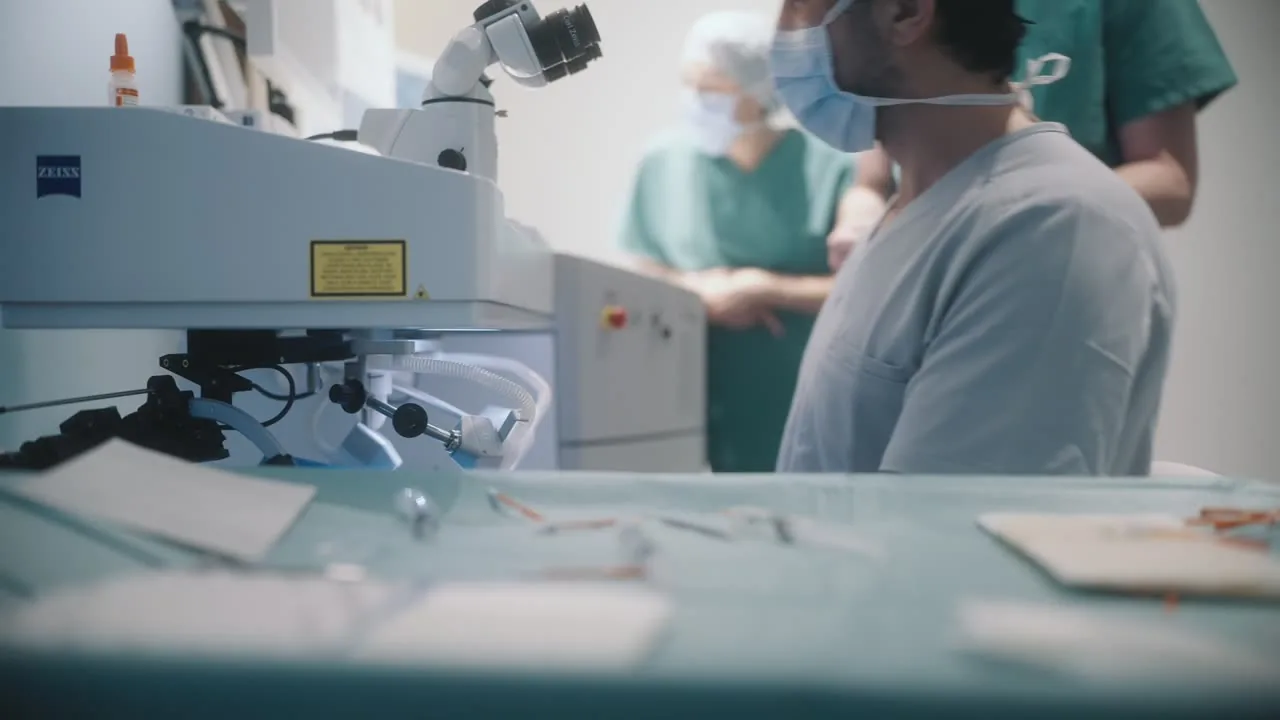
10 cm
A ring muscle relaxes the suspension of the lens, which becomes rounder and refracts more strongly. This is how the eye switches from far to near. This is called accommodation.
40 cm
The lens grows in layers throughout life and loses its elasticity in the process. The muscle still works, but the lens no longer follows. The near point moves out to arm's length.
+2,5 D
From about 60, presbyopia is fully developed and hardly changes anymore. After that, in many people a cataract slowly begins, again in the lens.
Self-test: Where do you stand?
How far do you have to hold your phone away, without reading glasses, to read a message?
How do you see at a distance?
Typically between 43 and 47. More light still helps, but evenings get tiring. Weak reading glasses of around +1.0 D are usually enough.
A rough guide, not an eye test. Your exact reading strength is measured by your eye doctor or optician.
| Age | Near point (how close things are still sharp) | Reading glasses strength | How it feels |
|---|---|---|---|
| around 20 | about 10 cm | none needed | Small print right in front of your nose |
| around 40 | about 20–25 cm | none needed | still unnoticeable, evenings a little more tiring |
| around 45 | about 25–35 cm | +0.75 to +1.0 D | Phone and menu drift away, more light helps |
| around 50 | about 50 cm | +1.5 D | reading is hardly possible without reading glasses |
| around 55 | over 60 cm | +2.0 D | even the laptop gets blurry |
| from 60 | over 1 m | +2.5 D | final; after this, near vision hardly changes any more |
Average values for normally sighted eyes, varying from person to person.
A nearsighted eye is naturally set for close range. At −2.5 D, the point of sharp focus is at around 40 cm, exactly reading distance. That is why many nearsighted people simply take their glasses off to read from 45 on. This is practical, but they then need glasses for distance and none for reading, or progressive glasses for both.
Farsighted people already have to help with the lens at a young age in order to see sharply at all. When near focusing weakens, they notice it earlier, often as early as 40, and later in the distance too. For them, lens exchange is often the better solution than laser treatment.
No. The cause is the hardening of the lens, not a weak muscle. No training makes the lens soft again, and dietary supplements have no proven effect either. The worry that reading glasses make “the eyes lazy” is also unfounded: presbyopia progresses at the same rate with or without glasses. Glasses only take away the strain.
Presbyopia affects only near vision and both eyes equally. Have yourself examined if one eye suddenly sees worse, if lines look distorted or wavy (macula), if you notice glare and loss of contrast (early cataract) or if you are over 40 and have never had your eye pressure measured (glaucoma). Before any treatment against reading glasses, we examine the lens, retina and eye pressure.
Five questions. An honest direction.
Three things almost always decide: your age, the condition of your own lens and how many compromises you accept. Answer five questions. You will see which path probably suits you and how you will see afterward at a distance, at the screen and when reading.
Choose your answers. The result adjusts immediately.
1 · How old are you?
2 · How do you see in the distance today?
3 · Has an eye doctor mentioned an early clouding of the lens (cataract)?
4 · What do you wish for?
5 · Do you drive a lot at night or have dry eyes?
Your direction
Clear lens, age in the typical range.
A guide, not a diagnosis. Whether your lens is clear and how thick your cornea is will only be shown by the pre-operative examination.
Three ways. Each with its own compromise.
We offer three ways: monovision, Presbyond and lens exchange. None of them gives you back the vision of a 25-year-old; each one trades something off. Here is each way with what it can do, who it suits and where its limit lies.
Monovision: one eye for distance, one for near.
With monovision, the dominant eye is set for distance and the other eye is made slightly nearsighted for near. The brain automatically picks the sharp image. We do this with a laser or with artificial lenses. Not everyone gets along with it; by estimates about 6 in 10 do. That is why we always test it beforehand in the simulation test.
Presbyond is a further development: both eyes additionally get more depth of focus, so the difference between them can be smaller.
To PresbyondPresbyond: laser away the reading glasses, your own lens stays.
Yes, with Presbyond (Laser Blended Vision), as long as your own lens is clear. With Femto-LASIK, one eye is set for distance and the other slightly for near, both with extended depth of focus. This creates a shared range of sharp vision from distance to reading. Nearsightedness or farsightedness and astigmatism are corrected in the same procedure.
Process, Suitability Check and night vision in detail on the procedure page.
Everything about PresbyondLens exchange: final, cataract ruled out afterward.
In lens exchange (refractive lens exchange), an artificial lens replaces your own lens that has become stiff. With an EDOF lens you see distance and screen without glasses, with a trifocal lens reading as well; about 9 in 10 of our trifocal patients manage without glasses in daily life. The procedure takes about 20 minutes per eye, and a cataract can no longer develop afterward.
Which lens suits your daily life: trifocal lens, EDOF lens, lens types compared.
Everything about lens exchangeOur ways against reading glasses. In one table.
The criteria patients over 45 ask about most often: how sharp at distance, screen and near, how is night vision, what about dry eyes, is it reversible, what happens with cataract and what does it cost. The green column is the most common way with a clear lens, not automatically yours.
Swipe the table sideways to see all options.
| Criterion | Presbyondlaser, lens stays | Lens exchange EDOFartificial lens | Lens exchange trifocalartificial lens |
|---|---|---|---|
| Typical age | about 45–60 | from about 55 | from about 55 |
| Distance | sharp | sharp | sharp |
| Screen | good | good | good |
| Reading | mostly without glasses | mostly without, small print possibly with glasses | mostly without glasses |
| Night vision | halos at first | hardly any halos | halos at first |
| Dry eyes | common in the first months | hardly | hardly |
| Depth perception | slightly less | normal | normal |
| Adjustment | a few weeks | a few weeks | weeks to months |
| Reversible | no | with effort | with effort |
| Later cataract | will come, surgery possible as usual | ruled out | ruled out |
| Back to work | usually after 1–2 days | usually after 2–3 days | usually after 2–3 days |
| Costs | €6,398 | €7,242 | €7,876 |
Guide prices for both eyes under the German fee schedule for physicians (GOÄ). The detailed two-way comparison is at Lens exchange or Presbyond?
There were and are other approaches: small rings or discs inserted into the cornea (inlays), and laser profiles that shape the cornea of one eye multifocally (PresbyLASIK). Inlays were often removed again because of clouding and dissatisfaction, and a well-known model is no longer on the market. The German Ophthalmological Society advises against purely multifocal corneal laser profiles (press release 2022). Presbyond works differently, with a moderate difference between the two eyes. That is why we offer only monovision, Presbyond and lens exchange, all with a preceding test or detailed lens consultation.
With classic monovision, one eye is set purely for distance and the other purely for near. There is a gap in between, and depth perception suffers more. Presbyond additionally creates an extended depth of focus in both eyes; the ranges of sharp vision of both eyes overlap in the intermediate range. As a result, the difference between the eyes can be smaller and the brain merges the images more easily. We still do the simulation test for both.
Deciding at 48. Thinking ahead to the next 20 years.
Presbyopia progresses until the early 60s, and from about 65 many people develop cataract. A good decision at 48 takes both into account. This is how the ways typically play out over the decades:
| Life stage | What happens in the eye | What is usually sensible then | What comes later |
|---|---|---|---|
| 45–50 | Lens clear, reading strength +1.0 to +1.5 D | Presbyond | Presbyond: near vision may weaken somewhat over the years, distance stays |
| 51–55 | Lens clear or first changes, reading strength up to +2.0 D | Presbyond with a clear lens, lens exchange with farsightedness or clouding | after Presbyond, later cataract surgery as for everyone |
| 56–64 | Lens often denser, first clouding common | Lens exchange with EDOF or trifocal lens | after lens exchange no more cataract, if needed secondary cataract laser |
| from 65 | Cataract in more than half | Cataract surgery with premium lens | separate page: Glasses-free from 65 |
This is where the closest look is worthwhile: Presbyond leaves your lens in the eye and corrects near vision for many years.
Then lens exchange is usually the more lasting solution. It solves the reading glasses and the later cataract in one procedure.
That is not an exclusion. Presbyond is possible if enough cornea is left; lens exchange almost always. Calculating the artificial lens is more demanding after laser surgery. If possible, bring your old values from back then.
In that case we advise against laser treatment: it would only last until the cataract surgery. Lens exchange treats the clouding and the reading glasses at the same time.
In that case every bit of contrast counts. Multifocal lenses and Presbyond are usually not the right choice. We will tell you this openly.
Then wait calmly. If cataract surgery is due in a few years, you will decide on the lens then, and with it on freedom from glasses.
If you had laser treatment for nearsightedness years ago, you need reading glasses at 45 like anyone else. Both paths are generally open. Presbyond requires that enough corneal thickness remains after the first treatment for a second ablation; we measure that with tomography. With lens exchange, calculating the strength of the artificial lens is harder because the standard formulas assume an untreated cornea. For this we use special formulas and, if available, your values from before the first treatment. After earlier laser treatment, trifocal lenses are not always ideal; often an EDOF lens is the calmer choice.
Yes, your own lens keeps aging until near focusing is lost completely in the early 60s. The near eye after Presbyond stays set for near, but the range that the lens itself still contributes gets smaller. Many manage without glasses for years and later use weak reading glasses for small print. If cataract develops, lens surgery is possible as usual; you will receive your data for it in writing.

Which way suits you?
We will sort that out calmly. Give us a call.
Jana from our Patient Care team answers your questions and arranges the pre-operative examination with Prof. Dr. Mehdi Shajari. Phone available 24 hours, WhatsApp Mon–Fri 8:00–19:00, Sat 9:00–15:00.
Test first. Then decide.
Treatment against reading glasses at dr.vision runs in four steps, from the initial consultation through the pre-operative examination with testing and the procedure to aftercare. Whether Presbyond or lens exchange: it starts with an initial consultation in which we compare both paths for your eyes. Anyone considering monovision or Presbyond first does a simulation test on site. Only then do you decide.
Step 1 of 4
All options on the table. Assessed honestly.
Please bring: glasses, contact lens data, previous findings, and the records from back then if you had laser surgery before.
In advance: Decision GuideStep 2 of 4

Measuring and trying out.
You go home with a written recommendation and a cost estimate.
Compare the waysStep 3 of 4
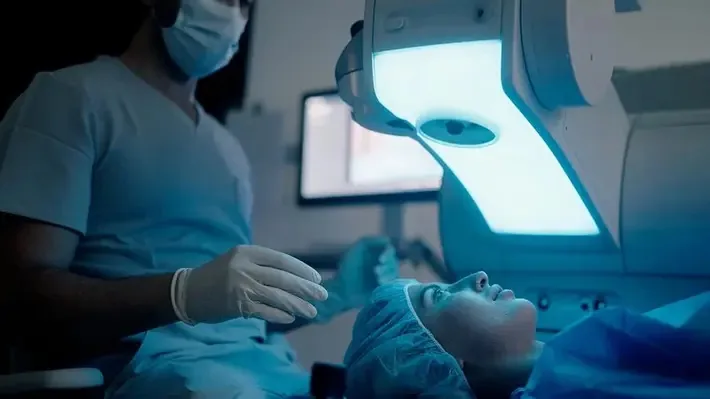
Awake, numbed with drops.
For a lens exchange, please come with someone accompanying you; for Presbyond, an escort is nice but not necessary. On this day, you do not drive yourself.
Step 4 of 4
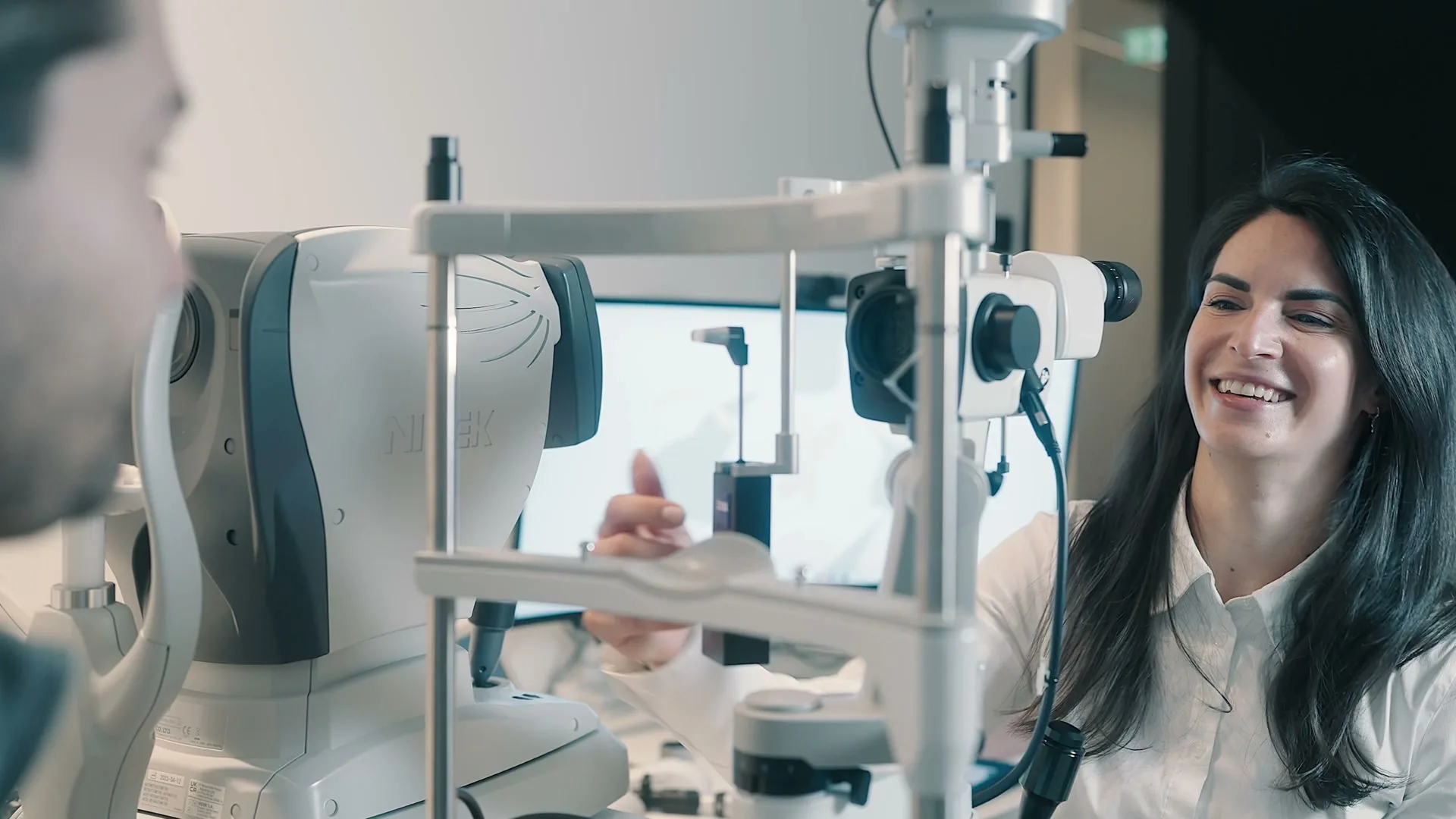
The brain learns along. We accompany you.
Near sharpness improves in the first weeks as your vision adapts. Emergency number around the clock.
For most people, near vision becomes clearly sharper in the first 4–12 weeks and the halos at night fade, because the brain learns to handle the new image.
After Presbyond or a lens exchange with an EDOF or trifocal lens, the brain has to learn to handle the new image. In the first days near vision often does not yet seem as sharp as hoped, and halos stand out at night. For most people both improve clearly in the first 4–12 weeks. With Presbyond, the near eye can feel “wrong” at first, until the brain merges the images. If something remains bothersome, there are solutions: an enhancement, weak glasses for certain situations or, with lenses, very rarely a lens replacement.
| Activity | Presbyond | Lens exchange |
|---|---|---|
| Screen, reading | from day 1, eyes tire faster | from day 1 |
| Work (office) | usually after 1–2 days | usually after 2–3 days per eye |
| Driving | usually after the follow-up check the next day | usually about 1 week after both eyes have been operated on, the doctor decides; at night only once halos do not bother you |
| Sports | usually after 1 week | light sports after 1 week |
| Swimming, sauna | after 2 weeks | after 2–4 weeks |
More on this: When will I be fit again?
Both procedures are done with numbing drops; you feel touch and pressure, usually no pain. After Presbyond the eyes feel scratchy and water for a few hours; after lens exchange the eye briefly feels as if there were a grain of sand in it. Increasing pain is not normal: in that case, call us.
Every way has its price. We tell you beforehand.
The most common side effects are not complications but compromises: getting used to it, halos and dry eyes in the first months. Serious complications such as infections are very rare, under 1 in 1,000. The risks for each procedure in detail are on Presbyond and lens exchange.
The brain has to learn to merge the images of both eyes (Presbyond) or of several focal points (multifocal lens). At first vision feels unfamiliar, near vision not quite sharp.
most within 4–12 weeks
Those who did well in the simulation test usually adjust quickly.
Simulation test before Presbyond, detailed lens consultation, follow-up checks in the first months. If it remains bothersome: fine correction, glasses for certain situations or adjustment.
Rings or rays around light sources in the dark. With trifocal lenses an effect of the optics, with Presbyond of healing and the extended depth of focus.
at first 3 in 10
bothersome with trifocal lenses, under 1 in 10 after three months. EDOF and Presbyond are bothersome much less often.
Measure pupil size, for people who drive a lot at night rather EDOF than trifocal, show and discuss the effects beforehand.
In laser treatment, corneal nerves that control tear flow are cut. From 45 the tear film is often thinner anyway.
common in the first months
after Presbyond; after lens exchange hardly.
Measure and treat the tear film beforehand. With pronounced dry eyes we advise lens exchange rather than laser.
The capsule behind the artificial lens clouds over months to years later. Vision slowly turns milky again.
about 1 in 10
within five years, somewhat more often in younger people.
A YAG laser opens the capsule within a few minutes, painlessly, without an incision. As a rule, the secondary cataract does not come back afterward.
The vitreous pulls on the retina and tears it. Signs: flashes, a shower of dark spots, a shadow in the field of vision.
up to about 1 in 100
In the first year about 2 in 1,000, the risk rises over the years. More common in men, high nearsightedness and younger patients; that is why we weigh up especially carefully for nearsighted patients under 55.
Retina examination with a dilated pupil before the procedure, information about warning signs, emergency number. Treatable well when caught early.
Germs get into the cornea (laser) or the inside of the eye (lens). Signs: increasing pain, redness, worse vision in the first days.
under 1 in 1,000
Sterile procedure, antibiotic, follow-up check the day after the procedure, emergency number around the clock.
Frequencies from the literature and our own evaluation (cataract/lens surgery n = 1,100, 2022–2026).

Because you get all the ways. Not just one.
Laser and lens from a single source, over 20,000 procedures, 5.0 stars from 376 reviews. Anyone who offers only one path recommends it, too. We offer both and recommend the one that suits your eyes.
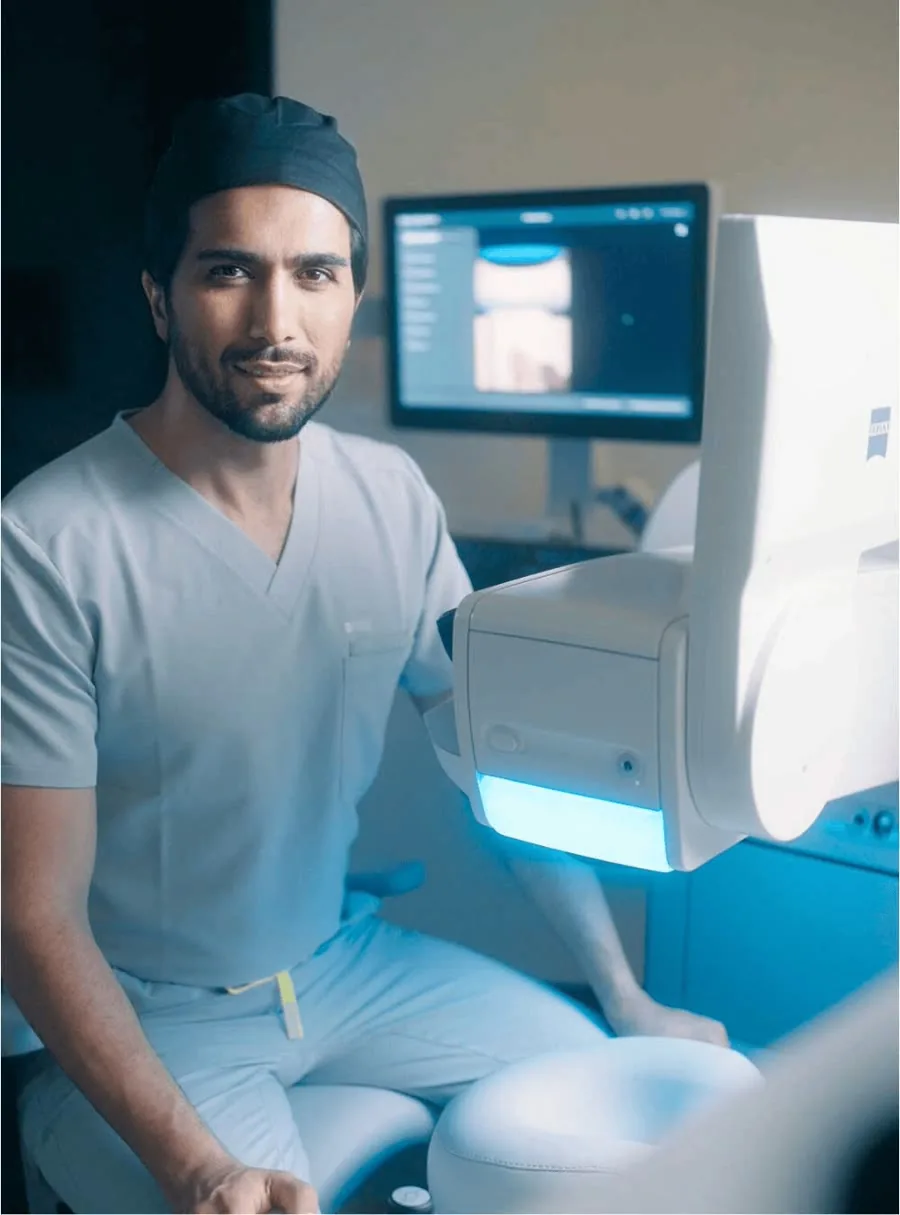
Every procedure: Prof. Dr. Mehdi Shajari. Personally.
Prof. Dr. Mehdi Shajari operates on every patient himself. He is a specialist physician and professor of ophthalmology (German title: außerplanmäßiger Professor), has published numerous papers on freedom from glasses, teaches, and has trained several colleagues in this field. He performs Presbyond and lens exchange himself and therefore knows both sides of the decision.
“As long as your own lens is clear, Presbyond comes into question. With farsightedness or first clouding, I tend to advise lens exchange.”
Prof. Dr. Mehdi Shajari
€6,398 or from €6,998. For both eyes.
Guide prices at dr.vision for both eyes: Presbyond €6,398, lens exchange from €6,998, billed privately under the German fee schedule for physicians (GOÄ). You receive your written cost estimate after the pre-operative examination, before you decide. The pre-operative examination is included in the price of the treatment; without a procedure, it is billed separately. Financed, that comes to from €3.90 a day* over 72 months or from €533 a month interest-free over 12 months.
| Way | Costs | What is included | More |
|---|---|---|---|
| Presbyond | €6,398 both eyes | Pre-operative examination, simulation test, procedure by Prof. Dr. Mehdi Shajari, aftercare | Presbyond |
| Lens exchange | from €6,998 both eyes, depending on the lens | Pre-operative examination with biometry, procedure on both eyes, lenses, aftercare | What does lens surgery cost? |
* Representative example Presbyond: €6,398 net loan amount · 72 months · fixed borrowing rate 9.49% p.a. · 9.90% effective annual percentage rate · monthly installment €116.90 · total amount €8,416.80 · via medipay. Representative example lens exchange: €6,497.47 net loan amount after €500.53 down payment · 72 months · fixed borrowing rate 9.49% p.a. · 9.90% effective annual percentage rate · monthly installment €118.72 · total amount €8,547.84 (with down payment €9,048.37) · via medipay. Alternatively 0% over 12 months directly with dr.vision. You can calculate your installment on Financing & Monthly Installment, and all prices are listed under Prices & Costs.
Whether your private health insurance (PKV) reimburses Presbyond or lens exchange depends on the plan. Many insurers check whether the refractive error counts as requiring treatment; sometimes a share is reimbursed. With our cost estimate, you can clarify in advance with your insurer what it covers. More: Private health insurance.
Beihilfe (allowance for German civil servants) reimburses procedures for presbyopia only in exceptions; the rules differ between the federal government and the states. With a simultaneous clouding of the lens, this can change. More: Beihilfe.
Statutory health insurance does not pay for procedures against reading glasses. dr.vision is a private practice; you pay yourself, after a written cost estimate, financed on request. You can claim the costs as extraordinary expenses on your tax return. Whether and how much the tax office recognizes depends, among other things, on your reasonable burden. More: Tax, Statutory health insurance.
Go deeper.
This page is the overview of all the ways. The detail pages explain each procedure with process, risks and results:
Laser away your reading glasses: suitability, simulation test, night vision, process.
To Presbyond ProceduresGet rid of reading and distance glasses from about 55: process, lens choice, results.
To lens exchange ComparisonThe direct side-by-side comparison with all criteria and borderline cases.
View comparison LensesWhich artificial lens suits your daily life.
Compare lenses Younger than 45?SMILE Pro/SmartSight, Femto-LASIK, Trans-PRK or ICL.
Learn more Older than 65?How cataract surgery becomes an opportunity to be free from glasses.
Learn moreStill have questions?
“These are the questions I hear most often in consultation hours. Here are my answers.” Prof. Dr. Mehdi Shajari
Usually between 43 and 48. From about 40 the lens measurably loses elasticity, and from 45 almost everyone notices it when reading. Until the early 60s reading strength increases to about +2.5 D, after that it hardly changes.
No. The hardened lens does not become elastic again, neither through training nor through drops or vitamins. Presbyopia can only be compensated for, at dr.vision with Presbyond or an artificial lens.
Yes, with Presbyond, as long as your own lens is clear, typically between about 45 and 60. One eye is set for distance and one slightly for near, both with extended depth of focus. Beforehand, a simulation test shows whether you get along with the principle. Guide price: €6,398 for both eyes.
With a clear lens and under about 55, Presbyond is the smaller procedure, and your own lens stays. With early clouding, pronounced farsightedness, dry eyes or over 55, lens exchange is usually more lasting, because a cataract can no longer develop afterward.
Usually yes. Presbyond is possible if there is still enough corneal thickness. Lens exchange works almost always, but calculating the artificial lens is more demanding after earlier laser surgery. If possible, bring your old values.
No. With increasing age only the way shifts: from about 55 lens exchange usually makes more sense than laser treatment, from 65 cataract surgery with a premium lens. There is no age limit; what matters is a healthy retina and cornea.
There is no guarantee. Most people read without glasses in daily life afterward; with very small print, dim light or long reading sessions some use weak reading glasses. With trifocal lenses, 9 in 10 of our patients no longer need glasses.
Usually a few weeks. In the first days near vision often does not yet seem quite sharp, and halos stand out at night. For most people both improve clearly within 4 to 12 weeks, because the brain adapts.
As a rule, yes. In the first weeks halos can be bothersome, especially with trifocal lenses. If you drive a lot at night, you are usually better advised with Presbyond or an EDOF lens. We discuss this in the pre-operative examination.
At dr.vision, Presbyond costs €6,398 and lens exchange from €6,998, each for both eyes under the German fee schedule for physicians (GOÄ). This includes the pre-operative examination, the procedure by Prof. Dr. Mehdi Shajari and aftercare. You receive the written cost estimate after the pre-operative examination.
Statutory health insurance does not. Private health insurance partly reimburses, depending on the plan and findings, and Beihilfe (allowance for German civil servants) only in exceptional cases. You can declare the costs as extraordinary expenses in your tax return. Whether and how much the tax office accepts depends, among other things, on your reasonable burden.
Medically reviewed by Prof. Dr. Mehdi Shajari · As of October 2026
Not ready yet? Everything to read later and pass on.
Arrives by e-mail in about 60 seconds. No newsletter, just the guide and, if you wish, a follow-up from Patient Care. Privacy policy
How would you like to continue?
You arrange the initial consultation by phone or online. The first appointment is a free consultation on which path suits your daily life. The detailed pre-operative examination with Prof. Dr. Mehdi Shajari follows: lens, cornea, tear film and retina. You go home with a written recommendation and a cost estimate.
In Frankfurt, Junghofstraße 16 · all measurements included
Our locations.
 Opening hours
Junghofstraße 16, 60311 Frankfurt am Main
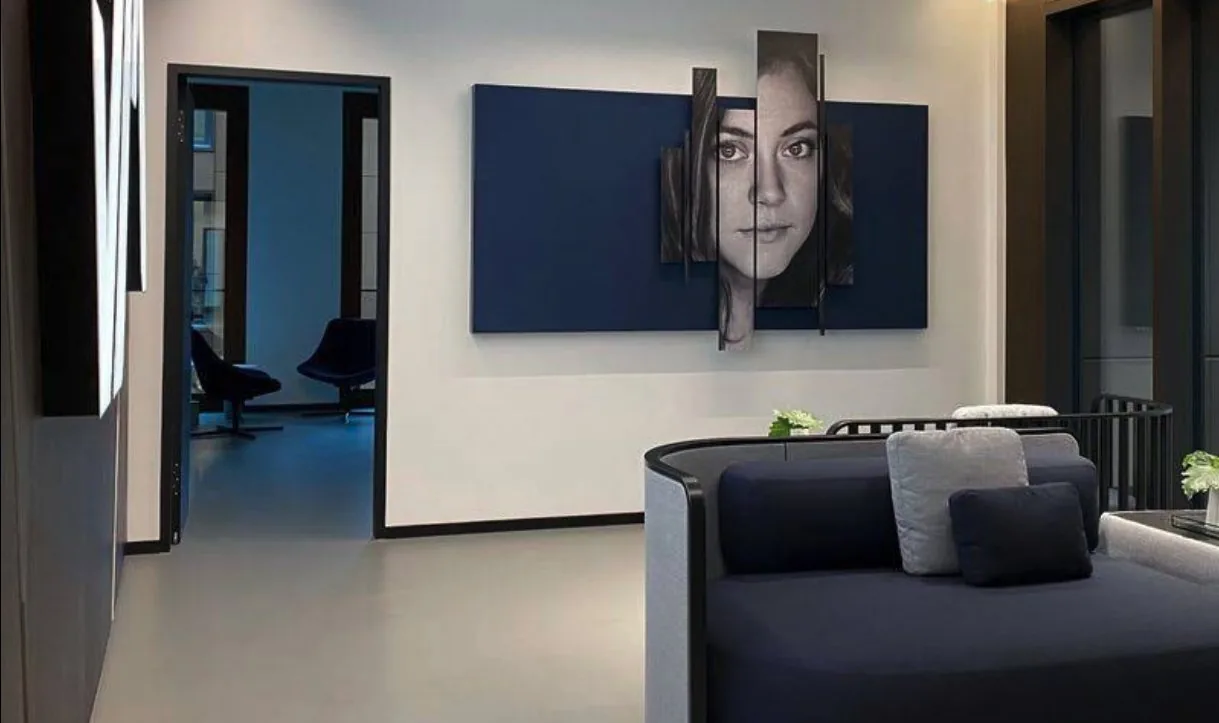 Opening 2027
Breite Straße 69, 40213 Düsseldorf (in the Neuer Stahlhof, corner of Graf-Adolf-Platz)
Until opening: preliminary talk in Frankfurt, Patient Care plans your travel.
Plan route Opening 2027
Lautenschlagerstraße 23, 70173 Stuttgart (2nd floor, step-free access)
Until opening: preliminary talk in Frankfurt, Patient Care plans your travel.
Plan routeMy name is Simone Richter. Before the treatment I had the problem, above all or increasingly, that I could not see well at all anymore at near and intermediate distance, which bothered and limited me extremely. For one thing at work, but of course also in private life, when you go hiking and want to read a map and can't see anything anymore and your glasses fog up or you lose them or break them, which I'm a great artist at. That bothered me a lot, limited me a lot. On top of that, wearing glasses felt to me like it triggered migraines, so the headaches bothered me a lot too, and that is why I decided on the surgery.
I got a lens exchange, so a new trifocal lens, which also comes with certain compromises, I have learned you always have to make a compromise, and and since the topic of freedom from glasses was very important to me, I decided on the trifocal lens.
So I actually came across Professor Shajari on the internet and had the first appointment with the intention of slowly getting used to the idea of progressive glasses. That would have been the next step. I had not dealt with the topic of surgery at all beforehand, because basically I am rather against having anything operated on without great need. And then in the conversation I felt, how should I put it, well taken care of. I did not feel pushed in any direction at all, just got information I did not have before. And with that I started to look into the topic. In between I also dropped it again, but then, through everyday activities, everything I just mentioned, hiking, swimming, cycling, where glasses really torment me, I thought, okay, I'll try this, and I also simply built up trust over time. That was all something that gave me a lot of reassurance, because Professor Shajari always took a lot of time. You know how it is with doctors, and I understand it too. There is a lot of pressure with queues of patients, and in the end you probably always have to answer the same questions. But I always had the feeling that there was enough calm to answer my questions.
The actual course of the surgery, from the pre-operative examinations to the appointment, goes very fast, it is very easy, much easier. I panicked a lot the evening before the first eye and thought, oh my God, how will this go? My head will be screwed down Hannibal Lecter style so that I don't flinch. And I worked myself into my horror scenarios. And it was all actually very relaxed. A very, very nice, good-humored team in the surgery center as well, which I think also helps a lot as a patient. And yes, it goes in no time, you don't feel anything, I think I can say that, and you go home again and everything is fine.
What was very astonishing for me was that I actually did not feel it at all, so during the surgery 0.0 pain. There was one point where Professor Shajari said, now comes a little pressure, and a little pressure came. To call that pain would be saying too much, but you really don't feel more than that. I must say, though, that between the two surgeries, from the first to the second eye, I felt even more unsure, even though that was always well handled and explained.
I think before the surgery it was also very important that, in my perception, it was explained realistically. It was explained well that it is a compromise, that in some ranges of vision it would get worse, but that in sum a visual ability that allows freedom from glasses will result. Now of course that is very subjective. So what does it mean, I will see worse in some ranges? That was a really big panic point for me and it stayed very strong in the time from the first eye to the second eye, because after the first eye I of course had the issue that I had one eye not operated on that doesn't see well and one operated eye that sees so-so after the surgery. Already much better. I also got a smile from people often, because on the second day I could already read with the operated eye, which would have been unthinkable before the surgery and which was also a really big pain point for me. But this panic still led me to this fear, what have you done, you had something operated on for the worse, because of course with glasses an operated and a non-operated eye create a really awkward situation. And now, today, day one after the surgery on the second eye, I am actually very happy at the moment.
I did good research beforehand. I also called my health insurer to ask how they view such operations. I deliberately chose Professor Shajari because he also has a good reputation. You hopefully only do this once in your life, and you don't have, you don't know, so I asked around my circle of acquaintances. What experiences have people had with these operations, which interestingly didn't give such positive feedback in my case. However, they were not patients of Professor Shajari, and some of it was also a while ago, I have to say. Medicine has surely progressed since then. That unsettled me and it was also one of the reasons why I first backed away from the operation again in my carousel of thoughts. But I believe in tapping all the information channels you have, asking all your questions, and really choosing a doctor who gives you a good gut feeling. Because I believe, with all these topics, you can check a lot of facts, and you should. But you also have to have a good feeling.
And I am not now, it was partly also an indication with the cataract in my case. And I am not that old, I could have gotten around this surgery with glasses for a while longer. I am 55, I could certainly have worked around such a surgery with glasses for a while. You have to really think it over carefully, I believe, then that also gives you a good feeling yourself. And if you then feel in good hands, which was the case here, then it can work well.
My name is Björn Kannegießer. For many years I wore glasses, which was especially a problem when reading, when you used your phone, and so on, checked e-mails. It no longer worked without glasses and at some point it reached a degree where you say, if there were a change, what would you do? And to get rid of the glasses, because they are always an obstacle somewhere, every day up, down, up, down, where are the glasses, forgotten again, and so on. And so we said, what alternatives are there, and then we looked into it and we have now taken the step, so to speak.
Yes, my wife is very savvy on the internet; whenever we have to buy, need or compare things, also price comparisons, my wife is always very good at that, she always has a good knack for it, and she took on the matter and came across this, so to speak, and then we tackled it here. Yes, of course you have a lot to do with social media, so also with computers, and it was always annoying, and what I also noticed was that I couldn't wear sunglasses anymore, because either you have sunglasses on and then you can't see anything, I couldn't read either at that moment, so I had to take them off, put the normal glasses on, and it was always up and down like that, sometimes you had two pairs of glasses somehow, the sunglasses you took along and the normal ones. I do have progressive glasses that also tint, but it wasn't the same as sunglasses, and at some point it was all too much for me, and this fiddling with contact lenses, in, out, lost, where is that thing, it was all way too much effort for me somehow and not an alternative for me, and to get rid of these glasses, we actually thought, let's take the step if it's feasible. So even in the first two days I still reached for my glasses by reflex, because I usually always had them on my head, as that was the easiest, and after two, three days it gets less, and now I can already read things again, I have that as of today, the other eye was still bandaged and so on. Now I first have to focus a bit, but I can read things again that I used to, because that's how it is, you know, so it's definitely a good thing, so now of course I first have to acclimate the left one a little, so to speak, but you can already notice it, it's definitely an improvement.
So absolutely, I felt absolutely comfortable here with the professor, the empathy is there, I felt well taken care of, also in the conversations, and of course during the procedures and so on, so I never felt uncomfortable in any way, and from that side I can recommend it, I would do it again, but I am annoyed that I did not do it earlier, I have to say quite honestly.
I am Margit Tappeiner, I am an architect and I am 60 years old.
So I have worn glasses since I was in my mid-20s, and I am farsighted, nearsighted, astigmatic and I also have a squint. So I was used to getting along with my glasses, which I got newly fitted every two years. But what I did notice was, when I criticized samples, these dull colors again and again and this yellow cast. I also missed the brilliance of my work. I mean, I always thought the colors would be more brilliant, the shapes sharper, the way I plan and build. And it was a creeping process, and that is why I did not think it was so important.
I hadn't expected it to reach me now, also because I'm apparently quite young for a cataract. And it is probably actually hereditary. My mother also had a cataract at a very early age.
My husband is a patient of his, my husband is a doctor too. And they hit it off right away as well. And yes, when I get a recommendation from a very good doctor, there is something to it.
Impressive equipment, everything brand new, everything as far as I can judge of the highest quality, and then also the explanation by Shajari himself on the big screens. That way it is simply shown to you visually what is going on in your eyes and not just explained.
At 60 you have so much behind you that you don't get anxious now. And Shajari took away every fear, I have to say. I knew it was a standard procedure, and that is how it was.
So yes, on the same day, I was operated on in the morning, and the most unusual thing was that it is done in two stages. First one eye, then the other. And in this case with a gap of one week. So one eye was operated on and seeing correctly and the other was still with a refractive error. And that was very odd, because I don't wear lenses, because of the squint no lenses. So I could not compensate with a lens on the not yet operated eye. So I had glasses where I took one lens out. So that was pretty spooky for a week.
But yes, I was allowed to take off the dressing already in the afternoon. And then put it on again at night for sleeping. That was great, that was fantastic, but of course everything was glaring. Sensitive to light, but it was wonderful. It was like a new view of things.
Yes of course, I have. Yes, the whole community has already turned up at his place.
My name is Eva Maria Hohmann. On July 16, I had my second eye surgery with Professor Shajari. I received the second lens implant. The first surgery was on July 9, and I am very, very happy with the results. I also found the surgery, which took place while I was awake, so without anesthesia or sedatives, still quite bearable, because I could take part by looking into the light. And Professor Shajari exchanged the lens in the process. After each surgery, I drove home and felt well.
I was simply told by my treating eye doctor that I have a very strong cataract in one eye, and in the other eye as well. And on top of that I am also strongly farsighted. Different on both sides. The right eye was more affected, the left somewhat less. And Professor Shajari operated on the right eye first.
Yes, when I looked through the dressing the next morning, I first noticed that I saw wonderfully bright light. And then there was a note on the kitchen table and I thought, I just read something there. That was no longer possible at all with this eye. So I really could not read anything without glasses.
But I kept having moments of tiredness where I felt exhausted and really just thought, I have to get up now. I just have to go somewhere else now and stop looking at the screen. And in the evening after work I also noticed it very strongly, the problem with the refractive error. So in the evening after work I was no longer able to sit down in front of the TV. It was simply too much for me. And that gradually became more intense over the last months.
Then, thank God, came the preventive check-up at my eye doctor. And then it also came out that the cataract there was already so advanced. And the really very kindly meant advice not to get new glasses but really to think about a lens exchange.
Through my treating eye doctor. The two apparently know each other. He recommended Professor Shajari to me, but also knew patients who had already been to him. And they were all very satisfied. And I also watched one or two YouTube videos by Professor Shajari. And that actually gave me trust as well. I think it is very important, when someone operates on my eyes, that I trust that person.
No, I had no pain. Every now and then I felt a more or less strong pressure. But then Professor Shajari also said, now it presses. Well okay, then it presses. It is bearable and I did not concentrate on it. I just breathed deeply. It does not last long either, this moment where it presses, it comes and it goes. Then it is already fine. So it is not like it presses for half an hour. It passes very quickly. So Professor Shajari, I noticed, also has a very skilled hand at the eye, he also put on this dressing that opens the eye completely. I had only seen that in a picture on YouTube and thought, oh man, but you don't feel it at all. It really can't be noticed. I mean, the eye is numbed through and through beforehand. So the eyelids, the eyeball, they are really insensitive then.
Yes of course, I would always recommend him to anyone who has questions about their eyes, who maybe also has little time, can't find an eye doctor who has an appointment now. With specialist physicians there are often problems getting appointments. I can really only recommend him.
I also found the initial examination, when I was here for the very first time, very detailed and very appealing. Everything was examined with optical devices, very thoroughly. And so Professor Shajari had all my values before the surgery. And I had the feeling, yes, they know what they are doing here. And there are examination devices here that regular eye doctors do not have. For example, the measurement of the eyeball, they do not do that. The other device, the scanner camera for the retina, the back of the eye, I knew that one. The other measuring devices for the eyes, where the glasses prescription is measured, where visual acuity is measured, those are familiar too. But this is really thorough, and I also found the resident physicians and the assistants who performed the examinations all very friendly.
I would simply say, be honest with yourself. If you have an eye problem, tackle it, don't run away from it. It only gets worse with time. You could also have an accident or experience something unpleasant that does not have to be, if your eyes are in the best condition. And eye treatment is, as I once said, not the greatest party, but it goes very fast. As I said, in a nice environment, Professor Shajari is so friendly, also during the surgery, you simply forget what is actually being done. That is a good thing too, and just go, do it and then it is fine.