 dr.vision
1980s
Laser eye surgery began with PRK. The technology behind it is still the same today.
Start here
What suits you?
Find out in 2 minutes which procedure suits your eyes.
Start the Suitability CheckOr by age:
< 45yearsGet rid of glasses & contact lenses 45–64yearsGet rid of reading glasses 65+yearsCataract & glasses-free★★★★★ 5.0 · 376 Google reviews · 20,000+ procedures
Decide well
What you should know beforehand.
Who operates?Prof. Dr. Mehdi ShajariFOCUS Top Doctor · operates on every patient personally What does it cost?Laser from €3,498 · Lenses from €6,886Prices for both eyes Is it safe?Safety & risks When will I be fit again?Work, sports, driving Would you rather read in peace first?Decision Guide Freedom from GlassesProcedures
Laser or lens?
Laser eye surgery
SMILE ProSmartSightFemto-LASIKTrans-PRKPRKPresbyond (laser away your reading glasses)All laser procedures at a glanceLaser procedures compared ›Lens surgery
ICLLens exchange (reading glasses)Cataract surgery with premium lensLens types: trifocal, EDOF, toricLens types compared ›Start here
Something wrong with your eyes?
A thorough eye check-up with us clarifies what is behind it.
Book an eye check-up★★★★★ 5.0 · 376 Google reviews
Laser eye surgery · PRK
The oldest laser eye surgery procedure. Without an incision.
Thin cornea or martial arts? Trans-PRK shapes the cornea directly at the surface, without an incision and without any instrument touching the eye. Guide price for both eyes: €3,498. Prof. Dr. Mehdi Shajari performs the laser treatment on every patient personally.
 12× FOCUSTop Doctor
A few minutes of laser. A few days of patience.
1980s
Laser eye surgery began with PRK. The technology behind it is still the same today.
0
No flap, no lenticule: the laser shapes the cornea directly at the surface.
3–5 Days
until the top layer has regrown. The eyes burn for the first 2–3 days.
−6 D
Nearsightedness up to about −6 D, astigmatism up to about 3 D.
3.498 €
Guide price for Trans-PRK for both eyes, our most affordable laser procedure.
376 reviews. Average 5.0.
376 Google reviews give dr.vision an average of 5.0 out of 5 stars. dr.vision does not check whether Google reviews come from treated patients.
“Absolute recommendation for laser eye surgery in Frankfurt! After thorough research I chose dr.vision in Frankfurt and it was the best decision.”
“A big thank you also to the whole team of Dr. Vision. Everyone was incredibly friendly, attentive and professional.”
“Here the whole procedure of the surgery is explained by him himself without a single open question. Already today, the first day after the surgery, I see perfectly and am super happy about it!”
“I am completely satisfied and thank the whole team; it was not only professional but also created a very good and friendly atmosphere.”
Four patients. In their own words.
It really was not that bad.
At times I could no longer recognize my friends!
Less than 24h after surgery, better than ever.
There are always situations where glasses are limiting.
PRK in five answers.
For everyone who has three minutes. In detail on the treatment at our practice: Trans-PRK.
Photorefractive keratectomy: the thin top layer of the cornea (epithelium) is removed, then an excimer laser shapes the cornea underneath. No incision, no flap. The top layer regrows in 3–5 days.
To the chapterSame principle, different first step: in classic PRK the epithelium is loosened with alcohol and pushed aside, in Trans-PRK the laser removes it itself. At dr.vision, Trans-PRK is the standard.
The differenceFor nearsightedness up to about −6 D and astigmatism up to about 3 D, especially with a thin cornea, for combat and contact sports, for police and the Bundeswehr, and as an enhancement after earlier laser treatment.
SuitabilityNot during the treatment. In the first 2–3 days afterward the eyes burn and water, as with a scrape. Painkillers, chilled drops and a bandage lens help. Office usually after 5–7 days.
HealingAt dr.vision, Trans-PRK costs €3,498 for both eyes as a guide price, our most affordable laser procedure, including pre-operative examination and aftercare. Patients with statutory health insurance pay themselves.
CostsLasering on the surface. No flap, no incision.
PRK stands for photorefractive keratectomy: “changing the refractive power of the cornea with light”. The excimer laser removes around 12–15 micrometers of tissue per diopter directly under the top layer. Because nothing is lifted, the cornea stays as stable as with no other laser procedure.
The cornea has a skin like a Band-Aid. In PRK this wafer-thin layer is briefly removed, and the laser reshapes the tissue beneath. Then the layer regrows, smooth and without a scar.
50 µm
The outermost cell layer of the cornea is about as thick as half a hair. In classic PRK it is loosened with diluted alcohol and pushed aside, in Trans-PRK it is removed by the laser.
< 1 min
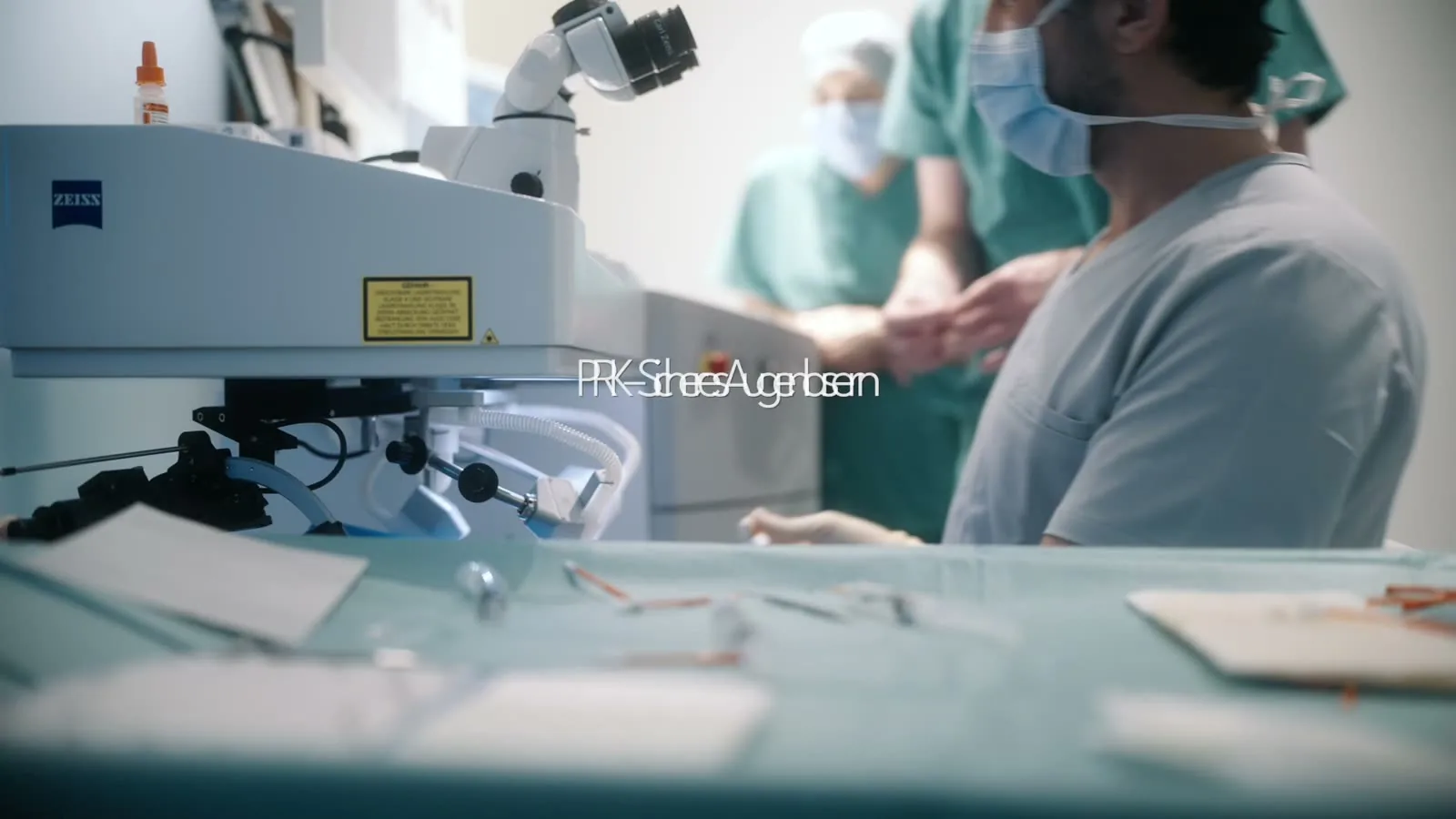
Ultraviolet light of 193 nanometers vaporizes tissue in thousandths of a millimeter without heating the surroundings. An eye tracker follows every eye movement. At our practice, a ZEISS excimer laser (MEL 90).
3–5 Days
A soft bandage lens protects the eye while the top layer regrows from the edge. After that the surface is closed, and the cornea has no incision that could ever weaken it.
PRK was the first laser procedure on the cornea, first on humans in the late 1980s, approved in the US in 1995. LASIK came a few years later because it makes you pain-free faster; SMILE followed from 2011. PRK is not outdated: laser, eye tracker and treatment profiles are the same today as with LASIK, and because no flap is created, it is often the safest choice for thin corneas and contact-sport athletes.
An average cornea is about 540 µm thick in the center. PRK removes the epithelium (which regrows) and, depending on diopters and treatment zone, a few dozen micrometers of tissue beneath it. Because no flap of about 100 µm is cut, more load-bearing tissue remains than with LASIK. That is why it is often still possible with a thin cornea. What matters is the shape: with signs of keratoconus, we advise against PRK as well.
Four names. One principle.
All four procedures laser the same spot, the tissue directly under the epithelium. They differ only in how the epithelium is removed beforehand: with alcohol, with a planer or with the laser itself. When you read “PRK experiences” online, usually all four are meant. Tap a variant.
Diluted alcohol is applied to the cornea for a few seconds, then the loosened epithelium is pushed aside with a fine instrument. The excimer laser shapes the cornea, and a bandage lens protects it while it heals. The longest-proven surface procedure.
As with PRK, the epithelium is loosened with alcohol, but pushed aside as a wafer-thin skin and put back after the lasering. The idea: a natural bandage. In practice the put-back epithelium usually dies off and is replaced; pain and healing are similar to PRK.
A mechanical device (epikeratome) lifts the epithelium off as a layer, without alcohol. Then the lasering is done as with PRK. Despite the name, Epi-LASIK has nothing in common with LASIK: no flap is created in the corneal tissue.
The excimer laser first removes the epithelium and shapes the cornea beneath it in the same pass. No alcohol, no instrument, no suction ring: “no-touch”. The wound edge is smooth and the wound area exactly as large as necessary, which speeds up healing somewhat in studies.
Everything about Trans-PRKSame result. Different first step.
The difference lies in removing the top layer: alcohol and instrument in PRK, laser in Trans-PRK. After three months, patients see equally well after classic PRK and Trans-PRK.
| Criterion | Classic PRKAlcohol + instrument | Trans-PRKNo-touch, our standard |
|---|---|---|
| Removing the epithelium | diluted alcohol, then pushed aside | removed by the laser |
| Contact with the eye | yes, instrument and alcohol funnel | no |
| Size of the wound | usually somewhat larger than necessary | exactly as large as the treatment zone |
| Wound edge | somewhat irregular | smooth |
| Pain afterward | 2–3 days; slightly stronger on the first day after Trans-PRK, the same from day three (literature) | 2–3 days; slightly stronger on the first day after Trans-PRK, the same from day three (literature) |
| Epithelium closed | usually after 3–5 days, somewhat slower | usually after 3–5 days |
| Office | usually after 5–7 days | usually after 5–7 days |
| Advantage | Epithelium is removed completely, regardless of its thickness | no contact, no alcohol, one working step |
| Use at dr.vision | individual cases (e.g. irregular epithelium) | standard for surface treatments |
| Price both eyes | €3,498 | €3,498 |
Swipe the table sideways to see both procedures.
Study: comparison of PRK, Trans-PRK and LASEK, Seoul (Lee HK et al., Am J Ophthalmol 2005).
For almost everyone who needs a surface treatment: thin cornea, martial arts, service, low to moderate nearsightedness. No contact with the eye, no alcohol.
A small residual error after earlier laser treatment can be corrected on the surface, without reopening the old flap. Which variant is used is decided by measuring the epithelial thickness.
When stability matters more than speed.
PRK is suitable for nearsightedness up to about −6 D and astigmatism up to about 3 D, from age 18 and with values that have been stable for 12 months. It is the first choice in four situations in which a flap or an incision would be a disadvantage. Without one of them, you are usually back to normal faster with SMILE Pro/SmartSight.
Without a flap and without a lenticule, the most load-bearing tissue remains. Many who were told “You can't have laser treatment” can have it with a surface treatment.
A blow to the eye can displace a LASIK flap even years later. Without a flap, there is nothing that can shift.
Surface procedures are recognized by many service authorities, usually with a waiting period and an expert report. Clarify the rules in writing beforehand. Details: Trans-PRK and service, Career and sports.
After earlier LASIK, SMILE or lens surgery, a small residual error sometimes remains. PRK corrects it on the surface.
Above −6 to −8 D (haze risk rises; then SMILE Pro/SmartSight or ICL, an additional lens in front of your own lens), keratoconus, unstable values, pregnancy and breastfeeding. From about 45, more likely Presbyond or lens exchange.
In that case SMILE Pro/SmartSight is often the more convenient choice: same result, back at the office after 1–2 instead of 5–7 days. PRK remains the more affordable option if you can plan a week off.
Four questions. An honest orientation.
Choose your values. The guidance shows whether a surface treatment fits or whether SMILE Pro/SmartSight, Femto-LASIK or ICL would be better. Whether your cornea is suitable is shown only by the measurement.
1 · Your prescription (stronger eye)
2 · Astigmatism (cylinder)
3 · Your age
4 · Does any of this apply?
Your orientation
Good prerequisites
…
Schedule the pre-operative examination Compare proceduresOrientation, not a diagnosis, and it does not replace an examination. The decision is made by Prof. Dr. Mehdi Shajari after measuring corneal thickness, corneal shape, pupil and tear film. If your glasses prescription is still changing (more than 0.5 D in 12 months), we wait with any laser procedure.
Same goal. Different path.
After three months, most patients see equally well with all three laser procedures. PRK needs 5–7 days until work instead of 1–2, but leaves no incision and, as Trans-PRK, costs the least at €3,498.
| Criterion | PRK / Trans-PRKSurface | SMILE ProLenticule | Femto-LASIKFlap | ICLlens |
|---|---|---|---|---|
| Incision | none | 2–4 mm access | flap all around | small incision at the edge |
| Nearsightedness | up to about −6 D | up to −8 D | up to about −8 D | from −6 D |
| Thin cornea | often possible | limited | less favorable | independent |
| Pain afterward | 2–3 days | a few hours | a few hours | hardly |
| Office | 5–7 days | 1–2 days | 1–2 days | 1–2 days |
| Corneal stability | highest | high | somewhat lower | unchanged |
| Contact sports | very good | good | limited | after clearance |
| Price both eyes | €3,498 | €5,198 | €4,298 | from €6,886 |
Swipe the table sideways to see all procedures.
All criteria in detail: Laser procedures compared · Overview: Laser eye surgery.

Surface treatment at dr.vision
At our practice, PRK usually means Trans-PRK.
Everything about the process, healing day by day, police and armed forces, and financing is on the Trans-PRK page. Jana from our Patient Care team answers questions, by phone reachable 24 hours, WhatsApp Mon–Fri 8:00–19:00, Sat 9:00–15:00.
15 minutes in the operating room. One week of patience.
The procedure takes about 15 minutes for both eyes and is painless. Afterward the eyes burn for 2–3 days, until the epithelium has closed after 3–5 days. You usually go back to the office after 5–7 days, you will see fully sharp after a few weeks, and definitively after up to three months.
Diopters with and without dilated pupil, corneal thickness, tomography, tear film. Consent discussion with Prof. Dr. Mehdi Shajari at least 24 hours before the procedure.
Eyelid holder, look at a light. The epithelium is removed, the laser works for under a minute per eye, then the bandage lens goes in. Both eyes on the same day.
Follow-up check on day 1, bandage lens out after 3–5 days, follow-up checks after one and after three months. Cortisone drops for a few weeks, sunglasses against UV.
| Time | What you feel and see | What helps |
|---|---|---|
| Day 0 | After the numbing wears off: burning, watering, light sensitivity; blurry vision | Painkillers, chilled drops, darkened room, sleep |
| Days 1–3 | The most uncomfortable phase: foreign-body sensation, fluctuating vision | Bandage lens stays in, follow-up check on day 1, rest your eyes |
| Days 3–5 | Epithelium closed, pain clearly less | Bandage lens is removed at the practice |
| Week 1 | Everyday life and office usually possible again, vision still soft | Screen breaks, artificial tears |
| Weeks 2–4 | Vision gets clearer, driving usually allowed | Cortisone drops as planned, UV protection |
| Month 3 | Final result | Final check |
In detail, with the healing course day by day and the table “What can I do when?”: Healing after Trans-PRK.
The corneal surface is densely supplied with nerve endings. As long as the epithelium is missing, they are exposed, similar to a scrape. With SMILE and LASIK the surface stays closed apart from an incision, so there it is only a few hours. The bandage lens, painkillers, chilled artificial tears and rest help against the pain; after 2–3 days it eases noticeably.
We usually treat both eyes on the same day, so that you have only one recovery phase. If you cannot do without both eyes in the first week, for example because of childcare, you can also have the eyes treated a few days apart. That lengthens the total time off.
The typical risk of the surface.
Haze is a milky scar clouding under the epithelium that can appear weeks to months after PRK. It is rare, and becomes more likely the higher the correction is. That is why we treat on the surface only up to about −6 D, protect against UV light and give cortisone drops. About 2 in 100 need an enhancement; an infection is very rare, under 1 in 1,000.
During wound healing, cells under the epithelium form new, slightly cloudy tissue. Usually this is visible only under the microscope; rarely it veils vision or shifts the diopters.
rare
More common with higher corrections, strong UV exposure and delayed healing.
Surface treatment only up to about −6 D, cortisone drops as planned, UV protection, mitomycin C during the procedure when the risk is higher. Mild haze usually recedes on its own.
Burning and light sensitivity until the epithelium has closed. Rarely it grows more slowly, for example with dry eyes.
almost all
feel discomfort for 2–3 days; delayed healing is rare.
Bandage lens, painkillers, chilled drops, close follow-up until the epithelium has closed.
Burning, a sandy feeling, fluctuating sharpness in the first weeks, while the surface nerves regrow.
temporarily common
usually less often persistent than after LASIK (literature).
Measure and treat the tear film beforehand, then preservative-free artificial tears.
Rings and rays around lights at night, while the surface heals, or when the pupil is larger than the treated zone.
common in the first weeks
clearly less often afterward.
Measure the pupil in the dark, choose a suitable treatment zone, treat dry eye.
If a bothersome residual error remains, we correct it again on the surface after three months at the earliest.
about 2 in 100
Stable values as a prerequisite, precise measurement. More: Enhancement.
As long as the epithelium is missing, germs can get in. Signs: increasing instead of decreasing pain, strong redness, worse vision.
under 1 in 1,000
Antibiotic drops, sterile bandage lens, follow-up check on day 1, emergency number around the clock.
Frequencies from the literature and our consent forms. All risks: Risks of laser eye surgery.
Mitomycin C (MMC) slows the cells that form scar tissue after PRK. During the procedure it is applied to the lasered area in a very low concentration (usually 0.02%) for a short time and then rinsed off. Because the agent can also have side effects, we use it only when the haze risk is increased, for example with higher corrections or a follow-up treatment. An optimal dose is not conclusively established in the literature (literature); we discuss this in the consent discussion.
Ultraviolet light stimulates the cells that form scar tissue. In the first months after PRK, protect your eyes outdoors with sunglasses with a UV filter, especially in snow, near water and in the mountains. It is best not to plan a trip to sunny regions directly after the procedure.
Blindness from PRK is practically not described in the specialist literature. The laser works only on the corneal surface; the lens, retina and optic nerve are not touched. The most serious complication, an infection in the first days, is very rare and well treatable if you call immediately when pain increases.
Because they are your eyes.
One surgeon for both eyes, over 20,000 procedures, Trans-PRK, classic PRK and the alternatives under one roof, 5.0 stars from 376 reviews. We recommend PRK when it is the safest choice for your cornea, not because it is cheaper.
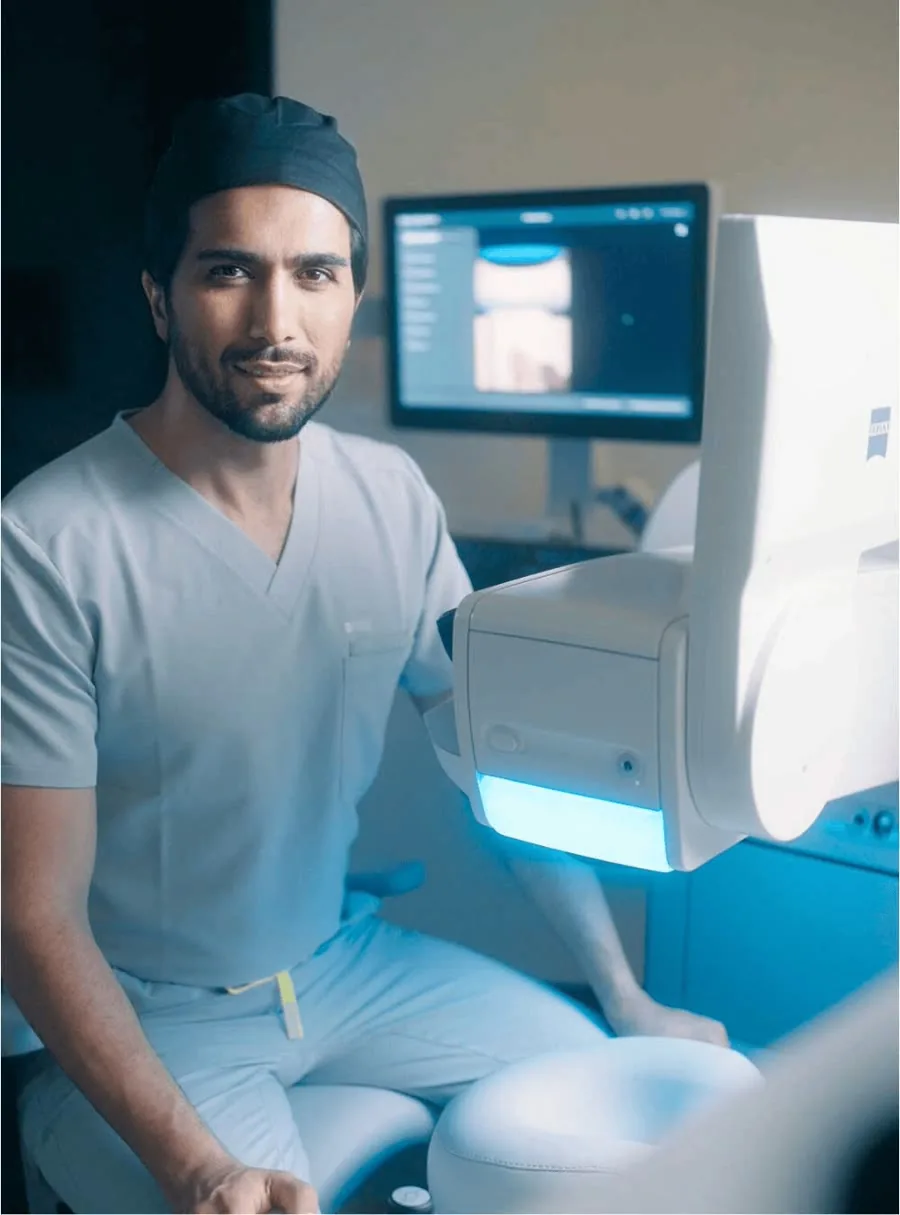
Every procedure: Prof. Dr. Mehdi Shajari. Personally.
Prof. Dr. Mehdi Shajari operates on every patient himself. He accompanies you from the first conversation to the final check. He is a specialist in ophthalmology with a professorship and habilitation at the University of Frankfurt and has 80+ publications on corneal and lens surgery.
“I recommend surface treatment above all for a thin cornea and for combat or contact sports. Without a flap, there is nothing that can shift from a blow to the eye.”
Prof. Dr. Mehdi Shajari
Prof. Dr. Mehdi Shajari has published numerous papers on freedom from glasses, teaches, and has trained several colleagues in this field.
Our most affordable laser procedure.
At dr.vision, Trans-PRK costs €3,498 for both eyes as a guide price, including pre-operative examination, procedure by Prof. Dr. Mehdi Shajari and aftercare; that is €1,700 less than SMILE Pro. You will receive your cost estimate under the German fee schedule for physicians (GOÄ) in writing after the pre-operative examination. Patients with statutory health insurance are self-paying patients.
€3,498Guide price · Trans-PRK, both eyes · billed according to the German fee schedule for physicians (GOÄ)
Many private health insurance (PKV) plans reimburse laser eye surgery in full or in part, depending on the plan (BGH, March 29, 2017, IV ZR 533/15). More: Private health insurance.
Beihilfe (allowance for German civil servants) does not usually reimburse laser eye surgery. More: Beihilfe.
dr.vision is a private practice; statutory health insurance does not pay for laser eye surgery. You can claim the costs as extraordinary expenses in your tax return. Whether and how much the tax office accepts depends, among other things, on your reasonable burden. More: Tax.
Go deeper.
This page explains PRK and its variants. The treatment at dr.vision in detail and the alternatives:
The process in pictures, healing day by day, police and Bundeswehr, financing. €3,498 for both eyes.
To Trans-PRK Faster recoveryNo flap, back at the office after 1–2 days. €5,198 for both eyes.
To SMILE Pro OverviewAll laser procedures, comparison and Suitability Check.
To the overview GuidesWhat is possible when LASIK is not.
To the guides Who it is forPolice, Bundeswehr, pilot, martial arts: what applies.
To the page High valuesWhen lasers are not suitable. From €6,886 for both eyes.
To ICLStill have questions?
Answers from Prof. Dr. Mehdi Shajari to the questions that come up most often in consultation hours.
PRK stands for photorefractive keratectomy. The top layer of the cornea (epithelium) is removed, then an excimer laser shapes the cornea at the surface. No incision and no corneal flap is created; the epithelium regrows in 3–5 days.
Only the first step. In classic PRK the epithelium is loosened with diluted alcohol and pushed aside with an instrument; in Trans-PRK the laser removes it itself, without contact. Result and pain are comparable; healing after Trans-PRK is somewhat faster in studies. At dr.vision, Trans-PRK is the standard.
No. PRK is the oldest laser procedure, but lasers and treatment profiles today are the same as with LASIK. Because no flap is created, the cornea stays the most stable. For thin corneas, martial artists and as an enhancement, it is often the safest choice.
Almost. In LASEK the epithelium loosened with alcohol is pushed aside and put back after the lasering, in PRK it is removed. Pain and healing are similar, because the put-back epithelium is usually replaced anyway.
With us up to about −6 diopters of nearsightedness and astigmatism up to about 3 diopters. Above that, the risk of scar clouding (haze) rises; then we recommend SMILE Pro/SmartSight or the implantable contact lens (ICL), and above −8 diopters the ICL.
Often yes. Because no flap and no lenticule are created, PRK leaves more load-bearing tissue than LASIK or SMILE. A prerequisite is a regularly shaped cornea without signs of keratoconus; the tomography shows this.
Not during the treatment; the cornea is numbed with drops. In the first 2–3 days afterward the eyes burn and water, as with a scrape. A bandage lens, painkillers and chilled drops help; once the epithelium has closed, the pain eases clearly.
The epithelium is closed after 3–5 days, then the bandage lens is removed. Office and screen usually after 5–7 days, driving usually after about a week once cleared. You will see fully sharp after a few weeks; the final result shows after up to three months.
Haze is a milky scar clouding under the epithelium that can develop weeks to months after PRK. It is rare and more common with higher corrections. Prevention: treatment only up to about −6 D, cortisone drops, UV protection and, with increased risk, mitomycin C during the procedure.
At dr.vision, Trans-PRK costs €3,498 for both eyes as a guide price, including pre-operative examination, procedure and aftercare. Statutory health insurance does not pay, many private health insurers reimburse in full or in part, Beihilfe (allowance for German civil servants) usually does not.
Medically reviewed by Prof. Dr. Mehdi Shajari · As of October 2026
Not ready yet? Everything important to read again and to pass on.
The Decision Guide summarizes what you need for your decision. Free of charge, in your inbox in 2 minutes, no newsletter.
Arrives by e-mail in about 60 seconds. No newsletter, just the guide and, if you wish, a follow-up from Patient Care. Privacy policy
How would you like to continue?
You arrange the consultation by phone or online. The first appointment is a detailed pre-operative examination with Prof. Dr. Mehdi Shajari: diopters, corneal thickness, tomography, pupil, tear film and a conversation about whether a surface treatment (Trans-PRK or PRK) or another procedure suits your eyes. You go home with a written recommendation and a cost estimate.
In Frankfurt, Junghofstraße 16 · all measurements included
Our locations.
 Opening hours
Junghofstraße 16, 60311 Frankfurt am Main
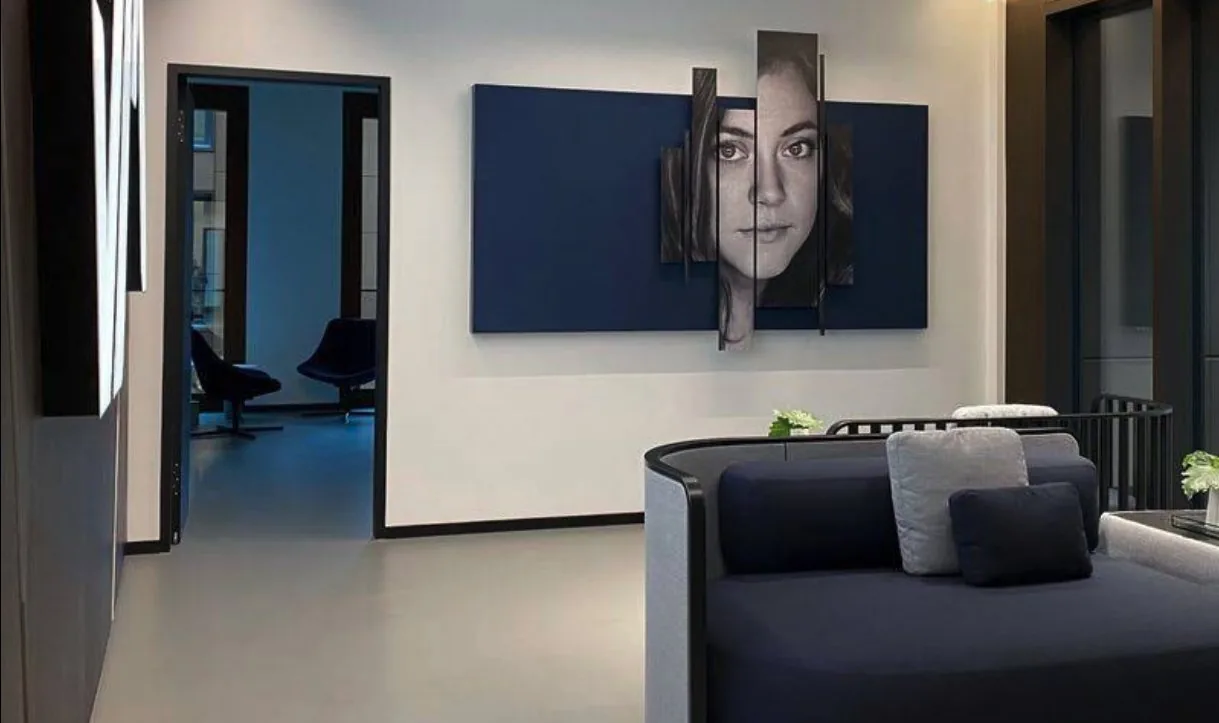 Opening 2027
Breite Straße 69, 40213 Düsseldorf (in the Neuer Stahlhof, corner of Graf-Adolf-Platz)
Until opening: preliminary talk in Frankfurt, Patient Care plans your travel.
Plan route Opening 2027
Lautenschlagerstraße 23, 70173 Stuttgart (2nd floor, step-free access)
Until opening: preliminary talk in Frankfurt, Patient Care plans your travel.
Plan routeHi, I'm Sebastian, 37, I live near Frankfurt, and I have somehow always been annoyed that I have to change glasses so often. I have kids now, who knock them off my head or smear them. And for me that was mainly a hassle problem. Apart from the fact that I naturally have weak eyesight, but I actually always got along quite well with glasses. And then I tried contact lenses and noticed that my eyes are dry and it all didn't fit together so well. And then I saw that this offer exists here and first informed myself. So, what does one actually do? There are so many treatments you could have. I went a bit too deep down the rabbit hole and watched videos and saw what these surgeries look like, and at first I kept my distance. It took half a year until I had gathered my courage and thought, well, it can't be that bad. So many thousands of people do it. And then I simply looked more closely at which treatment suits me. Before the doctor had even advised me, I don't know if I am the perfect patient if I already come with an idea, but I came here with the goal of having a PRK treatment. So basically the treatment that many patients are a bit afraid of. Rightly so, you always read in experience reports that it probably hurts quite a bit and that it is the most unpleasant of all the variants, with long healing times and long aftercare times.
So I have a refractive error, diagnosed since fifth grade or so, but not particularly bad. Somewhere between one and two diopters, it got a little worse over time, then I was at one and a half or 1.75, and from about eighth grade, ninth grade or so, it stayed stable. So it simply didn't change at all anymore. And it really only bothered me in that the glasses themselves are of course an obstacle. But that is bearable, it's not really that bad. It became more unpleasant when I started, for example, sports where glasses get in the way.
Climbing, bouldering and things like that, you don't necessarily want to start with glasses on, and that was annoying. Then I started with contact lenses, always had dry eyes, always had to rub my eye, push them around, and I didn't like that at all. Then of course I looked at what solutions there are, how I can get away from this somehow. I can say that my fear beforehand turned out not to be entirely justified, because the whole thing was basically not that bad for me. You have your eyes lasered, and of course that is an uneasy feeling.
And you also go home with swollen-shut eyes, maybe. Everything is not so great, it burns a little. But compared with the stories I had heard, what really happened to me, I have to say, it was really not that bad. You can take painkillers, and I should say, the first day it burns a little, but by far not as badly as is often said, in my case. And on the second day I hardly noticed it anymore, and on the third it was okay.
In terms of pain, that is. Of course you can't see anything right away. You may have to wait a little until your eyes can open again, the swelling has gone down and so on. But from then on it is actually a simple, straightforward healing process. It gets better every day, the vision gets better.
And I think after one week, that was it, I could already make out everything again reasonably well. And now, after a month, I am glad that I did it. I have no complaints at all. When I walk through Frankfurt, I can see the tops of the skyscrapers and see everything sharply again, without glasses, without contact lenses, without discomfort. It is wonderful.
The thing is, I have two children, and my two boys are not necessarily careful when it comes to touching my eyes. Now and then a hand lands in my eye, and perhaps not all that gently. And when I think about it after gathering my information, that something in the eye might actually not be firmly healed yet. Because with LASIK or other treatments, a disc or a piece of a disc is cut, so to speak, folded back and then put back.
This flap, exactly. It only heals at the outer edge. And when I imagine someone hitting it with force, I don't feel comfortable. Of course, I also know, you hear from doctors too, that it is not necessarily the force you need to lift this flap again.
But nevertheless I simply don't feel comfortable with it and couldn't warm to it at all. And PRK is actually a method that, according to my research, really many people have had done, and which is routinely used in the armed forces or other organizations, where force on the eye is perhaps more likely to occur. But if they do it, how bad can it really be for me? And this putting things into perspective is what in the end made me say, okay, this is my variant, this is how I want to do it.
And it worked well. I think that is true for everyone who starts out with this bad gut feeling. You try to optimize, you know, what can I do so that the whole thing goes well. And when you look around, of course you look for someone who treats the eyes and has a certain reputation.
A doctor, professor, doctor, someone who works at the university hospital, is of course exactly right. For me it was also close to work, so there were simply geographical reasons to come here as well. But it all fit together well. The information material was good, I could look closely at what the prices are, what the conditions are, and I could make an appointment where I could also speak directly with the doctor.
That is also very important to me, not to speak with just anyone but with the doctor, and also to know that the person I speak with at the start is the one who will treat me. Basically I would say it was a good decision, I would do it again, and it is certainly not as bad as is often said. Very many people have the surgery, few people have problems with it, and we all know the internet, often only those who have problems speak up. Don't trust it too much, get in contact, find out how I can do this, which doctor can support me.
In this case it was very easy, the first conversation was directly with the treating doctor, and then you see whether you feel up to it or not. Definitely, I had very positive experiences, I am satisfied with the result. No complaints to this day, of course.
My name is Laura. I had my eyes lasered in April by Dr. Shajari, because I saw very badly with both eyes and it limited me a lot in everyday life. Especially driving was not possible at all without glasses, and I can’t tolerate contact lenses. I find that unpleasant, and handling them just didn’t fit into my everyday life. I also found glasses very unpleasant even after wearing them for a long time, and above all you depend on them so much. If I forgot my glasses, I couldn’t work, I couldn’t see at university, I couldn’t take part in everyday life. And what was really one of the worst things, too, in private situations: I was outside, I didn’t recognize friends, I didn’t say hello to them, I didn’t recognize colleagues, and sometimes I even thought, that’s my father, that’s my mother, and then I said hello to people, and it was totally limiting. I really didn’t recognize people, I couldn’t really share in everyday life.
I was generally a patient on verifyMED, and I also learned through friends that he used to be a senior physician at a large hospital and enjoyed a very good reputation there. I heard that through friends, and I liked him a lot. The reviews are very positive. And when I had the first consultation appointment, because I actually also had consultation appointments elsewhere, it was immediately clear to me: I'm getting my laser treatment here. I already knew that with the eye, the doctor has to be the right fit, that's very important, especially with the eye, because everything is at stake there, I think.
On that day I had minimal pain, but it is really manageable, more of an unpleasant feeling. You can also take a painkiller, and then it was okay. You have to get used to it first, the eyes are very sensitive. But the next day it was really as if there had never been a surgery. So you can see right away, it is not unpleasant. You just have to keep taking the drops. There is a plan for that, which Dr. Shajari writes out. And in hindsight it wasn’t a big procedure.
I was in a bar here with friends, and it was really a different feeling of life. I walked in, finally saw people, noticed people. I didn’t feel uneasy, because without glasses I used to be like, do I know that person or not. It was simply a completely new feeling of life.
I tell everyone, I have also already recommended it to friends who had it done, who are very satisfied, I would do it again any time. For me, at the beginning, I was unsure, because I am still very young. I am only 24, because many people say, wait with it. Because the eyes will, even Dr. Shajari can’t stop that, still get a little worse. For me it has now even gone to much better, on purpose. If they get worse, I will still see 100 percent. I now see 160 percent, definitely pretty crazy.
And I would just urge people to do it as early as possible. Don’t think about it for long, just do it. Because I actually even regret that I didn’t do it a few years ago.
I'm Duilio, I'm 22 years old. I was nearsighted before, with a prescription of minus 4.75. I actually looked into laser eye surgery a few years ago. But this practice didn't exist yet back then, and I informed myself a bit about it, and now I've finally come to the conclusion to have my eyes lasered.
So there was a free initial consultation here. I came here, first took a look at the practice, and I found the technology to be state of the art, and I also found Professor Shajari to be a very empathetic and very likable doctor, also very young, and so I then decided to have my eyes lasered here.
So the process was actually quite simple. You first came into a small room, where the eyes were cleaned a little, it burned briefly and then they were numbed and that was it. They were numbed with eye drops and then it went straight to the operating room and right there I was laid on the bed of the laser, the Carl ZEISS VisuMax 800, which is the newest laser, and then he actually started operating right away. I think I was only in the operating room for 15 to 20 minutes in total, while the laser itself took about ten seconds per eye.
Right, so after the surgery I got up first and couldn't see very sharply yet. I saw it as if it were milky cloudy. So my vision was milky cloudy, as if you were looking through a plastic cup when you hold it in front of your eyes. But I could already see better, or at least I had the feeling that I could already see almost better than I did before without glasses.
When I came for the follow-up check the day after, the optician took off the protective glasses and then I could really see, I saw him clearly, I saw the devices clearly, we did the tests, he said yes, you are at 100 percent in one eye, 125 percent in the other, exactly, so it was a great feeling, I then took out my sunglasses right away, because the sun was shining that day, and I went for a little walk through downtown Frankfurt. It was very nice, as I said, to see everything clearly without glasses not even 24 hours after the surgery, I think it was about half a day, 13, 14 hours after the surgery, yes, so it was really great.
My name is Markus Mielert. Before the surgery I was nearsighted and had presbyopia in its early stage, and that was corrected with LASIK.
In everyday life, glasses are definitely a limitation again and again, especially in bad weather, rain for example, but then also in summer with sunglasses, with non-prescription ones at the beach and so on. So there are always situations where glasses are limiting. And that always bothered me, besides the look, also that glasses are maybe not always 100% pretty. And what also came on top, a point I hadn’t thought of at all beforehand, was this presbyopia. I only found that out when I was here with Professor Shajari. He told me about it, and only then did I notice that I was affected at all. What I noticed in everyday life, for example: I looked at a phone list at work and wanted to look up a number and could hardly make it out. And I hadn’t been aware of that at all before, but this process apparently went very fast and then kept getting worse.
Yes, of course, in Frankfurt there are naturally many options for getting laser treatment. Of course, the first impression online is decisive. Both the look of the professor, that he made a very competent impression, and the reviews. The online reviews are the opener for the first contact. I actually only went to him, because the first conversation with him was also immediately great, he gave me a perfect impression, in the sense that he is 110 percent on top of his field. I am in very good hands, and so I didn't look any further at all.
First I sent an e-mail, because I don’t have private health insurance. I first wanted to know how it works with the pre-operative examination, what costs would come my way. Then I made this appointment, the first contact. Then I had a talk with him and first an eye test. At the second appointment the detailed tests were done, to determine that I am suitable for it, which procedure I am suitable for. That actually went very quickly. That was this second appointment, with all the tests. One thing he recommended to me, which was also very good: he recommended that I wear contact lenses with different strengths that simulate this post-surgery vision, because with this presbyopia combined with nearsightedness it has a different effect, since you have to treat the eyes differently with the laser. And that was also great, because through these contact lenses you could already see that the vision is perhaps a bit different from what you would have expected. That is very good, but it takes getting used to, and it was good to know what is coming.
Yes, it was very busy. It was always very calm in his office. There were many helping hands. Yes, no, but great, everyone was super focused and concentrated, calm, it was a good atmosphere, no stress, no hectic, nothing that gave you the feeling that something was not okay. I felt very welcome from the start, also with the preparation and so on, it was wonderful. During the surgery too, of course, it is a delicate thing on the eye. But he kept telling me, very reassuringly, which step of the process we were at, that everything was going well, and gave the impression that there were no problems. That was actually wonderful, and as I said, it actually went quite fast, faster than you would think.
I can of course recommend him without reservation, really flawless from A to Z. Laser eye surgery itself was always a topic that I could rule out for myself, because I didn't want to take the risk that something might go wrong. But probably the technology has now simply advanced so far that it has been perfected compared to how it was before. And I know now – I was lasered yesterday, and today the vision is wonderful. Let's see how it is in the long term, but as of now I would say it was the perfect decision. And I believe it makes life much better and of higher quality, without glasses, without restrictions. And I am looking forward to that.