 dr.vision
Choose SMILE Pro if …
- you are nearsighted (up to −8 D) and your astigmatism (cylinder) is at most 5 D
- your eyes tend to be dry or you tolerate contact lenses poorly
- you do martial arts, ball sports or contact sports
- you work a lot at screens
Start here
What suits you?
Find out in 2 minutes which procedure suits your eyes.
Start the Suitability CheckOr by age:
< 45yearsGet rid of glasses & contact lenses 45–64yearsGet rid of reading glasses 65+yearsCataract & glasses-free★★★★★ 5.0 · 376 Google reviews · 20,000+ procedures
Decide well
What you should know beforehand.
Who operates?Prof. Dr. Mehdi ShajariFOCUS Top Doctor · operates on every patient personally What does it cost?Laser from €3,498 · Lenses from €6,886Prices for both eyes Is it safe?Safety & risks When will I be fit again?Work, sports, driving Would you rather read in peace first?Decision Guide Freedom from GlassesProcedures
Laser or lens?
Laser eye surgery
SMILE ProSmartSightFemto-LASIKTrans-PRKPRKPresbyond (laser away your reading glasses)All laser procedures at a glanceLaser procedures compared ›Lens surgery
ICLLens exchange (reading glasses)Cataract surgery with premium lensLens types: trifocal, EDOF, toricLens types compared ›Start here
Something wrong with your eyes?
A thorough eye check-up with us clarifies what is behind it.
Book an eye check-up★★★★★ 5.0 · 376 Google reviews
Comparison · SMILE or LASIK
Equally sharp. A different path.
For nearsightedness up to −8 diopters, the results of both procedures are comparable. SMILE Pro usually suits better for dry eyes and contact sports, Femto-LASIK for farsightedness. Prof. Dr. Mehdi Shajari performs both laser procedures personally.
 12× FOCUSTop Doctor
For most nearsighted people: SMILE Pro.
Both procedures achieve comparable visual acuity for nearsightedness. SMILE Pro needs an access of 2–3 mm, while Femto-LASIK folds open a flap of about 8–9 mm. The differences in dry eyes, sports and enhancement follow from this. Price: €5,198 versus €4,298 for both eyes.
SMILE Pro is better if you are nearsighted up to −8 D and tend to have dry eyes, play contact sports or want to get back to daily life quickly without the risk of a flap (corneal flap). Femto-LASIK is better if you are farsighted, have astigmatism over 5 D, want to see as sharply as possible on day 1 or want to save €900.
If both suit you, Prof. Dr. Mehdi Shajari usually recommends SMILE Pro for nearsighted patients. What matters are the cornea, the tear film and your daily life.
20 criteria. Two procedures.
SMILE Pro leads in 5 criteria (incision, one laser, dryness, stability, contact sports), Femto-LASIK in 6 (farsightedness, cylinder, irregular cornea, day 1, enhancement, price). In the end result, visual acuity after three months, both are equal. The stronger procedure in each case is marked green.
Swipe the table sideways
| Criterion | SMILE Prono flap | Femto-LASIKwith flap |
|---|---|---|
| Technology | ||
| Principle | Lenticule (the disc of tissue) inside the cornea is removed | Flap is folded open, tissue removed underneath |
| Laser | one laser: ZEISS VisuMax 800 | two lasers: femtosecond laser (flap) and excimer laser |
| Incision | Access 2–3 mm | Flap edge of about 8–9 mm diameter, almost all the way around |
| Laser time | approx. 8 sec per eye | a few seconds of flap plus excimer |
| Procedure, both eyes | approx. 20 min | approx. 20 min |
| Suitability | ||
| Nearsightedness | up to −8 D | up to about −8 D |
| Astigmatism | up to 5 D | up to about 6 D |
| Farsightedness | no | up to about +4 D |
| Irregular cornea, enhancement | limited | possible, topography-guided |
| The first weeks | ||
| Pain afterward | a few hours of foreign-body sensation | a few hours of burning |
| Vision on day 1 | good, sometimes still slightly soft | usually very good |
| Back at the office | 1–2 days | 1–2 days |
| Dry eyes | less often: 3 in 10 in the first weeks | more frequent in the first months (literature) |
| Halos at night | frequent at first, about 5 in 100 after 3 months | common at first |
| Long term | ||
| Visual acuity after 3 months | 96% fully sharp (dr.vision, n = 412) | comparable (literature) |
| Stability of the cornea | front layers preserved | flap contributes less |
| Contact sports | usually after 2 weeks, no flap | after about 2 weeks with protective glasses, flap remains vulnerable |
| Enhancement (2 in 100) | usually as a surface treatment (PRK) | flap is lifted again |
| Typical risk | lenticule hard to separate, rare | flap complication requiring treatment in under 1 in 100 |
| Price both eyes | €5,198 | €4,298 |
stronger procedure in this criterion · limits and prices (both eyes) at dr.vision
SMILE stands for “Small Incision Lenticule Extraction”. The procedure was developed by ZEISS and was originally called ReLEx SMILE. SMILE Pro is the same principle with the ZEISS VisuMax 800: it creates the lenticule in about 8 seconds instead of about 25–30 seconds with its predecessor and compensates for eye rotation when lying down. Older studies comparing SMILE and LASIK mostly refer to the previous generation.
In classic LASIK, a mechanical blade (microkeratome) cut the flap. In Femto-LASIK a femtosecond laser does this, blade-free and more even in thickness. In both cases the actual correction is done by an excimer laser under the flap. At dr.vision the ZEISS VisuMax 800 cuts the flap. More procedures at a glance: laser procedures compared.
Two paths through the same cornea.
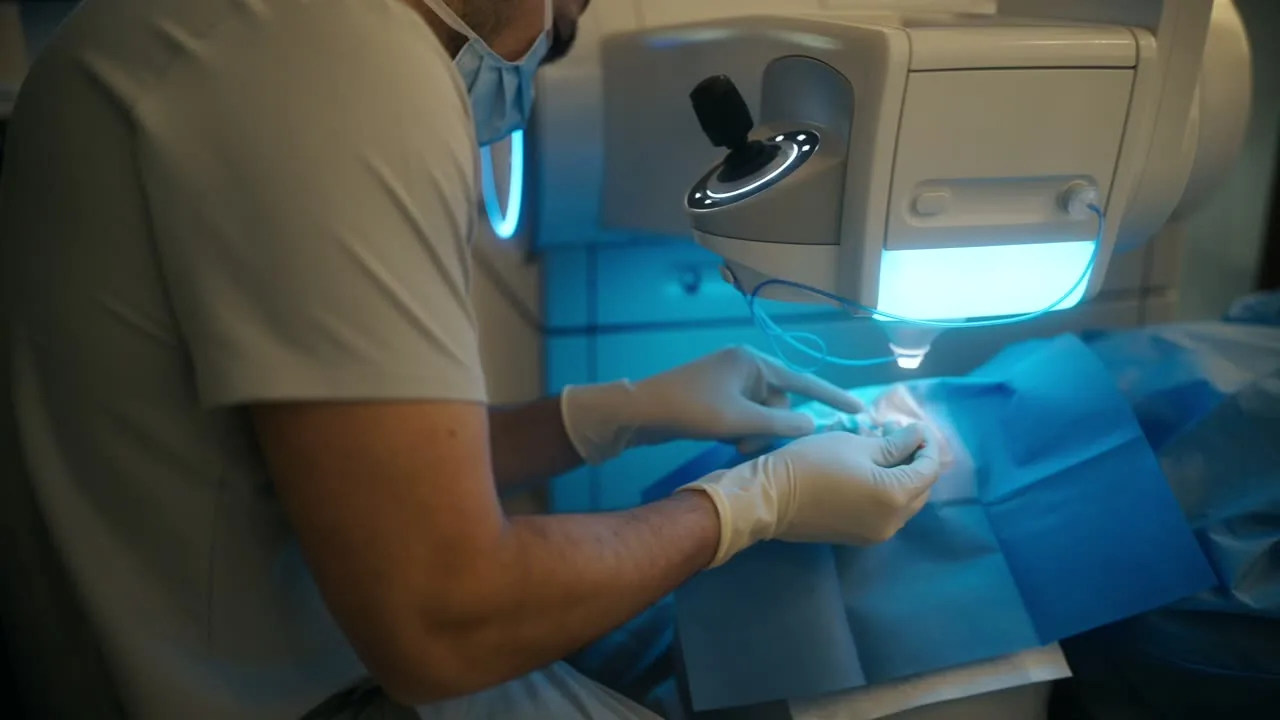
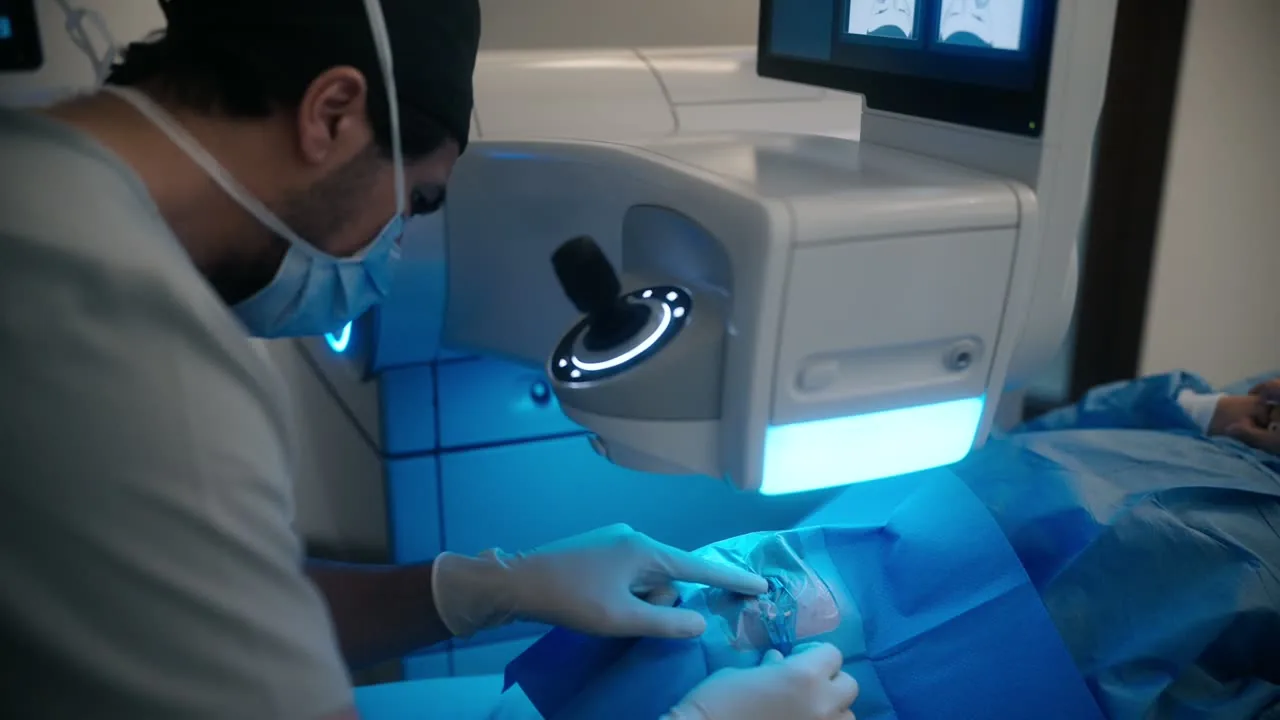
Preparation, numbing drops and suction are the same. The difference begins with the first laser cut: SMILE Pro cuts a disc and an access of 2–3 mm, Femto-LASIK a flap. Both eyes are done in about 20 minutes, and you feel pressure, not pain. Scroll through the four steps.


 The same for both
Numbing eye drops, a sterile drape, an eyelid holder so you do not have to blink. You look at a light, a curved contact glass gently holds the cornea. The image briefly turns gray. Up to here SMILE Pro and Femto-LASIK do not differ.
The femtosecond laserSMILE Pro: In about 8 seconds the VisuMax 800 draws a lenticule inside the cornea, whose thickness corresponds to your diopters, and a small access. Femto-LASIK: The same laser cuts a thin flap with a hinge. With LASIK the correction itself has not happened yet.
The correctionSMILE Pro: Prof. Dr. Mehdi Shajari separates the lenticule under the microscope and removes it through the access. No second laser. Femto-LASIK: The flap is folded open, the excimer laser removes the tissue beneath it and reshapes the cornea. For this you move to a different bed.
FinishSMILE Pro: The small access closes by itself, no stitch. Femto-LASIK: The flap is laid back and adheres on its own, also without a stitch. Then the second eye. In the evening: a few hours of scratchiness and watering in both.
Yes. Especially in the first half year.
The nerves that control the tear film run in the front layers of the cornea. The LASIK flap cuts them almost all the way around, SMILE Pro only at the small access. After SMILE Pro, 3 in 10 of our patients had dry eyes in the first weeks. Studies see dryness more often after LASIK even after 6 months; after about a year the two even out.
| Period | SMILE Pro | Femto-LASIK |
|---|---|---|
| Week 1–4 | Dryness in 3 in 10, mostly mild; artificial tears are enough | more frequent and often more pronounced (literature); artificial tears several times a day |
| Month 1–6 | steadily decreases; corneal sensation returns early | persistent in some; studies still show a difference after 6 months |
| from about 12 months | mostly subsided | mostly subsided, difference evened out |
| Who benefits especially | Screen work, contact lens intolerance, dry indoor air | if you have no tendency to dryness, you hardly notice the difference |
We measure the tear film during the pre-operative examination (break-up time, amount, eyelid margins). We treat a mildly dry eye before the procedure, for example with eyelid care and artificial tears, and then tend to choose SMILE Pro. If the eye is markedly dry, we advise against any corneal laser and check ICL (an additional lens in front of your own lens), which does not cut corneal nerves. More: dry eyes after laser eye surgery.
Preservative-free artificial tears several times a day, blink consciously at screens and take breaks, humidify heated air. For stronger symptoms, gel in the evening, eyelid care or anti-inflammatory drops help. We check the tear film at every aftercare appointment.
LASIK on day 1. Equal in the end.
After Femto-LASIK most people see very well the morning after, while after SMILE Pro the image is sometimes still soft on the first day. After about a month the difference is gone. After SMILE Pro, 96 % of our eyes saw fully sharp after three months (n = 412).
LASIK
The surface is smooth after the flap is laid back. After SMILE Pro, the interface inside first has to smooth out. For the follow-up check and daily life, vision is sufficient with both.
equal
Studies see slightly more glare and haze in the first week after SMILE, and after one month no difference in visual quality and satisfaction.
Rings and rays around lights are seen by many after both procedures in the first weeks, while the cornea heals. After three months they still bother about 5 in 100 after SMILE Pro. Large pupils and higher diopters increase the risk; that is why we measure your pupil in the dark. Tap an effect.

Simplified depiction. Photo: Patrick Tomasso, Unsplash (CC0).
Tap an effect. The photo shows what it looks like.
The flap stays for life.
The LASIK flap heals at the edge but never adheres as firmly again as untouched tissue. A hard blow to the eye can still displace it years later; this is rare and well treatable if you come immediately. With SMILE Pro there is no flap. For martial arts and contact sports, SMILE Pro is therefore our first choice.
Our recommendation: If you do martial arts, handball or climbing, or have to expect blows at work, choose SMILE Pro (or, with a thin cornea, Trans-PRK). For everyone else the flap is not an issue in daily life. What applies to your job: laser eye surgery for work and sports.
The front layers of the cornea carry most of its strength. In LASIK the flap is cut exactly there, and afterwards it contributes less. In SMILE Pro the lenticule is removed deeper, and the front layers are preserved except for the access. Review papers see a possible advantage for stability in this. In practice, bulging of the cornea (ectasia) is very rare with both (SMILE Pro clearly under 1 in 1,000, Femto-LASIK about 1 in 1,000 or less) if a tomography was done beforehand.
Enhancement, reading glasses, cataract.
About 2 in 100 eyes need an enhancement after both procedures; after LASIK the flap is lifted for this, after SMILE Pro usually the surface is lasered. For reading glasses from about 45 and for cataract later, it makes almost no difference which procedure you had.
If a bothersome residual error remains after three months, after LASIK we lift the flap and laser again: quick recovery. After SMILE Pro, the enhancement is usually done as PRK on the surface, with a few days of burning. If an enhancement is medically appropriate, under our concept it is usually possible within 6 months without a co-payment.
Leading: Femto-LASIKFrom about 45, presbyopia comes for everyone, lasered or not. If you then do not want reading glasses, after both procedures you can later be treated with Presbyond or a lens exchange, if the cornea has enough reserve.
equalCataract affects the lens, not the cornea. After both procedures it is operated on as normal. The measurements from before the laser help with calculating the artificial lens; we keep them and give them to you. More: cataract.
equalThe removed tissue does not grow back with either. For LASIK there are follow-up observations over decades, for SMILE over more than ten years. Prerequisite for both: your values were stable for 12 months before the procedure.
equal; LASIK researched longerTap what applies to you.
If both procedures suit your eyes, your daily life and your priorities decide. Select everything that applies to you; the recommendation appears immediately. Two answers rule out SMILE Pro: farsightedness and astigmatism over 5 diopters.
My eyes and values
My daily life
What matters to me
For your daily life
Both possible
Select what applies to you.
Schedule the pre-operative examination Compare all criteriaOrientation, not a diagnosis. Whether your cornea is thick and regular enough for the chosen procedure is shown by thickness measurement and tomography. All procedures and limits: full Suitability Check.

SMILE or LASIK, and you are unsure?
We have both. We will tell you honestly which one suits.
Jana from our Patient Care answers your questions and arranges the pre-operative examination with Prof. Dr. Mehdi Shajari, reachable 24 hours a day.
Equally safe. Different typical risks.
Review papers see SMILE and Femto-LASIK on par for safety and effectiveness. Serious complications are very rare with both: infection under 1 in 1,000, ectasia clearly under 1 in 1,000 after SMILE Pro, about 1 in 1,000 or less after Femto-LASIK. The difference lies in the typical risk: flap versus lenticule. Tap a risk.
3 in 10
in the first weeks, mostly mild, steadily decreasing.
more frequent
in the first months (literature), evened out after about a year.
Measure and treat the tear film beforehand, preservative-free artificial tears, check at every appointment.
rare
The lenticule is hard to separate or tears. Requires experience; usually resolved in the same appointment, otherwise switch to PRK.
needing treatment in under 1 in 100
Folds in the flap, displacement, cells growing in under the flap. Smoothed out or cleaned.
One surgeon for both procedures, check the day after the procedure, emergency number around the clock.
2 in 100
At our clinic 0.6% (n = 412). Usually as PRK on the surface.
2 in 100
Flap is lifted, lasered again, laid back.
Stable values as a prerequisite. Enhancement within 6 months usually without a co-payment.
under 1 in 1,000
Germs in the access or in the interface.
under 1 in 1,000
Germs under the flap; also, rarely, a non-infectious inflammation under the flap.
Sterile conditions, antibiotic drops, check the day after the procedure. If pain increases, call immediately.
well under 1 in 1,000
Front layers are preserved.
very rare
Most likely with an undetected keratoconus.
Tomography and thickness measurement before every procedure; no laser if anything is unusual. An ectasia can be stabilized with cross-linking.
Frequencies from our own evaluation (SMILE Pro n = 412, 01/2024–01/2026), informed consent and literature. In detail: Laser eye surgery: risks and side effects.
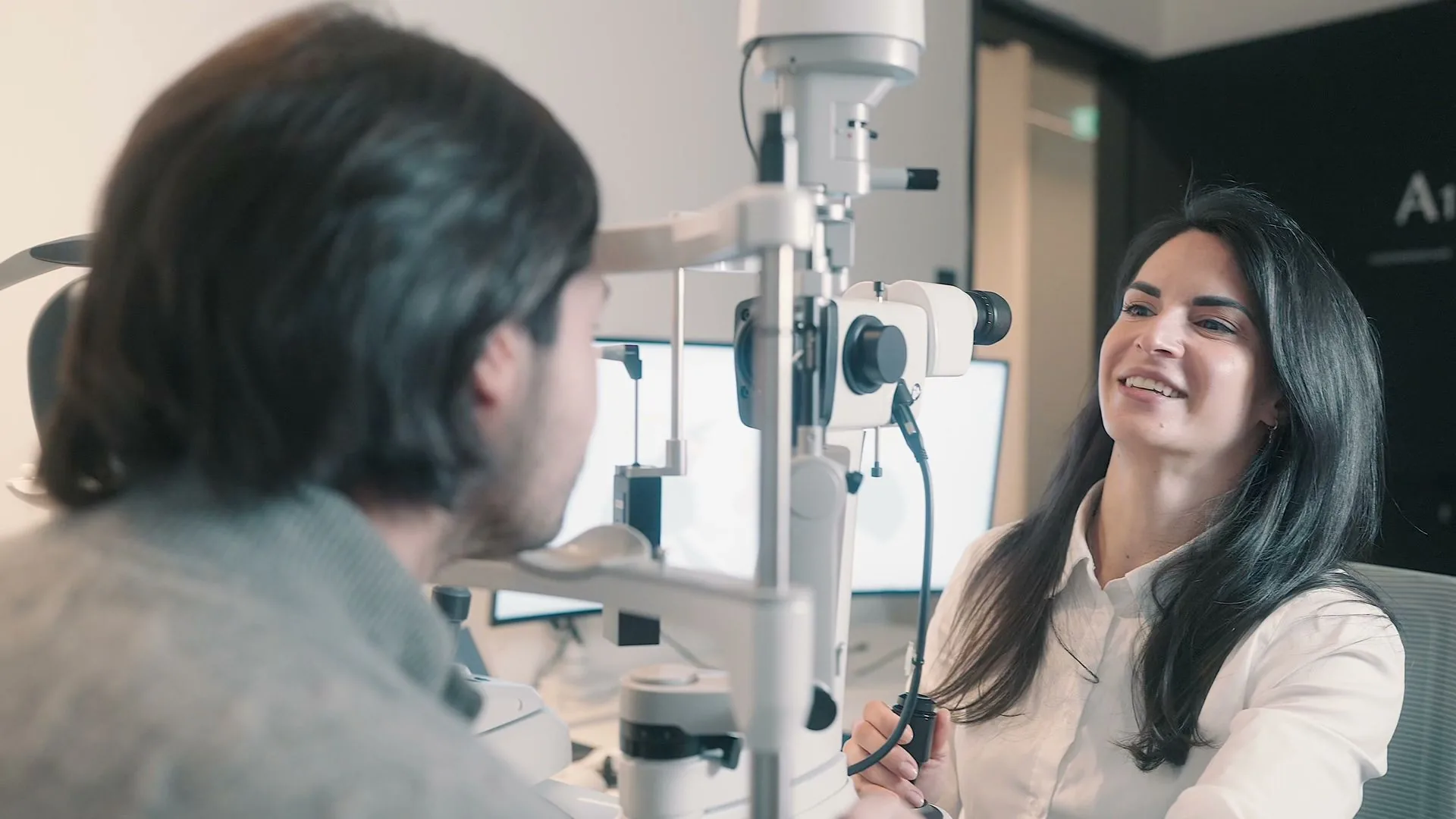
Both procedures. One surgeon.
At dr.vision, SMILE Pro and Femto-LASIK run on the same ZEISS VisuMax 800, and Prof. Dr. Mehdi Shajari performs both himself: over 20,000 procedures on the cornea and lens. We have no reason to sell you one or the other.
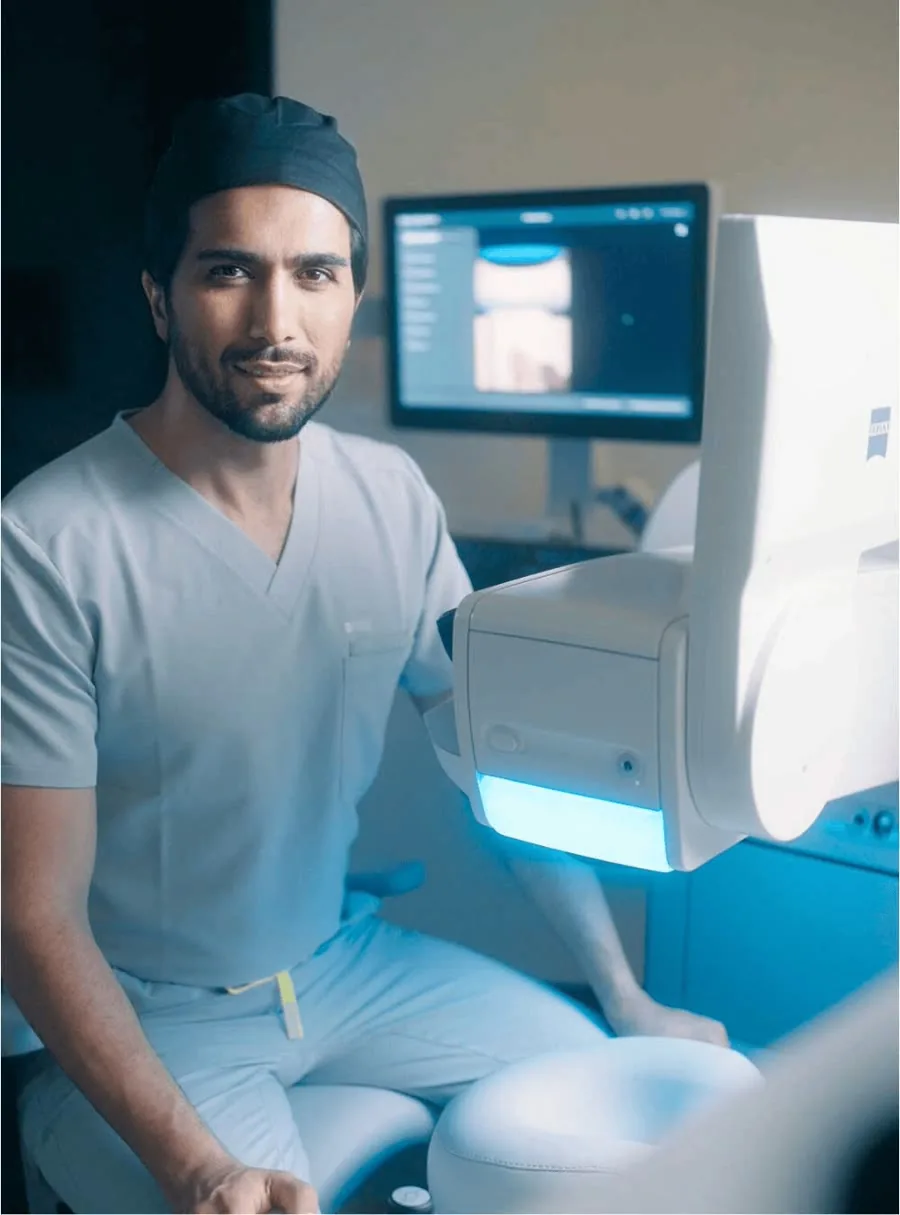
Prof. Dr. Mehdi Shajari. Both eyes. Both procedures.
Prof. Dr. Mehdi Shajari operates on every patient himself. He is a specialist in ophthalmology with a professorship and habilitation at the University of Frankfurt, has numerous publications on freedom from glasses, teaches and has trained several colleagues in this field, and is a 12× FOCUS Top Doctor. He evaluates every SMILE Pro treatment and discusses the results openly.
“For nearsightedness I usually recommend SMILE Pro, especially with dry eyes or contact sports. For farsightedness or astigmatism over 5 diopters I advise Femto-LASIK.”
Prof. Dr. Mehdi Shajari
€5,198 or €4,298.
Guide prices for both eyes at dr.vision, each including the pre-operative examination, the procedure by Prof. Dr. Mehdi Shajari and follow-up checks. The €900 difference comes from the laser: for each SMILE Pro eye, single-use material and a treatment license from the manufacturer are incurred. The medical service is the same.
€5,198
both eyes · from €3.90 a day* · €95 a month over 72 months or from €433 a month interest-free over 12 months directly at dr.vision
€4,298
both eyes · €79 a month over 72 months or from €358 a month interest-free over 12 months directly at dr.vision
* Representative example SMILE Pro: €5,198 net loan amount · 72 months · fixed nominal interest rate 9.49% p.a. · 9.90% effective annual percentage rate · monthly installment €94.97 · total amount €6,837.84 · via medipay. Example 0% over 12 months directly with dr.vision: €5,198 cash price · no down payment · fixed nominal interest rate 0% p.a. · 0% effective annual percentage rate · monthly installment €433.17, final installment €433.13 · total amount €5,198. Calculate your installment: financing calculator.
Many private health insurance (PKV) plans reimburse SMILE Pro and Femto-LASIK in full or in part; whether the plan distinguishes between the procedures, we clarify in advance with our cost estimate under the German fee schedule for physicians (GOÄ). More: Private health insurance.
Beihilfe (allowance for German civil servants) does not usually reimburse laser eye surgery; your private supplementary insurance for the remaining costs may cover a share, depending on the plan. More: Beihilfe.
dr.vision is a private practice; statutory health insurance does not pay for laser eye surgery. You pay yourself. You can claim the costs as extraordinary expenses in your tax return. Whether and how much the tax office recognizes depends, among other things, on your reasonable burden. More: Tax.
If you tend to have dry eyes, work a lot at screens or play contact sports: usually yes, because the first months are more comfortable and no flap remains. If you are farsighted or have astigmatism over 5 D, the question does not arise; then Femto-LASIK is the way. Without special priorities, both are good decisions.
Go deeper.
The procedure pages explain the process, suitability and aftercare in detail. The comparisons help if a third procedure comes into question.
Process, results, aftercare, €5,198 for both eyes.
To SMILE Pro ProceduresAlso for farsighted patients, €4,298 for both eyes.
To Femto-LASIK All lasersWith Trans-PRK and Presbyond.
To the comparison Thin corneaWithout a cut, €3,498 for both eyes.
To Trans-PRK Over −8 DWhen no laser suits.
To the comparison GuidesHow long, what helps.
To the guides376 reviews. Average 5.0.
376 Google reviews give dr.vision an average of 5.0 out of 5 stars. dr.vision does not check whether Google reviews come from treated patients.
“I am so happy to be able to see again! Thank you to Professor Shajari and his practice and surgical team!”
“The practice is highly professional and at the same time very empathetic. Prof. Dr. Shajari takes a lot of time to answer all questions in detail and in an understandable way.”
“From the first moment you feel in excellent hands in the modern practice right in the city center.”
“The whole atmosphere was pleasant and I felt really comfortable all around; I would choose it again at any time.”
Four patients. In their own words.
Less than 24h after surgery, better than ever.
Then everything went fast.
It was a very good decision to come here.
There are always situations where glasses are limiting.
Still have questions?
“‘SMILE or LASIK?’, most nearsighted people ask me. Here are my answers to the questions that come next.” Prof. Dr. Mehdi Shajari
For nearsightedness up to −8 diopters, both reach comparable visual acuity. SMILE Pro needs no corneal flap: dry eyes are less frequent in the first months and there is no flap that can shift during sports. Femto-LASIK is better for farsightedness, strong astigmatism and the sharpest vision on the first day, and costs €900 less.
Review papers see both procedures on par for safety and effectiveness. Serious complications such as infection (under 1 in 1,000) or ectasia are very rare with both. The difference lies in the typical risk: flap problems with LASIK (under 1 in 100), a hard-to-separate lenticule with SMILE (rare).
Not at dr.vision. We use SMILE Pro for nearsightedness up to −8 diopters and astigmatism up to 5 diopters. Farsightedness up to about +4 diopters we correct with Femto-LASIK, from about 45 also with Presbyond or lens exchange.
The principle is the same: a lenticule is removed through a small access. SMILE Pro uses the ZEISS VisuMax 800, which creates the lenticule in about 8 seconds instead of a much longer time and compensates for eye rotation. For you this means holding still for a shorter time and precise alignment with astigmatism.
Yes, especially in the first months. SMILE Pro cuts corneal nerves only at the small access, LASIK almost all the way around at the flap. After SMILE Pro, 3 in 10 of our patients had dry eyes in the first weeks. After about a year the two procedures even out.
On the first day, usually yes. After Femto-LASIK, vision the morning after is often already very good, after SMILE Pro sometimes still slightly soft. After a few days to a month the difference is gone. You can usually go back to the office after 1 to 2 days with either.
Yes, rarely. The flap heals at the edge but never adheres as firmly again as untouched tissue. A hard blow to the eye can displace it even years later; this is well treatable if you come immediately. With SMILE Pro there is no flap.
SMILE Pro, because no corneal cap can shift. Contact sports are usually possible after about 2 weeks, after Femto-LASIK after about 2 weeks with protective glasses, and the flap remains the more vulnerable spot permanently. With a thin cornea, Trans-PRK is the alternative without a cap.
Neither hurts during the procedure; numbing drops are enough, and you feel pressure. Afterwards you have a few hours of scratchiness, burning and watering with both. The next morning this is usually over.
It is needed in about 2 in 100 eyes with either. After LASIK the flap is lifted and lasered again. After SMILE Pro, the enhancement is usually done as PRK on the surface, with a few days of burning. If an enhancement is medically appropriate, under our concept it is usually possible within 6 months without a co-payment.
At dr.vision €5,198 for SMILE Pro and €4,298 for Femto-LASIK, each for both eyes as a guide price including the pre-operative examination, procedure and aftercare. You receive the written cost estimate after the pre-operative examination. Both can be financed, also at 0% over 12 months.
For each SMILE Pro eye, single-use material and a treatment license from the manufacturer are incurred. The medical service, pre-operative examination and aftercare are the same for both procedures.
Medically reviewed by Prof. Dr. Mehdi Shajari · As of October 2026
Not ready yet? Everything important to read again and to pass on.
Arrives by e-mail in about 60 seconds. No newsletter, just the guide and, if you wish, a follow-up from Patient Care. Privacy policy
How would you like to continue?
Online, by phone at 069 509 586 770 (reachable 24 hours) or via WhatsApp. The first appointment is a free consultation. This is followed by the detailed pre-operative examination, in which Prof. Dr. Mehdi Shajari measures diopters with and without dilated pupils, corneal thickness, tomography, pupil in the dark and tear film. This determines whether both procedures are possible and which one suits your daily life. You go home with a written recommendation and a cost estimate.
In Frankfurt, Junghofstraße 16 · all measurements included
Our locations.
 Opening hours
Junghofstraße 16, 60311 Frankfurt am Main
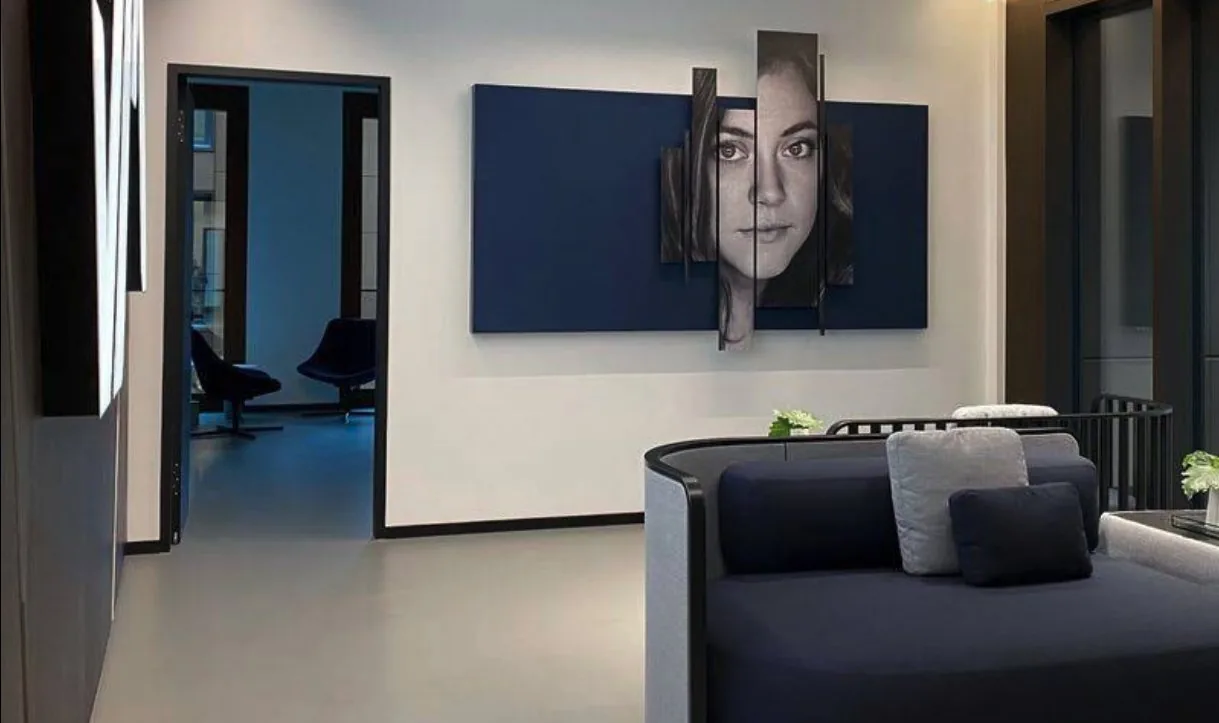 Opening 2027
Breite Straße 69, 40213 Düsseldorf (in the Neuer Stahlhof, corner of Graf-Adolf-Platz)
Until opening: preliminary talk in Frankfurt, Patient Care plans your travel.
Plan route Opening 2027
Lautenschlagerstraße 23, 70173 Stuttgart (2nd floor, step-free access)
Until opening: preliminary talk in Frankfurt, Patient Care plans your travel.
Plan routeI'm Duilio, I'm 22 years old. I was nearsighted before, with a prescription of minus 4.75. I actually looked into laser eye surgery a few years ago. But this practice didn't exist yet back then, and I informed myself a bit about it, and now I've finally come to the conclusion to have my eyes lasered.
So there was a free initial consultation here. I came here, first took a look at the practice, and I found the technology to be state of the art, and I also found Professor Shajari to be a very empathetic and very likable doctor, also very young, and so I then decided to have my eyes lasered here.
So the process was actually quite simple. You first came into a small room, where the eyes were cleaned a little, it burned briefly and then they were numbed and that was it. They were numbed with eye drops and then it went straight to the operating room and right there I was laid on the bed of the laser, the Carl ZEISS VisuMax 800, which is the newest laser, and then he actually started operating right away. I think I was only in the operating room for 15 to 20 minutes in total, while the laser itself took about ten seconds per eye.
Right, so after the surgery I got up first and couldn't see very sharply yet. I saw it as if it were milky cloudy. So my vision was milky cloudy, as if you were looking through a plastic cup when you hold it in front of your eyes. But I could already see better, or at least I had the feeling that I could already see almost better than I did before without glasses.
When I came for the follow-up check the day after, the optician took off the protective glasses and then I could really see, I saw him clearly, I saw the devices clearly, we did the tests, he said yes, you are at 100 percent in one eye, 125 percent in the other, exactly, so it was a great feeling, I then took out my sunglasses right away, because the sun was shining that day, and I went for a little walk through downtown Frankfurt. It was very nice, as I said, to see everything clearly without glasses not even 24 hours after the surgery, I think it was about half a day, 13, 14 hours after the surgery, yes, so it was really great.
Yes, so I'm Sevim, I'm 35 years old, and for many years now I've had the issue that I always wore a lot of contact lenses, but because of that I have very dry eyes. I couldn't really get used to glasses. Over the last few months I did wear them, to go easy on my eyes a bit, but in the long run I wanted a lasting solution, especially for sports and for activities where you don't want to always depend on glasses.
It actually started when I got my driver's license at 18; that was the first time I needed glasses for driving. Back then I still had a very slight vision problem. I think it started at minus 0.5 and minus 0.25 and then it actually got worse over the years. Also during my studies, because I read a lot, it kept getting worse. And then, I'm a lawyer, I took the state exam twice, and with each state exam it went down by about minus two. Exactly. And now I had minus four on the right side, until yesterday, and minus 3.75 on the left. So already a clear impairment in everyday life when you don't have a vision aid.
What bothered me most in general, when I was walking around, was simply that I couldn't see certain things sharply in the distance. I could tell from afar, while driving for example, that there was a sign there, but what was written on it, no chance. And then I started to blink and squint, because that always helps a bit with astigmatism. It really bothered me, and during sports it also annoyed me a lot that the glasses always slide down because of sweat and so on, and that is really annoying.
So I started to inform myself a few years ago about what comes into question. And then I went to a university hospital in Mainz and informed myself about the different procedures. I had a good feeling there too, but I always had real respect. Simply because it is a procedure on the eye and there are always horror scenarios in your head. What if you're one of the 0.0-something percent who then maybe can't see anything at all later. And then I dropped the idea again for the time being.
Then last year I took it up again, because I was having more and more problems with the contact lenses. Small infections again and again, and because of that I had to wear glasses a lot again and was really annoyed by it. And then last year I came to the practice here for the first time; I actually just googled for good reviews, and right at the first visit I had a very good feeling. That is, the feeling that I'm really in good hands here, that the doctor really takes time, explains everything calmly and also isn't annoyed when you have a follow-up question or so. I always find that very disturbing with doctors, because the patient simply has many questions, and when everything is answered, and very calmly, you simply get a good feeling. And in the end it is of course also the trust in the doctor that encourages you to choose one or the other.
The first impression, when you walk into the practice, everything is somehow super chic, super clean and everyone is just very nice. You don't always get that at the doctor's, I think. Mostly you already have such annoyed medical assistants who give you the feeling right at the start that it's somehow stressful and so on, and here everything is actually always very calm, and for a procedure like this, that gave me a lot of trust.
That was a few weeks ago, and then I got the appointment for today, for yesterday, for the surgery, and for today the aftercare. That means between the decision, I'm doing it, and the procedure it was a few weeks. So not throughout all those weeks. I was really looking forward to it. I actually counted the days until it was finally time, and on the day itself I thought, oh no. You simply have respect for it, and I also have respect for the job and for the procedure as such, but there too I have to say I was completely well looked after, because the doctor talked with me the whole time. He kept reassuring me that everything is fine, that I'm doing everything right, and that was very calming. And he had also explained all the individual steps beforehand. So I knew exactly what was coming, and also during the procedure, I was slightly nervous, I was excited for sure, but I tried to cooperate well so that I don't wobble or anything, and then everything went very, very fast.
After getting up it was already like, okay, wow, I see better, and I also notice that it keeps getting better bit by bit. When I look into the distance, I think about what I saw before and what I see now. And you simply notice steadily that it keeps getting better. And I just found out that I'm already at 100 percent with my vision. So it really goes, really goes fast.
I think I informed myself very well. For me personally, it's always important to know what is going to happen. Because for me it gave a lot of calm that I already knew the individual steps. I also read up a bit more on the procedure, the differences between the procedures, and thought about what the consequences are and what the side effects could be. For me personally, it simply helps to know what is happening to me. And I think that's a tip I can give, too: of course, choose the doctor very carefully. I definitely recommend this doctor. I think I did everything right here. So I can really only encourage everyone to take this step as well.
I’m Teresa Schwenger, I’m 31 years old, I’m a project manager. I was nearsighted, so I didn’t see well at a distance, and at some point it was just super annoying with contact lenses, putting them in every morning, taking them out again in the evening. I think I wore contact lenses for about ten years, and then I also had the problem that my eye was no longer supplied with oxygen so well, which is why the little vessels grew further into the eye, and so I looked around for an alternative. Glasses were not an alternative for me, because I simply don’t like myself in glasses. It was always an issue with the swimming pool or the lake or the sea. Do you put your contact lenses in, can you dive, do you maybe lose a contact lens, and that was always really annoying. Or also when you stayed somewhere overnight, you always had your little contact lens case, your solutions and care products, which you had to take along, always a whole pack just for the contact lenses. I always found that very annoying, and also on long days, when I had put my contact lenses in very early, in the evening while watching TV I noticed, oh, this really annoys me now, I would like to take them out, and then watching TV with glasses on a couch, really very uncomfortable, and so that was a situation where I am now grateful that I will hopefully or probably never have them again.
And then I looked at which doctors in this area offer laser eye surgery, and I read through lots of reviews and looked at who is very good here. And the doctor here is really rated very, very highly, and I had a totally likeable first conversation with him and felt comfortable right away. I also saw all his awards, the FOCUS awards and so on, which reinforced my impression, and also lots of positive reviews, which I can confirm. So you feel very comfortable, and the work here is very professional. So it was a very good decision to come here, definitely.
Not quite so good. I was very nervous, had many worries and fears too. I would have liked to leave again right away on the day when I was sitting here. But I was received super kindly and warmly. Everything was explained to me well. Everyone was very warm, and they took the nervousness away. So I felt I was in good hands, and when it then started, the nervousness was already a bit less, because I knew that I was simply in good hands.
So I simply arranged the appointment, the first appointment, online, and then I got a call asking me to please stop wearing contact lenses from that point on, so that the eyes are already free of contact lenses, because things can still change there. Then the parking garage is right next door, you walk in here, and it is a very beautiful building and a very beautiful practice, definitely. I was welcomed warmly right away by the receptionists. Everything was explained to me well right away. I was given water and everything. Then I had the first tests. I was totally amazed at how many tests were done and with which devices. It's really incredible what names are on the devices and how expensive these devices are. But really everything was measured that I think can be measured in an eye. Then I had the conversation with the doctor. That was also really great, warm. He answered all the questions I had and took the time for me. I then said I would rather sleep on it for another night, because I am simply the type of person who plays it safe. But at home I actually already knew that I would like to have it done. The next day I called again and made a second appointment. The eyes were checked once more, again with a colleague of the doctor and with him. And then I had another informed-consent talk about what risks there are. I was able to ask my questions again and then got my treatment appointment very quickly. And on the day of the treatment, as I said, I was already here super nervous, but I was also welcomed very warmly. Many of my worries and fears were taken away.
Yes, exactly. So I got up this morning and I could see right away. That was my biggest worry, that I would no longer be able to see as I did before, but I could see perfectly right away. I also saw at a distance again. That was the exciting part in my case. I looked out of the window and also noticed the trees farther away. The outlines, which I otherwise always saw only like this, were clear and distinct. So it really is a change right away. I notice it totally, and it’s super nice.
Definitely, yes, absolutely. I felt super comfortable from the first second to the last. So definitely, if I ever have laser treatment again, then definitely here. I can only recommend it to everyone.
Yes, I definitely should have done it earlier, that's true, because I believe it really gives you a lot of quality of life back, and it is also good for the eyes. Of course, there is the treatment itself, but in the long run, as it was with me, because of the contact lenses, I had these tiny blood vessels, or I have them in my eye, because the eyes were not supplied well. Had I done this earlier with the lasers, it might not be as pronounced. So my appeal would be to do it earlier rather than too late.
My name is Markus Mielert. Before the surgery I was nearsighted and had presbyopia in its early stage, and that was corrected with LASIK.
In everyday life, glasses are definitely a limitation again and again, especially in bad weather, rain for example, but then also in summer with sunglasses, with non-prescription ones at the beach and so on. So there are always situations where glasses are limiting. And that always bothered me, besides the look, also that glasses are maybe not always 100% pretty. And what also came on top, a point I hadn’t thought of at all beforehand, was this presbyopia. I only found that out when I was here with Professor Shajari. He told me about it, and only then did I notice that I was affected at all. What I noticed in everyday life, for example: I looked at a phone list at work and wanted to look up a number and could hardly make it out. And I hadn’t been aware of that at all before, but this process apparently went very fast and then kept getting worse.
Yes, of course, in Frankfurt there are naturally many options for getting laser treatment. Of course, the first impression online is decisive. Both the look of the professor, that he made a very competent impression, and the reviews. The online reviews are the opener for the first contact. I actually only went to him, because the first conversation with him was also immediately great, he gave me a perfect impression, in the sense that he is 110 percent on top of his field. I am in very good hands, and so I didn't look any further at all.
First I sent an e-mail, because I don’t have private health insurance. I first wanted to know how it works with the pre-operative examination, what costs would come my way. Then I made this appointment, the first contact. Then I had a talk with him and first an eye test. At the second appointment the detailed tests were done, to determine that I am suitable for it, which procedure I am suitable for. That actually went very quickly. That was this second appointment, with all the tests. One thing he recommended to me, which was also very good: he recommended that I wear contact lenses with different strengths that simulate this post-surgery vision, because with this presbyopia combined with nearsightedness it has a different effect, since you have to treat the eyes differently with the laser. And that was also great, because through these contact lenses you could already see that the vision is perhaps a bit different from what you would have expected. That is very good, but it takes getting used to, and it was good to know what is coming.
Yes, it was very busy. It was always very calm in his office. There were many helping hands. Yes, no, but great, everyone was super focused and concentrated, calm, it was a good atmosphere, no stress, no hectic, nothing that gave you the feeling that something was not okay. I felt very welcome from the start, also with the preparation and so on, it was wonderful. During the surgery too, of course, it is a delicate thing on the eye. But he kept telling me, very reassuringly, which step of the process we were at, that everything was going well, and gave the impression that there were no problems. That was actually wonderful, and as I said, it actually went quite fast, faster than you would think.
I can of course recommend him without reservation, really flawless from A to Z. Laser eye surgery itself was always a topic that I could rule out for myself, because I didn't want to take the risk that something might go wrong. But probably the technology has now simply advanced so far that it has been perfected compared to how it was before. And I know now – I was lasered yesterday, and today the vision is wonderful. Let's see how it is in the long term, but as of now I would say it was the perfect decision. And I believe it makes life much better and of higher quality, without glasses, without restrictions. And I am looking forward to that.