 dr.vision
5 D
cylinder can be corrected by SMILE Pro and SmartSight, together with nearsightedness up to −8 D.
Start here
What suits you?
Find out in 2 minutes which procedure suits your eyes.
Start the Suitability CheckOr by age:
< 45yearsGet rid of glasses & contact lenses 45–64yearsGet rid of reading glasses 65+yearsCataract & glasses-free★★★★★ 5.0 · 376 Google reviews · 20,000+ procedures
Decide well
What you should know beforehand.
Who operates?Prof. Dr. Mehdi ShajariFOCUS Top Doctor · operates on every patient personally What does it cost?Laser from €3,498 · Lenses from €6,886Prices for both eyes Is it safe?Safety & risks When will I be fit again?Work, sports, driving Would you rather read in peace first?Decision Guide Freedom from GlassesProcedures
Laser or lens?
Laser eye surgery
SMILE ProSmartSightFemto-LASIKTrans-PRKPRKPresbyond (laser away your reading glasses)All laser procedures at a glanceLaser procedures compared ›Lens surgery
ICLLens exchange (reading glasses)Cataract surgery with premium lensLens types: trifocal, EDOF, toricLens types compared ›Start here
Something wrong with your eyes?
A thorough eye check-up with us clarifies what is behind it.
Book an eye check-up★★★★★ 5.0 · 376 Google reviews
Freedom from glasses · Astigmatism
Laser treatment usually works. If the cornea is regular.
Streetlights trail streaks, letters have shadows? Regular astigmatism can usually be treated with the laser as well, with SMILE Pro or SmartSight up to 5 D, with Femto-LASIK up to about 6 D. Prof. Dr. Mehdi Shajari treats you personally, with experience from over 20,000 procedures.
 12× FOCUSTop Doctor
Yes, if it is regular. Up to 5 D with SMILE Pro or SmartSight, up to about 6 D with Femto-LASIK.
5 D
cylinder can be corrected by SMILE Pro and SmartSight, together with nearsightedness up to −8 D.
6 D
cylinder or so, also together with farsightedness.
regular?
With an irregular cornea, such as keratoconus, laser treatment is usually ruled out. The tomography decides.
10°
of misalignment costs about a third of the effect. That is why the axis is transferred precisely before the procedure.
from 3,498 €
Guide price for both eyes. The astigmatism correction is included in the price of the procedure.
Astigmatism in five answers.
For anyone with three minutes. Each answer leads to the detailed chapter.
The cornea is curved more like a rugby ball than a soccer ball. Light focuses to a line instead of a point, and images are distorted at every distance. It usually comes together with nearsightedness or farsightedness.
UnderstandCYL is the strength in diopters, ACH the direction in degrees. Up to 1 D mild, up to 3 D moderate, above that strong. In the calculator you can place your values in a minute.
Place your valuesA regular astigmatism can be lasered well. An irregular one, for example with keratoconus, usually cannot. That is why we measure every cornea with tomography.
The differenceSMILE Pro and SmartSight up to 5 D, Femto-LASIK up to about 6 D. Above that or with a thin cornea, the toric ICL, and from about age 45 a toric artificial lens.
Limits tableThe astigmatism correction is included in the procedure. Guide prices for both eyes: Trans-PRK €3,498, Femto-LASIK €4,298, SMILE Pro €5,198, SmartSight €5,198, ICL from €6,886.
CostsRugby ball instead of soccer ball.
With astigmatism (also called cylinder error), the cornea is curved more strongly in one direction than in the other. A point becomes a line. That is why the image is not just blurry but distorted, near and far.
at night
Typical are elongated lights while driving, double contours on the screen and quick tiredness when reading. Many people squint.
1 in 3
A slight astigmatism is almost normal. From about 1 D it is usually corrected; among patients with a cataract, about one in three has at least this value.
+ / −
With all procedures, the astigmatism is corrected in the same step. More about the basic refractive errors: nearsightedness, farsightedness.
Most astigmatism is congenital and inherited; it stays largely stable in adulthood. Less often it results from a disease of the cornea such as keratoconus, from scars after an injury or inflammation, or after eye surgery. Drooping eyelids or eyelid tumors can also slightly deform the cornea.
In children, sharp vision develops until about school age. A stronger, uncorrected astigmatism can lead to a permanently weaker eye. That is why it should be examined by an eye doctor early and corrected with glasses. Laser treatment is usually done only from age 18. More: pediatric eye doctor.
The glasses prescription is the sum of cornea and lens. Usually the cornea dominates; sometimes the lens offsets part of it or adds to it. For a laser, what matters is what has to be corrected at the cornea; for a lens exchange, what is left after your own lens is removed. That is why we measure the cornea itself instead of simply taking over your glasses prescription.
Cylinder and axis, explained clearly.
In your glasses prescription, the astigmatism appears under CYL (strength in diopters) and ACH (direction in degrees), the nearsightedness or farsightedness under SPH. Enter your values: you see how strong the astigmatism is and which procedures come into question at your age.
Enter the values from your glasses prescription. The assessment adjusts immediately.
The strength of the curvature. A plus cylinder is converted; the amount stays the same.
Minus means nearsighted, plus means farsighted. If it says 0 or nothing, the astigmatism is on its own.
The direction of the curvature in degrees. It does not matter for the strength, but it is decisive for the treatment.
Has an eye doctor mentioned keratoconus or an irregular cornea?
Your age
Your values, assessed
Orientation, not a diagnosis. The cylinder in your glasses prescription does not always come from the cornea alone. Whether the astigmatism is regular and how thick the cornea is, only the tomography in the pre-operative examination shows. You will find the detailed check under Suitability Check.
| Strength | Cylinder | What you notice | What usually fits |
|---|---|---|---|
| Mild | up to 1 D | often little, slight streaks at night | is corrected along with nearsightedness or farsightedness; on its own rarely a reason for a procedure |
| Moderate | 1 to 3 D | distorted vision without glasses, headaches | SMILE Pro, SmartSight, Femto-LASIK or Trans-PRK |
| High | 3 to 5 D | clearly limited without glasses | SMILE Pro, SmartSight or Femto-LASIK, if the cornea is regular |
| Very high | over 5 D | often not ideal even with glasses | Femto-LASIK up to about 6 D, otherwise toric ICL or, from 45, a toric artificial lens; rule out keratoconus |
The division into mild, moderate and strong is not uniform. Opticians write the cylinder with plus or minus; the amount, and with it the strength, is the same, only sphere and axis are converted. Technical terms are explained in the glossary.
The most important question before any laser.
With regular astigmatism, the strongest and the weakest curvature are at right angles to each other; glasses or a laser compensate for it completely. With irregular astigmatism, the surface is uneven, for example with keratoconus or after scars. It cannot be fully corrected with glasses, and laser ablation can destabilize a weakened cornea further.
| Feature | Regular | Irregular |
|---|---|---|
| Form | even, axes at right angles | uneven, often bulging on one side |
| Common cause | congenital | Keratoconus, scars, after surgery or injuries |
| Progress | usually stable | often progressive with keratoconus |
| With glasses | fully correctable | often not quite sharp |
| Laser treatment | SMILE Pro and SmartSight up to 5 D, Femto-LASIK up to about 6 D | usually ruled out |
| Instead | for high values, toric ICL or lens | Cross-linking, rigid contact lenses, in individual cases toric ICL |
If strength or axis change noticeably in young people, keratoconus may be behind it. Then get a tomography before any laser treatment, and soon. More: keratoconus.
Frequent eye rubbing is considered a risk factor for keratoconus. Mention it at the pre-operative examination.
Then your astigmatism is regular and well correctable. Tomography measures the front and back surface of the cornea and also detects early forms that cannot yet be seen with the slit lamp.
Three lasers, two toric lenses.
Lasers reshape the cornea to be flatter in one direction. Toric lenses compensate for the astigmatism from the inside, either as an ICL in front of your own lens or as an artificial lens during lens exchange. Which path fits depends on cylinder, sphere, corneal shape and age. Here are the most important points; the details are on the procedure pages.
SMILE Pro and SmartSight: cylinder up to 5 D, without a flap.
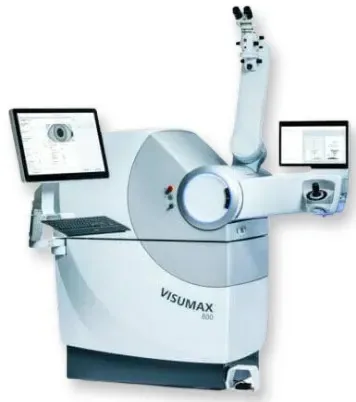
Yes. The disc of tissue that SMILE Pro removes from the cornea is shaped thicker for curvature in one direction. This flattens the cornea exactly where it is too steep. This works up to 5 D of cylinder, together with nearsightedness up to −8 D. The laser (ZEISS VisuMax 800) compensates for the rotation of the eye when lying down. SmartSight works on the same principle with a different laser, also up to 5 D of cylinder and −8 D.
Femto-LASIK: a little further, also with plus.
Under a thin corneal flap, the excimer laser removes tissue precisely along the steep axis. Femto-LASIK reaches up to about 6 D of cylinder and is the procedure when farsightedness comes with the astigmatism. For some corneal shapes, the ablation can additionally be adapted to the measured surface.
Direct comparison: SMILE or LASIK?
Everything about Femto-LASIKTrans-PRK: from the outside, without a cut.
Yes, for mild to moderate astigmatism. Removing tissue at the surface leaves more load-bearing tissue in place, which is why Trans-PRK is an option for a somewhat thinner cornea. Healing of the surface takes a few days and is more painful; with higher cylinders the predictability is lower.
Toric ICL: cylinder built into the lens.
The toric ICL is an implantable lens with a built-in cylinder. It is placed behind the iris and rotated so that its axis matches your astigmatism. It makes sense when the laser reaches its limits: high nearsightedness or farsightedness with astigmatism, a thin cornea or, in individual cases, a stable keratoconus after cross-linking.
Important: If the lens rotates, its effect decreases; it is then realigned in a short procedure.
Everything about ICLToric artificial lens: usually compensates for the astigmatism permanently.
Yes, with a toric artificial lens. It replaces your own lens and compensates for the curvature of the cornea from the inside. Without it, glasses for the astigmatism would still be needed after a lens exchange or cataract surgery. Toric optics are available as monofocal, EDOF and trifocal lenses.
Everything about the lens: toric lens. With a cataract: cataract surgery with a premium lens.
Everything about lens exchangeWithout surgery: works if everything fits properly.
Glasses with cylinder lenses reliably correct regular astigmatism, with distortions at the edge for high values. Soft toric contact lenses must sit in a fixed position; if they rotate when you blink, sharpness fluctuates. With an irregular cornea, many people see best with rigid contact lenses, because the tear film underneath evens out the irregularities.
All options and their limits at a glance.
Laser up to 5 D of cylinder (SMILE Pro, SmartSight) or about 6 D (Femto-LASIK), toric ICL up to about 6 D, toric artificial lenses also above that. Always provided that the cornea is regular. Marked in green is the most common recommendation for astigmatism with nearsightedness, not automatically yours.
Swipe the table sideways to see all options.
| Criterion | SMILE Pro / SmartSightLaser, small incision | Femto-LASIKLaser with flap | Trans-PRKLaser at the surface | Toric ICLLens in front of your own | Toric artificial lensDuring lens exchange |
|---|---|---|---|---|---|
| Cylinder | up to 5 D | up to about 6 D | up to about 3 D | up to 6 D | even higher, depending on the model |
| Together with | Nearsightedness up to −8 D | Nearsightedness and farsightedness | low nearsightedness, very low farsightedness | high nearsightedness and farsightedness | any strength |
| Irregular cornea | no | no | usually no | in individual cases, after stabilization | in individual cases |
| Cornea | medium thickness needed | more thickness needed | thinner also possible | remains untouched | remains untouched |
| transfer the axis | alignment at the laser | alignment at the laser | alignment at the laser | lens is rotated | lens is rotated |
| Age | from 18, stable values | from 18, stable values | from 18, stable values | about 21–45 | usually from 45 |
| Back to work | usually after 1–2 days | usually after 1–2 days | usually after 5–7 days | usually after 1–2 days | usually after 2–3 days |
| Reversible | no | no | no | yes, removable | no |
| guide price, both eyes | €5,198 | €4,298 | €3,498 | from €6,886 | from €6,998 + toric surcharge |
Limits according to the recommendations of the Commission for Refractive Surgery (KRC) of the DOG and BVA (version May 2024: LASIK for astigmatism up to 5 D, in the borderline range up to 6 D) and the procedure pages of dr.vision.

High cylinder or changing values?
Please bring your glasses prescriptions to the pre-operative examination.
Jana from our Patient Care team answers your questions via WhatsApp, usually within 10–15 minutes, and schedules the pre-operative examination with tomography; whether and how your values can be treated is clarified by the doctor at the pre-operative examination. Mon–Fri 8:00–19:00, Sat 9:00–15:00.
Right strength, wrong direction: lost effect.
A cylinder correction only has its full effect in the right direction. As a rule of thumb, every degree of deviation costs about 3% of the effect; at 10° about a third is lost, and at 30° the astigmatism remains practically unchanged.
From glasses prescription to clear vision. In four steps.
The process is similar for all procedures. For astigmatism, two things are central: the tomography, which rules out an irregular cornea, and the precise transfer of the axis. If you come from farther away, you can manage everything in under 72 hours, with the ICL in two trips, because it is ordered for you after the pre-operative examination.
Step 1 of 4
Assess your values, make an appointment.
The initial consultation is free and non-binding.
Place your valuesStep 2 of 4
Regular or irregular? We clarify that first.
Please leave out your contact lenses beforehand: soft ones for 10 to 14 days, rigid ones for three to four weeks, because they deform the cornea. You go home with a recommendation and a cost estimate.
Step 3 of 4
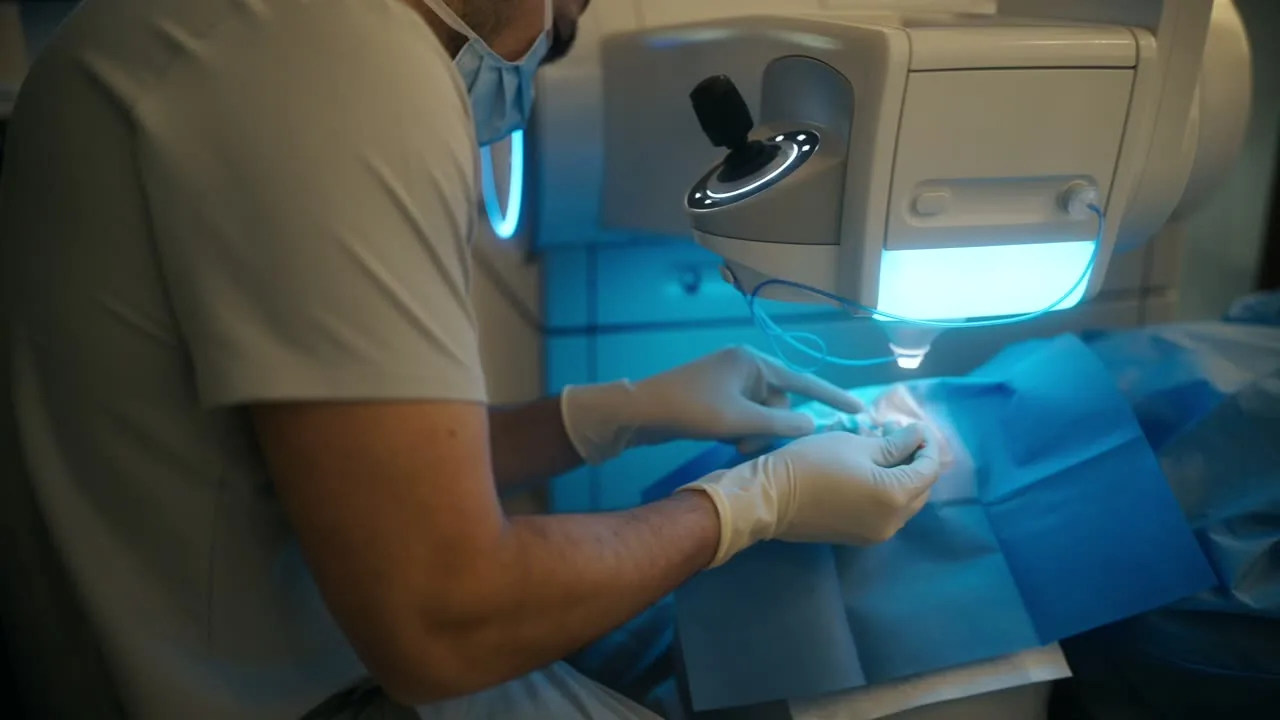
Awake, numbed with drops, both eyes in one appointment.
Do not drive yourself afterward. With ICL and lens exchange, the eyes are usually treated on separate appointments.
Step 4 of 4
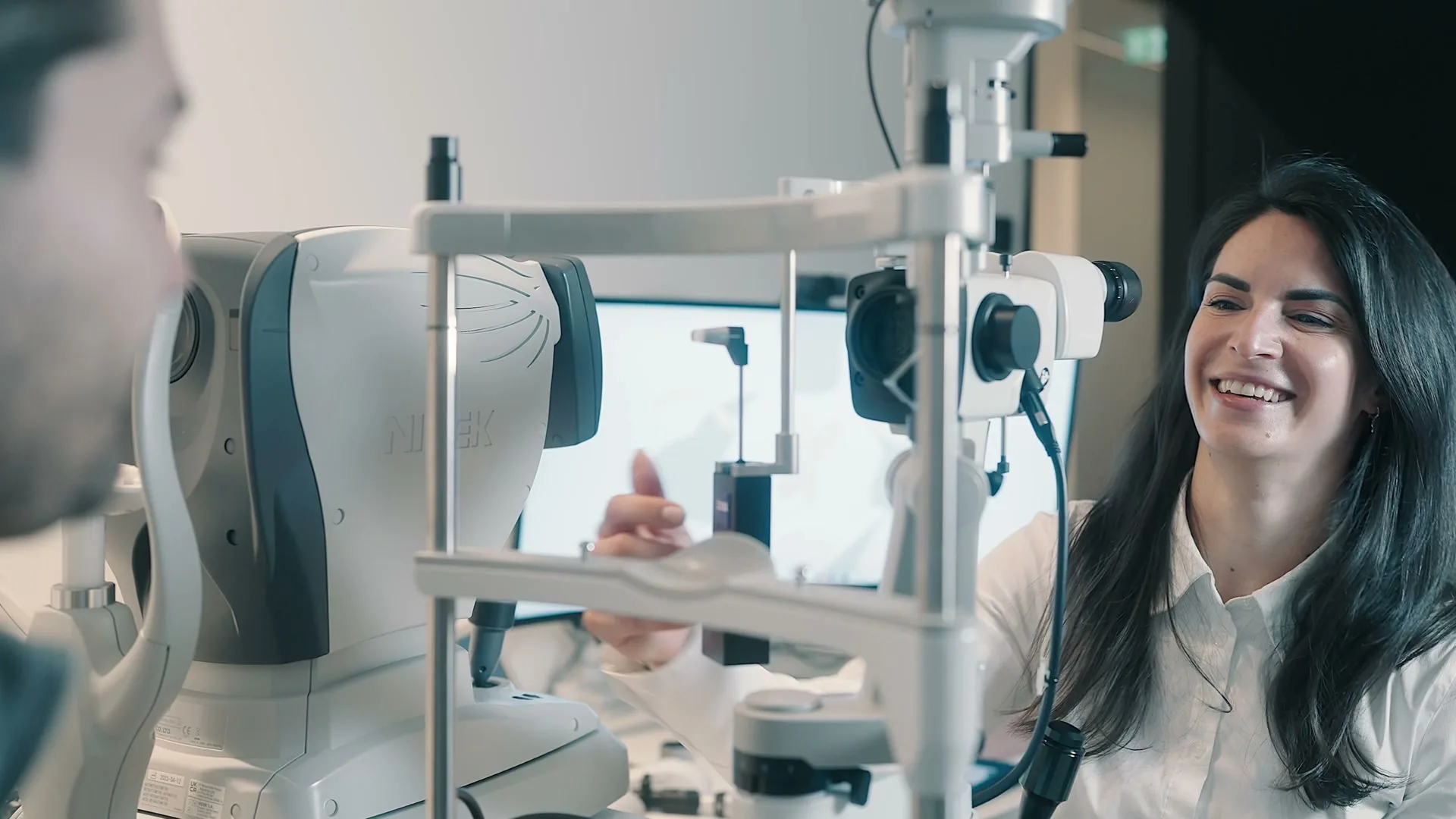
First follow-up check the day after the procedure. Then back to everyday life.
Emergency number around the clock. Patients from afar can have later follow-up checks with their own eye doctor.
| Activity | From when | Note |
|---|---|---|
| Sharp vision | usually fit for everyday life the next day | full sharpness within the first weeks |
| Work (office) | usually after 1–2 days | Trans-PRK usually 5–7 days, ICL 1–2 days |
| Driving | usually after the follow-up check the next day | at night only once halos no longer interfere |
| Sports | light sports after 1 week | contact sports, martial arts and ball sports after 2 weeks at the earliest |
| Swimming, sauna | after 2 weeks | only after healing |
| Eye makeup | after 1 week | use new products |
Everything in detail: When am I fit again?
During the procedure, thanks to the drops you usually feel no pain, only pressure. After SMILE Pro, SmartSight and Femto-LASIK, the eyes feel scratchy and water for a few hours. After Trans-PRK, the first 4–5 days are noticeably more uncomfortable. Lens procedures are usually barely noticeable afterward.
Rarely serious. A small residual cylinder is the most common.
The most common side effect is dry eyes in the first weeks, in 3 in 10 after SMILE Pro. Typical for astigmatism is a small residual cylinder, for example from a slightly shifted axis. Serious complications are very rare. Overview: Laser eye surgery: risks.
A slight astigmatism remains because the axis was not hit exactly or the cornea heals differently than planned.
2 in 100
need an enhancement after laser treatment; at our clinic after SMILE Pro 0.6%.
Transfer the axis precisely, measure the cornea instead of relying only on the glasses prescription. Enhancement usually by laser. More: enhancement.
Severed corneal nerves temporarily reduce tear production. The eyes feel dry or gritty.
3 in 10 in the first weeks
after SMILE Pro; more often after LASIK, rarely with lenses.
Measure and treat the tear film beforehand, artificial tears for the first weeks. More: Dry eyes after laser eye surgery.
Rings or rays around lights, while the cornea heals and with a large pupil in the dark.
about 5 in 100 after 3 months
common in the first weeks. Afterward, many find the streaks less noticeable than before.
Measure the pupil in the dark, choose a treatment zone that is large enough.
After the procedure, a toric ICL or artificial lens rotates out of its planned axis, and sharpness decreases.
rare
Choose the right lens size, check the position the day after the procedure, realign it in a short procedure if needed.
After the tissue removal, the cornea becomes unstable and bulges forward. The risk is higher mainly with undetected keratoconus.
about 1 in 1,000 after LASIK, clearly rarer after SMILE and PRK
when irregular corneas are ruled out beforehand.
Tomography for everyone, no laser in borderline cases. If detected early, cross-linking can usually stabilize the cornea.
Frequencies for SMILE Pro from the literature and our own analysis (n = 412, 01/2024–01/2026).

Because we measure first and only then use the laser.
Tomography for every patient, laser and toric lenses from one source. One surgeon, over 20,000 procedures, 5.0 stars from 376 reviews.
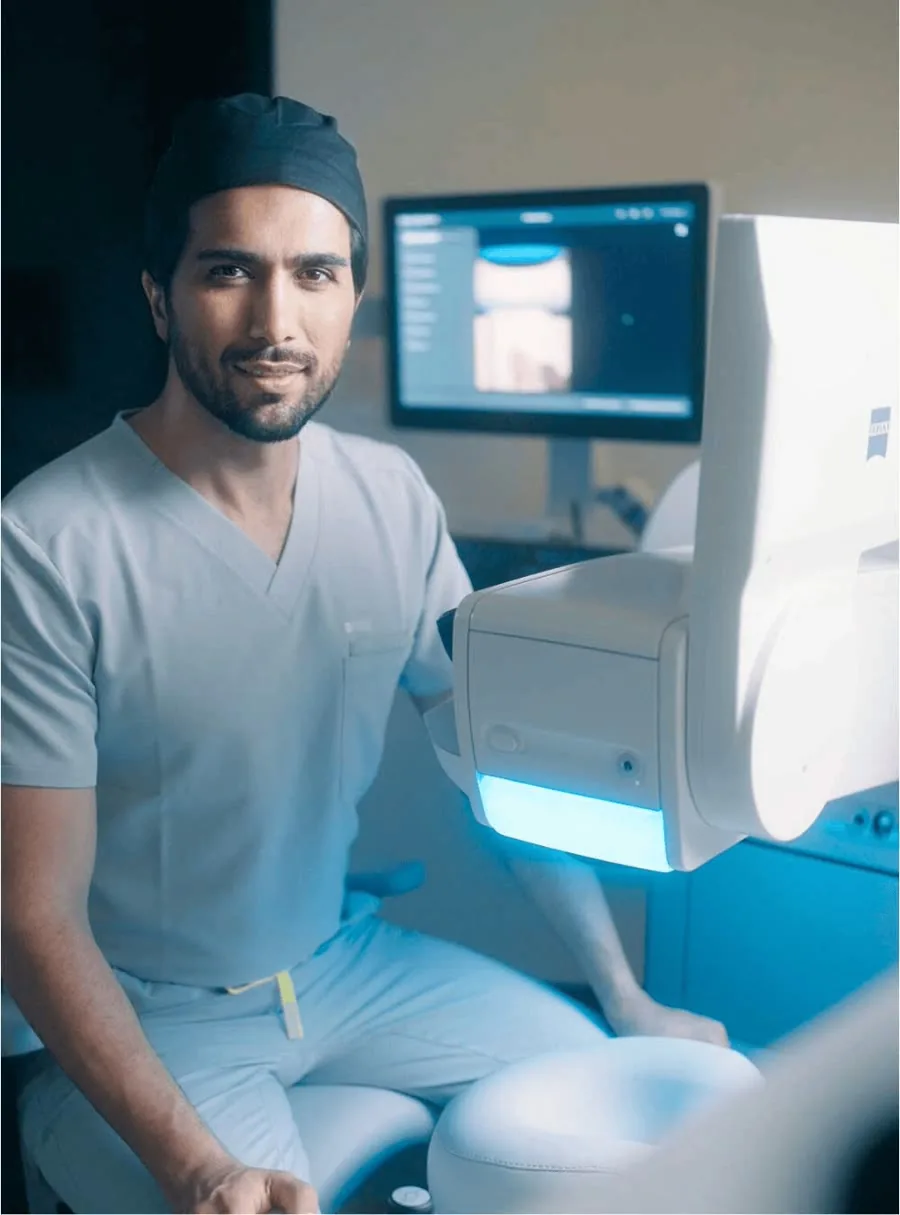
Every procedure: Prof. Dr. Mehdi Shajari. Personally.
Specialist in ophthalmology and professor (German title: außerplanmäßiger Professor) of ophthalmology, numerous publications on freedom from glasses, teaching and training of several colleagues in this field. He performs laser treatment and implants toric lenses and can therefore weigh the options for high cylinder instead of selling one procedure. At dr.vision he treats you himself, not a rotating team.
376 reviews. Average 5.0.
“Before the consultation, my eyes were first examined with various devices. […] They looked at which procedure was best for me and my eyes. In the end, laser treatment was not ideal for my eyes and we agreed on the ICL procedure.”
“Prof. Shajari took this fear away from me right from the start: very competent, calm explanation; he answered all questions clearly and honestly. […] After four weeks now, I have the same vision in both eyes and am extremely satisfied with the result.”
“Because of cataract, I needed a lens exchange. […] The next day I could already take off the plastic shields and saw 100% right away. No pain and completely free of complaints.”
“The practice is equipped with first-rate technical examination devices, and in my case narrowings were found that no doctor had seen before, or at least mentioned […] A planned procedure was also postponed for now, or rather Dr. Shajari advised me against it at this point, which shows what he stands for as a doctor and for honest, patient-centered advice and treatment.”
Four patients. In their own words.
It is an absolute liberation.
It was a very good decision to come here.
Constantly switching between glasses & contact lenses – not anymore.
Suddenly reading at a distance – a new world.
No surcharge for the cylinder with a laser.
The astigmatism correction is included in the price of the procedure. Guide prices for both eyes: Trans-PRK €3,498, Femto-LASIK €4,298, SMILE Pro €5,198, SmartSight €5,198, toric ICL from €6,886, lens exchange from €6,998 plus toric surcharge on request. Billing is based on the German fee schedule for physicians (GOÄ); you will receive the written cost estimate after the pre-operative examination.
| Procedures | For which astigmatism | guide price, both eyes | More |
|---|---|---|---|
| Trans-PRK | mild to moderate, thinner cornea | €3,498 | Trans-PRK |
| Femto-LASIK | up to about 6 D, also with farsightedness | €4,298 | Femto-LASIK |
| SMILE Pro | up to 5 D with nearsightedness | €5,198 · financed €95 per month over 72 months* | SMILE Pro |
| SmartSight | up to 5 D with nearsightedness | €5,198 | SmartSight |
| Toric ICL | high values, under 45 | from €6,886 | ICL |
| Toric artificial lens | from about 45, with cataract | from €6,998 + surcharge on request | Toric lens |
Included in the guide price: pre-operative examination with tomography, procedure by Prof. Dr. Mehdi Shajari and aftercare. * Representative example: €5,198 net loan amount · 72 months · fixed borrowing rate 9.49% p.a. · 9.90% effective annual rate · monthly installment €94.97 · total amount €6,837.84 · via medipay. Example 0% over 12 months directly with dr.vision: €5,198 cash price · no down payment · fixed borrowing rate 0% p.a. · 0% effective annual rate · monthly installment €433.17, last installment €433.13 · total amount €5,198. Calculate your installment: Financing & monthly installment. All prices: Prices & costs.
The health insurer does not usually pay for laser eye surgery. For a cataract, it covers surgery with a standard lens in a statutory-insurance practice; dr.vision is a private practice, so here you pay yourself after a cost estimate. More: Statutory health insurance.
Many private health insurers cover a large part, depending on plan and findings; you should plan for a share of your own, and toric lenses depend on the plan. We write the cost estimate so that your insurer can answer in advance. More: Private health insurance, Beihilfe.
You can claim the costs as extraordinary expenses in your tax return. Whether and how much the tax office recognizes depends, among other things, on your reasonable burden. More: Taxes.
Go deeper.
This page is the navigator for astigmatism. The specialist pages explain every procedure and every condition in detail:
If the curvature is irregular: cross-linking and other options.
To keratoconus ProceduresCorrecting astigmatism during lens exchange and cataract surgery.
To the toric lens ProceduresToric ICL for high values and thin corneas.
To ICL ProceduresCylinder up to 5 D with nearsightedness, without a flap.
To SMILE Pro ProceduresCylinder up to 5 D with nearsightedness, without a flap.
To SmartSight Refractive errorProcedures and limits for minus values.
Learn more Refractive errorWhy laser treatment has narrower limits for plus values.
Learn moreStill have questions?
“These are the questions about astigmatism I hear most often in consultation hours. Here are my answers.” Prof. Dr. Mehdi Shajari
Yes, regular astigmatism can be treated well with a laser, usually together with nearsightedness or farsightedness. With SMILE Pro or SmartSight up to 5 D, with Femto-LASIK up to about 6 D. With irregular astigmatism, as in keratoconus, laser treatment is usually ruled out.
With SMILE Pro or SmartSight up to 5 D, with Femto-LASIK up to about 6 D, with Trans-PRK for lower values. Higher cylinders are corrected by a toric ICL or, from about 45, by a toric artificial lens during lens exchange.
Up to 5 D, both are suitable. SMILE Pro and SmartSight have no flap and less often lead to dry eyes. Femto-LASIK reaches a little further, also corrects farsightedness and can be adapted more precisely for some corneal shapes.
The cylinder (CYL) states the strength of the astigmatism in diopters, the axis (AXIS) its direction in degrees from 0 to 180. Both values belong together: a cylinder without the right axis does not correct.
Up to about 1 D it counts as mild, up to about 3 D as moderate, above that as high. From as little as 0.75 to 1 D, many people see things noticeably distorted without correction, especially at night and on screens.
On its own usually not; together with nearsightedness or farsightedness, it is of course corrected along with it. With complaints such as headaches or glare at night, even a slight astigmatism can be bothersome.
Reliably only with a corneal tomography. Signs are astigmatism that increases in a short time, frequently changing glasses values, distorted vision despite glasses and strong eye rubbing. Keratoconus usually begins in youth or young adulthood.
Regular astigmatism usually stays largely stable in adulthood; in older age the axis often rotates slowly. If it increases clearly in young people, keratoconus should be ruled out.
Usually not, because the tissue removal would further destabilize the already weakened cornea. First, progression is usually stopped with cross-linking. Afterward, in individual cases, a toric ICL can correct the refractive error.
When lying down, the eye rotates slightly. That is why the axis is marked while you sit, or transferred by iris recognition, before the procedure, and the laser is aligned accordingly. With toric lenses, we check the position after the procedure.
After SMILE Pro, SmartSight and Femto-LASIK, vision is usually good enough for everyday life the next day; full sharpness comes in the first weeks. Most people can work after 1 to 2 days.
The astigmatism correction is included in the price of the procedure. Guide prices for both eyes: Trans-PRK €3,498, Femto-LASIK €4,298, SMILE Pro €5,198, SmartSight €5,198, ICL from €6,886. For toric artificial lenses in lens exchange, a surcharge on request applies.
Yes. Soft toric contact lenses correct regular astigmatism but must sit in the right position. With irregular astigmatism such as keratoconus, many people see best with rigid lenses.
Medically reviewed by Prof. Dr. Mehdi Shajari · As of October 2026
Not ready yet? Everything to read later and pass on.
Arrives by e-mail in about 60 seconds. No newsletter, just the guide and, if you wish, a follow-up from Patient Care. Privacy policy
How would you like to continue?
The first step is a free initial consultation at the practice; you can arrange the appointment online, by phone at 069 509 586 770 (reachable 24 hours) or via WhatsApp. On request, the pre-operative examination with Prof. Dr. Mehdi Shajari follows: diopters, corneal thickness, tear film, retina and a talk about which procedure suits you. You go home with a written recommendation and a cost estimate.
In Frankfurt, Junghofstraße 16 · all measurements included
Our locations.
 Opening hours
Junghofstraße 16, 60311 Frankfurt am Main
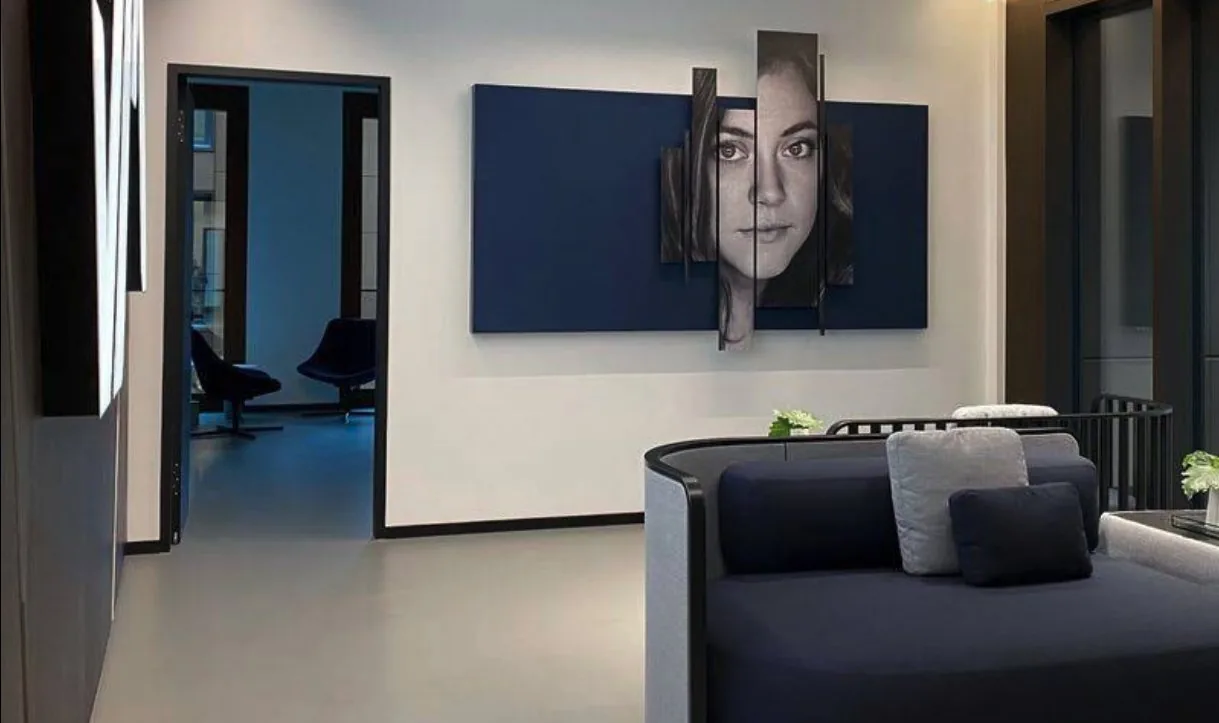 Opening 2027
Breite Straße 69, 40213 Düsseldorf (in the Neuer Stahlhof, corner of Graf-Adolf-Platz)
Until opening: preliminary talk in Frankfurt, Patient Care plans your travel.
Plan route Opening 2027
Lautenschlagerstraße 23, 70173 Stuttgart (2nd floor, step-free access)
Until opening: preliminary talk in Frankfurt, Patient Care plans your travel.
Plan routeMy name is Raquel Schulze Wischeler. I have basically worn glasses since I was 13. I was really nearsighted, you could say. Really, really. I could only see outlines without glasses. I had minus 6 in one eye, a diopter of minus 6, and almost minus five in the right one. I think everyone who wears contact lenses or glasses knows how stressful all of that is. The eye dries out completely. In the evening, when you are lying on the couch, you notice, okay, my eye is super tired, I really do not feel like doing anything anymore. Whether it is contact lenses or glasses. With that diopter, you have rather thick lenses, and you notice that over the day too. And just getting the feeling, or knowing, hey, I do not have to wear anything anymore, neither glasses that I always have to clean, nor contact lenses where I have to watch hygiene, that is an absolute liberation. And that felt more like a dream to me, and then I said, okay, now you dare to do it, and so I will do it.
Interestingly, I had already thought about having my eyes lasered about five years ago, but I was very afraid and then dropped the idea again. And lately I had big problems with my eyes because of chalazia, because my glands in the eyelids do not quite work, and so I had surgery twice. And then I said, okay, since I have already had surgery on my eye, you might as well dare it once more. And then I first just googled, came across dr. vision, saw, oh, there are really great reviews, and by coincidence my eye doctor had worked with him at the university hospital in Munich, and I had an eye doctor appointment beforehand and told her about it, I am getting my eyes lasered, and then she said, well, where? Then I told her the doctor's name. And then she said, yes, I know him, I worked with him. You can go there, he specializes in this, he is really great. And that took away the last bit of doubt for me.
And yes, then I came, had an appointment the next day. And right away I had the feeling that I was in the right hands. He sat down with me, explained all the risks to me, explained how it works, showed me the treatment room. And then the fear was somehow gone, and then I said, okay, I am doing it here. I was thrilled by the professionalism, first of the practice itself, which is superbly organized, and by the speed. You do not have long waiting times, you are examined, you have the feeling, okay, here they really examine thoroughly and extensively, and then of course it is explained to you on the screen, you can see it. So that was just totally professional for me. And so I felt safe right away.
Yes, my biggest fear was the eye itself. It is on the eye. And you have a reflex, a physical one. And the question of course was, okay, do I react, and does something go wrong because of that. But the fear was taken from me relatively quickly. I also talked about the fear. And then during the treatment I saw that the eye was held still. I did not feel that either. And then I calmed down relatively quickly. And I knew the eye was numbed. And so everything worked quite well.
I have no pain. I feel that something has happened to the eye, like a slight pressure, but it is one day after. I was already at work today, I have no pain.
Absolutely, so I can answer that question with yes, and go for it. It's not bad at all, it doesn't hurt at all, it's quick, and the healing process is pretty much there a day later. And it's an absolute quality of life. That's totally great.
I’m Teresa Schwenger, I’m 31 years old, I’m a project manager. I was nearsighted, so I didn’t see well at a distance, and at some point it was just super annoying with contact lenses, putting them in every morning, taking them out again in the evening. I think I wore contact lenses for about ten years, and then I also had the problem that my eye was no longer supplied with oxygen so well, which is why the little vessels grew further into the eye, and so I looked around for an alternative. Glasses were not an alternative for me, because I simply don’t like myself in glasses. It was always an issue with the swimming pool or the lake or the sea. Do you put your contact lenses in, can you dive, do you maybe lose a contact lens, and that was always really annoying. Or also when you stayed somewhere overnight, you always had your little contact lens case, your solutions and care products, which you had to take along, always a whole pack just for the contact lenses. I always found that very annoying, and also on long days, when I had put my contact lenses in very early, in the evening while watching TV I noticed, oh, this really annoys me now, I would like to take them out, and then watching TV with glasses on a couch, really very uncomfortable, and so that was a situation where I am now grateful that I will hopefully or probably never have them again.
And then I looked at which doctors in this area offer laser eye surgery, and I read through lots of reviews and looked at who is very good here. And the doctor here is really rated very, very highly, and I had a totally likeable first conversation with him and felt comfortable right away. I also saw all his awards, the FOCUS awards and so on, which reinforced my impression, and also lots of positive reviews, which I can confirm. So you feel very comfortable, and the work here is very professional. So it was a very good decision to come here, definitely.
Not quite so good. I was very nervous, had many worries and fears too. I would have liked to leave again right away on the day when I was sitting here. But I was received super kindly and warmly. Everything was explained to me well. Everyone was very warm, and they took the nervousness away. So I felt I was in good hands, and when it then started, the nervousness was already a bit less, because I knew that I was simply in good hands.
So I simply arranged the appointment, the first appointment, online, and then I got a call asking me to please stop wearing contact lenses from that point on, so that the eyes are already free of contact lenses, because things can still change there. Then the parking garage is right next door, you walk in here, and it is a very beautiful building and a very beautiful practice, definitely. I was welcomed warmly right away by the receptionists. Everything was explained to me well right away. I was given water and everything. Then I had the first tests. I was totally amazed at how many tests were done and with which devices. It's really incredible what names are on the devices and how expensive these devices are. But really everything was measured that I think can be measured in an eye. Then I had the conversation with the doctor. That was also really great, warm. He answered all the questions I had and took the time for me. I then said I would rather sleep on it for another night, because I am simply the type of person who plays it safe. But at home I actually already knew that I would like to have it done. The next day I called again and made a second appointment. The eyes were checked once more, again with a colleague of the doctor and with him. And then I had another informed-consent talk about what risks there are. I was able to ask my questions again and then got my treatment appointment very quickly. And on the day of the treatment, as I said, I was already here super nervous, but I was also welcomed very warmly. Many of my worries and fears were taken away.
Yes, exactly. So I got up this morning and I could see right away. That was my biggest worry, that I would no longer be able to see as I did before, but I could see perfectly right away. I also saw at a distance again. That was the exciting part in my case. I looked out of the window and also noticed the trees farther away. The outlines, which I otherwise always saw only like this, were clear and distinct. So it really is a change right away. I notice it totally, and it’s super nice.
Definitely, yes, absolutely. I felt super comfortable from the first second to the last. So definitely, if I ever have laser treatment again, then definitely here. I can only recommend it to everyone.
Yes, I definitely should have done it earlier, that's true, because I believe it really gives you a lot of quality of life back, and it is also good for the eyes. Of course, there is the treatment itself, but in the long run, as it was with me, because of the contact lenses, I had these tiny blood vessels, or I have them in my eye, because the eyes were not supplied well. Had I done this earlier with the lasers, it might not be as pronounced. So my appeal would be to do it earlier rather than too late.
So, my name is Zhao Xingshu, I come from China and have been working in Germany for 20 years. I have been nearsighted since childhood in China, and it has always bothered me a lot. In Germany I started doing sports and also tech. I work a lot with computers and my phone. And I always had to switch between glasses and contact lenses. And as I grew older, it became very, very unpleasant and also very time-consuming for me.
I have always wanted to find someone who is not only professional but can also offer good service. Then I read about it online and found the professor. Then I called him, and the appointment came very, very quickly. And the next day I was already here and met my professor. He made a very professional impression on me. And also really very nice and kind. And what I liked best is the speed of the services. And I think that is actually what is most lacking in Germany.
The first impression was not the typical eye doctor's practice but a very professional consulting company. Well, because I myself work in a technical role for consulting companies, the first moment felt a bit very different to me, but at the same time I liked it a lot, because I really like this customer-focused, patient-focused approach, the fast speed with the appointment, and the professional consultation. That was my first impression.
Of course, absolutely. I have already sent my husband here, and my child. Yes, and I think I would recommend it to all my Chinese friends in Frankfurt as well.
I am Dominic Boeschen, 26 years old, I actually come from the region here, from Fulda, and have now moved to Frankfurt for my job, and I was severely nearsighted at minus 8 diopters in both eyes. I have been nearsighted since about 11th or 12th grade in school and have always worn glasses. Lately it had become so bad that even with glasses I only reached 80% vision.
Accordingly, I had looked into alternatives. I actually did not wear contact lenses, simply because it became enormously expensive with these diopters and astigmatism. So I played sports with glasses. And the sweating alone is annoying, because the glasses slide back and forth.
If the glasses then do not sit properly or move slightly, you suddenly do not see quite sharply. That lasts a few seconds, and I quickly missed a ball that way. That was extremely annoying. But when I was at the swimming pool with friends, it was not possible without my friends keeping an eye on me.
Because I could not see them. As soon as they were about 50 cm away, I only saw blurry shapes. I could no longer recognize the face. I no longer knew who it was.
LASIK unfortunately no longer worked for me. Or rather, Prof. Dr. Shajari had not recommended any laser surgery, because it would have been too risky.
Instead, he recommended the ICL, which is a bit more expensive but has significantly fewer risks, and accordingly I was very happy with it. I am now one day after the second surgery and we have just reached 160% vision. But it is already a huge difference, just when I get up, that I do not have to put on my glasses before I can see anything. Instead, I get up and walk to the bathroom completely normally, get ready and head out. I had not been able to do that for so many years.
I cannot do sports yet, or am not allowed to yet, but that will also make an enormous difference. With these high diopters it was very hard to follow balls, because everything moved relatively hard to see and the eye had to correct quite a lot. So I am hoping that the ICL implantation will make it clearly better. You still have this glass ball on the eye. That makes vision a little restricted for now, because there are only a few holes you can look through deliberately.
Because of the glass ball itself everything is a bit darker, but you can already tell that it is getting sharp. When the glass ball is taken off and you do this test here, meaning they really check again how much you see now with the new eye, with the new lens, then you notice a huge difference. I could read the numbers at a distance right away, whereas, with my nearsightedness, it is hard to describe, I could not see anything at all. And then suddenly I can read in the distance. It is really hard to describe, it is completely different, a completely different world.
I actually had consulted several doctors. I was given different recommendations in part. Some said you could still use a laser. Then I spoke with Prof. Dr. Shajari.
I simply felt much better advised. Everything went much faster than with all the doctors I had visited and talked to, who would have had it paid completely privately by me as a statutory health insurance patient. But even there I had more the feeling that it was about selling me something quickly. They always recommended doing something. But I was not told which would necessarily be better; it was simply said that the most expensive is the best, more or less.
When you read up on the internet, you see a lot of bad reports. You very rarely see good reports on the practices' own websites. But now, in the end, I simply relied on how Prof. Dr. Shajari advised me and I am super satisfied.
The whole surgery took maybe three, four, five minutes. Completely painless. I didn't feel anything. It was a bit strange because you looked into the light the whole time, but all good.