 dr.vision
+3 D
is considered well established, in individual cases with a favorable cornea up to about +4 D.
Start here
What suits you?
Find out in 2 minutes which procedure suits your eyes.
Start the Suitability CheckOr by age:
< 45yearsGet rid of glasses & contact lenses 45–64yearsGet rid of reading glasses 65+yearsCataract & glasses-free★★★★★ 5.0 · 376 Google reviews · 20,000+ procedures
Decide well
What you should know beforehand.
Who operates?Prof. Dr. Mehdi ShajariFOCUS Top Doctor · operates on every patient personally What does it cost?Laser from €3,498 · Lenses from €6,886Prices for both eyes Is it safe?Safety & risks When will I be fit again?Work, sports, driving Would you rather read in peace first?Decision Guide Freedom from GlassesProcedures
Laser or lens?
Laser eye surgery
SMILE ProSmartSightFemto-LASIKTrans-PRKPRKPresbyond (laser away your reading glasses)All laser procedures at a glanceLaser procedures compared ›Lens surgery
ICLLens exchange (reading glasses)Cataract surgery with premium lensLens types: trifocal, EDOF, toricLens types compared ›Start here
Something wrong with your eyes?
A thorough eye check-up with us clarifies what is behind it.
Book an eye check-up★★★★★ 5.0 · 376 Google reviews
Freedom from glasses · Farsightedness
Laser treatment works. But with narrower limits.
Farsightedness can be treated with a laser, with Femto-LASIK well supported up to about +3 D, in individual cases up to +4 D. Above that, an implantable lens helps, or from about age 45 lens exchange. Prof. Dr. Mehdi Shajari operates on every patient personally.
 12× FOCUSTop Doctor
Yes, with Femto-LASIK. Well established up to about +4 D, above that with a lens.
+3 D
is considered well established, in individual cases with a favorable cornea up to about +4 D.
1
Main procedure: Femto-LASIK. SMILE Pro is not used for farsightedness in Germany.
latent
Part of the farsightedness only shows up with drops. Without this measurement, too little is corrected.
45 years
lens exchange is often the better solution for farsighted people, because it corrects distance and near at the same time.
4.298 €
Femto-LASIK, guide price for both eyes. ICL from €6,886, lens exchange from €6,998.
376 reviews. Average 5.0.
“Excellent service and very friendly examination and treatment”
“Treatment at the highest medical level, which I can recommend without reservation.”
“I came to Prof. Dr. Shajari because my diopter values are in the double digits.”
“Honestly, everything was first-class, and I practically did not have to wait. A fantastic experience from start to finish!”
Four patients. In their own words.
I wanted my life back – without glasses, without headaches.
Now I can already read things again.
I was allowed to take off the bandage that very afternoon.
I saw wonderfully bright light.
Farsightedness in five answers.
For anyone with three minutes. Each answer leads to the detailed chapter.
The eye is slightly too short, the image forms behind the retina. Young eyes compensate with their own lens, often with headaches. Over the years this no longer works.
UnderstandWith Femto-LASIK well established up to about +4 D. Above that, the result becomes less certain; then ICL or lens exchange are better.
LimitsThe laser has to make the center of the cornea steeper instead of flattening it. The cornea compensates for part of it again. That is why regression and enhancement are more common.
The explanationFarsighted people need reading glasses earlier and then also lose distance vision. From about 45, lens exchange is often the best solution, because it corrects both.
By ageGuide prices for both eyes: Femto-LASIK €4,298, ICL from €6,886, Presbyond €6,398, lens exchange from €6,998. Patients with statutory health insurance pay themselves.
CostsAn eye that is too short and constantly readjusts.
In farsightedness (hyperopia), the eye is too short for its refractive power. The focal point lies behind the retina. The eye's own lens already has to focus extra for distance, and even more for near. That takes effort, every day.
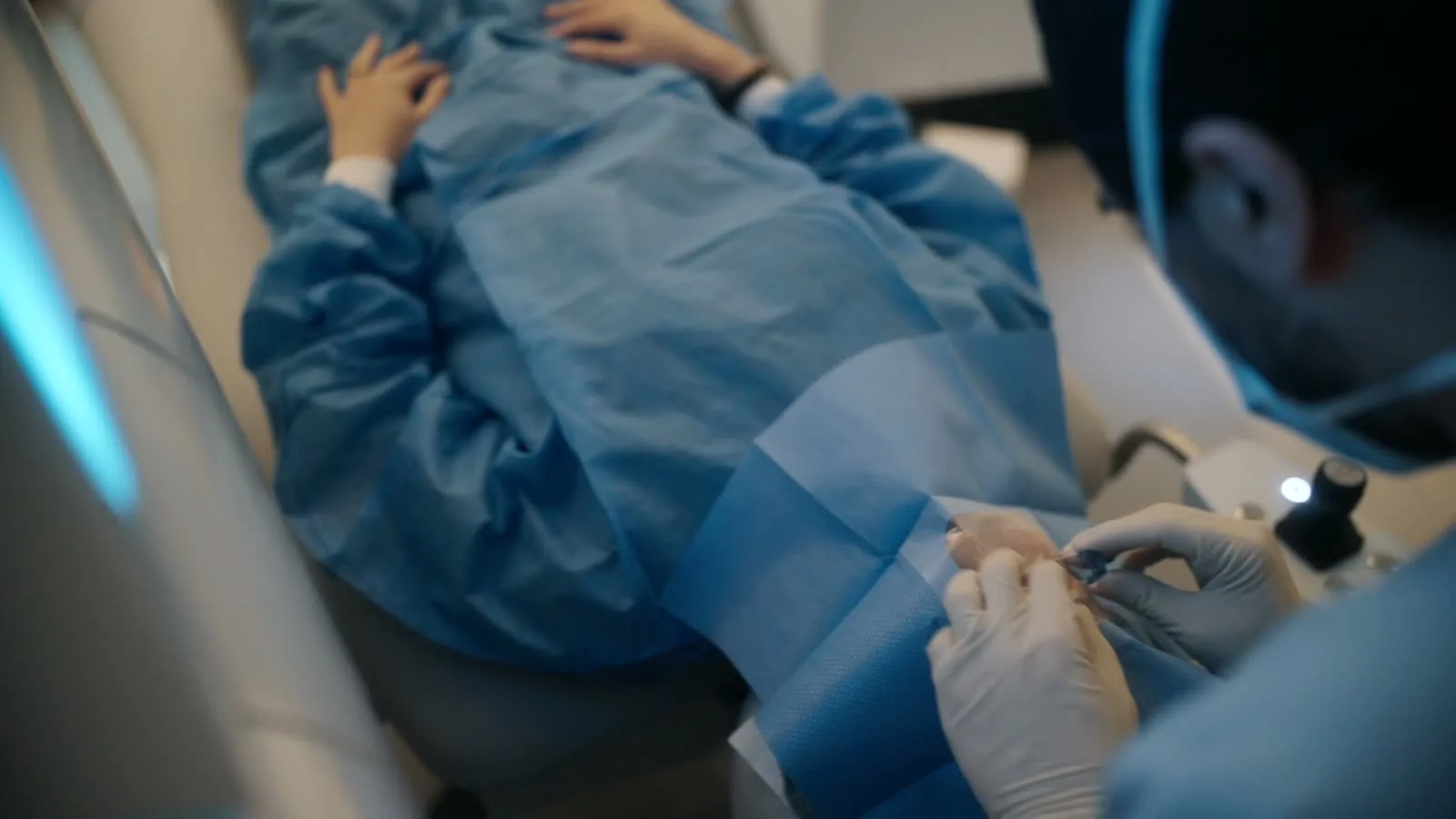
evening
Especially after screen work or reading. Sharpness is often good, but tiring. Some only notice it when driving at dusk.
1 mm
If the eye is one millimeter too short, that corresponds to roughly +3 D. Less often, the cornea is too flat. Farsightedness is congenital and barely increases in adulthood; it only becomes more noticeable.
≠
Presbyopia affects everyone from about 45. Farsighted people just notice it earlier, often as early as their late 30s. More: Getting rid of reading glasses.
| Feature | Farsightedness | Presbyopia |
|---|---|---|
| Cause | Eye too short, congenital | Lens loses elasticity |
| Who | some people, any age | everyone from about 45 |
| In the glasses prescription | Plus value under SPH | Addition under ADD |
| Distance without glasses | good at first, blurry later | unchanged |
| Correction | Femto-LASIK, ICL, lens exchange | Presbyond, lens exchange, reading glasses |
From 45, many people have both. Then we plan distance and near vision together; see Farsightedness by age.
The lens tightens to bring the focal point forward. Young eyes usually manage this, but only with constant effort. Many describe it as pressure behind the eyes, reading that becomes tiring after an hour, or fluctuating sharpness in the evening. Glasses relieve the strain; a correction makes the relief permanent.
Plus in the prescription. What that means for you.
In farsightedness, SPH shows a plus value, astigmatism appears under CYL, and from about 45 a reading addition appears under ADD. Set your values: you will see how much your eye has to compensate for every day, how strong the farsightedness is and which procedures come into question at these values and at your age.
Enter the values from your glasses prescription. The assessment adjusts immediately.
The plus stands for farsightedness. The larger the number, the stronger it is.
The astigmatism. If nothing is written there, it is 0. A plus cylinder is converted; if in doubt, ask your optician.
Your age
Your values, assessed
Guidance, not a diagnosis. With farsightedness, the glasses prescription often shows only part of it: we measure the hidden part with drops. Corneal curvature, anterior chamber depth and tear film also matter. You can find the detailed check under Suitability Check.
| Strength | Diopters | What you notice | What usually fits |
|---|---|---|---|
| Mild | up to +2 D | when young often nothing, from the late 30s first problems with reading | Femto-LASIK, for very low values Trans-PRK; from 45 Presbyond or lens exchange |
| Moderate | +2 to +5 D | tired eyes, headache, blurry near vision early on | up to about +4 D Femto-LASIK, above that ICL; from 45 lens exchange |
| High | above +5 D | blurry in the distance too without glasses | ICL if there is enough space in the eye; from about 40–45 lens exchange |
For the laser limit, the strongest plus value counts. Terms such as sphere, cylinder, ADD and cycloplegia are explained in the glossary.
The part your glasses prescription does not show.
Young eyes keep their lens slightly tensed all the time and so hide part of the farsightedness, in some people 1–2 D. At the optician, only the visible (manifest) part is measured. If we corrected only that part, some of the farsightedness would come back in a few years. That is why we also measure with drops that relax near focusing for a few hours.
visible
The part your eye can no longer compensate for by itself. It is listed in the glasses prescription.
hidden
This part only shows up under cycloplegia, that is, with relaxing drops. It becomes manifest over the years; this is why farsighted people around 40 “suddenly” see worse.
Sum
We plan the correction on this basis. How much of the latent part is treated as well, we decide individually, so that you are not overcorrected in the short term.
We instill a medication that temporarily paralyzes the ring muscle of the lens (cycloplegia) and dilates the pupil. After about 30–45 minutes, we measure the glasses values (refraction) again. Afterward, you see blurry up close for a few hours and are sensitive to glare. Please do not come in your own car and bring sunglasses.
If only the manifest value is corrected, the lens gradually relaxes after the procedure. The hidden part becomes visible, and a slight farsightedness remains. Conversely, a correction that is too generous can cause slight nearsightedness at first. The right balance depends on age, occupation and reading habits.
A laser, a lens in front, a lens instead.
Femto-LASIK is the laser procedure for farsightedness, Trans-PRK only for low values. Above that, the ICL inserts an additional lens; from about 45, lens exchange replaces the eye's own lens. Which route fits is decided by plus value, age, cornea and space in the eye. Here is the most important information for farsighted people; the details are on the procedure pages.
Femto-LASIK: the center becomes steeper.
A femtosecond laser cuts a hair-thin corneal flap. Underneath, the excimer laser removes tissue in a ring around the center, so that the center of the cornea becomes steeper and refracts more strongly. The flap is laid back and adheres by itself. This is how we correct farsightedness up to about +4 D, with astigmatism corrected at the same time.
SMILE Pro is not used for farsightedness in Germany; the technique for nearsighted people cannot simply be reversed.
Everything about Femto-LASIKTrans-PRK: without a cut, with limits.
Trans-PRK removes the cornea from the outside, without a flap. In farsightedness, the surface heals less evenly over the ring-shaped removal, so we use it only for low plus values, for example when the cornea is too thin for a flap or martial arts rule out a flap. The first days are more painful.
ICL: high plus values, without removal of tissue.
The ICL is a soft lens placed behind the iris and in front of the eye's own lens. It corrects farsightedness up to about +10 D without changing the cornea, and it can be removed again. The catch with farsighted people: short eyes often have a shallow anterior chamber. If there is not enough space there, the ICL is ruled out.
The measurement at the pre-operative examination shows whether your eye has enough space.
Everything about ICLLens exchange: distance and near in one.
From the mid-40s, farsighted people usually lose near and distance sharpness at the same time. An artificial lens in place of the eye's own corrects the farsightedness regardless of its level, and on request, with a trifocal or EDOF optic (extended depth of focus), near vision as well. Side benefit: the artificial lens is thinner than the eye's own and creates more space in the eye, which helps with a narrow chamber angle. A cataract can no longer develop afterward.
Laser alternative from 45 for low values: Presbyond (€6,398). Weighing it up: Lens exchange or Presbyond?
Everything about lens exchangeWithout surgery: relieves the strain as long as you wear them.
Glasses take the work off the eye, and headaches and burning often ease. At higher values, plus lenses magnify the image and are thick; contact lenses are optically more pleasant. From 45, progressive glasses usually come into play. Eye training does not lengthen the eye and does not replace a correction.
Making steeper is harder than flattening.
In nearsightedness, the laser removes tissue in the center and the cornea becomes flatter; this works up to −8 D. In farsightedness, the center has to become steeper. For that, a ring at the edge is removed, over a larger area. The cornea partly refills this ring with its surface layer. That is why we laser farsightedness up to about +4 D.
The ring-shaped removal needs more diameter than a central removal. With a small or very steep cornea, this reaches limits sooner.
The surface layer (epithelium) thickens in the removed ring. Part of the correction is lost this way in the first months. We plan for it, but it cannot be prevented completely.
The higher the plus value, the steeper the center and the more likely halos and loss of contrast in the dark. Above +4 D, the disadvantages outweigh the benefits.
After laser treatment for farsightedness, more patients need an enhancement than after treatment for nearsightedness. We discuss this openly beforehand. More: Enhancement.
Right after the procedure, farsighted people often see slightly nearsighted at first, because we plan for some regression. Sharpness settles over a few weeks.
The ICL up to about +10 D with enough space in the eye, from about 45 lens exchange for any strength. Neither changes the cornea.
Swipe the table sideways to see all options.
| Criterion | Femto-LASIKLaser with flap | Trans-PRKLaser at the surface | SMILE ProLaser, small incision | ICLlens in front of your own | Lens exchangeartificial lens instead of your own |
|---|---|---|---|---|---|
| Farsightedness | up to about +4 D | low, up to about +2 D | not in use | up to +10 D | any strength |
| Astigmatism in addition | yes | low | – | toric up to 6 D | toric lens |
| Age | from 18, stable values | from 18 | – | about 21–45 | usually from 45 |
| Special requirement | corneal thickness and curvature | very low values | – | deep anterior chamber, often tight in farsighted people | healthy retina |
| regression possible | more common than with nearsightedness | more frequent | – | hardly | hardly |
| Near vision from 45 | Reading glasses or Presbyond | Reading glasses | – | Reading glasses | corrected as well with trifocal/EDOF |
| Back to work | usually after 1–2 days | usually after 4–5 days | – | usually after 1–2 days | usually after 2–3 days |
| Reversible | no | no | – | yes, removable | no |
| guide price, both eyes | €4,298 | €3,498 | – | from €6,886 | from €6,998 |
Limits according to the recommendations of the Refractive Surgery Commission (KRC) of DOG and BVA (as of 05/2024, section 1.2: LASIK for hyperopia up to +3 D, borderline range up to +4 D) and the procedure pages of dr.vision. More on the laser: Femto-LASIK, for comparison: Laser procedures compared.

Plus values at the limit?
Send us your glasses prescription.
Jana from our Patient Care team assesses your values in advance via WhatsApp, usually within 10–15 minutes, and plans the pre-operative examination with drop measurement. Phone reachable 24 hours, WhatsApp Mon–Fri 8:00–19:00, Sat 9:00–15:00.
Hidden at 25. Unmistakable at 45.
Farsightedness itself stays almost the same in adulthood. What changes is the power of the eye's own lens to compensate for it. That is why the right correction for farsighted people depends more on age than for nearsighted people. This is how it typically goes:
| Age | What is typical | What usually fits |
|---|---|---|
| Children | mild farsightedness is normal and decreases with growth; higher values can cause strabismus or a lazy eye | eye examination, glasses if needed: pediatric eye doctor |
| 18–34 | much is compensated unnoticed, symptoms more likely at the screen | Femto-LASIK up to about +4 D, above that ICL; measurement with drops is decisive |
| 35–44 | the latent part becomes visible, reading becomes tiring earlier than for peers | Femto-LASIK if distance vision bothers you; plan for reading glasses from the mid-40s |
| 45–54 | near and often distance vision too blurry without glasses | Lens exchange for distance and near, or Presbyond for low values |
| from 55 | progressive glasses, first clouding of the lens possible | Lens exchange, with cataract as cataract surgery with a premium lens |
Then Femto-LASIK is the direct route. From the mid-40s you need reading glasses like everyone else, as a farsighted person somewhat earlier.
Then it is rarely worth lasering only the distance. A lens exchange solves distance and near together. More: Getting rid of reading glasses.
In a short eye, the drainage of aqueous humor is often narrow. With age, the eye's own lens becomes thicker and can narrow the angle further; an acute rise in pressure is rarely a threat. We measure the angle at every pre-operative examination. More: Glaucoma.
From glasses prescription to clear vision. In four steps.
The process is similar for all procedures, with one difference: for farsightedness, we always measure with drops as well. The procedure itself takes minutes. If you come from farther away, you can do everything in under 72 hours.
Step 1 of 4
Assess your values, make an appointment.
Patient Care clarifies the process, costs and appointment in advance, free of charge, by phone or WhatsApp.
Place your valuesStep 2 of 4
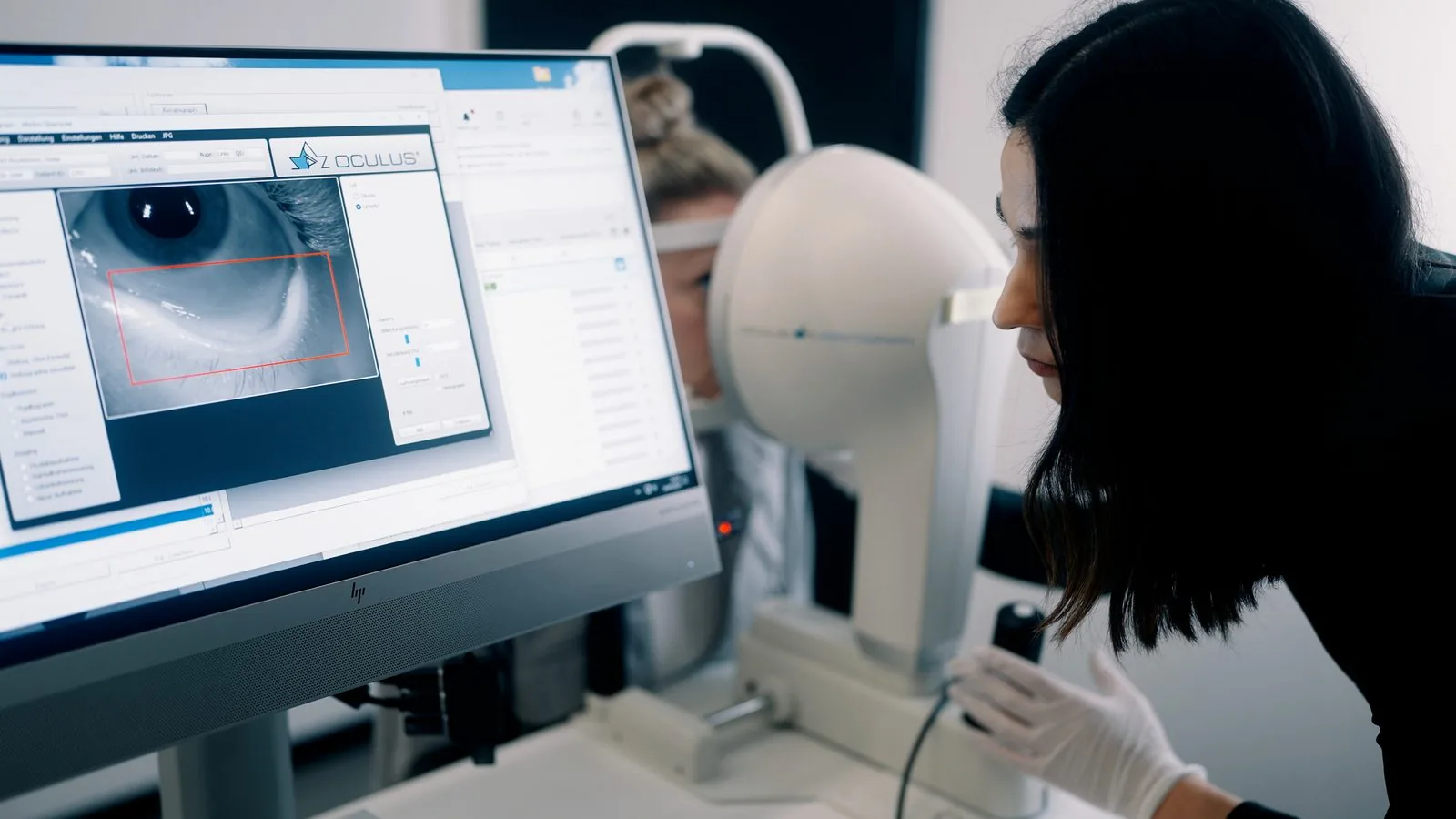
Measuring the hidden farsightedness too.
After the drops, you see blurry up close for a few hours and are sensitive to light: please do not drive yourself. You go home with a recommendation and a cost estimate.
Step 3 of 4

Awake, painless, both eyes in one appointment.
Do not drive yourself afterward. With ICL and lens exchange, the eyes are usually treated on separate appointments.
Step 4 of 4
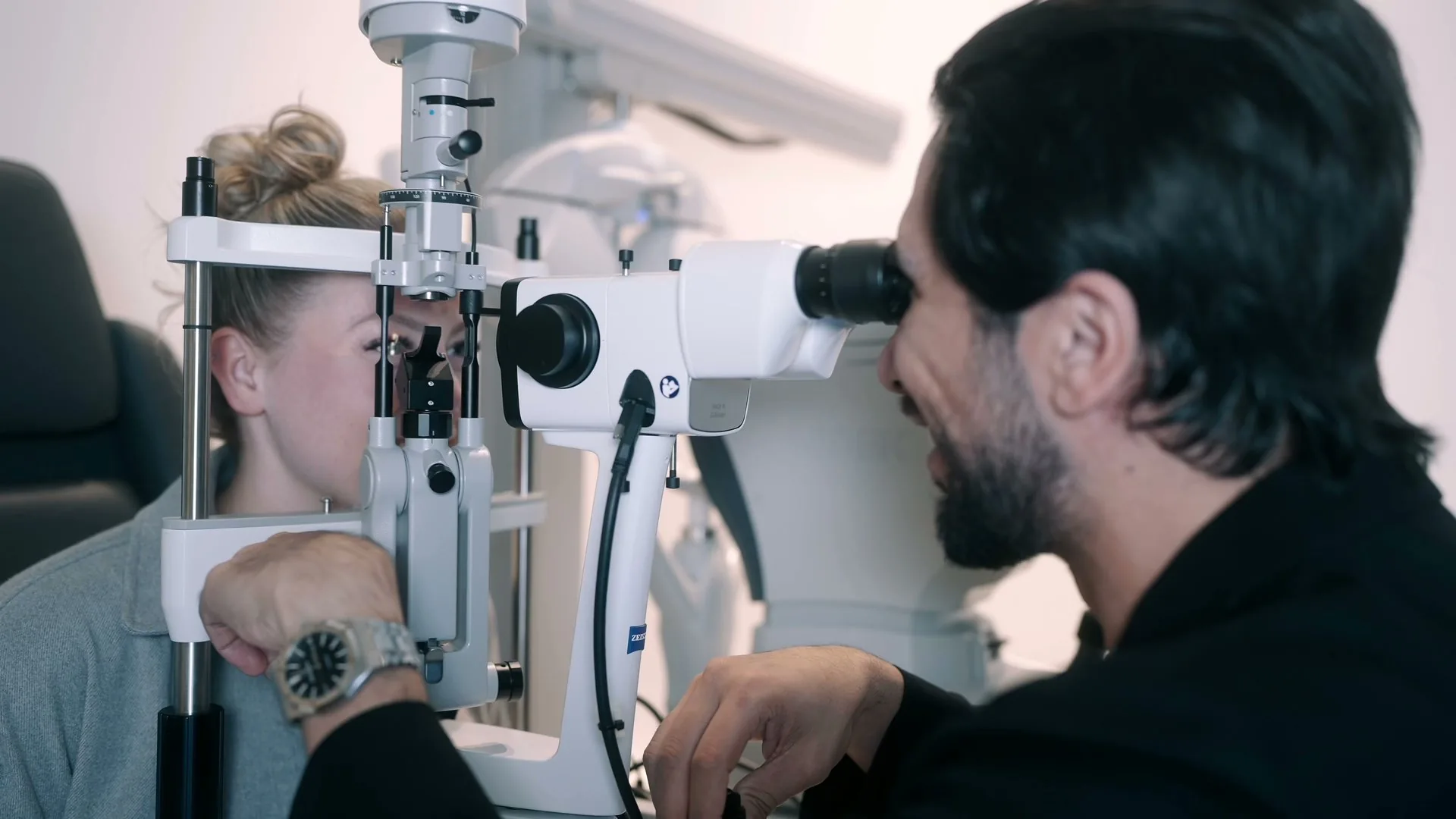
Follow-up check the next day, then back to everyday life.
Emergency number around the clock. Patients from afar can have later follow-up checks with their own eye doctor.
| Activity | From when | Note |
|---|---|---|
| Sharp vision | usually fit for everyday life the next day | often slightly nearsighted at first, final sharpness after weeks to a few months |
| Work (office) | usually after 1–2 days | ICL usually 1–2 days, lens exchange usually 2–3 days |
| Driving | after the follow-up check, if visual acuity is sufficient | at night only once halos no longer interfere |
| Sports | usually after 1 week | Martial arts and ball sports after consultation |
| Swimming, sauna | after 2 weeks | only after healing |
| Eye makeup | after 1 week | use new products |
Everything in detail: When am I fit again?
During the procedure you feel no pain thanks to drops, only pressure. After Femto-LASIK, the eyes feel scratchy and water for a few hours. After Trans-PRK, the first 2–4 days are clearly more uncomfortable. ICL and lens exchange are usually barely noticeable afterward.
Rarely serious. Regression is the main issue.
Typical for farsightedness is that part of the correction can be lost in the first months. The most common side effect is dry eyes in the first weeks, more often after Femto-LASIK than after SMILE Pro. Serious complications such as infections are very rare. Overview: Laser eye surgery: risks.
The cornea partly refills the ring-shaped removal, a remainder of farsightedness returns. Usually minor.
Frings A et al.: LASIK and PRK in hyperopic astigmatic eyes: is early retreatment advisable? Clin Ophthalmol 2016;10:565–570.
generally about 2 in 100 with laser treatment; somewhat more common with farsightedness.
Measure total farsightedness with drops, plan for regression, at the limit prefer ICL or lens exchange. More: Enhancement.
The flap cut severs corneal nerves. The eyes feel dry, gritty or tired.
common in the first weeks
usually subsided after 3–6 months; rare with ICL and lens exchange.
Measure the tear film beforehand and treat it, artificial tears in the first weeks. More: Dry eyes after laser treatment.
Rings or rays around lights, because the center of the cornea is steeper and the pupil is larger at night.
common at first
more likely to remain with higher plus values.
Measure the pupil in the dark, large treatment zone, no laser above +4 D.
Wrinkles in the flap or cells growing in underneath, rarely displacement after a blow to the eye.
rare
Butt AB et al.: Incidence of femtosecond laser-assisted LASIK flap complications: a systematic review. J Cataract Refract Surg 2026.
Femtosecond laser instead of a blade, check on day 1, protection from rubbing in the first days.
Germs get into the fresh wound. Signs: increasing pain, redness, worse vision in the first days.
under 1 in 1,000
very rare with all laser procedures.
Sterile procedure, antibiotic drops, check on day 1, emergency number around the clock.
Frequencies from the literature.
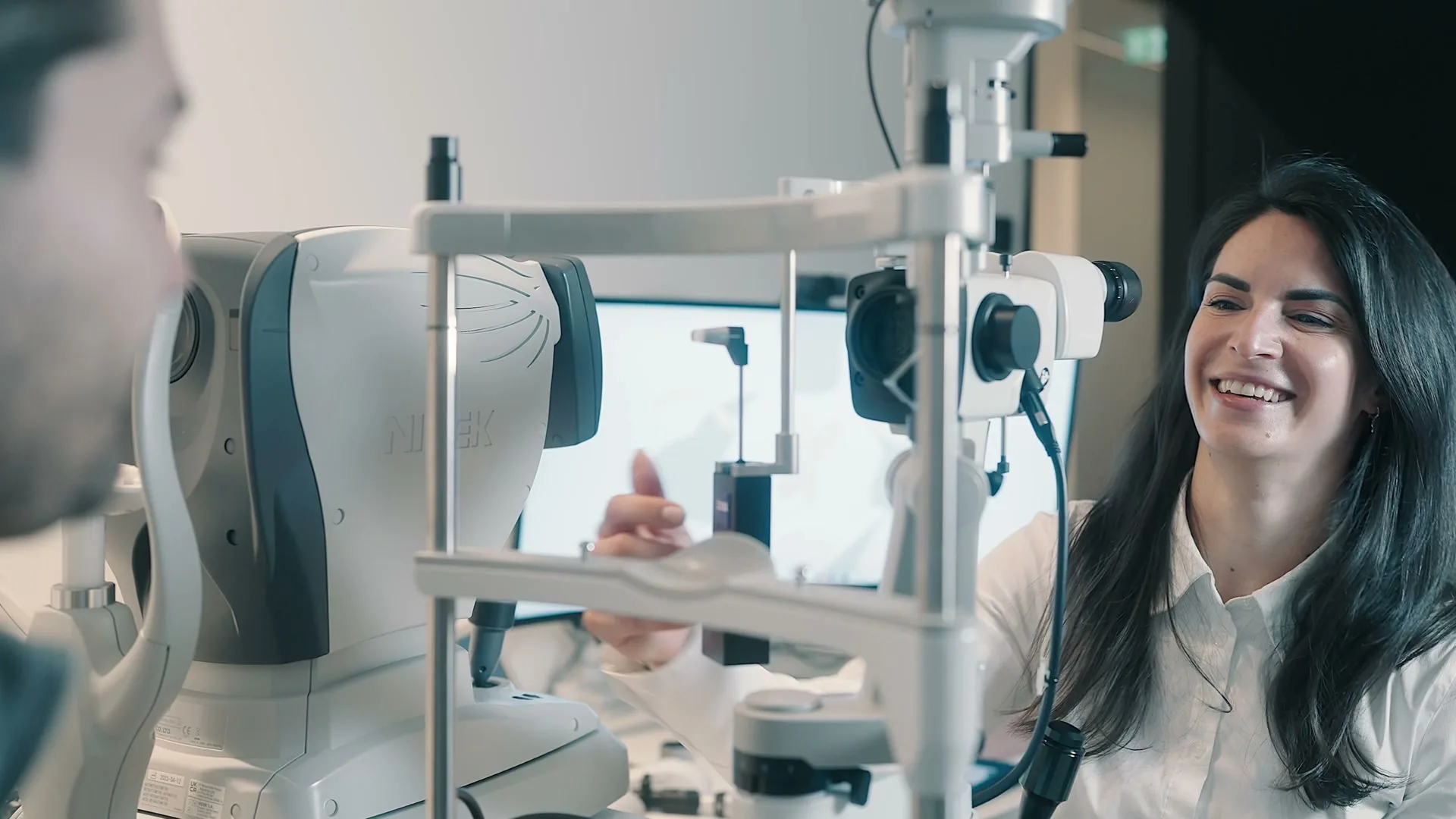
Because here “no laser” is also an answer.
Femto-LASIK, ICL and lens exchange from a single source: at +3.5 D and age 44, you get an honest weighing of options instead of the one procedure that happens to be on offer. One surgeon, over 20,000 procedures, 5.0 stars from 376 reviews.
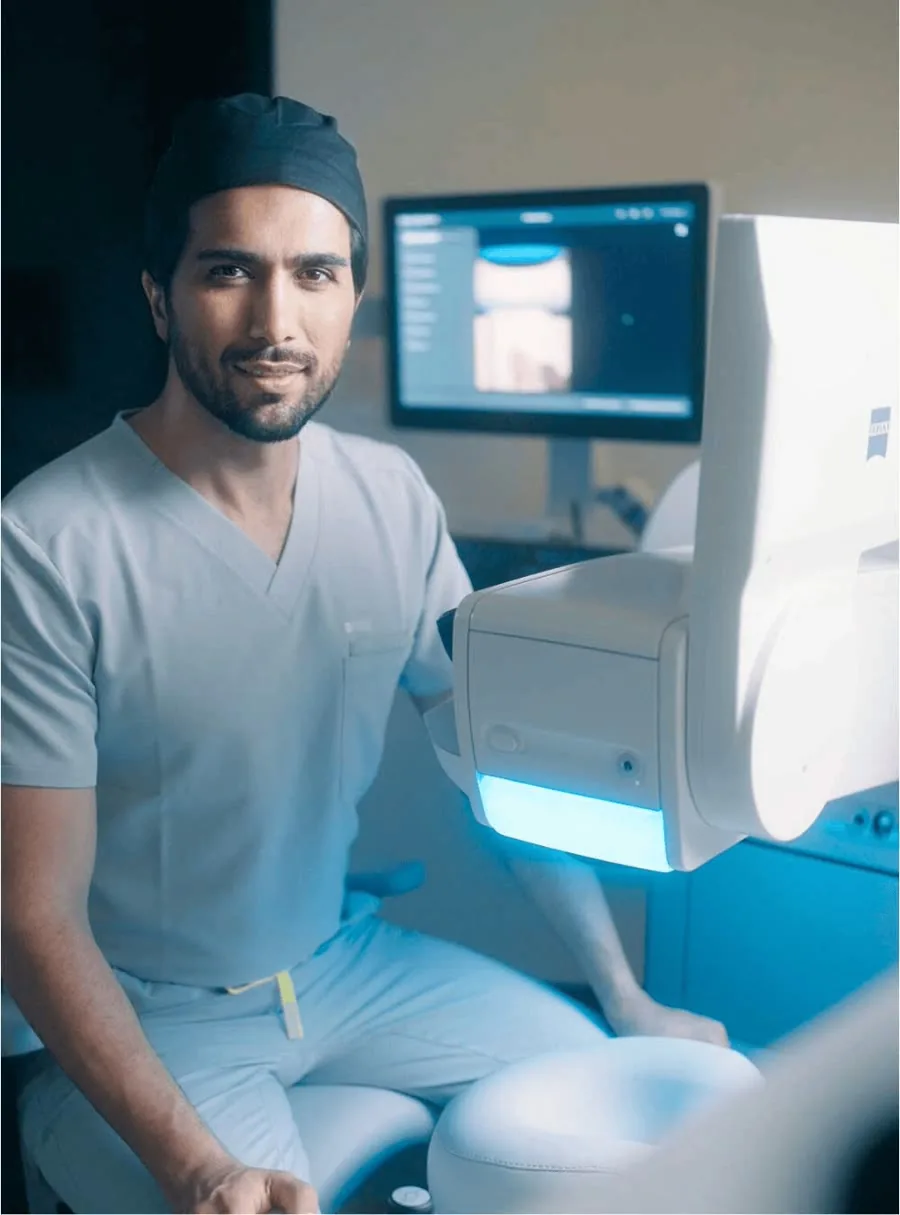
Every procedure: Prof. Dr. Mehdi Shajari. Personally.
Prof. Dr. Mehdi Shajari is a specialist in ophthalmology with a professorship and habilitation at the University of Frankfurt, has published numerous papers on freedom from glasses, teaches and has trained several colleagues in this field. Especially with farsightedness, where laser, ICL and lens exchange are close together, it matters that one surgeon masters all three. At dr.vision he treats you himself, not a changing team.
“Up to about +3 diopters I correct farsightedness with Femto-LASIK. Above that, or from about 45, I tend to recommend a lens, because lens exchange corrects distance and near at the same time.”
Prof. Dr. Mehdi Shajari
From €3,498 for both eyes, depending on the procedure.
Guide prices for both eyes: Femto-LASIK €4,298, Trans-PRK €3,498 (low values only), Presbyond €6,398, ICL from €6,886, lens exchange from €6,998. Billing is private under the German fee schedule for physicians (GOÄ); you receive the written cost estimate after the pre-operative examination. Financing is possible.
| Procedures | For which farsightedness | guide price, both eyes | More |
|---|---|---|---|
| Femto-LASIK | up to about +4 D, individual cases +4 | €4,298 | Femto-LASIK |
| Trans-PRK | only low values | €3,498 | Trans-PRK |
| Presbyond | from about 45, low values plus near vision | €6,398 | Presbyond |
| ICL | above +4 D up to +10 D, under 45 | from €6,886 | ICL |
| Lens exchange | any strength, from about 45 | from €6,998 | Lens exchange |
Included in the guide price: pre-operative examination, procedure by Prof. Dr. Mehdi Shajari and aftercare. You can calculate your monthly installment at Financing & monthly installment; all prices under Prices & costs.
Health insurers do not usually pay for the correction of farsightedness. dr.vision is a private practice; you pay yourself, after a cost estimate. More: Statutory health insurance.
Many private health insurance (PKV) plans reimburse in full or in part, depending on the plan and findings. For lens exchange, the situation is often different than for laser treatment. With our cost estimate, you can clarify in advance with your insurer what it covers. More: Private health insurance, Beihilfe.
You can claim the costs as extraordinary expenses in your tax return. Whether and how much the tax office recognizes depends, among other things, on your reasonable burden. More: Taxes.
Go deeper.
This page is the navigator for farsighted people. The procedure pages explain each procedure in detail, with process, risks and results:
The laser procedure for farsightedness, step by step.
To Femto-LASIK ProceduresDistance and near in one procedure, from about 45.
To lens exchange ProceduresLaser for distance and near with low values from 45.
To Presbyond SituationWhat is possible from 45, also for farsighted people.
Learn more Refractive errorWhen a high cylinder comes on top of the plus value.
Learn more Refractive errorThe counterpart: procedures and limits for minus values.
Learn moreStill have questions?
“These are the questions I hear most often from farsighted people in consultation hours. Here are my answers.” Prof. Dr. Mehdi Shajari
Yes, usually with Femto-LASIK. The range up to about +4 D is considered well established. SMILE Pro is not used for farsightedness in Germany. Above that, the ICL or, from about 45, a lens exchange comes into question.
The standard is a range up to about +4 D. Above that, the result becomes less stable and the quality of night vision gets worse. What matters are your measured values, above all the corneal curvature.
In nearsightedness, the center of the cornea is flattened; in farsightedness, it has to become steeper. For that, the laser removes tissue in a ring at the edge. The cornea partly compensates for this again, which is why part of the correction is more often lost.
No, SMILE Pro is used in Germany only for nearsightedness and astigmatism. For farsightedness, Femto-LASIK is the laser procedure of choice, and with low values Trans-PRK as well.
Farsightedness is a difference in build: the eye is too short, and it exists from birth. Presbyopia affects everyone from about 45 because the lens loses its elasticity. Farsighted people notice presbyopia earlier because they already have to readjust.
The part of farsightedness that young eyes compensate for unnoticed with their own lens. It only shows up when near focusing is relaxed with drops. That is why we also measure under cycloplegia before every correction.
It is a mild to moderate farsightedness. At 25, many people still compensate for it, often with tired eyes or headaches at the screen. From about 40, the power of the lens is no longer enough, and then near vision first and later distance vision becomes blurry.
Usually from about 45, with higher values and beginning presbyopia somewhat earlier. Lens exchange corrects distance and, on request, near vision in one procedure and prevents cataract.
Mild farsightedness is normal in children and is often outgrown. Higher values or differences between the eyes can lead to strabismus or a lazy eye and should be examined by an eye doctor early.
More often than with nearsightedness, because the cornea compensates for part of the correction again. It is usually minor. With higher values, somewhat more patients need an enhancement than after lasering nearsightedness.
Femto-LASIK takes approx. 20 minutes for both eyes, and the eyes are numbed with drops. Afterward they feel scratchy and water for a few hours. Most people can work after 1–2 days; full sharpness often comes somewhat later in farsighted than in nearsighted people.
Guide prices for both eyes at dr.vision: Femto-LASIK €4,298, Trans-PRK €3,498, ICL from €6,886, lens exchange from €6,998, Presbyond €6,398. You receive the written cost estimate after the pre-operative examination.
Medically reviewed by Prof. Dr. Mehdi Shajari · As of October 2026
Not ready yet? Everything to read later and pass on.
Arrives by e-mail in about 60 seconds. No newsletter, just the guide and, if you wish, a follow-up from Patient Care. Privacy policy
How would you like to continue?
You make the appointment by phone or online. The first step is a pre-operative examination with Prof. Dr. Mehdi Shajari: diopters, corneal thickness, tear film, retina and a conversation about which procedure suits you. You go home with a written recommendation and a cost estimate.
In Frankfurt, Junghofstraße 16 · with corneal tomography
Our locations.
 Opening hours
Junghofstraße 16, 60311 Frankfurt am Main
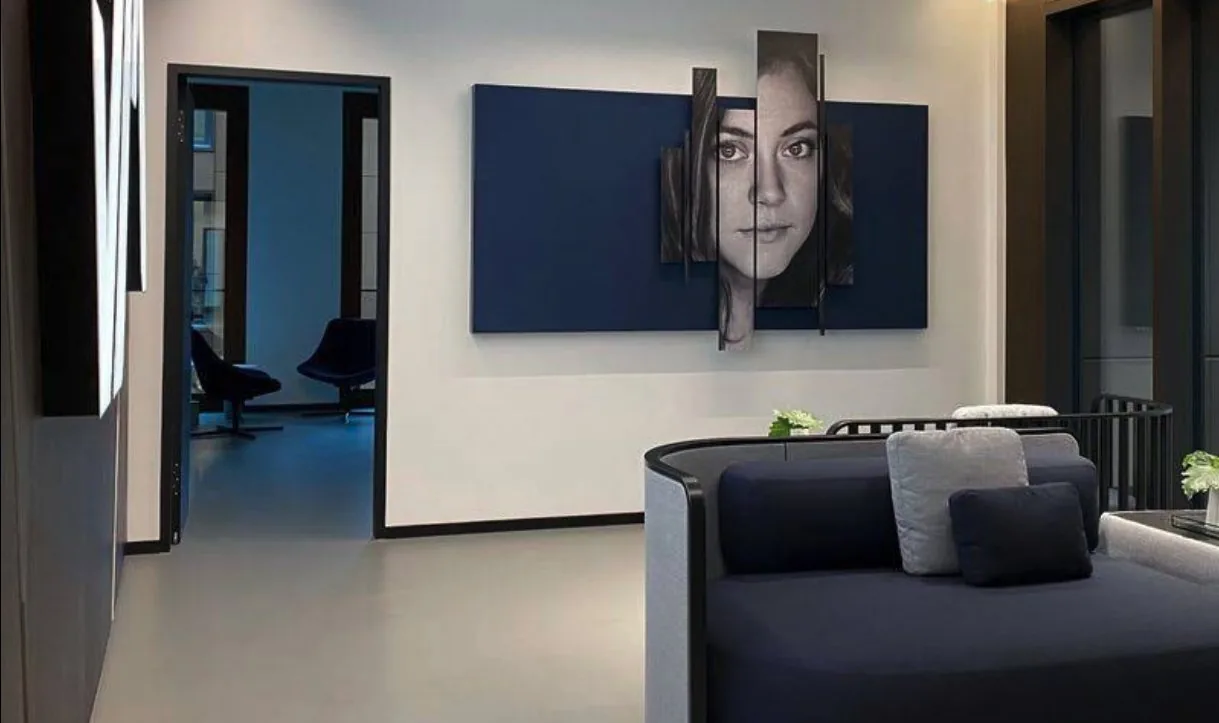 Opening 2027
Breite Straße 69, 40213 Düsseldorf (in the Neuer Stahlhof, corner of Graf-Adolf-Platz)
Until opening: preliminary talk in Frankfurt, Patient Care plans your travel.
Plan route Opening 2027
Lautenschlagerstraße 23, 70173 Stuttgart (2nd floor, step-free access)
Until opening: preliminary talk in Frankfurt, Patient Care plans your travel.
Plan routeMy name is Simone Richter. Before the treatment I had the problem, above all or increasingly, that I could not see well at all anymore at near and intermediate distance, which bothered and limited me extremely. For one thing at work, but of course also in private life, when you go hiking and want to read a map and can't see anything anymore and your glasses fog up or you lose them or break them, which I'm a great artist at. That bothered me a lot, limited me a lot. On top of that, wearing glasses felt to me like it triggered migraines, so the headaches bothered me a lot too, and that is why I decided on the surgery.
I got a lens exchange, so a new trifocal lens, which also comes with certain compromises, I have learned you always have to make a compromise, and and since the topic of freedom from glasses was very important to me, I decided on the trifocal lens.
So I actually came across Professor Shajari on the internet and had the first appointment with the intention of slowly getting used to the idea of progressive glasses. That would have been the next step. I had not dealt with the topic of surgery at all beforehand, because basically I am rather against having anything operated on without great need. And then in the conversation I felt, how should I put it, well taken care of. I did not feel pushed in any direction at all, just got information I did not have before. And with that I started to look into the topic. In between I also dropped it again, but then, through everyday activities, everything I just mentioned, hiking, swimming, cycling, where glasses really torment me, I thought, okay, I'll try this, and I also simply built up trust over time. That was all something that gave me a lot of reassurance, because Professor Shajari always took a lot of time. You know how it is with doctors, and I understand it too. There is a lot of pressure with queues of patients, and in the end you probably always have to answer the same questions. But I always had the feeling that there was enough calm to answer my questions.
The actual course of the surgery, from the pre-operative examinations to the appointment, goes very fast, it is very easy, much easier. I panicked a lot the evening before the first eye and thought, oh my God, how will this go? My head will be screwed down Hannibal Lecter style so that I don't flinch. And I worked myself into my horror scenarios. And it was all actually very relaxed. A very, very nice, good-humored team in the surgery center as well, which I think also helps a lot as a patient. And yes, it goes in no time, you don't feel anything, I think I can say that, and you go home again and everything is fine.
What was very astonishing for me was that I actually did not feel it at all, so during the surgery 0.0 pain. There was one point where Professor Shajari said, now comes a little pressure, and a little pressure came. To call that pain would be saying too much, but you really don't feel more than that. I must say, though, that between the two surgeries, from the first to the second eye, I felt even more unsure, even though that was always well handled and explained.
I think before the surgery it was also very important that, in my perception, it was explained realistically. It was explained well that it is a compromise, that in some ranges of vision it would get worse, but that in sum a visual ability that allows freedom from glasses will result. Now of course that is very subjective. So what does it mean, I will see worse in some ranges? That was a really big panic point for me and it stayed very strong in the time from the first eye to the second eye, because after the first eye I of course had the issue that I had one eye not operated on that doesn't see well and one operated eye that sees so-so after the surgery. Already much better. I also got a smile from people often, because on the second day I could already read with the operated eye, which would have been unthinkable before the surgery and which was also a really big pain point for me. But this panic still led me to this fear, what have you done, you had something operated on for the worse, because of course with glasses an operated and a non-operated eye create a really awkward situation. And now, today, day one after the surgery on the second eye, I am actually very happy at the moment.
I did good research beforehand. I also called my health insurer to ask how they view such operations. I deliberately chose Professor Shajari because he also has a good reputation. You hopefully only do this once in your life, and you don't have, you don't know, so I asked around my circle of acquaintances. What experiences have people had with these operations, which interestingly didn't give such positive feedback in my case. However, they were not patients of Professor Shajari, and some of it was also a while ago, I have to say. Medicine has surely progressed since then. That unsettled me and it was also one of the reasons why I first backed away from the operation again in my carousel of thoughts. But I believe in tapping all the information channels you have, asking all your questions, and really choosing a doctor who gives you a good gut feeling. Because I believe, with all these topics, you can check a lot of facts, and you should. But you also have to have a good feeling.
And I am not now, it was partly also an indication with the cataract in my case. And I am not that old, I could have gotten around this surgery with glasses for a while longer. I am 55, I could certainly have worked around such a surgery with glasses for a while. You have to really think it over carefully, I believe, then that also gives you a good feeling yourself. And if you then feel in good hands, which was the case here, then it can work well.
My name is Björn Kannegießer. For many years I wore glasses, which was especially a problem when reading, when you used your phone, and so on, checked e-mails. It no longer worked without glasses and at some point it reached a degree where you say, if there were a change, what would you do? And to get rid of the glasses, because they are always an obstacle somewhere, every day up, down, up, down, where are the glasses, forgotten again, and so on. And so we said, what alternatives are there, and then we looked into it and we have now taken the step, so to speak.
Yes, my wife is very savvy on the internet; whenever we have to buy, need or compare things, also price comparisons, my wife is always very good at that, she always has a good knack for it, and she took on the matter and came across this, so to speak, and then we tackled it here. Yes, of course you have a lot to do with social media, so also with computers, and it was always annoying, and what I also noticed was that I couldn't wear sunglasses anymore, because either you have sunglasses on and then you can't see anything, I couldn't read either at that moment, so I had to take them off, put the normal glasses on, and it was always up and down like that, sometimes you had two pairs of glasses somehow, the sunglasses you took along and the normal ones. I do have progressive glasses that also tint, but it wasn't the same as sunglasses, and at some point it was all too much for me, and this fiddling with contact lenses, in, out, lost, where is that thing, it was all way too much effort for me somehow and not an alternative for me, and to get rid of these glasses, we actually thought, let's take the step if it's feasible. So even in the first two days I still reached for my glasses by reflex, because I usually always had them on my head, as that was the easiest, and after two, three days it gets less, and now I can already read things again, I have that as of today, the other eye was still bandaged and so on. Now I first have to focus a bit, but I can read things again that I used to, because that's how it is, you know, so it's definitely a good thing, so now of course I first have to acclimate the left one a little, so to speak, but you can already notice it, it's definitely an improvement.
So absolutely, I felt absolutely comfortable here with the professor, the empathy is there, I felt well taken care of, also in the conversations, and of course during the procedures and so on, so I never felt uncomfortable in any way, and from that side I can recommend it, I would do it again, but I am annoyed that I did not do it earlier, I have to say quite honestly.
I am Margit Tappeiner, I am an architect and I am 60 years old.
So I have worn glasses since I was in my mid-20s, and I am farsighted, nearsighted, astigmatic and I also have a squint. So I was used to getting along with my glasses, which I got newly fitted every two years. But what I did notice was, when I criticized samples, these dull colors again and again and this yellow cast. I also missed the brilliance of my work. I mean, I always thought the colors would be more brilliant, the shapes sharper, the way I plan and build. And it was a creeping process, and that is why I did not think it was so important.
I hadn't expected it to reach me now, also because I'm apparently quite young for a cataract. And it is probably actually hereditary. My mother also had a cataract at a very early age.
My husband is a patient of his, my husband is a doctor too. And they hit it off right away as well. And yes, when I get a recommendation from a very good doctor, there is something to it.
Impressive equipment, everything brand new, everything as far as I can judge of the highest quality, and then also the explanation by Shajari himself on the big screens. That way it is simply shown to you visually what is going on in your eyes and not just explained.
At 60 you have so much behind you that you don't get anxious now. And Shajari took away every fear, I have to say. I knew it was a standard procedure, and that is how it was.
So yes, on the same day, I was operated on in the morning, and the most unusual thing was that it is done in two stages. First one eye, then the other. And in this case with a gap of one week. So one eye was operated on and seeing correctly and the other was still with a refractive error. And that was very odd, because I don't wear lenses, because of the squint no lenses. So I could not compensate with a lens on the not yet operated eye. So I had glasses where I took one lens out. So that was pretty spooky for a week.
But yes, I was allowed to take off the dressing already in the afternoon. And then put it on again at night for sleeping. That was great, that was fantastic, but of course everything was glaring. Sensitive to light, but it was wonderful. It was like a new view of things.
Yes of course, I have. Yes, the whole community has already turned up at his place.
My name is Eva Maria Hohmann. On July 16, I had my second eye surgery with Professor Shajari. I received the second lens implant. The first surgery was on July 9, and I am very, very happy with the results. I also found the surgery, which took place while I was awake, so without anesthesia or sedatives, still quite bearable, because I could take part by looking into the light. And Professor Shajari exchanged the lens in the process. After each surgery, I drove home and felt well.
I was simply told by my treating eye doctor that I have a very strong cataract in one eye, and in the other eye as well. And on top of that I am also strongly farsighted. Different on both sides. The right eye was more affected, the left somewhat less. And Professor Shajari operated on the right eye first.
Yes, when I looked through the dressing the next morning, I first noticed that I saw wonderfully bright light. And then there was a note on the kitchen table and I thought, I just read something there. That was no longer possible at all with this eye. So I really could not read anything without glasses.
But I kept having moments of tiredness where I felt exhausted and really just thought, I have to get up now. I just have to go somewhere else now and stop looking at the screen. And in the evening after work I also noticed it very strongly, the problem with the refractive error. So in the evening after work I was no longer able to sit down in front of the TV. It was simply too much for me. And that gradually became more intense over the last months.
Then, thank God, came the preventive check-up at my eye doctor. And then it also came out that the cataract there was already so advanced. And the really very kindly meant advice not to get new glasses but really to think about a lens exchange.
Through my treating eye doctor. The two apparently know each other. He recommended Professor Shajari to me, but also knew patients who had already been to him. And they were all very satisfied. And I also watched one or two YouTube videos by Professor Shajari. And that actually gave me trust as well. I think it is very important, when someone operates on my eyes, that I trust that person.
No, I had no pain. Every now and then I felt a more or less strong pressure. But then Professor Shajari also said, now it presses. Well okay, then it presses. It is bearable and I did not concentrate on it. I just breathed deeply. It does not last long either, this moment where it presses, it comes and it goes. Then it is already fine. So it is not like it presses for half an hour. It passes very quickly. So Professor Shajari, I noticed, also has a very skilled hand at the eye, he also put on this dressing that opens the eye completely. I had only seen that in a picture on YouTube and thought, oh man, but you don't feel it at all. It really can't be noticed. I mean, the eye is numbed through and through beforehand. So the eyelids, the eyeball, they are really insensitive then.
Yes of course, I would always recommend him to anyone who has questions about their eyes, who maybe also has little time, can't find an eye doctor who has an appointment now. With specialist physicians there are often problems getting appointments. I can really only recommend him.
I also found the initial examination, when I was here for the very first time, very detailed and very appealing. Everything was examined with optical devices, very thoroughly. And so Professor Shajari had all my values before the surgery. And I had the feeling, yes, they know what they are doing here. And there are examination devices here that regular eye doctors do not have. For example, the measurement of the eyeball, they do not do that. The other device, the scanner camera for the retina, the back of the eye, I knew that one. The other measuring devices for the eyes, where the glasses prescription is measured, where visual acuity is measured, those are familiar too. But this is really thorough, and I also found the resident physicians and the assistants who performed the examinations all very friendly.
I would simply say, be honest with yourself. If you have an eye problem, tackle it, don't run away from it. It only gets worse with time. You could also have an accident or experience something unpleasant that does not have to be, if your eyes are in the best condition. And eye treatment is, as I once said, not the greatest party, but it goes very fast. As I said, in a nice environment, Professor Shajari is so friendly, also during the surgery, you simply forget what is actually being done. That is a good thing too, and just go, do it and then it is fine.